The official Alibaba Cloud announcement describes three model families: Qwen-RobotManip for manipulation, Qwen-RobotNav for navigation, and Qwen-RobotWorld for predicting future visual trajectories. Alibaba says the suite has entered pilot testing with selected enterprise robotics customers. That matters, but the word "enterprise" is doing real work. The first deployments are more likely to involve industrial arms, delivery robots, quadrupeds, service robots, and controlled pilots than ordinary apartments.
Still, this is a home robot story because it shows where the industry is moving. A home robot does not need one vague "AI brain." It needs a stack that can turn language into motion, remember what it saw, avoid breaking things, and recover when the room does not look like the demo.
The Short Version
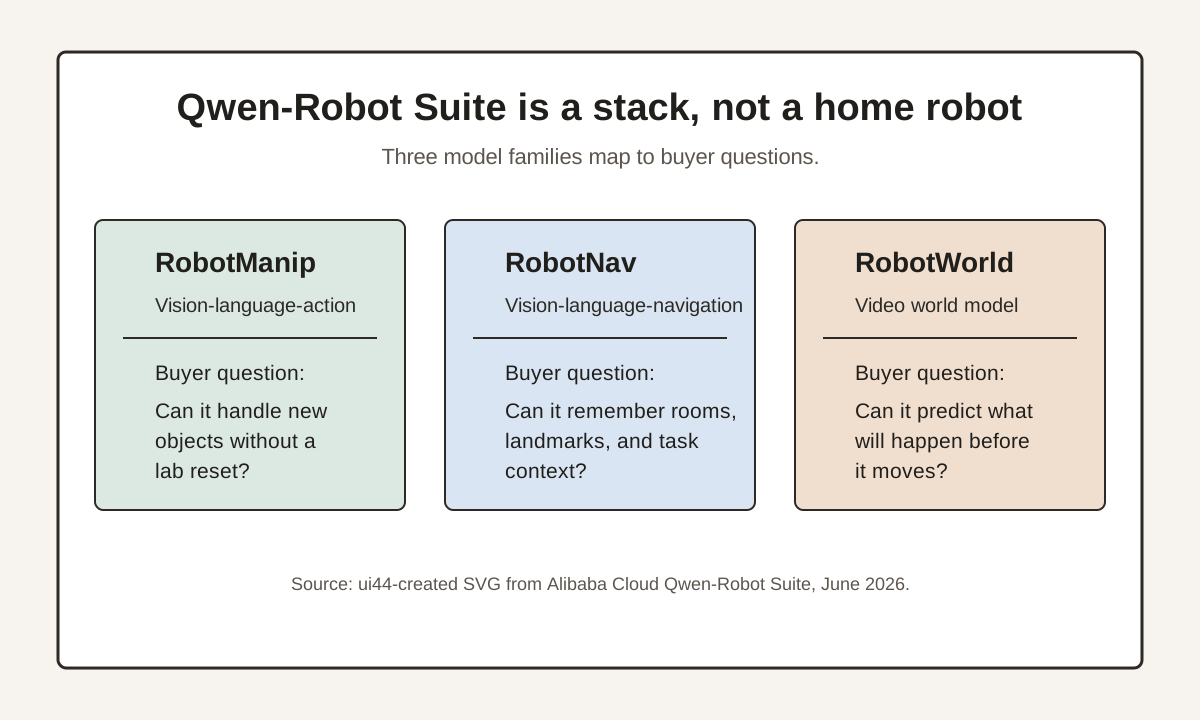
Qwen-Robot Suite is best understood as infrastructure for physical robots, not a product announcement. Its three parts map to three different buyer questions:
Model family
Qwen-RobotManip
- What it is for
- Vision-language-action manipulation
- Home robot buyer question
- Can the robot handle unfamiliar objects without constant retraining?
Model family
Qwen-RobotNav
- What it is for
- Vision-language-navigation
- Home robot buyer question
- Can it follow language instructions through a real home and remember enough context?
Model family
Qwen-RobotWorld
- What it is for
- Video world prediction
- Home robot buyer question
- Can it anticipate what may happen before it moves?
| Model family | What it is for | Home robot buyer question |
|---|---|---|
| Qwen-RobotManip | Vision-language-action manipulation | Can the robot handle unfamiliar objects without constant retraining? |
| Qwen-RobotNav | Vision-language-navigation | Can it follow language instructions through a real home and remember enough context? |
| Qwen-RobotWorld | Video world prediction | Can it anticipate what may happen before it moves? |
That separation is healthy. Home robots fail in different ways. Some know where to go but cannot grasp anything useful. Some can move an arm in a lab but cannot navigate a cluttered hallway. Some can chat well but have no grounded model of whether a glass will tip, a cable will snag, or a door will block the path.
For buyers, the right question is not "Does this robot use a foundation model?" The better question is "Which part of the physical task stack is actually improved, and can the vendor show it outside a curated demo?"
Why Alibaba Split the Problem Into Three Parts
Manipulation, navigation, and prediction sound related because a person performs them together. For a robot, they are separate hard problems.
Manipulation is about acting on objects. The robot has to identify a target, understand the instruction, choose a grasp or contact point, move without collision, and adapt when the object is not where expected. Alibaba says Qwen-RobotManip is a generalizable vision-language-action model trained on more than 38,000 hours of open-source data from robotics repositories, human manipulation videos, and synthesized human-to-robot datasets. The claim that matters for home robots is cross-embodiment transfer: if a model can transfer across different robot bodies with less retraining, it may reduce the cost of teaching every new arm from scratch.
Navigation is about moving through space. Qwen-RobotNav is the most directly home-relevant part of the suite because apartments are navigation-heavy environments. The official Qwen-RobotNav article says it was trained on 15.6 million samples and exposes controllable observation settings such as visual token budget, temporal decay, camera weighting, and frame sampling. In plain English: the system can be asked to remember more history for a long route, focus on recent frames for tracking, or weigh a particular camera view more heavily.
World prediction is about consequence. Qwen-RobotWorld is described as a video world model trained on 8.6 million video-text pairs, more than 200 million frames, more than 20 embodiment types, and 500 action categories. That does not mean it can safely run your kitchen. It means Alibaba is trying to give robots a way to simulate near-future visual outcomes before execution. For a home robot, that could eventually matter for tasks like deciding whether pushing a drawer will hit a chair, whether a towel is likely to drag a cup off a counter, or whether a path through toys is too risky.
What Qwen-RobotNav Says About Real Homes
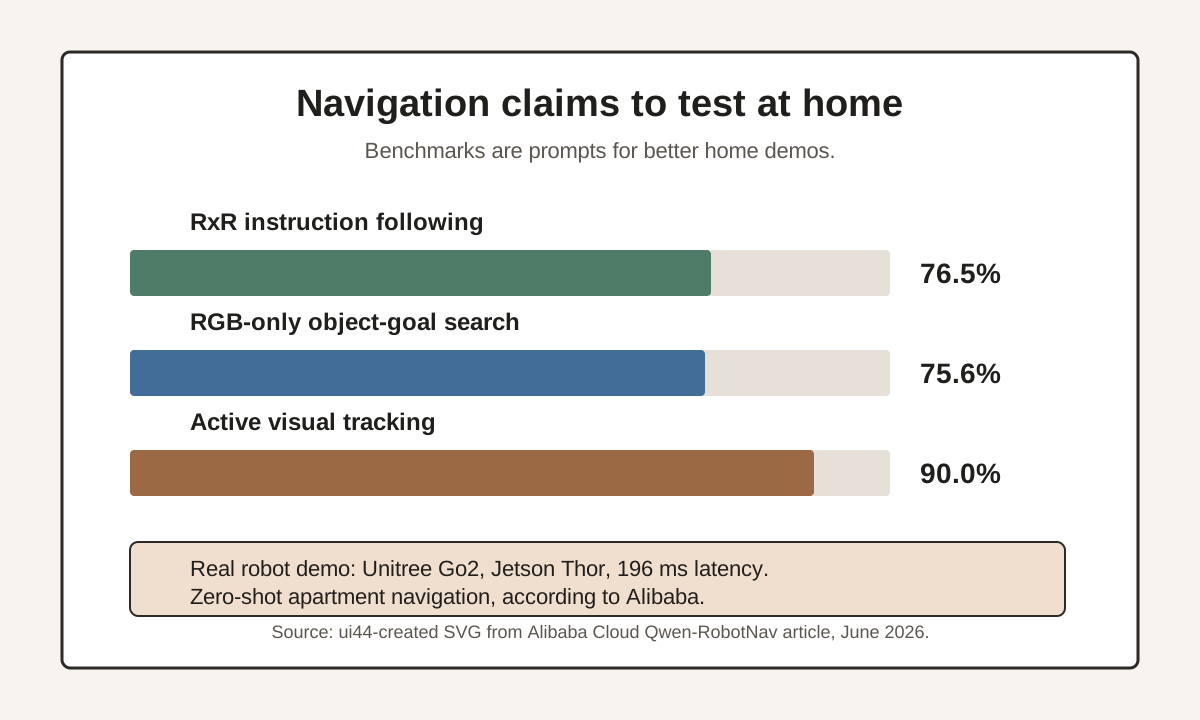
The navigation numbers are the easiest to translate into buyer expectations. Alibaba reports Qwen-RobotNav-8B at 76.5% success rate on RxR instruction following, Qwen-RobotNav-4B at 75.6% on HM3Dv2 object-goal navigation using RGB only, and Qwen-RobotNav at 90.0% tracking rate on EVT-Bench. It also describes a real-world deployment on a Unitree Go2 quadruped using an NVIDIA Jetson Thor, with 196 ms latency, or 5.1 Hz, in zero-shot tests.
Those are not consumer guarantees. Benchmarks compress the mess of a home into repeatable tasks, and home buyers live in edge cases: low light, mirrored furniture, pets, moving people, temporary clutter, narrow storage areas, and half-open doors. But the details point to a better vendor test.
If a company claims its robot has Qwen-style navigation intelligence, ask for demonstrations that resemble the benchmark categories but look like a home:
Claimed capability
Long instruction following
- Practical home test
- "Go from the kitchen to the bedroom, pass the sofa on the left, stop by the laundry basket, then come back."
Claimed capability
Object-goal search
- Practical home test
- "Find the blue backpack without using a saved exact location."
Claimed capability
Tracking
- Practical home test
- "Follow me through two rooms, then stop when I sit down."
Claimed capability
Embodied question answering
- Practical home test
- "Check whether my umbrella is by the door and tell me what you saw."
Claimed capability
Context control
- Practical home test
- "Search broadly first, then inspect only the desk area closely."
| Claimed capability | Practical home test |
|---|---|
| Long instruction following | "Go from the kitchen to the bedroom, pass the sofa on the left, stop by the laundry basket, then come back." |
| Object-goal search | "Find the blue backpack without using a saved exact location." |
| Tracking | "Follow me through two rooms, then stop when I sit down." |
| Embodied question answering | "Check whether my umbrella is by the door and tell me what you saw." |
| Context control | "Search broadly first, then inspect only the desk area closely." |
That last row is important. A robot that treats every task with the same memory settings will waste compute or forget useful context. A home robot needs different observation habits for different jobs. Looking for a missing medicine box is not the same as following a person through a hallway.
The ui44 Buyer Lens: Which Robots Could Benefit First?
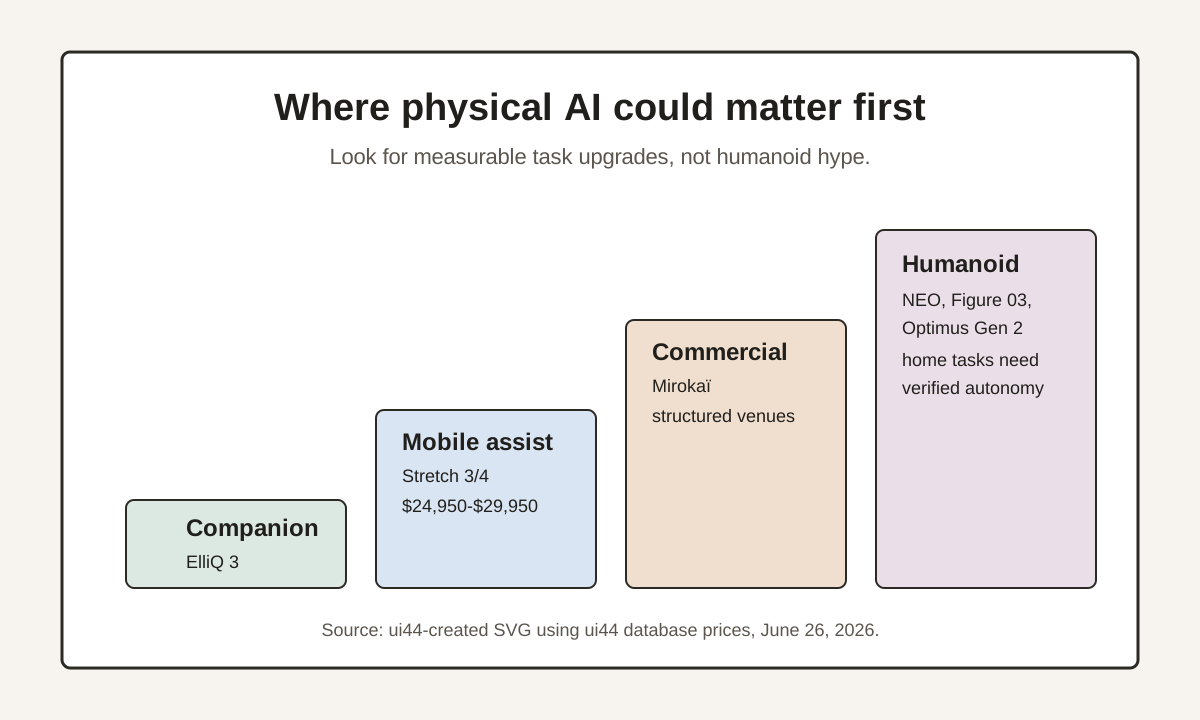
The current home robot market is not one market. It is a ladder.
At the practical end, Stretch 4 from Hello Robot is listed in the ui44 database as an available home assistant at $29,950, while Stretch 3 is listed at $24,950. These are expensive, research-friendly mobile manipulators, not mass-market appliances. They are exactly the type of platform where better navigation, planning, and manipulation models could make visible progress because the hardware already exists and the task scope can be constrained.
NEO from 1X Technologies is listed as a humanoid pre-order at $20,000. Figure 03 is active in the database, while Figure 02 is now marked discontinued. Optimus Gen 2 remains in development. These humanoids are where the imagination goes first, but they are also where proof needs to be strongest. A humanoid walking through a kitchen is not automatically useful. It needs reliable object handling, safe navigation, task memory, and an honest support model.
Commercial service robots may see benefits before consumers do. Mirokai from Enchanted Tools is a commercial robot, and its likely deployment environments are more structured than a private home. That makes commercial venues a reasonable bridge: still messy enough to teach useful lessons, but controlled enough to supervise failures.
Companion robots sit in a different category. ElliQ 3 is listed as an available companion robot. It does not need Qwen-RobotManip to be useful because it is not built around arms and grasping. But embodied memory and grounded perception could still matter for future social robots if they move from conversation toward checking rooms, noticing changes, or coordinating with mobile devices.
Do Not Confuse Model Progress With Product Readiness
The biggest mistake is to treat a robotics foundation model as if it solved productization. A model can improve generalization and still leave the hardest buyer issues untouched.
Homes need quiet operation, safe power behavior, reliable charging, local privacy controls, child and pet safety, durable hardware, warranty service, and a way for non-experts to recover from errors. A robot can score well on navigation and still be annoying if it asks for help every five minutes. It can manipulate test objects and still be unsafe around glassware. It can answer a question about an umbrella and still fail when the hallway is dark.
There is also a cloud question. Alibaba's announcement is tied to Alibaba Cloud and selected enterprise robotics customers. That does not automatically mean future home robots would stream sensitive home video to a remote model, but buyers should ask where inference happens, what data is retained, and whether camera history can be disabled or deleted. For home robots, privacy is not a footnote. The environment is the user's private life.
How This Compares With RynnBrain
Qwen-Robot Suite is not arriving in isolation. Alibaba DAMO Academy's RynnBrain project frames another version of the same trend: embodied foundation models with variants for planning, navigation, and spatial reasoning. RynnBrain lists dense 2B and 8B variants, a 30B mixture-of-experts variant, and specialized models such as RynnBrain-Plan, RynnBrain-Nav, and RynnBrain-CoP.
The pattern is clear. Robotics AI is becoming modular. Instead of one giant demo model that claims to do everything, the stronger direction is a set of models with specific roles: plan the task, find the target, move through space, manipulate the object, predict the next state, and summarize what happened.
For home robot buyers, modularity is useful because it creates accountability. If the robot gets lost, that is a navigation failure. If it drops a towel, that is a manipulation failure. If it repeats a risky motion after seeing the risk, that is a prediction and planning failure. The clearer the stack, the easier it is to ask the vendor what improved and what still needs supervision.
What To Watch Next
The next useful milestone is not a dramatic humanoid video. It is a repeatable home-like evaluation.
Watch for robots that can run the same multi-room task across several unfamiliar layouts. Watch whether object search works with ordinary household clutter, not just clean lab props. Watch whether a robot can explain failed attempts in grounded terms: "I could not reach the shelf because the chair blocked the path," not "task failed." Watch whether the system can recover after a human moves the target mid-task.
Also watch whether models move from cloud pilots to deployable edge systems. The Qwen-RobotNav article's Unitree Go2 demo mentions on-device inference with Jetson Thor and 196 ms latency. That kind of detail matters because home robots need responsive local behavior, especially for collision avoidance and close-range interaction.
Finally, watch pricing. The robots most likely to benefit early are still expensive. Stretch 4 is $29,950 in the ui44 database, Stretch 3 is $24,950, and NEO is listed as a $20,000 pre-order. Better foundation models may make robots more capable, but buyers still need to see whether those gains reduce setup labor, support burden, and task failure enough to justify the price.
Bottom Line
Qwen-Robot Suite is a serious signal, not a shopping recommendation. Alibaba is saying that physical AI needs dedicated model families for manipulation, navigation, and world prediction. That is the right direction for home robots, but it is not the same as a finished home assistant.
For buyers, the takeaway is practical: stop asking whether a robot has AI and start asking which physical skill the AI improves. A useful home robot should be able to navigate through language, search for objects, manipulate safely, remember task context, predict consequences, and recover from mistakes. Qwen-Robot Suite does not prove those capabilities are ready for your home. It gives us a sharper checklist for judging the robots that claim they are.
Related in the database
Use this article as a privacy verification workflow
Turn the article into a privacy verification pass grounded in the robots, manufacturers, and components it actually references.
Qwen-Robot Suite: What It Means for Home Robots already points you toward 8 linked robots, 6 manufacturers, and 4 countries inside the ui44 database. That matters because strong buyer guidance is easier to apply when you can move immediately from a claim or warning into concrete product pages, manufacturer directories, component explainers, and country-level context instead of treating the article as an isolated opinion piece. The fastest next step is to turn the article into a shortlist workflow: open the linked robot pages, verify which specs are actually published for those models, then compare the surrounding manufacturer and component context before you decide whether the underlying claim changes your buying plan.
For this topic, the useful discipline is to separate the editorial lesson from the catalog evidence. The article gives you the framing, but the robot pages tell you what each product actually ships with today: sensor stack, connectivity methods, listed price, release timing, category, and support-relevant compatibility notes. The manufacturer pages then show whether you are looking at a one-off launch, a broader lineup pattern, or a company that spans multiple categories. That layered workflow reduces the risk of buying on a single marketing phrase or a single support FAQ.
Use the robot pages to confirm which products actually expose cameras, microphones, Wi-Fi, or voice systems, then use the manufacturer pages to decide how much of the privacy question seems product-specific versus brand-wide. On this route cluster, NEO, Figure 03, and Figure 02 form the fastest reality check. If you want a quick working shortlist, open Compare NEO, Figure 03, and Figure 02 next, then keep this article open as the reasoning layer while you compare structured data side by side.
Practical Takeaway
Every robot, manufacturer, category, component, and country reference below resolves to a real ui44 page, keeping the follow-up path grounded in database records rather than generic advice.
Suggested next steps in ui44
- Open NEO and note the listed sensors, connectivity methods, and voice stack before you interpret any policy claim.
- Cross-check the wider brand context on 1X Technologies so you can see whether the privacy question touches one model or a broader lineup.
- Use the linked component pages to confirm how common the relevant sensors and connectivity layers are across the database.
- Keep a short note of which policy layers you checked, which device features are actually present on the robot page, and which items still depend on region- or app-level confirmation.
- Finish with Compare NEO, Figure 03, and Figure 02 so the policy reading sits next to structured product data.
Robot profiles worth opening next
Use the linked product pages as the evidence layer
The linked robot pages are where this article becomes operational. Instead of asking whether the headline is interesting, use the robot entries to inspect the actual mix of sensors, connectivity options, batteries, pricing, release timing, and stated capabilities attached to the products mentioned in the article. That is the easiest way to see whether the warning or opportunity described here affects one product family, a specific design pattern, or an entire buying lane.
NEO
1X Technologies · Humanoid · Pre-order
NEO is tracked on ui44 as a pre-order humanoid robot from 1X Technologies. The database currently records a listed price of $20,000, a release date of 2025-10-28, ~4 hours battery life, Not disclosed charging time, and a published stack that includes RGB Cameras, Depth Sensors, and Tactile Skin plus Wi-Fi and Bluetooth.
For privacy-focused reading, this page matters because it shows the concrete device surface behind the policy discussion. Use it to verify whether NEO combines sensors and connectivity in a way that could change the in-home data footprint, and compare the listed capabilities such as Household Chores, Tidying Up, and Safe Human Interaction with any cloud, app, or voice layers.
Figure 03 is tracked on ui44 as a active humanoid robot from Figure AI. The database currently records a listed price of Price TBA, a release date of 2025-10-09, ~5 hours battery life, Not disclosed charging time, and a published stack that includes Stereo Vision, Depth Cameras, and Force Sensors plus Wi-Fi and Bluetooth.
For privacy-focused reading, this page matters because it shows the concrete device surface behind the policy discussion. Use it to verify whether Figure 03 combines sensors and connectivity in a way that could change the in-home data footprint, and compare the listed capabilities such as Complex Manipulation, Warehouse Work, and Manufacturing Tasks with any cloud, app, or voice layers.
Figure 02 is tracked on ui44 as a discontinued humanoid robot from Figure AI. The database currently records a listed price of Price TBA, a release date of 2024-08-06, Not disclosed (50% greater capacity than Figure 01) battery life, Not disclosed charging time, and a published stack that includes 6 RGB Cameras, Onboard Vision Language Model, and Microphones plus Wi-Fi and Bluetooth.
For privacy-focused reading, this page matters because it shows the concrete device surface behind the policy discussion. Use it to verify whether Figure 02 combines sensors and connectivity in a way that could change the in-home data footprint, and compare the listed capabilities such as Autonomous Task Execution, Speech-to-Speech Conversation, and Pick and Place with any cloud, app, or voice layers, including OpenAI Custom Model.
Optimus Gen 2
Tesla · Humanoid · Development
Optimus Gen 2 is tracked on ui44 as a development humanoid robot from Tesla. The database currently records a listed price of Price TBA, a release date of 2023-12-13, Not officially disclosed battery life, Not officially disclosed charging time, and a published stack that includes Cameras, Force/Torque Sensors, and IMU plus Wi-Fi and Bluetooth.
For privacy-focused reading, this page matters because it shows the concrete device surface behind the policy discussion. Use it to verify whether Optimus Gen 2 combines sensors and connectivity in a way that could change the in-home data footprint, and compare the listed capabilities such as Bipedal Walking, Object Manipulation, and Factory Tasks with any cloud, app, or voice layers.
Stretch 4
Hello Robot · Home Assistants · Available
Stretch 4 is tracked on ui44 as a available home assistants robot from Hello Robot. The database currently records a listed price of $29,950, a release date of 2026-05-12, 8 hours (light CPU load) battery life, Not officially disclosed charging time, and a published stack that includes Wide-FOV depth sensing, High-resolution RGB cameras, and Calibrated RGB + depth perception plus its listed connectivity stack.
For privacy-focused reading, this page matters because it shows the concrete device surface behind the policy discussion. Use it to verify whether Stretch 4 combines sensors and connectivity in a way that could change the in-home data footprint, and compare the listed capabilities such as Mobile Manipulation, Omnidirectional Indoor Mobility, and Autonomous Mapping and Navigation with any cloud, app, or voice layers.
Manufacturer context behind the article
Check whether this is one product story or a broader company pattern
Manufacturer pages add the privacy context that individual product pages cannot show on their own. They help you check whether cameras, microphones, cloud accounts, app controls, and policy assumptions appear across a broader lineup or stay tied to one specific product story.
1X Technologies
ui44 currently tracks 2 robots from 1X Technologies across 1 category. The company is grouped under Norway, and the current catalog footprint on ui44 includes NEO, EVE.
That wider brand context matters because privacy questions rarely stop at one FAQ page. A manufacturer route helps you see whether the article is centered on one premium model or on a company that has several relevant products and therefore more than one place where the same policy or app assumptions might matter. The category mix here currently points toward Humanoid as the most useful next route if you want to see whether this article reflects a wider pattern inside the brand.
Figure AI
ui44 currently tracks 2 robots from Figure AI across 1 category. The company is grouped under USA, and the current catalog footprint on ui44 includes Figure 03, Figure 02.
That wider brand context matters because privacy questions rarely stop at one FAQ page. A manufacturer route helps you see whether the article is centered on one premium model or on a company that has several relevant products and therefore more than one place where the same policy or app assumptions might matter. The category mix here currently points toward Humanoid as the most useful next route if you want to see whether this article reflects a wider pattern inside the brand.
Tesla
ui44 currently tracks 2 robots from Tesla across 1 category. The company is grouped under USA, and the current catalog footprint on ui44 includes Optimus Gen 2, Optimus Gen 1.
That wider brand context matters because privacy questions rarely stop at one FAQ page. A manufacturer route helps you see whether the article is centered on one premium model or on a company that has several relevant products and therefore more than one place where the same policy or app assumptions might matter. The category mix here currently points toward Humanoid as the most useful next route if you want to see whether this article reflects a wider pattern inside the brand.
Hello Robot
ui44 currently tracks 2 robots from Hello Robot across 1 category. The company is grouped under USA, and the current catalog footprint on ui44 includes Stretch 3, Stretch 4.
That wider brand context matters because privacy questions rarely stop at one FAQ page. A manufacturer route helps you see whether the article is centered on one premium model or on a company that has several relevant products and therefore more than one place where the same policy or app assumptions might matter. The category mix here currently points toward Home Assistants as the most useful next route if you want to see whether this article reflects a wider pattern inside the brand.
Broaden the scan without leaving the database
Categories, components, and countries add the wider context
Category framing
Category pages are useful when the article touches a buying pattern that shows up across brands. A category route helps you confirm whether the linked products sit in a narrow niche or whether the same question should be tested across a larger field of alternatives.
Humanoid
The Humanoid category page currently groups 129 tracked robots from 92 manufacturers. ui44 describes this lane as: Full-size bipedal humanoid robots built to work alongside people — from factory floors to household tasks. Compare the cutting edge of humanoid robotics.
That makes the category route a practical follow-up when you want to check whether the products linked in this article are typical for the lane or whether they sit at one edge of the market. Useful starting examples currently include NEO, EVE, Mornine M1.
Home Assistants
The Home Assistants category page currently groups 16 tracked robots from 14 manufacturers. ui44 describes this lane as: Arm-based household helpers — laundry folders, kitchen robots, and mobile manipulators that take on hands-on physical tasks around the home.
That makes the category route a practical follow-up when you want to check whether the products linked in this article are typical for the lane or whether they sit at one edge of the market. Useful starting examples currently include Robody, Futuring 2 (F2), Stretch 3.
Country and ecosystem context
Country pages give extra context when support practices, launch sequencing, regulatory posture, or manufacturer mix matter. They are not a substitute for model-level verification, but they do help you see which ecosystems cluster together and which manufacturers sit in the same regional field when you broaden the search beyond the article headline.
Norway
The Norway route currently groups 2 tracked robots from 1 manufacturers in ui44. That gives you a useful regional lens when the article points toward support practices, launch sequencing, or brand clusters that may share similar ecosystem assumptions.
On the current route, manufacturers like 1X Technologies make the page a good way to broaden the scan without losing the regional context that often shapes availability, documentation style, and adjacent alternatives.
USA
The USA route currently groups 89 tracked robots from 69 manufacturers in ui44. That gives you a useful regional lens when the article points toward support practices, launch sequencing, or brand clusters that may share similar ecosystem assumptions.
On the current route, manufacturers like Faraday Future, iRobot, Boston Dynamics make the page a good way to broaden the scan without losing the regional context that often shapes availability, documentation style, and adjacent alternatives.
France
The France route currently groups 8 tracked robots from 7 manufacturers in ui44. That gives you a useful regional lens when the article points toward support practices, launch sequencing, or brand clusters that may share similar ecosystem assumptions.
On the current route, manufacturers like Pollen Robotics, Aldebaran / Maxtronics, Aldebaran Robotics make the page a good way to broaden the scan without losing the regional context that often shapes availability, documentation style, and adjacent alternatives.
Questions to answer before you move from reading to buying
A follow-up FAQ built from the entities already linked in this article
Frequently Asked Questions
Which page should I open first after reading “Qwen-Robot Suite: What It Means for Home Robots”?
Start with NEO. That gives you a concrete product anchor for the article’s main claim. From there, branch into the manufacturer and component pages so you can tell whether the article is describing one specific model, a repeated brand pattern, or a wider technology issue that affects multiple shortlist options.
How do the manufacturer pages change the buying decision?
1X Technologies help you zoom out from one article and one product. On ui44 they show lineup breadth, category spread, and the neighboring robots tied to the same company. That context is useful when you are deciding whether a risk belongs to a single model, whether it shows up across a brand’s portfolio, and whether you should keep looking at alternatives before committing.
When should I switch from reading to side-by-side comparison?
Move into Compare NEO, Figure 03, and Figure 02 as soon as you understand the article’s main warning or promise. The article explains what to watch for, but the compare view is where you can check whether price, status, battery life, connectivity, sensors, and category fit still make the robot a good match for your own home and budget.
Where to go next in ui44
Keep the research chain inside the database
If you want to keep going, these follow-on pages give you the cleanest expansion path from article to research session. Open the comparison route first if you are deciding between products today. Open the manufacturer, category, and component routes if you still need to understand the broader pattern behind the claim.
Written by
ui44 Team
Published July 6, 2026
Share this article
Open a plain share link on X or Bluesky. No embeds, no widgets, no cookie baggage.