That is why fall recovery may matter more than stair climbing. A 2026 study from Singapore University of Technology and Design's ROAR Lab focuses on the residual risk after ordinary fall prevention fails: the moment when a stair-traversing robot is already falling and must reduce harm fast. The team reports that stair-capable robots can fail far more often on stairs than on flat ground, and their reinforcement-learning fall-mitigation system averaged 69.4% recovery success in simulation. That is promising research, but it is not a home safety guarantee.
For ui44 readers, the takeaway is practical: stair ability belongs in the same conversation as weight, speed, edge detection, physical softness, remote stop controls, and warranty language. A home robot that can climb but cannot fail safely may be less useful than a robot that refuses stairs in the first place.
Stair Climbing Is Not the Same as Stair Safety
Most consumer robot safety discussion still revolves around avoiding the hazard: better mapping, better obstacle detection, step-edge sensors, no-go zones, and balance control. Those are necessary. They are not complete.
The SUTD/EurekAlert release describes a residual-risk problem that home users will recognize immediately. A robot can be well planned and still get hit by a door, nudged by a child, surprised by a loose rug near a landing, or pushed from above by someone carrying laundry. Once a robot starts moving down a stair edge, gravity adds energy faster than most home buyers intuitively expect.
That changes how we should read product demos:
Demo claim
The robot climbed stairs once
- What it proves
- The robot can execute a stair gait or traversal routine
- What it does not prove
- It can recover after a shove, missed step, or traction loss
Demo claim
The robot has obstacle detection
- What it proves
- It may avoid known hazards in mapped space
- What it does not prove
- It can handle moving humans, pets, and objects near stair edges
Demo claim
The robot is lightweight
- What it proves
- Impact energy may be lower
- What it does not prove
- The robot is safe to operate near children or fragile spaces
Demo claim
The robot has remote supervision
- What it proves
- A human may intervene
- What it does not prove
- The human can react quickly enough during an actual fall
| Demo claim | What it proves | What it does not prove |
|---|---|---|
| The robot climbed stairs once | The robot can execute a stair gait or traversal routine | It can recover after a shove, missed step, or traction loss |
| The robot has obstacle detection | It may avoid known hazards in mapped space | It can handle moving humans, pets, and objects near stair edges |
| The robot is lightweight | Impact energy may be lower | The robot is safe to operate near children or fragile spaces |
| The robot has remote supervision | A human may intervene | The human can react quickly enough during an actual fall |
This is not a reason to dismiss stair-capable robots. It is a reason to ask for evidence that includes failures, not just clean wins.
What the New Fall-Recovery Research Shows
The ROAR Lab work, reported by Interesting Engineering and published in Results in Engineering under DOI 10.1016/j.rineng.2026.110413, studied stair-traversing service robots rather than living-room humanoids. The details still matter for home robotics because the failure modes are physical, not just software categories.
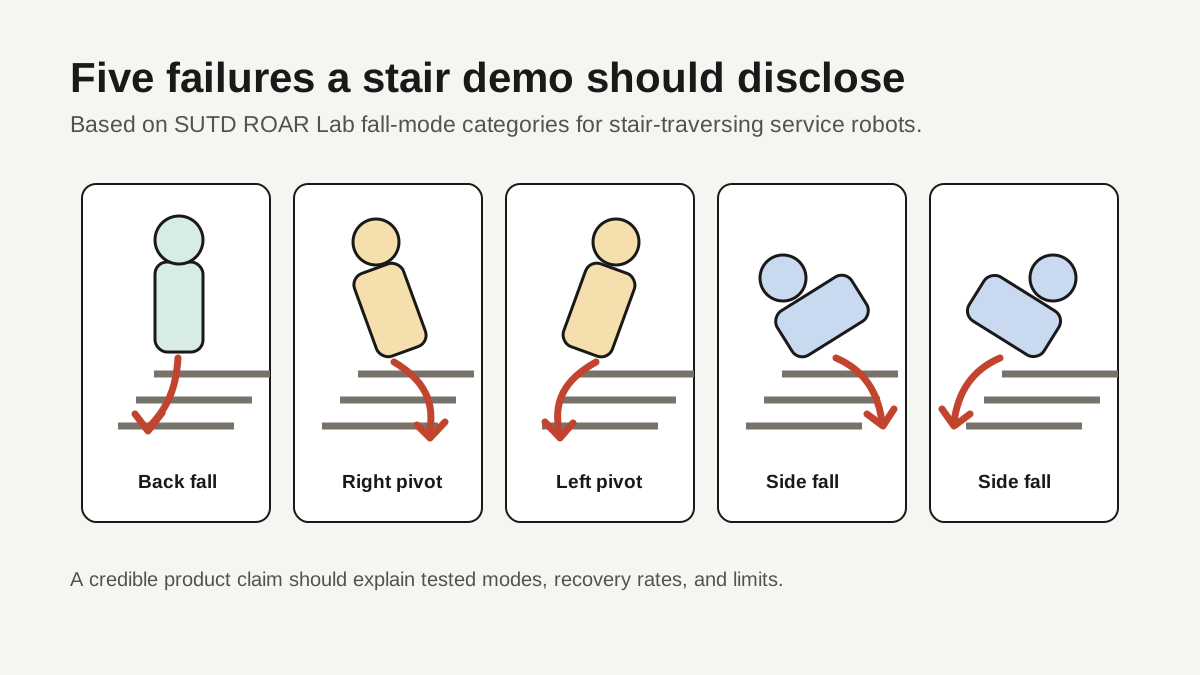
The researchers identified five stair-fall modes: a straight backward fall, two pivoting variants, and two sideways collapses. They then tested a rear-mounted, three-degree-of-freedom bracing arm controlled by a policy trained in simulation. Across five trained controllers, the system recovered an average of 69.4% of falls, compared with 38.6% for a hand-coded baseline. When it did recover, it stabilized the robot in an average of 4.25 seconds.
The most important number is not only the 69.4% success rate. It is the gap between "better than a hand-coded baseline" and "ready to trust around people." The SUTD team explicitly notes that average performance at this level is not enough for certification as a standalone safety function. In plain language: this is a useful layer of defense, not a permission slip to let heavy robots roam stairwells unattended.
The ui44 Database View: Which Robots Make This Question Urgent?
The safety question becomes sharper when you look at real products in the ui44 database. The market now spans soft home-focused humanoids, developer humanoids, heavy industrial humanoids, wheeled home assistants, and research platforms. They should not be evaluated with the same stair-safety checklist.

1X NEO is listed in ui44 as a home-focused humanoid from 1X Technologies with a $20,000 price and a soft, lightweight body concept. That makes it one of the most relevant robots for household safety discussions because its stated direction is home coexistence, not just factory demonstration. For a robot like NEO, buyers should ask whether "soft" means lower impact energy, better pinch protection, slower default motion near stairs, or simply a friendlier exterior. Softness helps, but it does not replace fall detection, stair exclusion zones, and recovery behavior.
Unitree G1 sits in a different lane. ui44 lists it as a compact humanoid at $13,500, 132 cm tall, and 35 kg. That lower mass is meaningful compared with larger humanoids, but 35 kg falling down stairs is still a serious event. For developer-friendly humanoids, the right question is not "can it do dynamic moves?" It is whether the robot exposes limits that home users can actually set: maximum speed, stair permissions, emergency stop, allowed rooms, supervision mode, and conservative balance profiles.
Figure 03 and Figure 02 show why industrial progress does not translate automatically into household stair trust. ui44 lists Figure 03 as the newer humanoid platform and Figure 02 as an industrially oriented predecessor. Industrial pilots can control floors, staff, task envelopes, and emergency procedures. Homes are less predictable: stairs may be narrow, pets may cut across landings, and people may move around the robot with no training.
Wheeled Robots Have a Different Safety Pattern
Not every home robot should attempt stairs. In many homes, the safest design choice is to stay on one floor.
Amazon Astro, listed by ui44 at $1,599, is a wheeled home security and remote-care robot. Samsung Ballie is a spherical rolling companion concept. Their limitation is obvious: they are not stair-climbing humanoids. But that limitation can be a safety feature if the robot reliably avoids stair edges, respects map boundaries, and does not create trip hazards in hallways.
For wheeled robots, buyers should focus less on fall recovery and more on containment. Can the robot detect a stair edge in low light? Does it remember no-go zones after a map update? What happens if someone moves it manually to another floor? Does the app warn before operating near a landing? A robot that refuses stairs gracefully is often easier to trust than one that tries to master them.
Heavy and Research Robots Need Higher Evidence
Some robots in ui44 are clearly not ordinary home purchases, but they are still useful reference points. Kepler Forerunner K1 is listed at $30,000 with an industrial direction and 40 degrees of freedom. Reachy 2 is a $70,000 open-source research humanoid for manipulation and human-robot interaction. These platforms underline the same lesson: capability rises faster than household certification.
With heavier, more capable robots, buyers and integrators should expect a higher burden of proof. That proof should include failed attempts, not just polished videos. It should also include limits: maximum payload while walking, stair dimensions tested, flooring conditions, slope tolerance, fall detection latency, recovery success rate, and what the robot does when confidence drops.
If a vendor cannot answer those questions yet, that is not automatically a scandal. Home robotics is young. But it should change the deployment plan. A robot without validated fall recovery should be kept away from open staircases unless it has strong physical barriers, reliable geofencing, or human supervision.
What Buyers Should Ask Before Trusting a Robot Near Stairs
The useful checklist is simple and fairly strict.
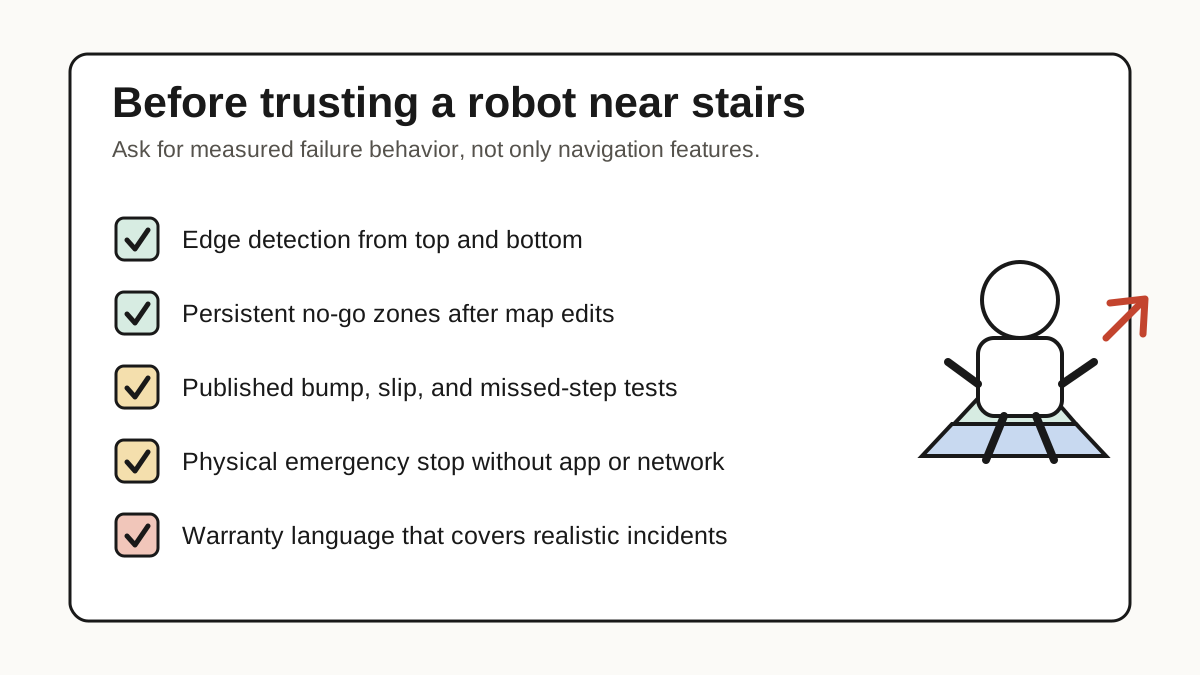
Ask the vendor:
- Can the robot detect stair edges from both the top and bottom of a staircase?
- Does it support no-go zones that remain active after map edits, resets, or floor changes?
- What is the robot's maximum speed near stairs, and can the user lower it?
- Has the robot been tested after bumps, pushes, missed steps, and low-traction conditions?
- What is the measured fall-recovery success rate, and across how many stair geometries?
- Does the robot have a physical emergency stop that works without the app?
- What happens if the network drops during stair-adjacent operation?
- Does the warranty exclude stair falls or unsupervised stair use?
The last question is especially revealing. If a company markets stair capability but excludes common stair incidents from support, treat the feature as a demonstration rather than a household-ready function.
How to Think About Stair Robots in 2026
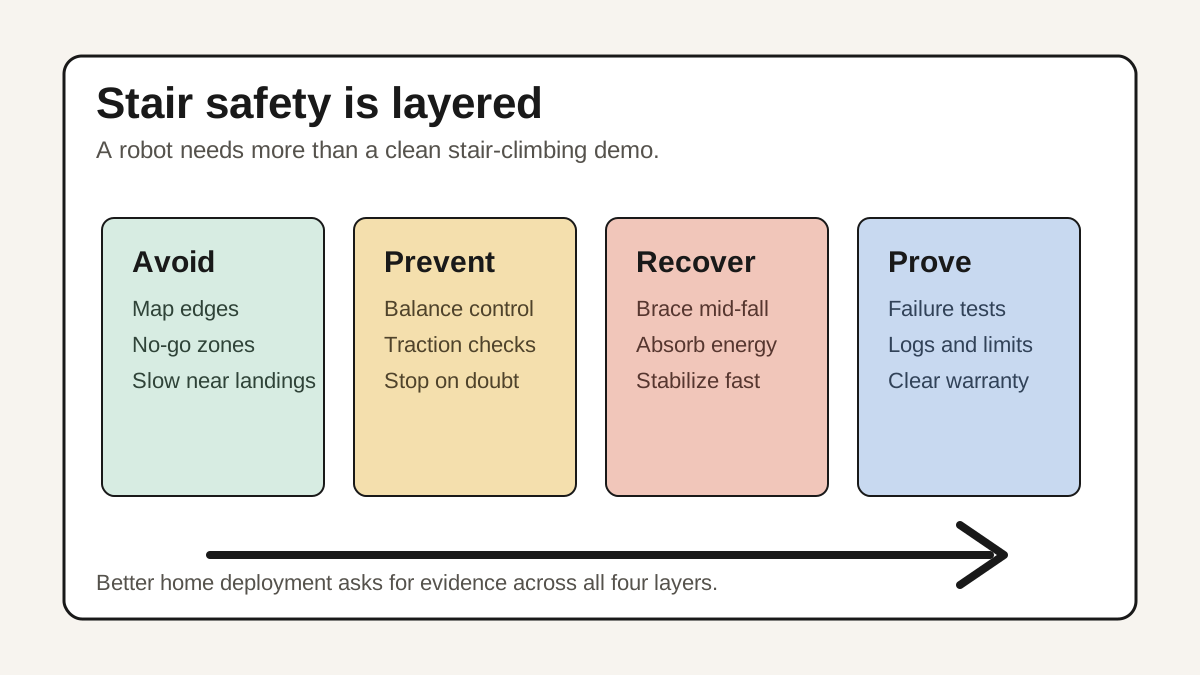
For now, stair safety should be evaluated in layers.
The first layer is avoidance: mapping, edge detection, no-go zones, speed limits, and conservative route planning. The second layer is prevention: balance control, traction management, posture limits, and stop behavior when confidence drops. The third layer is mitigation: bracing, controlled collapse, energy absorption, or recovery after the robot is already unstable. The fourth layer is accountability: logs, certification claims, warranty coverage, and clear operating instructions.
The SUTD study is exciting because it pushes robotics into that third layer. It says, in effect, that robots need a plan for the fall they failed to prevent. That is exactly the kind of thinking home robots need before they move from demos into messy houses.
Bottom Line
A stair-climbing clip is not enough evidence for a home robot. In 2026, the better question is whether the robot can limit harm when the stair demo goes wrong.
For a home-focused humanoid like 1X NEO, the buyer question is whether soft design and autonomy are backed by measured stair exclusion and fall-recovery behavior. For a compact humanoid like Unitree G1, it is whether developer flexibility comes with conservative safety controls. For wheeled robots like Amazon Astro and Samsung Ballie, it is whether they reliably refuse dangerous terrain.
Until vendors publish real failure testing, stair-capable robots should be treated as supervised machines around stairs. The future home robot may climb, recover, and continue. The home robot you can trust today is the one that knows when not to try.
Related in the database
Use this article as a warranty and coverage workflow
Turn the article into a warranty and coverage pass grounded in the robots and manufacturers it actually references.
Can Home Robots Fall Safely on Stairs? already points you toward 8 linked robots, 7 manufacturers, and 5 countries inside the ui44 database. That matters because strong buyer guidance is easier to apply when you can move immediately from a claim or warning into concrete product pages, manufacturer directories, component explainers, and country-level context instead of treating the article as an isolated opinion piece. The fastest next step is to turn the article into a shortlist workflow: open the linked robot pages, verify which specs are actually published for those models, then compare the surrounding manufacturer and component context before you decide whether the underlying claim changes your buying plan.
For this topic, the useful discipline is to separate the editorial lesson from the catalog evidence. The article gives you the framing, but the robot pages tell you what each product actually ships with today: sensor stack, connectivity methods, listed price, release timing, category, and support-relevant compatibility notes. The manufacturer pages then show whether you are looking at a one-off launch, a broader lineup pattern, or a company that spans multiple categories. That layered workflow reduces the risk of buying on a single marketing phrase or a single support FAQ.
The most practical move is to keep warranty language and product context together. Compare the linked robots first, then check whether the manufacturer pages suggest a mature service lane or a more limited lineup. On this article, NEO, G1, and Figure 03 are the right place to start. If you want a quick working shortlist, open Compare NEO, G1, and Figure 03 next, then keep this article open as the reasoning layer while you compare structured data side by side.
Practical Takeaway
Every robot, manufacturer, category, component, and country reference below resolves to a real ui44 page, keeping the follow-up path grounded in database records rather than generic advice.
Suggested next steps in ui44
- Compare the listed price, release timing, and category fit of the linked robots before you treat warranty length as a direct value proxy.
- Open 1X Technologies to see whether the brand has several relevant models in the same lane or whether the article is centered on one flagship product.
- Record what the article proves, what still depends on seller or region rules, and which consumables or battery-related details you still need to verify externally.
- Use Compare NEO, G1, and Figure 03 before checkout so the warranty conversation stays anchored to a real shortlist.
- Do not treat the article as the final source of truth on coverage terms. Treat it as the framing layer that tells you which documentation you still need to inspect before purchase.
Robot profiles worth opening next
Use the linked product pages as the evidence layer
The linked robot pages are where this article becomes operational. Instead of asking whether the headline is interesting, use the robot entries to inspect the actual mix of sensors, connectivity options, batteries, pricing, release timing, and stated capabilities attached to the products mentioned in the article. That is the easiest way to see whether the warning or opportunity described here affects one product family, a specific design pattern, or an entire buying lane.
NEO
1X Technologies · Humanoid · Pre-order
NEO is tracked on ui44 as a pre-order humanoid robot from 1X Technologies. The database currently records a listed price of $20,000, a release date of 2025-10-28, ~4 hours battery life, Not disclosed charging time, and a published stack that includes RGB Cameras, Depth Sensors, and Tactile Skin plus Wi-Fi and Bluetooth.
For warranty and coverage questions, the robot page gives you the operating context that fine print often leaves out. Review the published capability mix, including Household Chores, Tidying Up, and Safe Human Interaction, and the listed battery and charging profile before deciding whether a coverage term meaningfully reduces your ownership risk or merely sounds reassuring in isolation.
G1 is tracked on ui44 as a available humanoid robot from Unitree. The database currently records a listed price of $13,500, a release date of 2024-05-13, ~2 hours battery life, Not disclosed charging time, and a published stack that includes Depth Camera, 3D LiDAR, and 4 Microphone Array plus Wi-Fi 6 and Bluetooth 5.2.
For warranty and coverage questions, the robot page gives you the operating context that fine print often leaves out. Review the published capability mix, including Bipedal Walking, Object Manipulation, and Dexterous Hands (optional Dex3-1), and the listed battery and charging profile before deciding whether a coverage term meaningfully reduces your ownership risk or merely sounds reassuring in isolation.
Figure 03 is tracked on ui44 as a active humanoid robot from Figure AI. The database currently records a listed price of Price TBA, a release date of 2025-10-09, ~5 hours battery life, Not disclosed charging time, and a published stack that includes Stereo Vision, Depth Cameras, and Force Sensors plus Wi-Fi and Bluetooth.
For warranty and coverage questions, the robot page gives you the operating context that fine print often leaves out. Review the published capability mix, including Complex Manipulation, Warehouse Work, and Manufacturing Tasks, and the listed battery and charging profile before deciding whether a coverage term meaningfully reduces your ownership risk or merely sounds reassuring in isolation.
Figure 02 is tracked on ui44 as a discontinued humanoid robot from Figure AI. The database currently records a listed price of Price TBA, a release date of 2024-08-06, Not disclosed (50% greater capacity than Figure 01) battery life, Not disclosed charging time, and a published stack that includes 6 RGB Cameras, Onboard Vision Language Model, and Microphones plus Wi-Fi and Bluetooth.
For warranty and coverage questions, the robot page gives you the operating context that fine print often leaves out. Review the published capability mix, including Autonomous Task Execution, Speech-to-Speech Conversation, and Pick and Place, and the listed battery and charging profile before deciding whether a coverage term meaningfully reduces your ownership risk or merely sounds reassuring in isolation.
Astro is tracked on ui44 as a active security & patrol robot from Amazon. The database currently records a listed price of $1,599, a release date of 2021, Not officially disclosed battery life, Not officially disclosed charging time, and a published stack that includes 5MP Bezel Camera, 1080p Periscope Camera (132° FOV), and Infrared Vision plus Wi-Fi 802.11ac and Bluetooth.
For warranty and coverage questions, the robot page gives you the operating context that fine print often leaves out. Review the published capability mix, including Autonomous Home Patrol, Visual ID (face recognition), and Remote Home Monitoring, and the listed battery and charging profile before deciding whether a coverage term meaningfully reduces your ownership risk or merely sounds reassuring in isolation.
Manufacturer context behind the article
Check whether this is one product story or a broader company pattern
Manufacturer pages add the support context that individual product pages cannot show on their own. They help you check whether the article is pointing at one coverage promise or at a company with a broader service footprint and multiple products to maintain.
1X Technologies
ui44 currently tracks 2 robots from 1X Technologies across 1 category. The company is grouped under Norway, and the current catalog footprint on ui44 includes NEO, EVE.
That wider brand context matters because support confidence is easier to judge when you can see the company’s overall footprint, not just one warranty phrase attached to one product. A broader tracked lineup can change how you interpret the article’s coverage discussion. The category mix here currently points toward Humanoid as the most useful next route if you want to see whether this article reflects a wider pattern inside the brand.
Unitree
ui44 currently tracks 2 robots from Unitree across 1 category. The company is grouped under China, and the current catalog footprint on ui44 includes H1, G1.
That wider brand context matters because support confidence is easier to judge when you can see the company’s overall footprint, not just one warranty phrase attached to one product. A broader tracked lineup can change how you interpret the article’s coverage discussion. The category mix here currently points toward Humanoid as the most useful next route if you want to see whether this article reflects a wider pattern inside the brand.
Figure AI
ui44 currently tracks 2 robots from Figure AI across 1 category. The company is grouped under USA, and the current catalog footprint on ui44 includes Figure 03, Figure 02.
That wider brand context matters because support confidence is easier to judge when you can see the company’s overall footprint, not just one warranty phrase attached to one product. A broader tracked lineup can change how you interpret the article’s coverage discussion. The category mix here currently points toward Humanoid as the most useful next route if you want to see whether this article reflects a wider pattern inside the brand.
Amazon
ui44 currently tracks 1 robot from Amazon across 1 category. The company is grouped under USA, and the current catalog footprint on ui44 includes Astro.
That wider brand context matters because support confidence is easier to judge when you can see the company’s overall footprint, not just one warranty phrase attached to one product. A broader tracked lineup can change how you interpret the article’s coverage discussion. The category mix here currently points toward Security & Patrol as the most useful next route if you want to see whether this article reflects a wider pattern inside the brand.
Broaden the scan without leaving the database
Categories, components, and countries add the wider context
Category framing
Category pages are useful when the article touches a buying pattern that shows up across brands. A category route helps you confirm whether the linked products sit in a narrow niche or whether the same question should be tested across a larger field of alternatives.
Humanoid
The Humanoid category page currently groups 129 tracked robots from 92 manufacturers. ui44 describes this lane as: Full-size bipedal humanoid robots built to work alongside people — from factory floors to household tasks. Compare the cutting edge of humanoid robotics.
That makes the category route a practical follow-up when you want to check whether the products linked in this article are typical for the lane or whether they sit at one edge of the market. Useful starting examples currently include NEO, EVE, Mornine M1.
Security & Patrol
The Security & Patrol category page currently groups 5 tracked robots from 5 manufacturers. ui44 describes this lane as: Autonomous surveillance and patrol robots that monitor homes, businesses, and perimeters — keeping watch without an operator on site.
That makes the category route a practical follow-up when you want to check whether the products linked in this article are typical for the lane or whether they sit at one edge of the market. Useful starting examples currently include Astro, Vision 60, K7 Autonomous Security Robot.
Country and ecosystem context
Country pages give extra context when support practices, launch sequencing, regulatory posture, or manufacturer mix matter. They are not a substitute for model-level verification, but they do help you see which ecosystems cluster together and which manufacturers sit in the same regional field when you broaden the search beyond the article headline.
Norway
The Norway route currently groups 2 tracked robots from 1 manufacturers in ui44. That gives you a useful regional lens when the article points toward support practices, launch sequencing, or brand clusters that may share similar ecosystem assumptions.
On the current route, manufacturers like 1X Technologies make the page a good way to broaden the scan without losing the regional context that often shapes availability, documentation style, and adjacent alternatives.
China
The China route currently groups 189 tracked robots from 87 manufacturers in ui44. That gives you a useful regional lens when the article points toward support practices, launch sequencing, or brand clusters that may share similar ecosystem assumptions.
On the current route, manufacturers like AGIBOT, Dreame, Unitree Robotics make the page a good way to broaden the scan without losing the regional context that often shapes availability, documentation style, and adjacent alternatives.
USA
The USA route currently groups 89 tracked robots from 69 manufacturers in ui44. That gives you a useful regional lens when the article points toward support practices, launch sequencing, or brand clusters that may share similar ecosystem assumptions.
On the current route, manufacturers like Faraday Future, iRobot, Boston Dynamics make the page a good way to broaden the scan without losing the regional context that often shapes availability, documentation style, and adjacent alternatives.
Questions to answer before you move from reading to buying
A follow-up FAQ built from the entities already linked in this article
Frequently Asked Questions
Which page should I open first after reading “Can Home Robots Fall Safely on Stairs?”?
Start with NEO. That gives you a concrete product anchor for the article’s main claim. From there, branch into the manufacturer and component pages so you can tell whether the article is describing one specific model, a repeated brand pattern, or a wider technology issue that affects multiple shortlist options.
How do the manufacturer pages change the buying decision?
1X Technologies help you zoom out from one article and one product. On ui44 they show lineup breadth, category spread, and the neighboring robots tied to the same company. That context is useful when you are deciding whether a risk belongs to a single model, whether it shows up across a brand’s portfolio, and whether you should keep looking at alternatives before committing.
When should I switch from reading to side-by-side comparison?
Move into Compare NEO, G1, and Figure 03 as soon as you understand the article’s main warning or promise. The article explains what to watch for, but the compare view is where you can check whether price, status, battery life, connectivity, sensors, and category fit still make the robot a good match for your own home and budget.
Where to go next in ui44
Keep the research chain inside the database
If you want to keep going, these follow-on pages give you the cleanest expansion path from article to research session. Open the comparison route first if you are deciding between products today. Open the manufacturer, category, and component routes if you still need to understand the broader pattern behind the claim.
Written by
ui44 Team
Published June 27, 2026
Share this article
Open a plain share link on X or Bluesky. No embeds, no widgets, no cookie baggage.