That is a much stronger signal than a concept video. It is still not the same thing as a normal consumer home robot that you can confidently buy, unbox, and trust around your family. The useful question is not "is this real or fake?" It is: what part of the Faraday Future robot story is already a shipping product, and what part is still a claim about future capability?
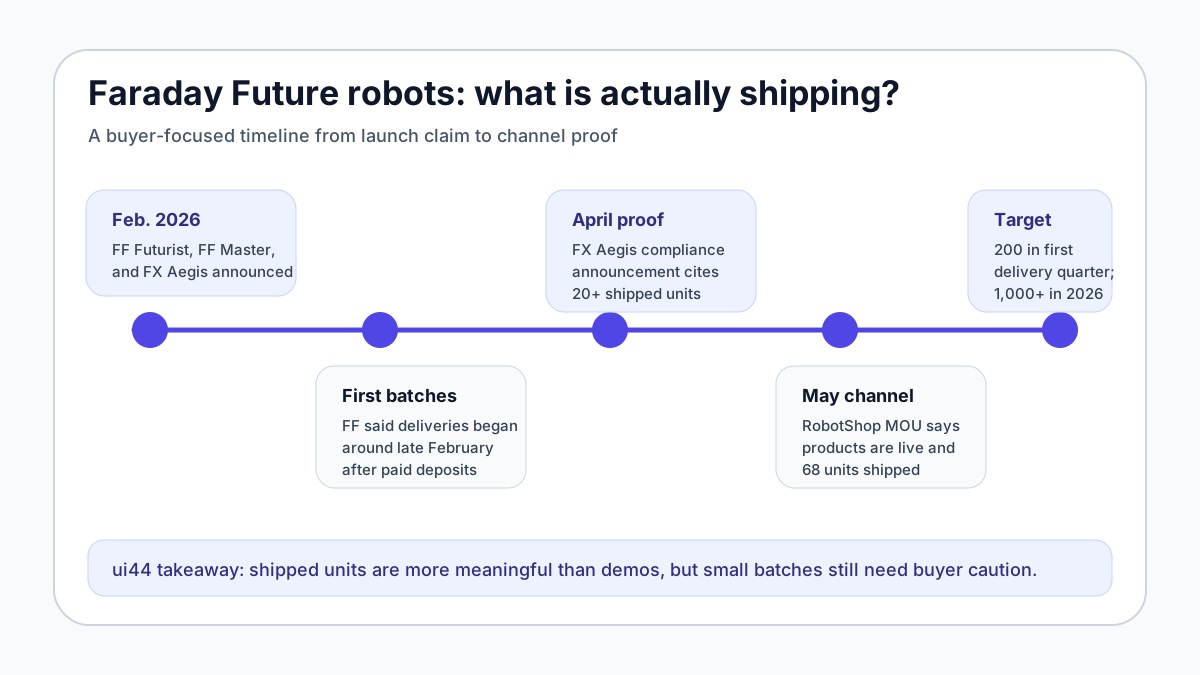
The short version: Faraday Future has moved beyond pure announcement mode. There are published prices, product pages, a public retail channel signal, and company-reported shipment counts. But the buyer-grade evidence is still thin: small batches, many forward-looking claims, unclear home task proof, and a support model that has to be tested in the real world.
What did Faraday Future actually launch?
Faraday Future introduced the robots at the 2026 NADA Show in Las Vegas. A launch release mirrored by StockTitan described three products: the full-size FF Futurist humanoid, the smaller FF Master humanoid, and the FX Aegis quadruped. The same release said Faraday Future opened sales or pre-order collection, had more than 1,200 units covered by paid non-binding B2B deposits, and planned first-batch deliveries for late February.
The current official robotics pages are careful in a way buyers should notice. Faraday Future's main robotics site says the world is still in the early stages of humanoid-robot exploration and warns buyers to understand limitations before purchase. It also says shown scenarios and capabilities may represent potential future functionality, with actual features subject to final product and delivery versions. That caution matters because many listed use cases are broad: concierge work, retail, education, home assistance, security patrol, emergency response, and factory support.
The strongest shipping signal came later. A May 2026 BusinessWire release mirrored by Morningstar said FF AI-Robotics signed an MOU with RobotShop and that FF products were live and available for purchase on RobotShop's platform. The same release said FF had cumulatively shipped 68 EAI robots as of April 30, 2026, expected May shipments to accelerate toward a first-delivery-quarter target of 200 units, and expected more than 1,000 cumulative shipments in 2026.
That is not proof of household usefulness. It is proof that the story has moved from "watch our launch" to "there is an order channel and reported shipped volume." For a young robotics category, that distinction is important.
The three Faraday Future robots in ui44's database
ui44 currently tracks all three Faraday Future robots. The database view is more useful than the marketing names because it lines up price, status, form factor, battery life, sensors, and missing fields.
Robot
- Current ui44 status
- Active
- Starting price
- $34,990
- Form factor
- Full-size humanoid
- Buyer note
- Official tiers list ~2 kg base payload, up to 8 kg Ultra
Robot
- Current ui44 status
- Active
- Starting price
- $19,990
- Form factor
- Compact humanoid
- Buyer note
- Official tiers list max 3 kg payload across versions
Robot
- Current ui44 status
- Pre-order
- Starting price
- $2,490
- Form factor
- Quadruped
- Buyer note
- Official payload varies by tier: 8 kg to 12 kg
| Robot | Current ui44 status | Starting price | Form factor | Buyer note |
|---|---|---|---|---|
| FF Futurist | Active | $34,990 | Full-size humanoid | Official tiers list ~2 kg base payload, up to 8 kg Ultra |
| FF Master | Active | $19,990 | Compact humanoid | Official tiers list max 3 kg payload across versions |
| FX Aegis | Pre-order | $2,490 | Quadruped | Official payload varies by tier: 8 kg to 12 kg |
FF Futurist is the most expensive and the most professional of the three. ui44's current record tracks the higher-end published configuration at 169 cm tall, about 69 kg, with an NVIDIA Jetson Orin processor rated at 200 TOPS, about 3 hours of continuous standing time, and a hot-swappable battery design. Faraday Future's official tier table is more nuanced: the base Futurist is about 64 kg with roughly 2 kg payload, while Futurist Ultra is about 69 kg with payload listed at up to 8 kg. The sensor list includes 3D LiDAR, RGB-D, fisheye and HD cameras, plus tactile sensors. Faraday Future positions it for concierge, sales, hosting, education, and future home or factory roles.
FF Master is the more home-facing humanoid. ui44's current record tracks the higher-end published configuration at 131 cm tall, 39 kg, with an NVIDIA Jetson Orin NX at 157 TOPS, and up to 2 hours of battery life. Faraday Future's official tier table again matters: base and Edu versions are listed at about 35 kg, Master Ultra at about 39 kg, and all tiers list max 3 kg payload. Speed also needs attribution because FF materials conflict: the comparison table lists 1.8 m/s across tiers, while another spec widget says 2 m/s maximum walking speed. Faraday Future says Master can support family, education, remote home monitoring, and interactive roles, but the current public data still does not turn that into a verified chore list.
FX Aegis is the price surprise. The base tier starts at $2,490, close to some consumer robot-dog pricing. But the current official tiering is much wider: Aegis Pro at $4,490, Edu at $8,990, Ultra at $9,990, Ultra+ at $17,990, and Ultra W+ at $19,990, with skill packages on some versions. ui44 lists Aegis as about 15 kg, with 120 minutes of operation, 3.7 m/s maximum speed, and optional LiDAR and depth-camera modules. The official payload table is tiered, not a single universal number: Aegis and Aegis Pro list 8 kg, Edu and Ultra list 10 kg, Ultra+ lists 12 kg, and Ultra W+ returns to 8 kg.
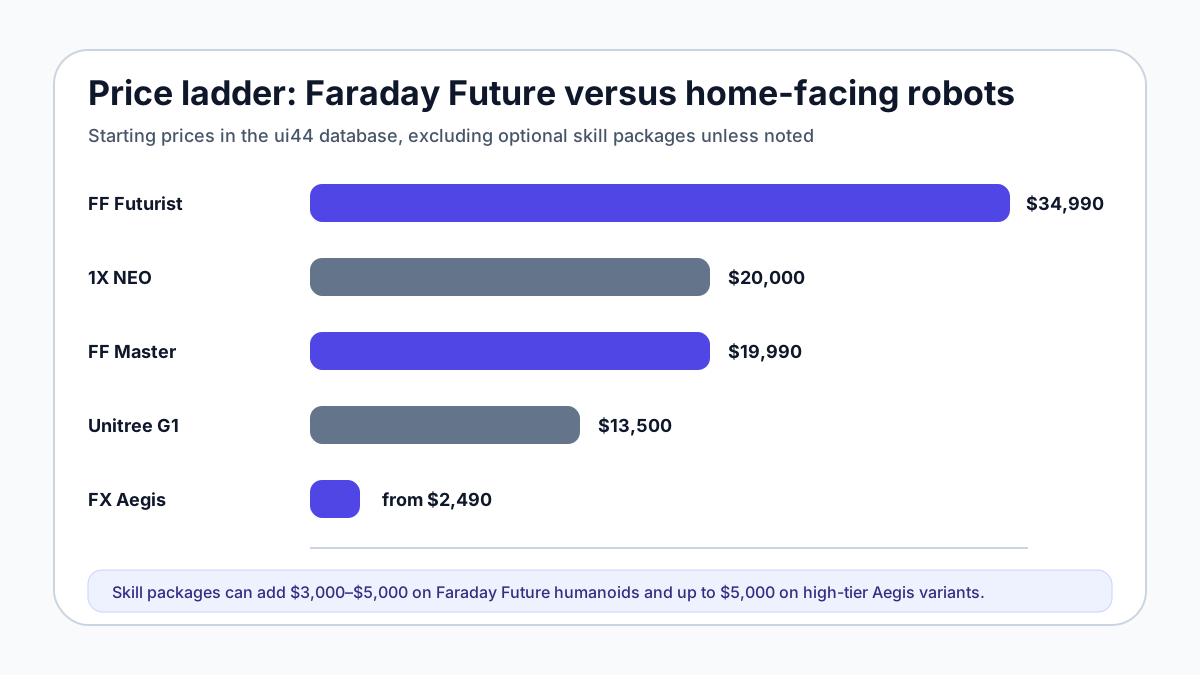
The key thing to notice is the gap between price and proof. FF Master costs almost exactly the same as 1X NEO in ui44's database, while Unitree G1 starts lower at $13,500. But price is only one part of the buying decision. A humanoid that is technically orderable still has to prove household navigation, manipulation, privacy, repairability, insurance, and fallback behavior.
Are they really shipping?
Based on the public record, the fair answer is: yes, Faraday Future claims small-batch robot shipments, but buyers should not treat that as mature consumer availability.
There are three levels of evidence here.
First, Faraday Future has official product pages and shop pages. That is basic, but it matters. Many humanoid announcements never get past a press release and a render. Faraday Future has published product positioning, prices, tiering, and purchase flow language.
Second, the company has reported shipment numbers. The May RobotShop MOU release says 68 EAI robots had shipped by April 30, 2026. An April compliance release snippet for FX Aegis said FF had exceeded a target of shipping 20 units in the first delivery month. Those are company-reported figures, not independent fleet registries, but they are more concrete than "coming soon."
Third, there is a channel signal. RobotShop is not the same as mass retail, but it is a real robotics-commerce platform. A RobotShop listing gives professional buyers a more familiar purchasing path than emailing a startup after watching a keynote. It also means Faraday Future is starting to expose the robots to normal commerce expectations: configuration, purchase, delivery, support, and returns.
The caution is that none of this proves a buyer can get a robot that performs open-ended home jobs safely and repeatedly. The shipment count could include education, partner, B2B, or demo units. The MOU is not the same as a long-term service network. A sold-out allocation can mean demand, but it can also mean a small batch. And when a product page warns that scenarios may show future functionality, the safest interpretation is to verify exactly what the delivered software can do today.
How FF Futurist and FF Master compare with other humanoids
The home-humanoid market has a strange mix of visible demos and uneven product truth. Figure 03 has more famous home-task videos and ui44 tracks about 5 hours of battery life, a 20 kg payload, and Figure's Helix VLA system. But Figure has not announced normal consumer pricing. 1X NEO has the clearest home positioning and a public early-adopter price, but it is still a preorder story. Unitree G1 is available and comparatively affordable, but its buyer case is closer to developer, education, and research use than "replace a housekeeper."
Faraday Future sits in the middle. It has public pricing and a claimed delivery ramp. It also has a company background in vehicles rather than a long visible track record in domestic robotics. That is not automatically bad. Automotive supply chains, field service, batteries, and safety processes are relevant to robots. But it does mean buyers should separate the brand's ambition from the robot's delivered behavior.
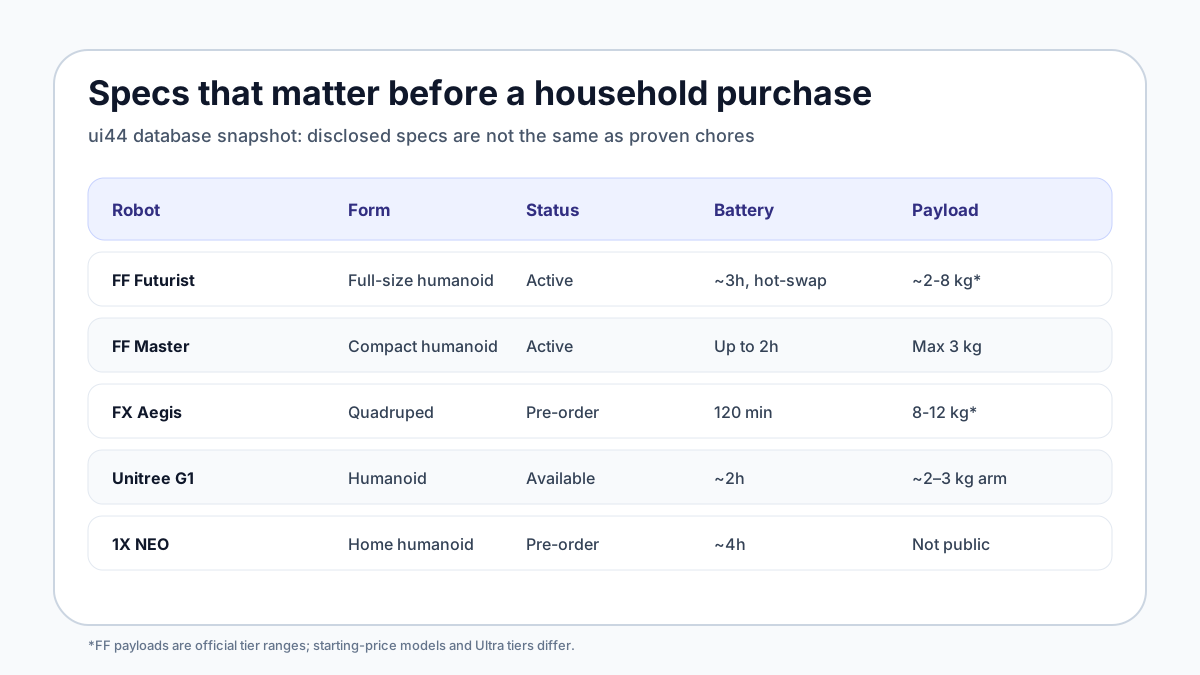
The most important field to read carefully is payload. Faraday Future does publish payload values, but they are tiered and modest rather than one blended family-level spec: roughly 2 kg for the base Futurist, up to 8 kg for Futurist Ultra, max 3 kg across FF Master tiers, and 8-12 kg across FX Aegis tiers. For a home buyer, payload is not a nerd spec. It determines whether the robot can safely lift a laundry basket, move a dining chair, carry groceries, open a heavy door, or recover when it grasps the wrong thing.
Battery life is another practical limit. Two to three hours can be enough for an event, classroom session, patrol window, or supervised demo. It is not enough to make a humanoid feel like a normal household appliance unless the robot docks, swaps, or schedules tasks reliably. A robot that helps for 45 minutes and then needs careful human handling is still useful in some contexts, but it should be priced and described honestly.
FX Aegis may be the more realistic near-term home-adjacent robot
The quadruped is less glamorous than a humanoid, but FX Aegis may have a clearer near-term use case. Robot dogs do not need to solve hands, dishes, drawers, folding, or tool use before they become useful. A quadruped can patrol a yard, follow a person, carry a small tier-limited payload, act as a mobile camera, inspect spaces, or serve education and research users.
That makes Aegis comparable in spirit to robots like Unitree Go2 and Boston Dynamics Spot, although the products target very different price and buyer segments. ui44 lists Unitree Go2 from $1,600, with Go2 Pro at $2,800 and Go2 X at $4,500. Spot is an enterprise platform with contact-sales pricing rather than a public consumer MSRP. Aegis starts closer to Unitree's consumer/developer band but climbs quickly into professional-tier pricing when configured.
For a household, that means Aegis should not be judged by whether it can "be a pet." It should be judged by whether the delivered product can do narrow, verifiable jobs: navigate safely, return to base, stream video securely, avoid children and animals, carry the payload advertised for the exact tier purchased, operate outdoors within its limits, and avoid becoming an expensive remote-control toy.
The Aegis tier spread also makes buyer comparison tricky. A $2,490 base robot and a $19,990 Ultra W+ version are not the same buyer decision. Anyone comparing Aegis with Unitree Go2, Xiaomi CyberDog 2, or an enterprise quadruped needs to match sensors, autonomy, payload, developer access, warranty, and service before comparing price.
The home/family-service claims need the most skepticism
Faraday Future's most consumer-friendly language appears around FF Master. The company describes family service, personal service, study help, elderly conversation, remote home monitoring, and outdoor companionship. Those are plausible directions for a small humanoid. They are not the same as evidence that the robot can safely live in an ordinary home.
There are four reasons to be cautious.
First, conversation is not autonomy. A robot can use language well and still be unsafe or clumsy when it moves. Home robots need perception, planning, collision-avoidance, grasping, force limits, and recovery behavior, not just a friendly interface.
Second, remote monitoring changes the privacy stakes. A mobile camera with 4G, 5G, app control, and VR teleoperation can be useful. It also needs clear rules for video storage, operator access, encryption, retention, and what happens if remote control is compromised.
Third, home layouts are worse than showrooms. Rugs, pets, stairs, glass tables, toys, cable clutter, low lighting, mirrors, and narrow hallways are not edge cases in homes. They are the environment. If a product has mostly been shown in controlled spaces, buyers should ask for real home proof before believing the family-service pitch.
Fourth, service is part of the product. A humanoid has hands, actuators, joints, batteries, cameras, computers, and software. A broken hand or dead battery is not a minor accessory problem if the robot cost $20,000 or $35,000. The support network matters as much as the launch video.
What buyers should ask before ordering
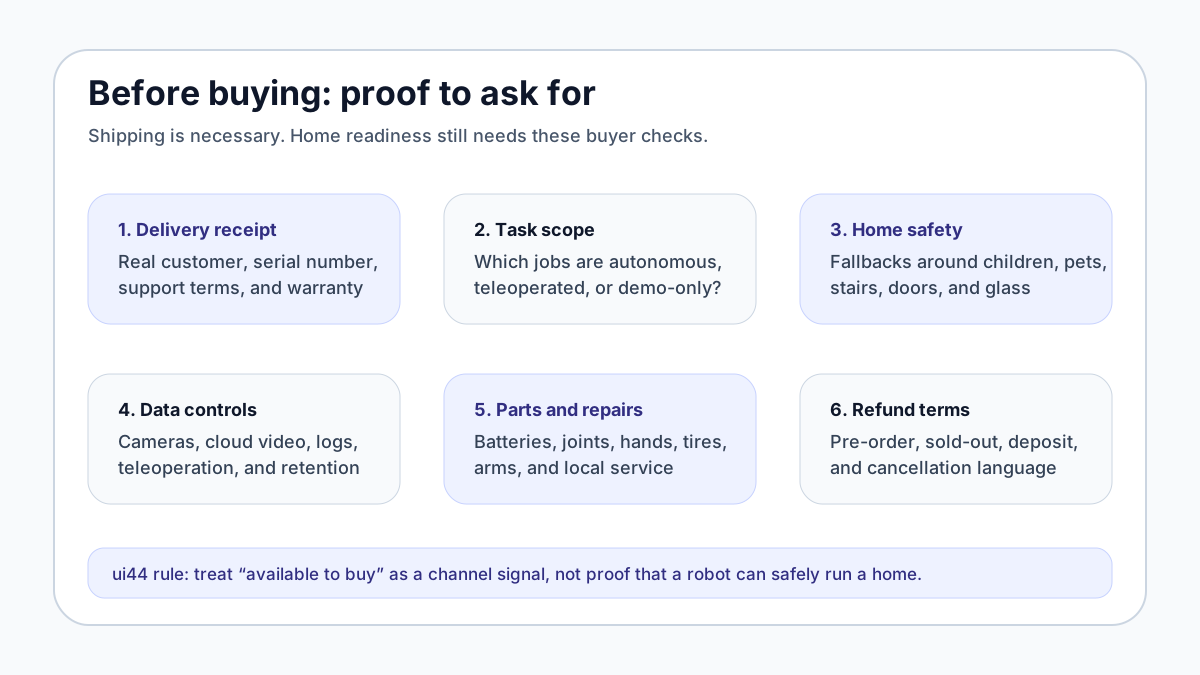
If you are seriously evaluating FF Futurist, FF Master, or FX Aegis, ask for proof in plain language. A good seller should be able to answer without hiding behind "AI" or "future update" language.
Start with delivery proof. Is the unit you are ordering part of a delivered production batch, a preorder allocation, or a partner program? What is the serial-numbered hardware revision? What is the promised delivery date? What happens if it slips?
Then ask for a task list with autonomy levels. For each job, is the robot fully autonomous, supervised, teleoperated, scripted, or demonstration-only? If FF Master is being considered for a family setting, ask exactly which home tasks are supported on delivered hardware and which are roadmap items.
Ask for safety and privacy documents. For a humanoid or quadruped with cameras, wireless connectivity, and remote operation, you want to know how video is stored, whether a human operator can access the stream, how logs are retained, what the emergency stop looks like, and what happens during network failure.
Ask for service economics. How much are extra batteries? How long do hands, actuators, foot pads, tires, sensors, and camera modules last? Who repairs the robot? Is there a local service partner? How long is the warranty? Does the RobotShop purchase path change support responsibilities?
Finally, ask what the optional ecosystem skill packages actually unlock. A $3,000 or $5,000 add-on may be reasonable for a lab, school, or professional buyer. It is not automatically reasonable for a household unless it unlocks specific, supported functions you will use.
ui44 verdict: real signal, not a household green light
Faraday Future's robotics launch deserves attention because it has more buyer surface area than many humanoid announcements: public pricing, official product pages, a RobotShop channel signal, and company-reported shipment counts. That moves FF Futurist, FF Master, and FX Aegis into the serious-watch category.
The strongest near-term case is probably not "a Faraday Future humanoid will do your chores." It is that education, events, research, patrol, and professional users may start stress-testing these platforms in larger numbers than a pure lab demo would allow. If those units generate support data, failure reports, repair processes, and software updates, the whole category learns faster.
For home buyers, the bar remains higher. A $19,990 or $34,990 humanoid must prove safe household movement, privacy boundaries, real task support, repair coverage, and fallback behavior. A $2,490 quadruped must prove it is more than a mobile camera with a good spec sheet. Shipping is necessary. It is just not the finish line.
The practical answer is: follow Faraday Future closely, but buy only against verified delivered functions, not the broadest future-use-case language. In home robotics, the difference between "available" and "ready for your home" is still the difference that matters most.
Related in the database
Use this article as a privacy verification workflow
Turn the article into a privacy verification pass grounded in the robots, manufacturers, and components it actually references.
Faraday Future Robots: Are They Really Shipping? already points you toward 8 linked robots, 6 manufacturers, and 3 countries inside the ui44 database. That matters because strong buyer guidance is easier to apply when you can move immediately from a claim or warning into concrete product pages, manufacturer directories, component explainers, and country-level context instead of treating the article as an isolated opinion piece. The fastest next step is to turn the article into a shortlist workflow: open the linked robot pages, verify which specs are actually published for those models, then compare the surrounding manufacturer and component context before you decide whether the underlying claim changes your buying plan.
For this topic, the useful discipline is to separate the editorial lesson from the catalog evidence. The article gives you the framing, but the robot pages tell you what each product actually ships with today: sensor stack, connectivity methods, listed price, release timing, category, and support-relevant compatibility notes. The manufacturer pages then show whether you are looking at a one-off launch, a broader lineup pattern, or a company that spans multiple categories. That layered workflow reduces the risk of buying on a single marketing phrase or a single support FAQ.
Use the robot pages to confirm which products actually expose cameras, microphones, Wi-Fi, or voice systems, then use the manufacturer pages to decide how much of the privacy question seems product-specific versus brand-wide. On this route cluster, FF Futurist, FF Master, and FX Aegis form the fastest reality check. If you want a quick working shortlist, open Compare FF Futurist, FF Master, and FX Aegis next, then keep this article open as the reasoning layer while you compare structured data side by side.
Practical Takeaway
Every robot, manufacturer, category, component, and country reference below resolves to a real ui44 page, keeping the follow-up path grounded in database records rather than generic advice.
Suggested next steps in ui44
- Open FF Futurist and note the listed sensors, connectivity methods, and voice stack before you interpret any policy claim.
- Cross-check the wider brand context on Faraday Future so you can see whether the privacy question touches one model or a broader lineup.
- Use the linked component pages to confirm how common the relevant sensors and connectivity layers are across the database.
- Keep a short note of which policy layers you checked, which device features are actually present on the robot page, and which items still depend on region- or app-level confirmation.
- Finish with Compare FF Futurist, FF Master, and FX Aegis so the policy reading sits next to structured product data.
Robot profiles worth opening next
Use the linked product pages as the evidence layer
The linked robot pages are where this article becomes operational. Instead of asking whether the headline is interesting, use the robot entries to inspect the actual mix of sensors, connectivity options, batteries, pricing, release timing, and stated capabilities attached to the products mentioned in the article. That is the easiest way to see whether the warning or opportunity described here affects one product family, a specific design pattern, or an entire buying lane.
FF Futurist
Faraday Future · Humanoid · Active
FF Futurist is tracked on ui44 as a active humanoid robot from Faraday Future. The database currently records a listed price of $34,990, a release date of 2026-02-04, Approx. 3 hours continuous standing time; hot-swappable without power interruption battery life, Not disclosed (hot-swappable battery design) charging time, and a published stack that includes 3D LiDAR, RGB-D Camera, and Fisheye Camera plus Wi-Fi and 4G.
For privacy-focused reading, this page matters because it shows the concrete device surface behind the policy discussion. Use it to verify whether FF Futurist combines sensors and connectivity in a way that could change the in-home data footprint, and compare the listed capabilities such as Bipedal Walking, Autonomous Navigation, and Obstacle Avoidance with any cloud, app, or voice layers.
FF Master
Faraday Future · Humanoid · Active
FF Master is tracked on ui44 as a active humanoid robot from Faraday Future. The database currently records a listed price of $19,990, a release date of 2026-02-04, Up to 2 hours battery life, Not disclosed charging time, and a published stack that includes 3D LiDAR, Stereo RGB Cameras, and Interactive RGB Camera plus Wi-Fi and Bluetooth.
For privacy-focused reading, this page matters because it shows the concrete device surface behind the policy discussion. Use it to verify whether FF Master combines sensors and connectivity in a way that could change the in-home data footprint, and compare the listed capabilities such as Bipedal Walking, Autonomous Navigation, and Obstacle Avoidance with any cloud, app, or voice layers.
FX Aegis
Faraday Future · Quadruped · Pre-order
FX Aegis is tracked on ui44 as a pre-order quadruped robot from Faraday Future. The database currently records a listed price of $2,490, a release date of 2026-02-05, 120 minutes battery life, Not officially disclosed charging time, and a published stack that includes HD Cameras, LiDAR (optional module), and Depth Cameras (optional module) plus Wi-Fi and 5G.
For privacy-focused reading, this page matters because it shows the concrete device surface behind the policy discussion. Use it to verify whether FX Aegis combines sensors and connectivity in a way that could change the in-home data footprint, and compare the listed capabilities such as Quadruped Locomotion, Wheeled Mobility (optional variant), and Autonomous Navigation with any cloud, app, or voice layers.
NEO
1X Technologies · Humanoid · Pre-order
NEO is tracked on ui44 as a pre-order humanoid robot from 1X Technologies. The database currently records a listed price of $20,000, a release date of 2025-10-28, ~4 hours battery life, Not disclosed charging time, and a published stack that includes RGB Cameras, Depth Sensors, and Tactile Skin plus Wi-Fi and Bluetooth.
For privacy-focused reading, this page matters because it shows the concrete device surface behind the policy discussion. Use it to verify whether NEO combines sensors and connectivity in a way that could change the in-home data footprint, and compare the listed capabilities such as Household Chores, Tidying Up, and Safe Human Interaction with any cloud, app, or voice layers.
G1 is tracked on ui44 as a available humanoid robot from Unitree. The database currently records a listed price of $13,500, a release date of 2024-05-13, ~2 hours battery life, Not disclosed charging time, and a published stack that includes Depth Camera, 3D LiDAR, and 4 Microphone Array plus Wi-Fi 6 and Bluetooth 5.2.
For privacy-focused reading, this page matters because it shows the concrete device surface behind the policy discussion. Use it to verify whether G1 combines sensors and connectivity in a way that could change the in-home data footprint, and compare the listed capabilities such as Bipedal Walking, Object Manipulation, and Dexterous Hands (optional Dex3-1) with any cloud, app, or voice layers.
Manufacturer context behind the article
Check whether this is one product story or a broader company pattern
Manufacturer pages add the privacy context that individual product pages cannot show on their own. They help you check whether cameras, microphones, cloud accounts, app controls, and policy assumptions appear across a broader lineup or stay tied to one specific product story.
Faraday Future
ui44 currently tracks 5 robots from Faraday Future across 3 categorys. The company is grouped under USA, and the current catalog footprint on ui44 includes FF Futurist, FF Master, FX Aegis.
That wider brand context matters because privacy questions rarely stop at one FAQ page. A manufacturer route helps you see whether the article is centered on one premium model or on a company that has several relevant products and therefore more than one place where the same policy or app assumptions might matter. The category mix here currently points toward Humanoid, Quadruped, Commercial as the most useful next route if you want to see whether this article reflects a wider pattern inside the brand.
1X Technologies
ui44 currently tracks 2 robots from 1X Technologies across 1 category. The company is grouped under Norway, and the current catalog footprint on ui44 includes NEO, EVE.
That wider brand context matters because privacy questions rarely stop at one FAQ page. A manufacturer route helps you see whether the article is centered on one premium model or on a company that has several relevant products and therefore more than one place where the same policy or app assumptions might matter. The category mix here currently points toward Humanoid as the most useful next route if you want to see whether this article reflects a wider pattern inside the brand.
Unitree
ui44 currently tracks 2 robots from Unitree across 1 category. The company is grouped under China, and the current catalog footprint on ui44 includes H1, G1.
That wider brand context matters because privacy questions rarely stop at one FAQ page. A manufacturer route helps you see whether the article is centered on one premium model or on a company that has several relevant products and therefore more than one place where the same policy or app assumptions might matter. The category mix here currently points toward Humanoid as the most useful next route if you want to see whether this article reflects a wider pattern inside the brand.
Figure AI
ui44 currently tracks 2 robots from Figure AI across 1 category. The company is grouped under USA, and the current catalog footprint on ui44 includes Figure 03, Figure 02.
That wider brand context matters because privacy questions rarely stop at one FAQ page. A manufacturer route helps you see whether the article is centered on one premium model or on a company that has several relevant products and therefore more than one place where the same policy or app assumptions might matter. The category mix here currently points toward Humanoid as the most useful next route if you want to see whether this article reflects a wider pattern inside the brand.
Broaden the scan without leaving the database
Categories, components, and countries add the wider context
Category framing
Category pages are useful when the article touches a buying pattern that shows up across brands. A category route helps you confirm whether the linked products sit in a narrow niche or whether the same question should be tested across a larger field of alternatives.
Humanoid
The Humanoid category page currently groups 129 tracked robots from 92 manufacturers. ui44 describes this lane as: Full-size bipedal humanoid robots built to work alongside people — from factory floors to household tasks. Compare the cutting edge of humanoid robotics.
That makes the category route a practical follow-up when you want to check whether the products linked in this article are typical for the lane or whether they sit at one edge of the market. Useful starting examples currently include NEO, EVE, Mornine M1.
Quadruped
The Quadruped category page currently groups 25 tracked robots from 16 manufacturers. ui44 describes this lane as: Four-legged robot dogs and quadrupeds built for rough terrain, inspection, and exploration — going where wheels can't.
That makes the category route a practical follow-up when you want to check whether the products linked in this article are typical for the lane or whether they sit at one edge of the market. Useful starting examples currently include Argos X1, D1 Pro, D2 Max.
Country and ecosystem context
Country pages give extra context when support practices, launch sequencing, regulatory posture, or manufacturer mix matter. They are not a substitute for model-level verification, but they do help you see which ecosystems cluster together and which manufacturers sit in the same regional field when you broaden the search beyond the article headline.
USA
The USA route currently groups 89 tracked robots from 69 manufacturers in ui44. That gives you a useful regional lens when the article points toward support practices, launch sequencing, or brand clusters that may share similar ecosystem assumptions.
On the current route, manufacturers like Faraday Future, iRobot, Boston Dynamics make the page a good way to broaden the scan without losing the regional context that often shapes availability, documentation style, and adjacent alternatives.
Norway
The Norway route currently groups 2 tracked robots from 1 manufacturers in ui44. That gives you a useful regional lens when the article points toward support practices, launch sequencing, or brand clusters that may share similar ecosystem assumptions.
On the current route, manufacturers like 1X Technologies make the page a good way to broaden the scan without losing the regional context that often shapes availability, documentation style, and adjacent alternatives.
China
The China route currently groups 189 tracked robots from 87 manufacturers in ui44. That gives you a useful regional lens when the article points toward support practices, launch sequencing, or brand clusters that may share similar ecosystem assumptions.
On the current route, manufacturers like AGIBOT, Dreame, Unitree Robotics make the page a good way to broaden the scan without losing the regional context that often shapes availability, documentation style, and adjacent alternatives.
Questions to answer before you move from reading to buying
A follow-up FAQ built from the entities already linked in this article
Frequently Asked Questions
Which page should I open first after reading “Faraday Future Robots: Are They Really Shipping?”?
Start with FF Futurist. That gives you a concrete product anchor for the article’s main claim. From there, branch into the manufacturer and component pages so you can tell whether the article is describing one specific model, a repeated brand pattern, or a wider technology issue that affects multiple shortlist options.
How do the manufacturer pages change the buying decision?
Faraday Future help you zoom out from one article and one product. On ui44 they show lineup breadth, category spread, and the neighboring robots tied to the same company. That context is useful when you are deciding whether a risk belongs to a single model, whether it shows up across a brand’s portfolio, and whether you should keep looking at alternatives before committing.
When should I switch from reading to side-by-side comparison?
Move into Compare FF Futurist, FF Master, and FX Aegis as soon as you understand the article’s main warning or promise. The article explains what to watch for, but the compare view is where you can check whether price, status, battery life, connectivity, sensors, and category fit still make the robot a good match for your own home and budget.
Where to go next in ui44
Keep the research chain inside the database
If you want to keep going, these follow-on pages give you the cleanest expansion path from article to research session. Open the comparison route first if you are deciding between products today. Open the manufacturer, category, and component routes if you still need to understand the broader pattern behind the claim.
Written by
ui44 Team
Published May 25, 2026
Share this article
Open a plain share link on X or Bluesky. No embeds, no widgets, no cookie baggage.