The useful signal is not that a made-in-India humanoid is suddenly ready to fold laundry. It is that Addverb chose the least glamorous path: flat floors, long routes, dual-arm work, human supervision, and limited proof-of-concept deployments before broader adoption. For home robot buyers, that says more than another stage demo.
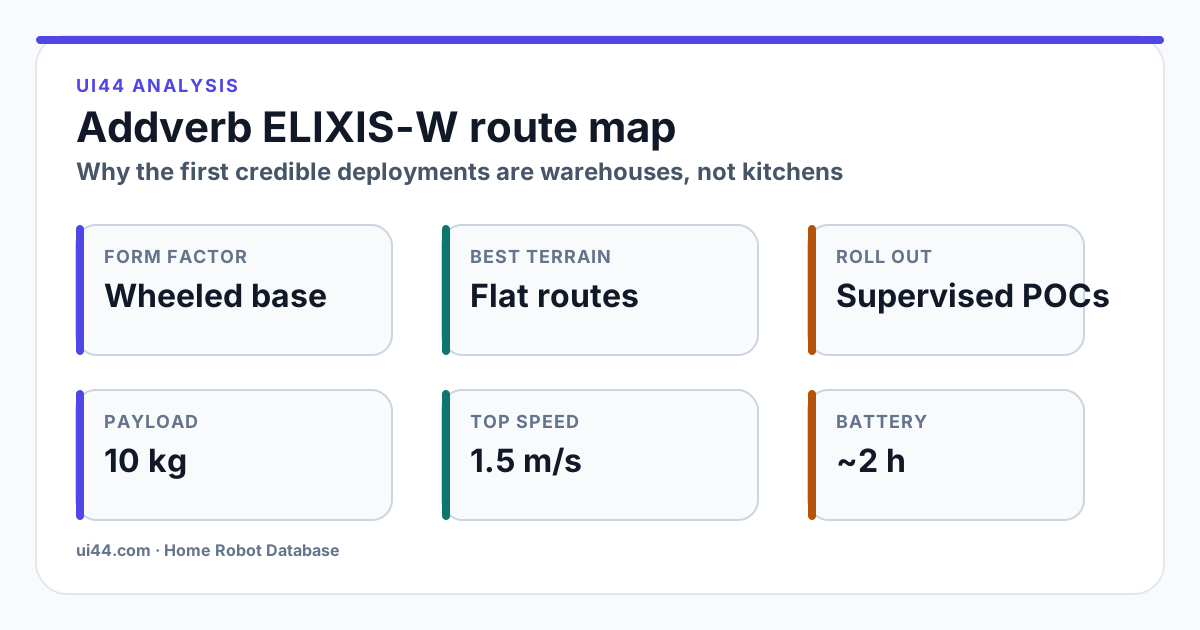
ui44's short read: Addverb ELIXIS-W looks like a credible industrial humanoid experiment, not a consumer robot. Its value for home robotics is the lesson it teaches: the shortest route to useful domestic robots may run through supervised commercial work first.
What is Addverb ELIXIS-W?
ELIXIS-W is the wheeled variant of Addverb's ELIXIS humanoid platform. Addverb describes ELIXIS as a general-purpose humanoid robot for dull, dirty, and dangerous work, with dexterous manipulation, multimodal perception, compliant control, and a Physical AI software stack. The biped ELIXIS page lists a 175 cm, 75 kg robot with 41 degrees of freedom, five-finger dexterous or parallel-jaw hands, 5 kg per-arm payload, up to 1 m/s walking speed, 60-90 minutes of targeted battery backup, stereo depth cameras, 3D LiDAR, IMUs, dual encoders, an i7 control unit, and NVIDIA Jetson Orin as an intelligence unit.
ELIXIS-W changes the mobility bet. Addverb's official product page says ELIXIS-W is the wheeled humanoid for longer routes, with 10 kg payload, up to 1.5 m/s speed, and roughly 2 hours of battery life. Addverb's LogiMAT India 2026 write-up calls it India's first made-in-India wheeled humanoid robot designed for industrial use, and says deployment will start with limited, closely supervised proof-of-concept projects in controlled industrial environments.
That last sentence matters. Addverb is not publicly selling a kitchen helper. It is trying to validate a mobile manipulator in places where the floor is known, the tasks are repeatable, and the humans nearby are trained to work around automation.
For ui44, that is a stronger signal than a more theatrical home claim. A robot that can repeatedly move between warehouse stations, carry payload, perceive people, and manipulate tools under supervision is still far from a living-room servant. But it creates evidence on the hard parts: navigation, uptime, safety stops, task chaining, and recovery from real workflow errors.
Why choose wheels instead of legs?
The honest answer is practicality. Warehouses and factories usually have flat floors, mapped lanes, defined work cells, chargers, maintenance teams, and operational discipline. A wheeled humanoid gives up stairs, rough terrain, and some human-like movement, but gains efficiency, stability, easier safety envelopes, and better battery use.
That trade-off is not a weakness if the first job is industrial. A biped makes sense when stairs, curbs, uneven terrain, or human-shaped reach are essential. A wheeled base makes sense when the robot needs to travel long routes on smooth floors and then use arms at the destination. This is why wheeled mobile manipulators keep reappearing in retail, hospitality, hospitals, and logistics.
Galbot G1 is the clearest database comparison. ui44 lists Galbot's G1 as a wheeled semi-humanoid mobile manipulator for retail automation, with 173 cm height, 85 kg weight, 10 hours of battery life, 5 km/h max speed, and a total dual-arm payload of 10 kg. It is not pitched as a domestic robot either. It is store-first: shelf replenishment, inventory, package handling, and delivery.
ELIXIS-W sits in a similar strategic lane. The question is not whether it can look human. The question is whether the wheeled body can make manipulation reliable enough to earn more difficult environments later.
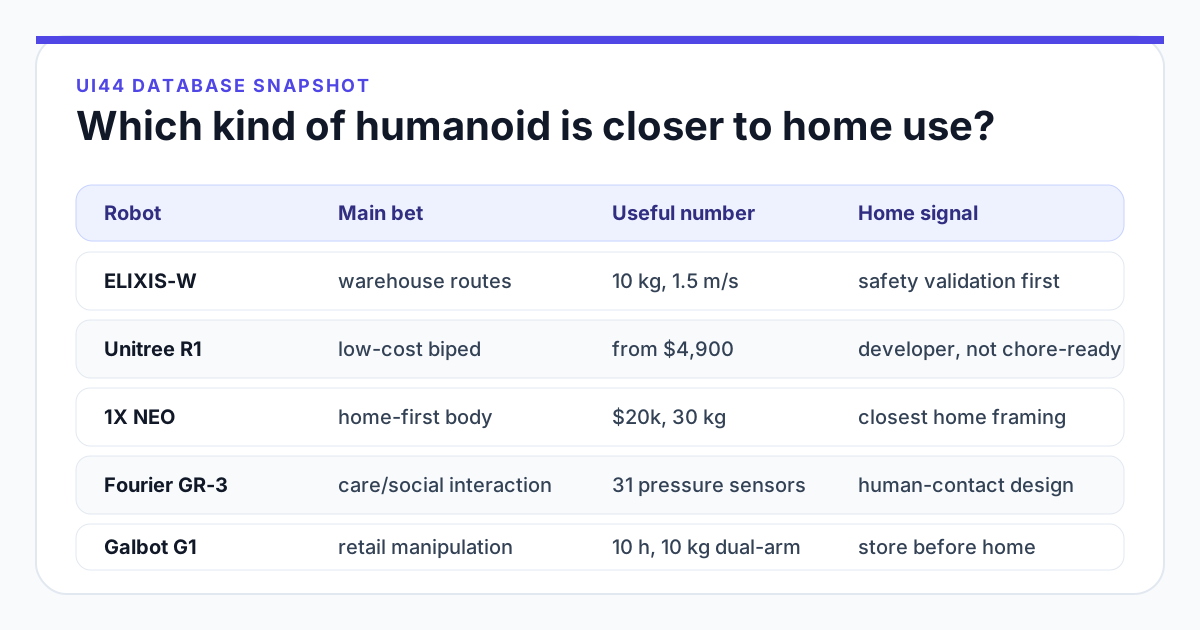
How does ELIXIS-W compare with home-adjacent humanoids?
The important comparison is not "which robot is most human-shaped?" It is "which robot has evidence for the environment it claims to serve?"
Robot
- ui44 status
- Development
- Public price
- Not disclosed
- Key database signal
- 10 kg payload, 1.5 m/s, ~2 h battery, supervised industrial POCs
- What it tells buyers
- Credible warehouse-first validation, not home-ready
Robot
- ui44 status
- Pre-order
- Public price
- From $4,900
- Key database signal
- 123 cm, about 29 kg, ~1 h battery, optional dexterous hands on EDU
- What it tells buyers
- Low-cost access, but movement-first and early-stage
Robot
- ui44 status
- Available
- Public price
- $29,900
- Key database signal
- 182 cm, about 70 kg, 31 DoF, about 3 h battery, rated arm payload ~7 kg
- What it tells buyers
- Powerful full-size hardware with caution flags
Robot
- ui44 status
- Pre-order
- Public price
- $20,000
- Key database signal
- 167 cm, 30 kg, ~4 h battery, soft home-focused body
- What it tells buyers
- Most explicitly home-oriented, but still early access
Robot
- ui44 status
- Active
- Public price
- Not disclosed
- Key database signal
- 165 cm, 71 kg, 31 pressure sensors, care/social focus
- What it tells buyers
- Safer human-contact design direction
Robot
- ui44 status
- Pre-order
- Public price
- €19,999
- Key database signal
- 132 cm, 36 kg, 3 kg payload, ~2.5 h battery
- What it tells buyers
- Compact research/service route with a public reservation path
Robot
- ui44 status
- Active
- Public price
- Not disclosed
- Key database signal
- wheeled, 10 h battery, 10 kg dual-arm payload, VLA retail skills
- What it tells buyers
- Store automation before private homes
| Robot | ui44 status | Public price | Key database signal | What it tells buyers |
|---|---|---|---|---|
| Addverb ELIXIS-W | Development | Not disclosed | 10 kg payload, 1.5 m/s, ~2 h battery, supervised industrial POCs | Credible warehouse-first validation, not home-ready |
| Unitree R1 | Pre-order | From $4,900 | 123 cm, about 29 kg, ~1 h battery, optional dexterous hands on EDU | Low-cost access, but movement-first and early-stage |
| Unitree H2 | Available | $29,900 | 182 cm, about 70 kg, 31 DoF, about 3 h battery, rated arm payload ~7 kg | Powerful full-size hardware with caution flags |
| 1X NEO | Pre-order | $20,000 | 167 cm, 30 kg, ~4 h battery, soft home-focused body | Most explicitly home-oriented, but still early access |
| Fourier GR-3 | Active | Not disclosed | 165 cm, 71 kg, 31 pressure sensors, care/social focus | Safer human-contact design direction |
| NEURA 4NE-1 Mini | Pre-order | €19,999 | 132 cm, 36 kg, 3 kg payload, ~2.5 h battery | Compact research/service route with a public reservation path |
| Galbot G1 | Active | Not disclosed | wheeled, 10 h battery, 10 kg dual-arm payload, VLA retail skills | Store automation before private homes |
This table makes ELIXIS-W easier to understand. Compared with a low-cost biped like Unitree R1, Addverb is not trying to win hobbyist attention. Compared with 1X NEO, it is not making a domestic promise. Compared with Fourier GR-3, it is less about emotional interaction and more about industrial task throughput. Compared with Galbot G1, it belongs to the same "structured public space before home" category.
That is why a buyer should resist two bad conclusions. The hype conclusion is "industrial humanoids mean home servants are almost here." The cynical conclusion is "if it cannot climb my stairs, it is irrelevant." Both miss the point. ELIXIS-W is evidence for one piece of the stack: practical deployment of a mobile, two-armed robot in human workplaces.
Does ELIXIS-W mean India has a home humanoid race now?
Not yet. It means India has a serious industrial humanoid signal from a company that already knows warehouse automation.
Addverb is not a new demo lab with no operating context. Its broader business includes autonomous mobile robots, sortation systems, automated storage and retrieval, picking technologies, and industrial customers. That matters because humanoid progress is not just a body problem. It is also deployment engineering: fleet support, workflow integration, site mapping, safety training, spare parts, service contracts, and software updates.
For a home robot, those operational details move indoors. Instead of a warehouse supervisor, there is a family. Instead of a mapped aisle, there is a hallway with shoes, toys, pets, visitors, and changed furniture. Instead of a maintenance shift, there is someone who wants the robot to work without becoming a part-time robotics technician.
That is why a warehouse-first company may be more credible than a home-first promise with no service model. But it is also why industrial success cannot be copied directly into a kitchen. The home has fewer trained operators and far more privacy risk.
What would have to change before ELIXIS-W-like robots enter homes?
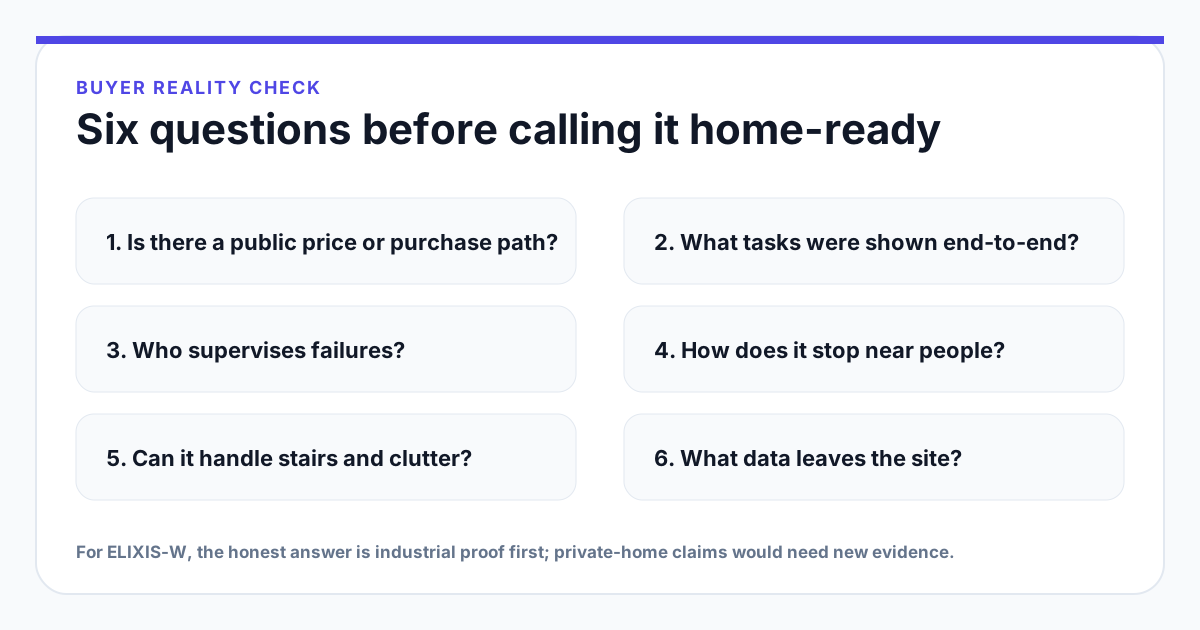
A home version would need evidence in six areas.
First, the robot would need a clear public purchase or leasing path. ui44 currently records ELIXIS-W with no manufacturer-published price and no consumer purchase path. Third-party pages may speculate about pricing, but without manufacturer confirmation, that should not drive a buyer decision.
Second, it would need demonstrated end-to-end tasks. Picking a box in a controlled demo is useful. Clearing a table, handling fragile dishes, opening varied cabinet handles, recognizing personal items, and asking for help when uncertain are different problems.
Third, it would need safety validation around untrained people. Unitree's own R1 and H2 pages tell individual users to understand the limitations of humanoid robots and keep a sufficient safety distance. That caution is not a footnote; it is the current state of the market. A useful home humanoid must be safe around children, pets, guests, older adults, and people who do not read robot manuals.
Fourth, it would need privacy boundaries. A warehouse robot can be instrumented heavily because the environment is commercial and governed by workplace policies. A home robot sees private rooms, routines, faces, documents, medications, and conversations. Physical AI needs data, but domestic data collection must be opt-in, minimal, understandable, and controllable.
Fifth, it would need better failure recovery. Industrial proof-of-concepts can assign trained staff to supervise and reset failures. Homes need graceful pauses, simple user instructions, safe self-parking, and a clear way to undo mistakes.
Sixth, it would need domestic mobility. A wheeled base can work in some apartments and single-floor homes, but stairs, thresholds, rugs, cables, clutter, wet floors, narrow bathrooms, and low furniture change the problem quickly.
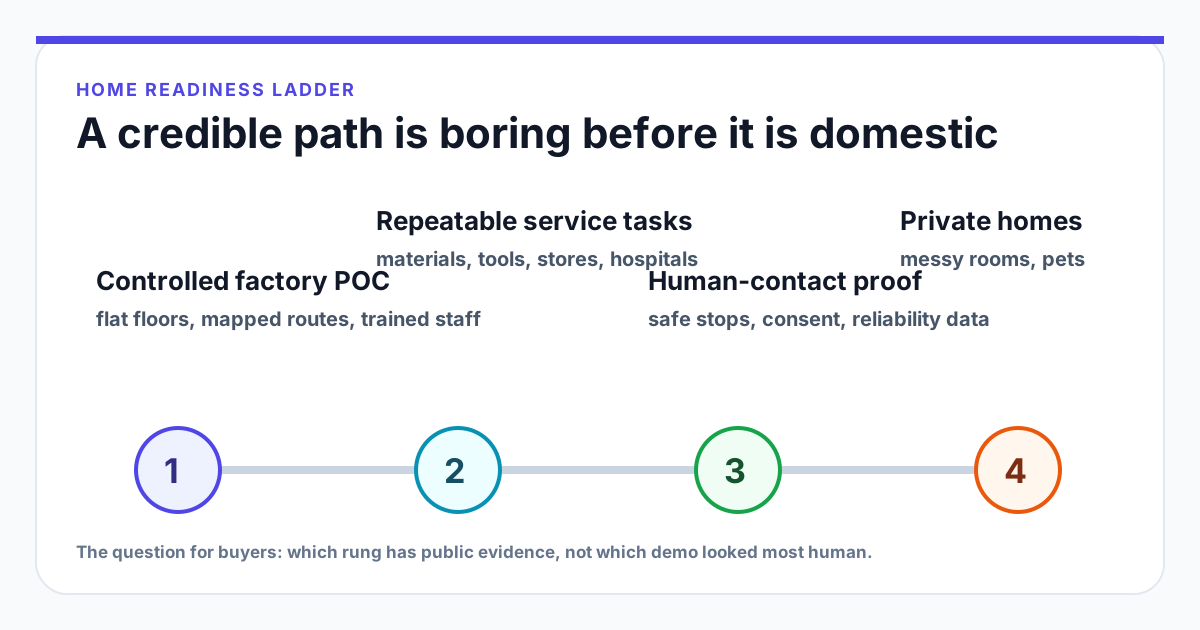
What should buyers watch next?
If you are tracking Addverb ELIXIS-W as a future home-robot signal, ignore the most cinematic clips and watch for boring evidence.
The first useful milestone is a named pilot environment with a repeated task: moving totes, fetching tools, restocking shelves, handling hospital supplies, or supporting a manufacturing cell. The second is measured reliability: how many runs, how many interventions, how many emergency stops, and what happens when perception fails. The third is safety documentation: speed limits near people, force limits, protected zones, stop behavior, and supervision model. The fourth is pricing or service structure, because a robot with no public cost is not yet a buyer option.
Also watch whether Addverb separates ELIXIS biped specs from ELIXIS-W specs more clearly. The public ELIXIS page provides rich data for the biped platform and a shorter summary for ELIXIS-W. For a serious buyer, ELIXIS-W still needs more detail: dimensions, weight, battery capacity, charging time, hand payload definitions, tactile sensing, connectivity, software interfaces, environmental ratings, and warranty terms.
None of that is a criticism unique to Addverb. It is where most humanoid robots are today. Even products with public prices often leave out the task-level reliability data that buyers actually need.
The home-robot takeaway
Addverb ELIXIS-W is interesting because it does not pretend the home is the first easy market. It starts where the floors are flatter, the tasks are more repeatable, and the humans can be trained. That may sound less exciting than a robot butler. It is probably more realistic.
For ui44 readers, the practical takeaway is simple: warehouse-first humanoids are not home robots, but they can reveal which home-robot claims deserve trust later. A company that proves safe, repeatable, dual-arm work in industrial environments earns the right to talk about more flexible spaces. A company that jumps straight from a demo video to domestic promises should face harder questions.
The best buyer stance is patient skepticism. Track ELIXIS-W's pilots. Compare its public evidence against robots on /compare. Watch how it handles supervision, safety, payload, battery life, and pricing. And do not treat a wheeled industrial humanoid as a failed home robot just because it is not ready for your kitchen.
If anything, ELIXIS-W is a reminder that useful robots may arrive by doing unromantic work first.
Related in the database
Use this article as a setup-friction workflow
Turn the article into a first-day setup pass grounded in the robots, manufacturers, and countries it actually references.
Addverb ELIXIS-W: India's Wheeled Humanoid Test already points you toward 7 linked robots, 6 manufacturers, and 4 countries inside the ui44 database. Treat those links as a first-day setup trail: open the robot pages, check what is actually published about charging, battery life, control method, app or OTA support, and recovery, then use the surrounding manufacturer and country context to judge whether the article describes a low-friction product path or a still-specialist deployment.
For setup topics, the useful discipline is to separate a polished demo from the work required after the box arrives. The article gives you the narrative, but the robot pages show the operational clues: dimensions, weight, battery runtime, charging time, controller support, listed availability, and the capabilities that might need supervision. Manufacturer pages then reveal whether the same setup assumptions repeat across a wider lineup.
Use the robot pages to verify what happens between delivery and the first useful task: size, weight, battery, charger or dock path, controller, app, OTA support, and recovery cues. On this route cluster, ELIXIS-W, G1, and R1 form the fastest setup-friction reality check. If you want a quick working shortlist, open Compare ELIXIS-W, G1, and R1 next, then keep this article open while you compare first-day setup evidence side by side.
Practical Takeaway
The links below stay tied to the robots, manufacturers, and countries actually referenced by this setup article, so the checklist remains grounded in published ui44 records rather than generic humanoid advice.
Suggested next steps in ui44
- Open ELIXIS-W and check the concrete first-day fields: box contents, charger or dock path, battery life, controller, app, OTA support, and recovery options.
- Use Addverb Technologies to see whether the company’s broader lineup looks appliance-like, developer-first, or still closer to a pilot deployment.
- Run Compare ELIXIS-W, G1, and R1 with the article open and compare battery, size, weight, price path, status, and support cues side by side.
- Write down the first realistic task each robot can plausibly attempt on day one, then separate low-friction setup signals from impressive but still lab-style demos.
Robot profiles worth opening next
Use the linked product pages as the evidence layer
The linked robot pages are where this setup article becomes operational. Use the robot entries to inspect the actual mix of size, weight, battery runtime, charging path, control method, pricing, availability, and stated capabilities attached to the products mentioned in the article. That is the easiest way to see whether the first useful task looks appliance-like, developer-led, or still dependent on supervised experimentation.
ELIXIS-W
Addverb Technologies · Humanoid · Development
ELIXIS-W is tracked on ui44 as a development humanoid robot from Addverb Technologies. The database currently records a listed price of Price TBA, a release date of 2026-02, Approximately 2 hours battery life, Not officially disclosed charging time, and a published stack that includes Multimodal perception, Stereo depth cameras, and 3D LiDAR plus Not officially disclosed.
For setup-friction reading, this page matters because it shows the physical and support burden behind the demo. Use it to verify whether ELIXIS-W has a credible day-one path across charging, control, recovery, battery limits, and listed capabilities such as Wheeled Humanoid Mobility, Industrial Assistance, and Long-Route Warehouse and Factory Travel.
G1 is tracked on ui44 as a active commercial robot from Galbot. The database currently records a listed price of Price TBA, a release date of 2025, 10 hours battery life, Not disclosed charging time, and a published stack that includes Binocular camera x1, Wrist depth cameras x2, and 6-axis force sensors x2 plus Wi-Fi (2.4/5 GHz) and Ethernet.
For setup-friction reading, this page matters because it shows the physical and support burden behind the demo. Use it to verify whether G1 has a credible day-one path across charging, control, recovery, battery limits, and listed capabilities such as Autonomous Retail Store Operation, Generalizable Object Grasping (5,000+ product types), and Shelf Replenishment & Inventory Management, with voice support noted as Natural Language Voice Commands.
R1
Unitree Robotics · Humanoid · Pre-order
R1 is tracked on ui44 as a pre-order humanoid robot from Unitree Robotics. The database currently records a listed price of $4,900, a release date of 2025, ~1 hour (mixed activity) battery life, Not officially disclosed charging time, and a published stack that includes Monocular camera (R1 Air); binocular camera (R1/R1 EDU), 4-Mic Array, and Dual 6-Axis IMU plus Wi-Fi 6 and Bluetooth 5.2.
For setup-friction reading, this page matters because it shows the physical and support burden behind the demo. Use it to verify whether R1 has a credible day-one path across charging, control, recovery, battery limits, and listed capabilities such as Bipedal Walking & Running, Cartwheels & Handstands, and Push Recovery, with voice support noted as UnifoLM (voice + image commands).
Unitree H2
Unitree Robotics · Humanoid · Available
Unitree H2 is tracked on ui44 as a available humanoid robot from Unitree Robotics. The database currently records a listed price of $29,900, a release date of 2025-10-20, About 3 hours battery life, Not officially disclosed charging time, and a published stack that includes Binocular Camera (Wide FOV), Array Microphone, and IMU plus Wi-Fi 6 and Bluetooth 5.2.
For setup-friction reading, this page matters because it shows the physical and support burden behind the demo. Use it to verify whether Unitree H2 has a credible day-one path across charging, control, recovery, battery limits, and listed capabilities such as 31 Degrees of Freedom, 360 N·m Peak Leg Joint Torque, and 120 N·m Peak Arm Joint Torque, with voice support noted as Built-in Voice Interaction.
NEO
1X Technologies · Humanoid · Pre-order
NEO is tracked on ui44 as a pre-order humanoid robot from 1X Technologies. The database currently records a listed price of $20,000, a release date of 2025-10-28, ~4 hours battery life, Not disclosed charging time, and a published stack that includes RGB Cameras, Depth Sensors, and Tactile Skin plus Wi-Fi and Bluetooth.
For setup-friction reading, this page matters because it shows the physical and support burden behind the demo. Use it to verify whether NEO has a credible day-one path across charging, control, recovery, battery limits, and listed capabilities such as Household Chores, Tidying Up, and Safe Human Interaction.
Manufacturer context behind the article
Check whether this is one product story or a broader company pattern
Manufacturer pages add the setup context that individual product pages cannot show on their own. They help you check whether a brand repeats the same controller, battery, update, support, and availability patterns across multiple robots, or whether the article is really describing one early product path. That matters for humanoids because first-day friction usually comes from the surrounding ecosystem as much as from the robot itself.
Addverb Technologies
ui44 currently tracks 1 robot from Addverb Technologies across 1 category. The company is grouped under India, and the current catalog footprint on ui44 includes ELIXIS-W.
That wider brand context matters because setup friction is rarely just a box problem. A manufacturer route helps you see whether the company has repeated controller, battery, support, and update patterns across its lineup, or whether the article is really about one early product story. The category mix here currently points toward Humanoid as the most useful next route if you want to see whether this article reflects a wider pattern inside the brand.
Galbot
ui44 currently tracks 2 robots from Galbot across 2 categorys. The company is grouped under China, and the current catalog footprint on ui44 includes G1, S1.
That wider brand context matters because setup friction is rarely just a box problem. A manufacturer route helps you see whether the company has repeated controller, battery, support, and update patterns across its lineup, or whether the article is really about one early product story. The category mix here currently points toward Commercial, Humanoid as the most useful next route if you want to see whether this article reflects a wider pattern inside the brand.
Unitree Robotics
ui44 currently tracks 9 robots from Unitree Robotics across 3 categorys. The company is grouped under China, and the current catalog footprint on ui44 includes B2, B1, Go2.
That wider brand context matters because setup friction is rarely just a box problem. A manufacturer route helps you see whether the company has repeated controller, battery, support, and update patterns across its lineup, or whether the article is really about one early product story. The category mix here currently points toward Quadruped, Humanoid, Research as the most useful next route if you want to see whether this article reflects a wider pattern inside the brand.
1X Technologies
ui44 currently tracks 2 robots from 1X Technologies across 1 category. The company is grouped under Norway, and the current catalog footprint on ui44 includes NEO, EVE.
That wider brand context matters because setup friction is rarely just a box problem. A manufacturer route helps you see whether the company has repeated controller, battery, support, and update patterns across its lineup, or whether the article is really about one early product story. The category mix here currently points toward Humanoid as the most useful next route if you want to see whether this article reflects a wider pattern inside the brand.
Broaden the scan without leaving the database
Categories, components, and countries add the wider context
Category framing
Category pages are useful when the article touches a buying pattern that shows up across brands. A category route helps you confirm whether the linked products sit in a narrow niche or whether the same question should be tested across a larger field of alternatives.
Humanoid
The Humanoid category page currently groups 129 tracked robots from 92 manufacturers. ui44 describes this lane as: Full-size bipedal humanoid robots built to work alongside people — from factory floors to household tasks. Compare the cutting edge of humanoid robotics.
That makes the category route a practical follow-up when you want to check whether the products linked in this article are typical for the lane or whether they sit at one edge of the market. Useful starting examples currently include NEO, EVE, Mornine M1.
Commercial
The Commercial category page currently groups 44 tracked robots from 38 manufacturers. ui44 describes this lane as: Delivery robots, warehouse automation, and hospitality service bots — robots built for business and commercial operations.
That makes the category route a practical follow-up when you want to check whether the products linked in this article are typical for the lane or whether they sit at one edge of the market. Useful starting examples currently include G2 Air, aeo, Pepper.
Country and ecosystem context
Country pages give extra context when support practices, launch sequencing, regulatory posture, or manufacturer mix matter. They are not a substitute for model-level verification, but they do help you see which ecosystems cluster together and which manufacturers sit in the same regional field when you broaden the search beyond the article headline.
India
The India route currently groups 6 tracked robots from 5 manufacturers in ui44. That gives you a useful regional lens when the article points toward support practices, launch sequencing, or brand clusters that may share similar ecosystem assumptions.
On the current route, manufacturers like Miko, Addverb Technologies, iHub Robotics make the page a good way to broaden the scan without losing the regional context that often shapes availability, documentation style, and adjacent alternatives.
China
The China route currently groups 189 tracked robots from 87 manufacturers in ui44. That gives you a useful regional lens when the article points toward support practices, launch sequencing, or brand clusters that may share similar ecosystem assumptions.
On the current route, manufacturers like AGIBOT, Dreame, Unitree Robotics make the page a good way to broaden the scan without losing the regional context that often shapes availability, documentation style, and adjacent alternatives.
Norway
The Norway route currently groups 2 tracked robots from 1 manufacturers in ui44. That gives you a useful regional lens when the article points toward support practices, launch sequencing, or brand clusters that may share similar ecosystem assumptions.
On the current route, manufacturers like 1X Technologies make the page a good way to broaden the scan without losing the regional context that often shapes availability, documentation style, and adjacent alternatives.
Questions to answer before you move from reading to buying
A follow-up FAQ built from the entities already linked in this article
Frequently Asked Questions
Which page should I open first after reading “Addverb ELIXIS-W: India's Wheeled Humanoid Test”?
Start with ELIXIS-W. That gives you a concrete product anchor for the article’s main claim. From there, branch into the manufacturer and component pages so you can tell whether the article is describing one specific model, a repeated brand pattern, or a wider technology issue that affects multiple shortlist options.
How do the manufacturer pages change the buying decision?
Addverb Technologies help you zoom out from one article and one product. On ui44 they show lineup breadth, category spread, and the neighboring robots tied to the same company. That context is useful when you are deciding whether a risk belongs to a single model, whether it shows up across a brand’s portfolio, and whether you should keep looking at alternatives before committing.
When should I switch from reading to side-by-side comparison?
Move into Compare ELIXIS-W, G1, and R1 as soon as you understand the article’s main warning or promise. The article explains what to watch for, but the compare view is where you can check whether price, status, battery life, connectivity, sensors, and category fit still make the robot a good match for your own home and budget.
Where to go next in ui44
Keep the research chain inside the database
If you want to keep going, these follow-on pages give you the cleanest expansion path from article to research session. Open the comparison route first if you are deciding between products today. Open the manufacturer, category, and component routes if you still need to understand the broader pattern behind the claim.
Written by
ui44 Team
Published May 12, 2026
Share this article
Open a plain share link on X or Bluesky. No embeds, no widgets, no cookie baggage.