Article 20 min read 4,657 words

Home Robot Handovers: Safe Object Passing Explained

A robot that can pick up an object is not automatically a robot that can hand it to you safely.

ui44 Team All articles

That distinction matters because home-robot demos are moving from waving and walking toward manipulation: towels, cups, bottles, drawers, packages, remote controls, laundry, and medicine bottles. The moment a robot gives something to a person, the task stops being only about arm strength. It becomes a shared action between a moving machine and a moving human.
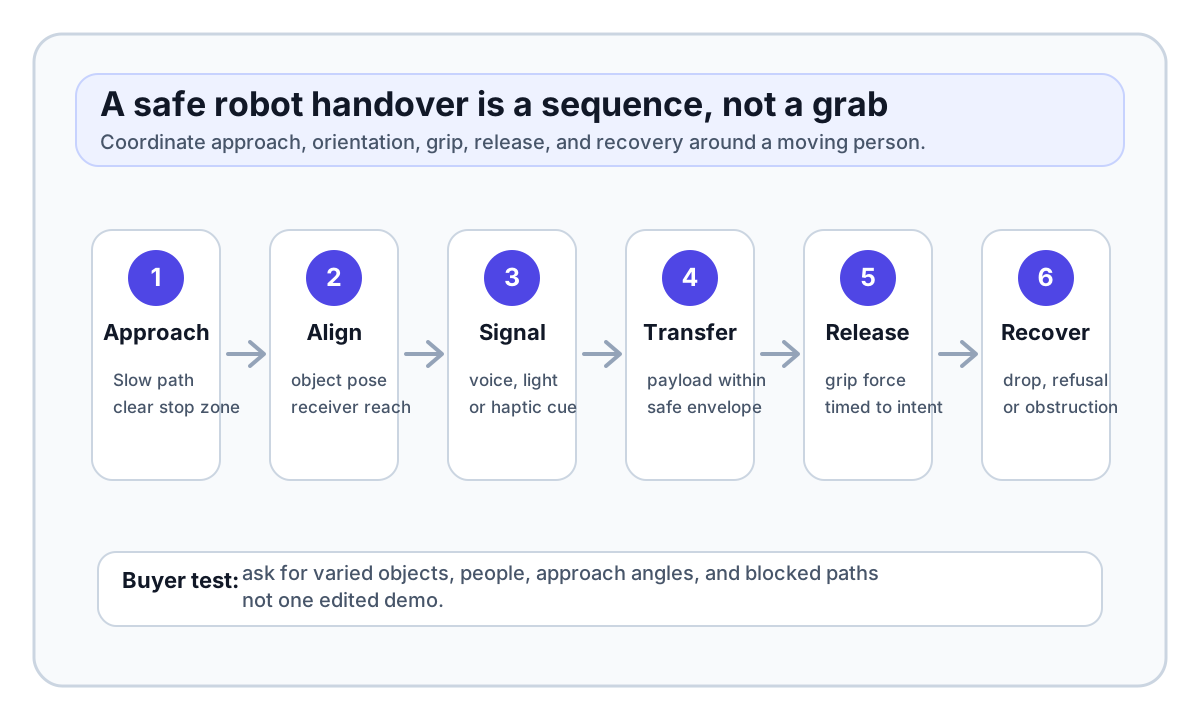
Home robot handover safety flow showing approach, alignment, signaling, transfer, release, and recovery steps
Scroll sideways to inspect the full chart.

Addverb's recent work with IIT Gandhinagar is a useful reminder of how much is hidden inside the word "handover." The research was not a consumer-home trial. It used robot arms and Addverb hardware to study robot-to-robot transfers of boxes and bottles. But the failure mode is exactly the one home buyers should care about: if the giver and receiver do not arrive together, face the object in the right orientation, and adapt when a path is blocked, the transfer can become a drop, a collision, or an unsafe reach.

For buyers, the question is not "does this robot have hands?" It is what proof shows the robot can pass, receive, refuse, and recover around real people?

What is a robot handover?

A robot handover is a physical transfer of an object between two agents. One is the giver, one is the receiver. Either side can be a person or a robot.

That sounds simple until you break down the pieces. The robot needs to detect the object, choose a grasp that leaves room for the other hand, approach at a speed that does not startle the person, orient the object correctly, sense whether the receiver is ready, release at the right moment, and stop safely if anything changes.

A home handover can be as ordinary as a robot bringing a water bottle from the kitchen to a sofa. It can also be safety-critical: a medication bottle, a phone, a cane, a hot mug, or a fragile item. In those cases, a single edited demo is not enough evidence.

This is why robot-handover research often studies timing, grip force, visual tracking, haptic cues, and motion planning together. A 2021 Frontiers in Robotics and AI paper described handover control as depending on visual and haptic perception, robot motion control, and grip-force control so the exchange feels intuitive, fluid, and safe. In plain English: the robot has to know when to hold on, when to let go, and how to adapt if the human does something slightly different from the plan.

What did Addverb and IIT Gandhinagar show?

Addverb's post, "Two Arms, One Handover," describes work by Debojit Das at the IIT Gandhinagar Robotics Laboratory in collaboration with Addverb Technologies. The team built a control framework for synchronized robot handovers. The core idea is a shared sense of progress: instead of two arms independently moving to a fixed point and hoping they line up, the arms adjust their pace together.

The framework uses an asynchronous phase while each arm moves independently, then a synchronous phase where the arms are phase-locked in position and orientation. That second word is important. Position alone is not enough. If two grippers arrive at the same point but face the object from the wrong angle, the handover can still fail.

Addverb says the system was tested on two hardware setups: two Syncro 5 cobot arms with parallel-jaw grippers, and Addverb's humanoid robot with a dexterous hand on one arm and a parallel-jaw gripper on the other. It tested box transfers, bottle transfers, and obstacle cases where a path changed mid-motion.

The most useful numbers are the ablation results. With synchronization coupling active, Addverb reports 5 out of 5 successful transfers for both box and bottle trials. Without coupling, box transfers failed entirely, and bottle transfers succeeded only 1 out of 5 times. That is the kind of difference buyers should look for in home-robot evidence: not just a successful clip, but a comparison showing what makes the success repeatable.

It is also important not to overread the result. This was not a public home deployment, not a medicine-handoff study, and not proof that a humanoid can hand objects to a child or older adult unsupervised. It is evidence that timing and orientation are not polish details. They are core safety mechanics.

Which ui44 robots are closest to useful home handovers?

The ui44 database helps separate three very different categories: research and assistive mobile manipulators, home-focused humanoids, and consumer products with small object pickup.
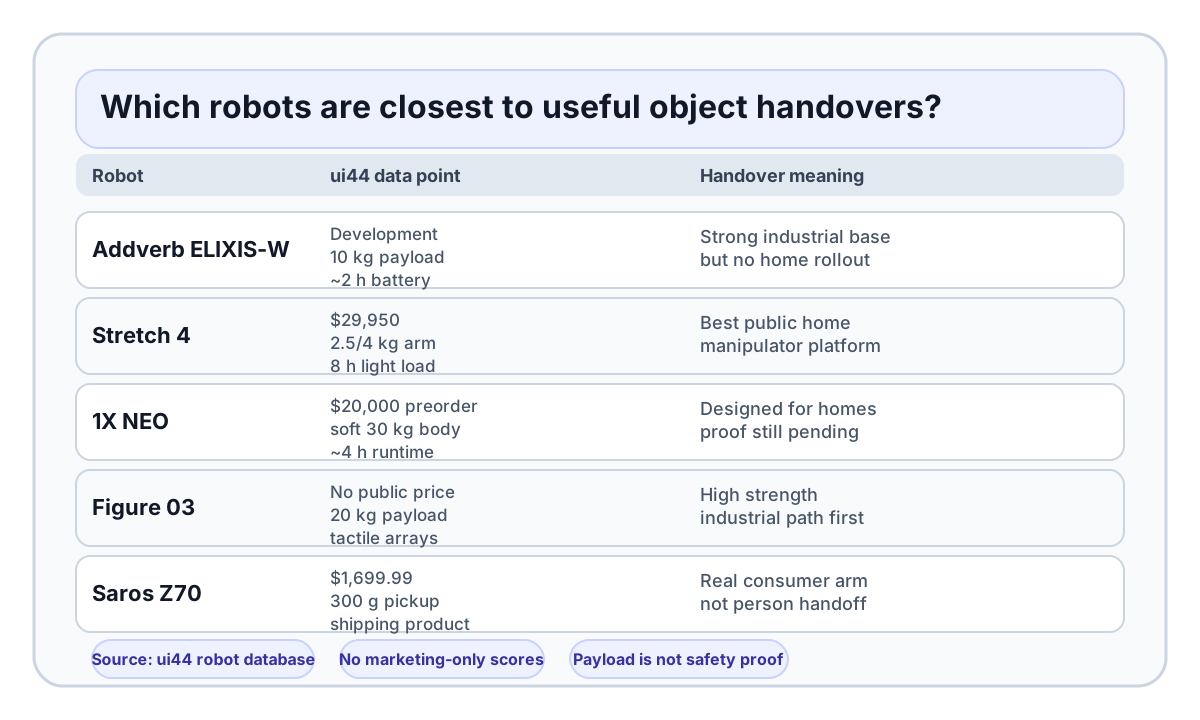
ui44 comparison chart of Addverb ELIXIS-W, Stretch 4, 1X NEO, Figure 03, and Roborock Saros Z70 for home robot object handover readiness
Scroll sideways to inspect the full chart.

Robot

Addverb ELIXIS-W

ui44 data point
Development-stage wheeled humanoid; 10 kg payload; roughly 2-hour battery
What it means for handovers
Strong industrial manipulation platform, and Addverb's research validates handover control on related hardware
Buyer caveat
No public home product, no public price, and no consumer safety record

Robot

Hello Robot Stretch 4

ui44 data point
$29,950; available; 2.5 kg extended / 4 kg retracted arm payload; 8-hour light-load runtime
What it means for handovers
One of the most relevant public platforms for home-like mobile manipulation and assistive pilots
Buyer caveat
Still a research/enterprise/assistive platform, not a mass-market appliance

Robot

1X NEO

ui44 data point
$20,000 preorder; soft 30 kg body; around 4-hour runtime; home-focused design
What it means for handovers
The most explicitly consumer-home humanoid angle in this set
Buyer caveat
Public proof needs to show repeated handovers, not just general chore ambition

Robot

Figure 03

ui44 data point
No public price; 20 kg payload; tactile arrays; Helix vision-language-action (VLA) system
What it means for handovers
Officially home-positioned high-payload humanoid manipulation could support household carrying and passing
Buyer caveat
No public purchase path and no public repeated home-handover proof yet

Robot

Roborock Saros Z70

ui44 data point
$1,699.99; available; OmniGrip arm can pick up items up to 300 g
What it means for handovers
A real shipping consumer product with object pickup, not a lab prototype
Buyer caveat
It moves objects out of the way; it is not designed to hand objects to people

The table shows why "has arms" is too crude. Stretch 4 is not humanoid, but its home-sized footprint, ROS 2/Python stack, depth sensing, floor hazard sensing, and 2.5-4 kg arm rating make it a serious handover-research platform. Roborock Saros Z70 has a much smaller 300 g object limit, but it is actually shipping to consumers. Figure 03 has far more payload on paper and Figure now positions it for homes, but ui44 has no public price, purchase path, or repeated home handover evidence yet.

The best home-handover candidate is not necessarily the strongest robot. It is the robot whose manufacturer can document the object list, payload envelope, approach behavior, release cue, stop behavior, and recovery plan.
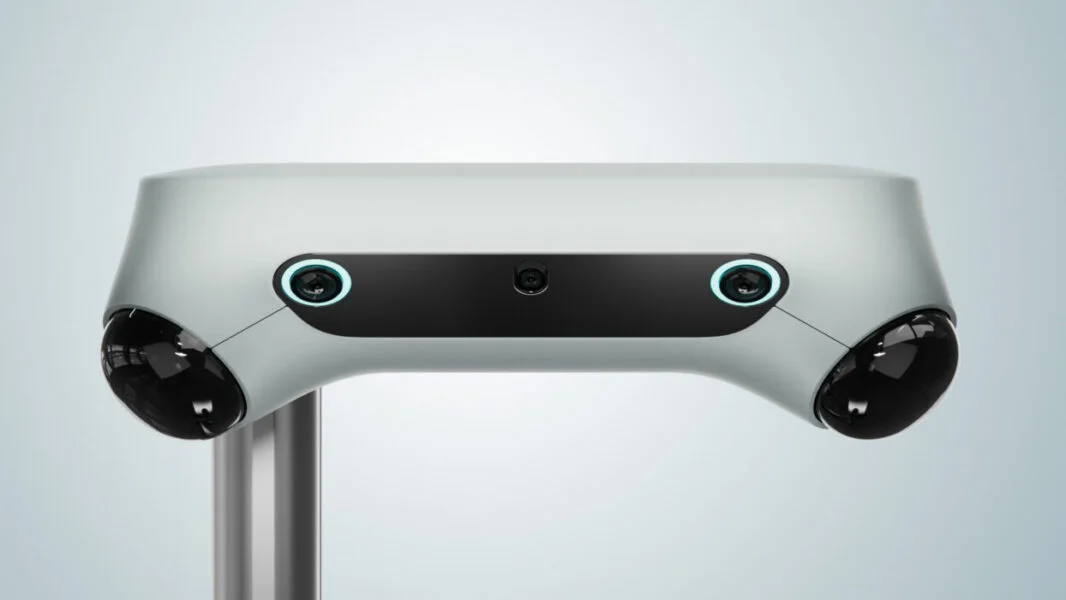
Hello Robot Stretch 4 mobile manipulator showing a home robot platform relevant to safe object handover research

Why payload alone is not enough

Payload is easy to market. Handover safety is harder.

A robot might lift 10 kg, but that does not mean it can safely pass a 1 kg object to a person. Handover quality depends on the full chain: gripper shape, wrist orientation, arm compliance, object detection, release timing, human-intent sensing, and the robot's response when the person hesitates.

Consider three everyday examples:

  • A water bottle needs orientation control so the receiver can grab the body or neck naturally. The robot should not present it cap-first into a palm.
  • A folded towel is deformable. The robot may need to hold it without crushing, dropping, or hiding the grasp point.
  • A medication bottle is light, but the consequence of dropping it or handing it to the wrong person is much higher than the weight suggests.

This is where Addverb's orientation result matters. A geometrically valid pose is not always a functionally valid handover. The object has to arrive in a pose that lets the receiver take it.

The same principle applies to home buyers using the ui44 robot comparison tool. A spec sheet can tell you payload, sensors, price, and status. It cannot by itself tell you whether the robot gracefully handles a person reaching early, pulling late, turning away, or saying "actually, put it on the table."

1X NEO home humanoid robot image representing consumer-home handover ambition and the need for repeated safety proof

What should buyers ask before trusting a handover demo?

A useful handover demo should answer more than "did the robot pass the object once?" Here is the checklist ui44 would use before treating a home handover claim as meaningful.
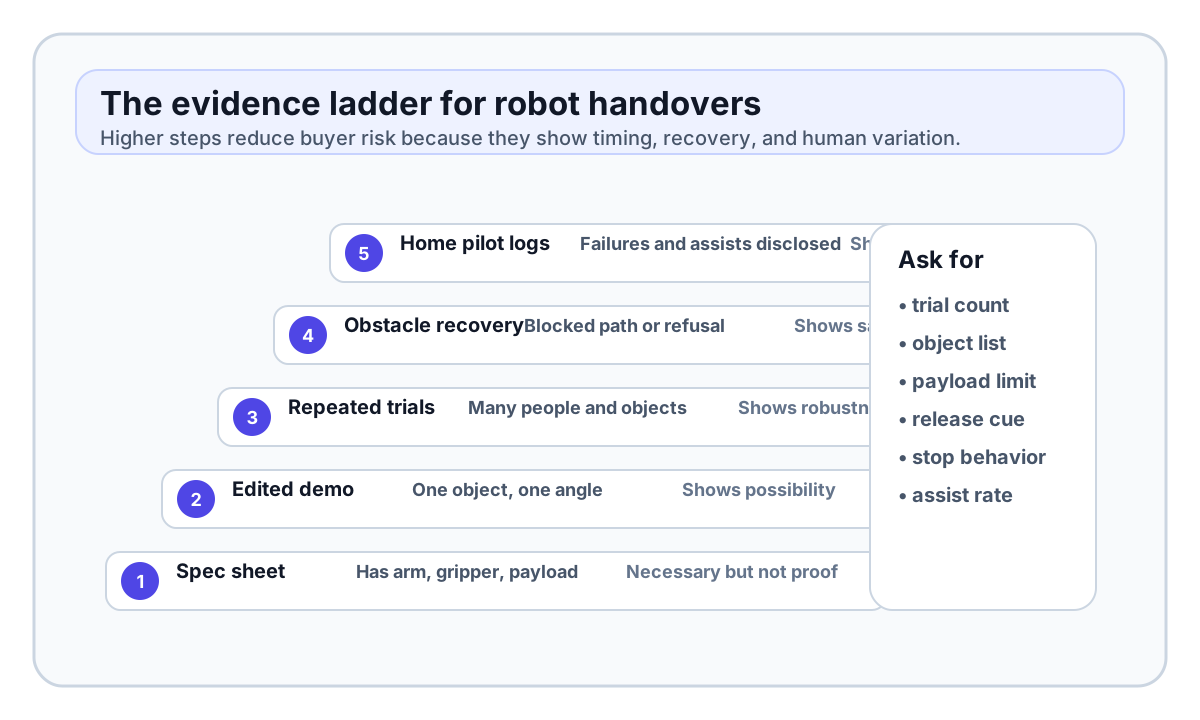
Home robot handover evidence ladder showing spec sheet, edited demo, repeated trials, obstacle recovery, and home pilot logs
Scroll sideways to inspect the full chart.

1. What objects were tested?

A robot passing a rigid box is not the same as passing a soft towel, a slippery bottle, a mug with a handle, a phone, or a pill organizer. Ask for the object list and the failure list. The failure list is often more informative.

2. How many trials were run?

Five successful trials are not enough for a commercial safety claim, but they are better evidence than one cinematic clip. The useful number is success rate across varied people, objects, approach angles, lighting, and clutter.

3. What is the release cue?

Does the robot release when it sees the hand? When it senses pull force? When a voice command is heard? When a button is tapped? If the release cue is vague, the handover is not ready for unsupervised home use.

4. What happens when the person is not ready?

A safe home robot should be able to pause, hold, retract, set the object down, or ask for clarification. "It drops the object" is not recovery. "It waits forever with the arm extended" is not good recovery either.

5. Is the handover bounded by user permissions?

The robot should not hand every object to every person. Medicines, sharp tools, cleaning chemicals, alcohol, and personal items need identity, consent, or at least household rules. This is a product-design issue, not just a manipulation issue.

6. Can the user choose a fixed handoff point?

For early home robots, the safest pattern may be boring: bring the object to a tray, counter edge, table, wheelchair side shelf, or marked handoff zone. Direct hand-to-hand transfers are impressive, but a predictable placement point can be more reliable.

How close are home robots to safe object passing?

Closer than they were, but not close enough to trust the broadest claims without proof.

The encouraging part is that several pieces are now real. Addverb's work shows synchronized handover control on physical hardware. Stretch 4 gives researchers and assistive pilots a home-scale mobile manipulator with serious sensing and a clear payload envelope. 1X NEO is explicitly aimed at homes, and Figure 03 shows how much investment is going into humanoid manipulation. Roborock Saros Z70 proves that a consumer robot can ship with a small arm and object pickup, even if it is not a human-handover device.

The limiting part is that homes are hostile test environments. People sit, turn, hesitate, interrupt, hold pets, use walkers, leave toys on the floor, and ask for objects in awkward places. A robot that can coordinate with another robot arm in a lab still has to earn trust around unpredictable humans.

So the buyer-friendly answer is this: object handovers are a real capability to watch, but they should be treated as a bounded safety claim. Ask for the object list, the trial count, the release cue, the recovery behavior, and the deployment context. If a manufacturer cannot answer those questions, the robot may have an arm — but it has not yet proved it can safely hand you the thing you asked for.

Database context

Use this article as a privacy verification workflow

Turn the article into a real verification pass

Home Robot Handovers: Safe Object Passing Explained already points you toward 5 linked robots, 5 manufacturers, and 3 countries inside the ui44 database. That matters because strong buyer guidance is easier to apply when you can move immediately from a claim or warning into concrete product pages, manufacturer directories, component explainers, and country-level context instead of treating the article as an isolated opinion piece. The fastest next step is to turn the article into a shortlist workflow: open the linked robot pages, verify which specs are actually published for those models, then compare the surrounding manufacturer and component context before you decide whether the underlying claim changes your buying plan.

For this topic, the useful discipline is to separate the editorial lesson from the catalog evidence. The article gives you the framing, but the robot pages tell you what each product actually ships with today: sensor stack, connectivity methods, listed price, release timing, category, and support-relevant compatibility notes. The manufacturer pages then show whether you are looking at a one-off launch, a broader lineup pattern, or a company that spans multiple categories. That layered workflow reduces the risk of buying on a single marketing phrase or a single support FAQ.

Use the robot pages to confirm which products actually expose cameras, microphones, Wi-Fi, or voice systems, then use the manufacturer pages to decide how much of the privacy question seems product-specific versus brand-wide. On this route cluster, ELIXIS-W, Stretch 4, and NEO form the fastest reality check. If you want a quick working shortlist, open Compare ELIXIS-W, Stretch 4, and NEO next, then keep this article open as the reasoning layer while you compare structured data side by side.

Practical Takeaway

Every robot, manufacturer, category, component, and country reference below resolves to a real ui44 page, keeping the follow-up path grounded in database records rather than generic advice.

Suggested next steps in ui44

  1. Open ELIXIS-W and note the listed sensors, connectivity methods, and voice stack before you interpret any policy claim.
  2. Cross-check the wider brand context on Addverb Technologies so you can see whether the privacy question touches one model or a broader lineup.
  3. Use the linked component pages to confirm how common the relevant sensors and connectivity layers are across the database.
  4. Keep a short note of which policy layers you checked, which device features are actually present on the robot page, and which items still depend on region- or app-level confirmation.
  5. Finish with Compare ELIXIS-W, Stretch 4, and NEO so the policy reading sits next to structured product data.

Database context

Robot profiles worth opening next

Use the linked product pages as the evidence layer

The linked robot pages are where this article becomes operational. Instead of asking whether the headline is interesting, use the robot entries to inspect the actual mix of sensors, connectivity options, batteries, pricing, release timing, and stated capabilities attached to the products mentioned in the article. That is the easiest way to see whether the warning or opportunity described here affects one product family, a specific design pattern, or an entire buying lane.

ELIXIS-W

Addverb Technologies · Humanoid · Development

Price TBA

ELIXIS-W is tracked on ui44 as a development humanoid robot from Addverb Technologies. The database currently records a listed price of Price TBA, a release date of 2026-02, Approximately 2 hours battery life, Not officially disclosed charging time, and a published stack that includes Multimodal perception, Stereo depth cameras, and 3D LiDAR plus Not officially disclosed.

For privacy-focused reading, this page matters because it shows the concrete device surface behind the policy discussion. Use it to verify whether ELIXIS-W combines sensors and connectivity in a way that could change the in-home data footprint, and compare the listed capabilities such as Wheeled Humanoid Mobility, Industrial Assistance, and Long-Route Warehouse and Factory Travel with any cloud, app, or voice layers.

Stretch 4

Hello Robot · Home Assistants · Available

$29,950

Stretch 4 is tracked on ui44 as a available home assistants robot from Hello Robot. The database currently records a listed price of $29,950, a release date of 2026-05-12, 8 hours (light CPU load) battery life, Not officially disclosed charging time, and a published stack that includes Wide-FOV depth sensing, High-resolution RGB cameras, and Calibrated RGB + depth perception plus its listed connectivity stack.

For privacy-focused reading, this page matters because it shows the concrete device surface behind the policy discussion. Use it to verify whether Stretch 4 combines sensors and connectivity in a way that could change the in-home data footprint, and compare the listed capabilities such as Mobile Manipulation, Omnidirectional Indoor Mobility, and Autonomous Mapping and Navigation with any cloud, app, or voice layers.

NEO

1X Technologies · Humanoid · Pre-order

$20,000

NEO is tracked on ui44 as a pre-order humanoid robot from 1X Technologies. The database currently records a listed price of $20,000, a release date of 2025-10-28, ~4 hours battery life, Not disclosed charging time, and a published stack that includes RGB Cameras, Depth Sensors, and Tactile Skin plus Wi-Fi and Bluetooth.

For privacy-focused reading, this page matters because it shows the concrete device surface behind the policy discussion. Use it to verify whether NEO combines sensors and connectivity in a way that could change the in-home data footprint, and compare the listed capabilities such as Household Chores, Tidying Up, and Safe Human Interaction with any cloud, app, or voice layers.

Figure 03

Figure AI · Humanoid · Active

Price TBA

Figure 03 is tracked on ui44 as a active humanoid robot from Figure AI. The database currently records a listed price of Price TBA, a release date of 2025-10-09, ~5 hours battery life, Not disclosed charging time, and a published stack that includes Stereo Vision, Depth Cameras, and Force Sensors plus Wi-Fi and Bluetooth.

For privacy-focused reading, this page matters because it shows the concrete device surface behind the policy discussion. Use it to verify whether Figure 03 combines sensors and connectivity in a way that could change the in-home data footprint, and compare the listed capabilities such as Complex Manipulation, Warehouse Work, and Manufacturing Tasks with any cloud, app, or voice layers.

Saros Z70

Roborock · Cleaning · Available

$1,700

Saros Z70 is tracked on ui44 as a available cleaning robot from Roborock. The database currently records a listed price of $1,700, a release date of 2025-05, 6,400 mAh Li-ion; official FAQ says about 2h15+ vacuuming/mopping with the arm disabled, or about 2h10+ with the arm enabled while tidying 10 items (Mop Wash Frequency set to 15 minutes). battery life, 2.5-hour fast charging charging time, and a published stack that includes LiDAR (StarSight 2.0), 3D Structured Light, and RGB Camera plus Wi-Fi and Bluetooth.

For privacy-focused reading, this page matters because it shows the concrete device surface behind the policy discussion. Use it to verify whether Saros Z70 combines sensors and connectivity in a way that could change the in-home data footprint, and compare the listed capabilities such as OmniGrip 5-Axis Mechanical Arm, Object Pickup up to 300 g (socks, sandals, crumpled tissues, towels; more items planned via OTA), and Obstacle Relocation with any cloud, app, or voice layers, including Amazon Alexa and Google Assistant.

Database context

Manufacturer context behind the article

Check whether this is one product story or a broader company pattern

Manufacturer pages add the privacy context that individual product pages cannot show on their own. They help you check whether cameras, microphones, cloud accounts, app controls, and policy assumptions appear across a broader lineup or stay tied to one specific product story.

Addverb Technologies

ui44 currently tracks 1 robot from Addverb Technologies across 1 category. The current catalog footprint on ui44 includes ELIXIS-W.

That wider brand context matters because privacy questions rarely stop at one FAQ page. A manufacturer route helps you see whether the article is centered on one premium model or on a company that has several relevant products and therefore more than one place where the same policy or app assumptions might matter. The category mix here currently points toward Humanoid as the most useful next route if you want to see whether this article reflects a wider pattern inside the brand.

Hello Robot

ui44 currently tracks 2 robots from Hello Robot across 1 category. The company is grouped under USA, and the current catalog footprint on ui44 includes Stretch 3, Stretch 4.

That wider brand context matters because privacy questions rarely stop at one FAQ page. A manufacturer route helps you see whether the article is centered on one premium model or on a company that has several relevant products and therefore more than one place where the same policy or app assumptions might matter. The category mix here currently points toward Home Assistants as the most useful next route if you want to see whether this article reflects a wider pattern inside the brand.

1X Technologies

ui44 currently tracks 2 robots from 1X Technologies across 1 category. The company is grouped under Norway, and the current catalog footprint on ui44 includes NEO, EVE.

That wider brand context matters because privacy questions rarely stop at one FAQ page. A manufacturer route helps you see whether the article is centered on one premium model or on a company that has several relevant products and therefore more than one place where the same policy or app assumptions might matter. The category mix here currently points toward Humanoid as the most useful next route if you want to see whether this article reflects a wider pattern inside the brand.

Figure AI

ui44 currently tracks 2 robots from Figure AI across 1 category. The company is grouped under USA, and the current catalog footprint on ui44 includes Figure 03, Figure 02.

That wider brand context matters because privacy questions rarely stop at one FAQ page. A manufacturer route helps you see whether the article is centered on one premium model or on a company that has several relevant products and therefore more than one place where the same policy or app assumptions might matter. The category mix here currently points toward Humanoid as the most useful next route if you want to see whether this article reflects a wider pattern inside the brand.

Database context

Broaden the scan without leaving the database

Categories, components, and countries add the wider context

Category framing

Category pages are useful when the article touches a buying pattern that shows up across brands. A category route helps you confirm whether the linked products sit in a narrow niche or whether the same question should be tested across a larger field of alternatives.

Humanoid

The Humanoid category page currently groups 96 tracked robots from 68 manufacturers. ui44 describes this lane as: Full-size bipedal humanoid robots designed to work alongside humans. From factory floors to household tasks, these machines represent the cutting edge of robotics.

That makes the category route a practical follow-up when you want to check whether the products linked in this article are typical for the lane or whether they sit at one edge of the market. Useful starting examples currently include NEO, EVE, Mornine M1.

Home Assistants

The Home Assistants category page currently groups 15 tracked robots from 14 manufacturers. ui44 describes this lane as: Arm-based household helpers — laundry folders, kitchen robots, and mobile manipulators that handle physical tasks at home.

That makes the category route a practical follow-up when you want to check whether the products linked in this article are typical for the lane or whether they sit at one edge of the market. Useful starting examples currently include Robody, Futuring 2 (F2), Stretch 3.

Country and ecosystem context

Country pages give extra context when support practices, launch sequencing, regulatory posture, or manufacturer mix matter. They are not a substitute for model-level verification, but they do help you see which ecosystems cluster together and which manufacturers sit in the same regional field when you broaden the search beyond the article headline.

USA

The USA route currently groups 19 tracked robots from 13 manufacturers in ui44. That gives you a useful regional lens when the article points toward support practices, launch sequencing, or brand clusters that may share similar ecosystem assumptions.

On the current route, manufacturers like Boston Dynamics, Figure AI, Hello Robot make the page a good way to broaden the scan without losing the regional context that often shapes availability, documentation style, and adjacent alternatives.

Norway

The Norway route currently groups 2 tracked robots from 1 manufacturers in ui44. That gives you a useful regional lens when the article points toward support practices, launch sequencing, or brand clusters that may share similar ecosystem assumptions.

On the current route, manufacturers like 1X Technologies make the page a good way to broaden the scan without losing the regional context that often shapes availability, documentation style, and adjacent alternatives.

China

The China route currently groups 60 tracked robots from 15 manufacturers in ui44. That gives you a useful regional lens when the article points toward support practices, launch sequencing, or brand clusters that may share similar ecosystem assumptions.

On the current route, manufacturers like AGIBOT, Unitree Robotics, Pudu Robotics make the page a good way to broaden the scan without losing the regional context that often shapes availability, documentation style, and adjacent alternatives.

Database context

Questions to answer before you move from reading to buying

A follow-up FAQ built from the entities already linked in this article

Frequently Asked Questions

Which page should I open first after reading “Home Robot Handovers: Safe Object Passing Explained”?

Start with ELIXIS-W. That gives you a concrete product anchor for the article’s main claim. From there, branch into the manufacturer and component pages so you can tell whether the article is describing one specific model, a repeated brand pattern, or a wider technology issue that affects multiple shortlist options.

How do the manufacturer pages change the buying decision?

Addverb Technologies help you zoom out from one article and one product. On ui44 they show lineup breadth, category spread, and the neighboring robots tied to the same company. That context is useful when you are deciding whether a risk belongs to a single model, whether it shows up across a brand’s portfolio, and whether you should keep looking at alternatives before committing.

When should I switch from reading to side-by-side comparison?

Move into Compare ELIXIS-W, Stretch 4, and NEO as soon as you understand the article’s main warning or promise. The article explains what to watch for, but the compare view is where you can check whether price, status, battery life, connectivity, sensors, and category fit still make the robot a good match for your own home and budget.

Database context

Where to go next in ui44

Keep the research chain inside the database

If you want to keep going, these follow-on pages give you the cleanest expansion path from article to research session. Open the comparison route first if you are deciding between products today. Open the manufacturer, category, and component routes if you still need to understand the broader pattern behind the claim.

UT

Written by

ui44 Team

Published May 28, 2026

Share this article

Open a plain share link on X or Bluesky. No embeds, no widgets, no cookie baggage.

Explore the database

Go beyond the headlines

Compare specs, features, and prices across 100+ robots from leading manufacturers worldwide.