The short answer is yes: a home robot can be hacked, just like any connected computer. The more useful buyer question is what evidence a manufacturer gives you that it has designed, tested, and maintained the robot as a secure physical machine, not just as an app-controlled gadget.
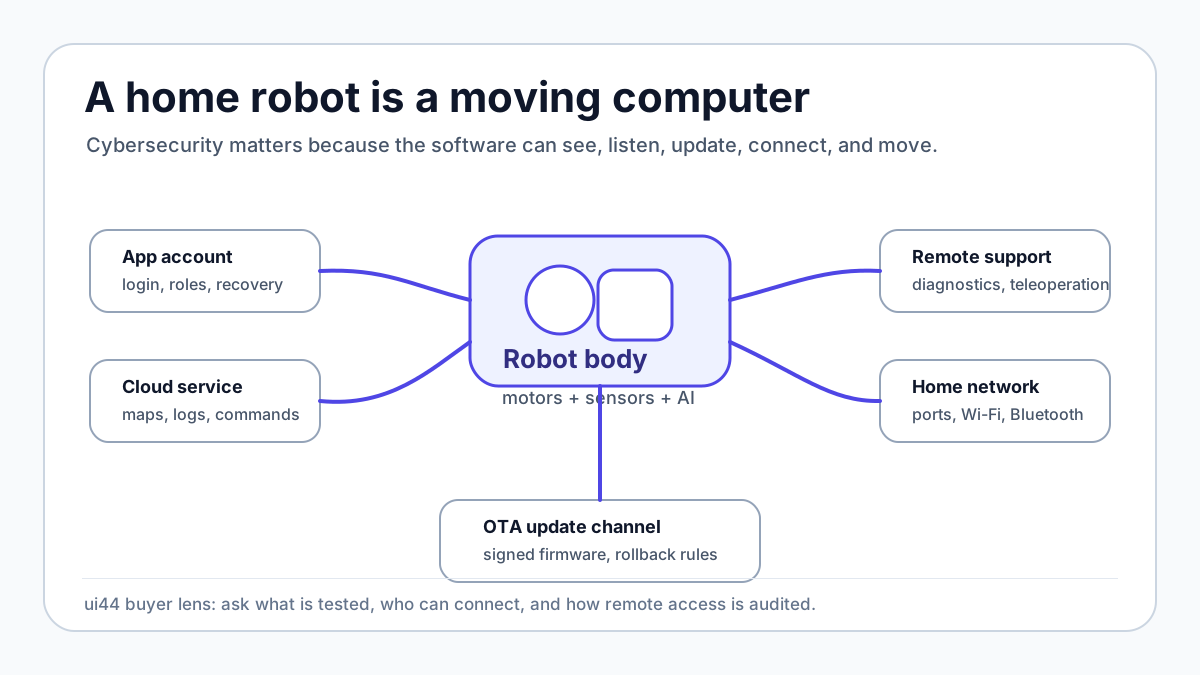
A May 2026 certification story makes that shift visible. SGS says DOBOT's CR 30H collaborative-robot series achieved compliance with the cybersecurity requirements of ISO 10218-1:2025, covering threat modeling, access control, secure communication, configuration protection, port and interface management, and secure software updates. That is an industrial robot, not a household companion. But it is exactly the kind of specific checklist home-robot buyers will soon need.
Why is robot cybersecurity different from smart-home privacy?
Privacy asks what a robot records, where the data goes, how long it is kept, and who can see it. Cybersecurity asks a more physical question: who can make the robot do something?
That distinction matters. A hacked smart speaker is bad. A hacked robot that can move, see, listen, unlock a remote support tunnel, receive firmware, or operate a blade is a different category of risk.
The recent Yarbo incident is the clearest consumer-facing warning sign. The Verge reported that security researcher Andreas Makris found severe weaknesses in Yarbo's modular yard robots, including remote-control paths, camera access, GPS locations, Wi-Fi credentials, and shared root-password problems. Yarbo's own security response confirmed serious issues in remote diagnostics, credential management, and data handling, then promised changes such as device-level credentials, tighter permissions, audit logging, and user-authorized remote diagnostics.
That is not a reason to assume every robot is unsafe. It is a reason to stop treating cybersecurity as a vague trust claim. If a robot has remote access, software updates, cloud commands, and a physical body, buyers should expect the same kind of evidence they would ask for on reliability or safety.
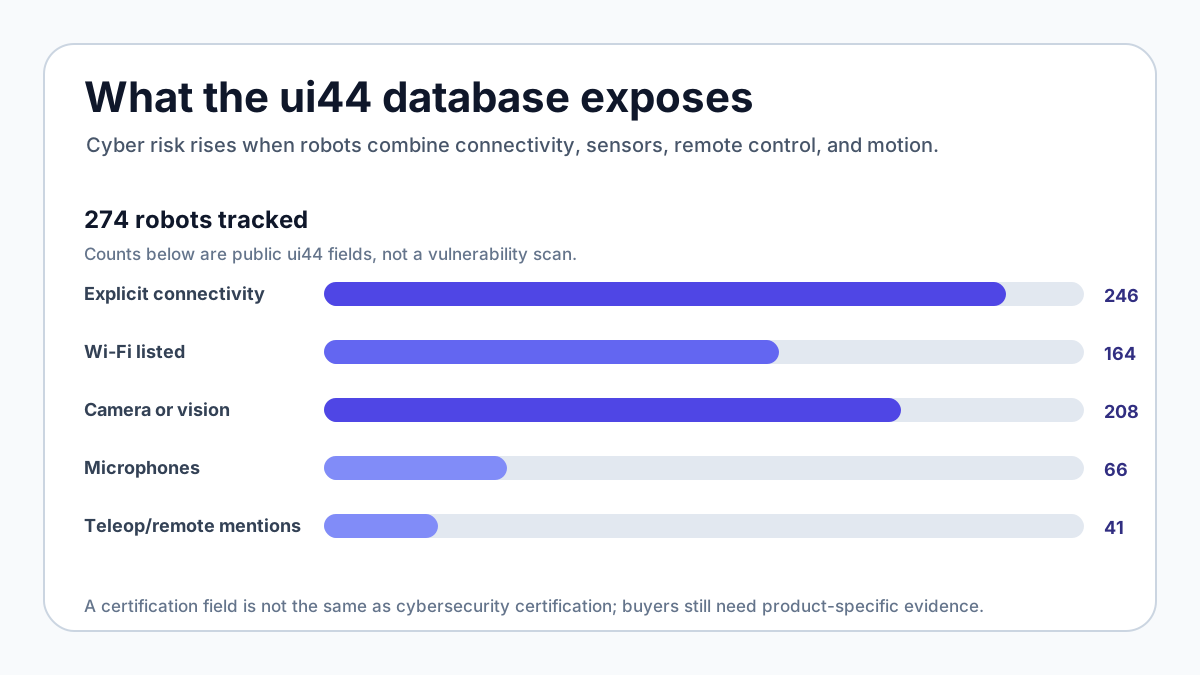
ui44's database shows why this is becoming a mainstream issue. We currently track 274 robots. Of those, 246 have explicit connectivity entries, including 164 with Wi-Fi, 79 with Bluetooth, and 42 with Ethernet. Using specs.sensors only, 208 records mention camera or vision sensors and 66 mention microphones or mics. Exact teleoperation or remote-control wording appears in 41 records. These are not vulnerability findings. They are a documented map of where trust has to be earned.
What ISO 10218-1:2025 does, and does not, prove
The SGS/DOBOT news is useful because it names concrete controls instead of saying only "secure" or "trusted." SGS says its cybersecurity assessment covered:
- threat modeling and risk assessment
- access control and identity authentication
- secure communication protocols
- configuration protection
- port and interface management
- secure software updates
That list maps directly to home robots. A buyer does not need to read a full industrial-robot standard to understand the practical questions: Can one stolen credential reach a whole fleet? Can remote support be turned on without the owner? Are firmware updates signed? Are open ports justified? Are camera feeds protected? Is there an incident-response channel?
But ISO 10218-1 is not a home-robot certification. ISO's public scope page says the standard is for industrial robots and explicitly excludes consumer products, service robots where the public can have access, healthcare robots, medical robots, and people-lifting robots. In other words, a factory-cobot compliance signal should not be copy-pasted onto a kitchen, bedroom, school, or elder-care setting.
That limitation is not a flaw. It is the point. Industrial robotics is already learning that cybersecurity belongs inside safety engineering. Home robotics is next, but the domestic version needs to account for children, guests, pets, shared Wi-Fi, family accounts, app permissions, cloud outages, remote helpers, and owners who are not trained integrators.

DOBOT is a good example of the blurred frontier. ui44 tracks DOBOT Atom as an available humanoid platform with binocular RGB vision, an Intel RealSense D455 depth camera, 360° LiDAR, Ethernet connectivity, and Transformer-based ROM-1 embodied AI claims. ui44's database still carries a $79,000 price estimate, but DOBOT no longer lists that price on the official product page, so buyers should treat it as unverified. The SGS certificate was for DOBOT's CR 30H collaborative robots, not Atom. Still, a manufacturer selling both connected industrial robots and humanoid platforms gives buyers a useful signal: cybersecurity evidence can become part of robotics go-to-market, not just a buried engineering concern.
The buyer checklist: seven questions that matter
How to compare robots in the ui44 database
Cybersecurity is not yet a neatly comparable spec like height or price. Still, you can use the database to spot risk questions before buying.
Start with the robot's category pages and individual robot pages:
Robot
- Public ui44 data point
- Lawn-and-garden robot; Wi-Fi, Bluetooth, HaLow, optional 4G; 40 kg core; modular mower/snow/yard use
- Security question to ask
- Can owners disable or audit remote diagnostics, and how are device credentials rotated?
Robot
- Public ui44 data point
- $13,500 available humanoid; Wi-Fi 6, Bluetooth 5.2, cameras/LiDAR/microphones, OTA upgrades
- Security question to ask
- Are updates signed, and what security evidence exists for individual/home buyers?
Robot
- Public ui44 data point
- $4,900 preorder humanoid; Wi-Fi, Bluetooth, voice/image interaction, OTA updates
- Security question to ask
- How are voice/image commands authenticated and separated from motion control?
Robot
- Public ui44 data point
- $20,000 home-focused preorder; cameras, depth sensors, tactile skin, microphones
- Security question to ask
- What data stays on-device, what leaves home, and when can a remote human assist?
Robot
- Public ui44 data point
- $24,950 mobile manipulator; Wi-Fi, Ethernet, USB, ROS 2, web/gamepad/dexterous teleop
- Security question to ask
- Is teleoperation intentionally exposed, authenticated, logged, and segmented by role?
Robot
- Public ui44 data point
- $999 companion robot; 4K camera, far-field mics, Wi-Fi, Alexa, GPT-4o mini integration
- Security question to ask
- What camera/mic data is retained, who can access it, and how are cloud tokens protected?
| Robot | Public ui44 data point | Security question to ask |
|---|---|---|
| Yarbo M | Lawn-and-garden robot; Wi-Fi, Bluetooth, HaLow, optional 4G; 40 kg core; modular mower/snow/yard use | Can owners disable or audit remote diagnostics, and how are device credentials rotated? |
| Unitree G1 | $13,500 available humanoid; Wi-Fi 6, Bluetooth 5.2, cameras/LiDAR/microphones, OTA upgrades | Are updates signed, and what security evidence exists for individual/home buyers? |
| Unitree R1 | $4,900 preorder humanoid; Wi-Fi, Bluetooth, voice/image interaction, OTA updates | How are voice/image commands authenticated and separated from motion control? |
| 1X NEO | $20,000 home-focused preorder; cameras, depth sensors, tactile skin, microphones | What data stays on-device, what leaves home, and when can a remote human assist? |
| Hello Robot Stretch 3 | $24,950 mobile manipulator; Wi-Fi, Ethernet, USB, ROS 2, web/gamepad/dexterous teleop | Is teleoperation intentionally exposed, authenticated, logged, and segmented by role? |
| Enabot EBO X | $999 companion robot; 4K camera, far-field mics, Wi-Fi, Alexa, GPT-4o mini integration | What camera/mic data is retained, who can access it, and how are cloud tokens protected? |
The point is not to rank these robots from safe to unsafe. ui44's public data is not a penetration test. The point is to turn a vague anxiety into specific buyer questions. A robot with no public cybersecurity answer may still be well engineered. But a manufacturer that can explain its architecture, update process, remote-access policy, and response channel deserves more trust than one that only says "secure."
What would a good home-robot security label say?
A useful future label for home robots would probably combine three layers:
- Mechanical safety: stopping distance, force limits, falls, pinch points, blades, no-go zones, child and pet behavior.
- Cybersecurity: credentials, update signing, secure communication, port management, remote access, audit logs, vulnerability response.
- Data governance: camera/microphone handling, map retention, cloud vs on-device processing, human review, deletion, account controls.
That is why cybersecurity belongs next to independent humanoid safety ratings, not in a separate IT-only bucket. A home robot's security failure can become a privacy failure, a safety failure, or a trust failure depending on what the robot can do.
Bottom line
Do not buy a connected home robot only because it says it uses AI, computer vision, or encrypted cloud services. Ask what is tested.
A serious manufacturer should be able to answer: who can connect to the robot, how updates are protected, whether remote support is opt-in and audited, how credentials are managed, what happens after a vulnerability report, and whether any independent lab has checked the product.
The SGS/DOBOT ISO 10218-1:2025 cybersecurity signal does not certify your next home humanoid. The Yarbo incident does not prove every home robot is dangerous. Together, they show where the market is heading: the next generation of home robot buying guides will need to compare security evidence with the same care we already apply to price, battery life, sensors, and manipulation.
If a robot can move through your home, cybersecurity is part of the product.
Related in the database
Use this article as a privacy verification workflow
Turn the article into a privacy verification pass grounded in the robots, manufacturers, and components it actually references.
Home Robot Cybersecurity: Buyer Checklist already points you toward 7 linked robots, 7 manufacturers, and 3 countries inside the ui44 database. That matters because strong buyer guidance is easier to apply when you can move immediately from a claim or warning into concrete product pages, manufacturer directories, component explainers, and country-level context instead of treating the article as an isolated opinion piece. The fastest next step is to turn the article into a shortlist workflow: open the linked robot pages, verify which specs are actually published for those models, then compare the surrounding manufacturer and component context before you decide whether the underlying claim changes your buying plan.
For this topic, the useful discipline is to separate the editorial lesson from the catalog evidence. The article gives you the framing, but the robot pages tell you what each product actually ships with today: sensor stack, connectivity methods, listed price, release timing, category, and support-relevant compatibility notes. The manufacturer pages then show whether you are looking at a one-off launch, a broader lineup pattern, or a company that spans multiple categories. That layered workflow reduces the risk of buying on a single marketing phrase or a single support FAQ.
Use the robot pages to confirm which products actually expose cameras, microphones, Wi-Fi, or voice systems, then use the manufacturer pages to decide how much of the privacy question seems product-specific versus brand-wide. On this route cluster, DOBOT Atom, G1, and R1 form the fastest reality check. If you want a quick working shortlist, open Compare DOBOT Atom, G1, and R1 next, then keep this article open as the reasoning layer while you compare structured data side by side.
Practical Takeaway
Every robot, manufacturer, category, component, and country reference below resolves to a real ui44 page, keeping the follow-up path grounded in database records rather than generic advice.
Suggested next steps in ui44
- Open DOBOT Atom and note the listed sensors, connectivity methods, and voice stack before you interpret any policy claim.
- Cross-check the wider brand context on DOBOT so you can see whether the privacy question touches one model or a broader lineup.
- Use the linked component pages to confirm how common the relevant sensors and connectivity layers are across the database.
- Keep a short note of which policy layers you checked, which device features are actually present on the robot page, and which items still depend on region- or app-level confirmation.
- Finish with Compare DOBOT Atom, G1, and R1 so the policy reading sits next to structured product data.
Robot profiles worth opening next
Use the linked product pages as the evidence layer
The linked robot pages are where this article becomes operational. Instead of asking whether the headline is interesting, use the robot entries to inspect the actual mix of sensors, connectivity options, batteries, pricing, release timing, and stated capabilities attached to the products mentioned in the article. That is the easiest way to see whether the warning or opportunity described here affects one product family, a specific design pattern, or an entire buying lane.
DOBOT Atom
DOBOT · Humanoid · Available
DOBOT Atom is tracked on ui44 as a available humanoid robot from DOBOT. The database currently records a listed price of $79,000, a release date of 2025-06, Not publicly disclosed battery life, Not publicly disclosed charging time, and a published stack that includes Binocular RGB Vision, Intel RealSense D455 Depth Camera, and 360° LiDAR plus Ethernet.
For privacy-focused reading, this page matters because it shows the concrete device surface behind the policy discussion. Use it to verify whether DOBOT Atom combines sensors and connectivity in a way that could change the in-home data footprint, and compare the listed capabilities such as 28 upper-body degrees of freedom (DoF), ±0.05 mm manipulation precision, and Straight-knee walking with any cloud, app, or voice layers.
G1 is tracked on ui44 as a available humanoid robot from Unitree. The database currently records a listed price of $13,500, a release date of 2024-05-13, ~2 hours battery life, Not disclosed charging time, and a published stack that includes Depth Camera, 3D LiDAR, and 4 Microphone Array plus Wi-Fi 6 and Bluetooth 5.2.
For privacy-focused reading, this page matters because it shows the concrete device surface behind the policy discussion. Use it to verify whether G1 combines sensors and connectivity in a way that could change the in-home data footprint, and compare the listed capabilities such as Bipedal Walking, Object Manipulation, and Dexterous Hands (optional Dex3-1) with any cloud, app, or voice layers.
R1
Unitree Robotics · Humanoid · Pre-order
R1 is tracked on ui44 as a pre-order humanoid robot from Unitree Robotics. The database currently records a listed price of $4,900, a release date of 2025, ~1 hour (mixed activity) battery life, Not officially disclosed charging time, and a published stack that includes Monocular camera (R1 Air); binocular camera (R1/R1 EDU), 4-Mic Array, and Dual 6-Axis IMU plus Wi-Fi 6 and Bluetooth 5.2.
For privacy-focused reading, this page matters because it shows the concrete device surface behind the policy discussion. Use it to verify whether R1 combines sensors and connectivity in a way that could change the in-home data footprint, and compare the listed capabilities such as Bipedal Walking & Running, Cartwheels & Handstands, and Push Recovery with any cloud, app, or voice layers, including UnifoLM (voice + image commands).
Stretch 3
Hello Robot · Home Assistants · Active
Stretch 3 is tracked on ui44 as a active home assistants robot from Hello Robot. The database currently records a listed price of $24,950, a release date of 2024, 2–5 hours battery life, Not disclosed charging time, and a published stack that includes Intel D405 RGBD Camera (gripper), Intel D435if RGBD Camera (head), and Wide-Angle RGB Camera (head) plus Wi-Fi 6E and Bluetooth.
For privacy-focused reading, this page matters because it shows the concrete device surface behind the policy discussion. Use it to verify whether Stretch 3 combines sensors and connectivity in a way that could change the in-home data footprint, and compare the listed capabilities such as Mobile Manipulation, Autonomous Navigation, and Teleoperation (Web / Gamepad / Dexterous) with any cloud, app, or voice layers.
NEO
1X Technologies · Humanoid · Pre-order
NEO is tracked on ui44 as a pre-order humanoid robot from 1X Technologies. The database currently records a listed price of $20,000, a release date of 2025-10-28, ~4 hours battery life, Not disclosed charging time, and a published stack that includes RGB Cameras, Depth Sensors, and Tactile Skin plus Wi-Fi and Bluetooth.
For privacy-focused reading, this page matters because it shows the concrete device surface behind the policy discussion. Use it to verify whether NEO combines sensors and connectivity in a way that could change the in-home data footprint, and compare the listed capabilities such as Household Chores, Tidying Up, and Safe Human Interaction with any cloud, app, or voice layers.
Manufacturer context behind the article
Check whether this is one product story or a broader company pattern
Manufacturer pages add the privacy context that individual product pages cannot show on their own. They help you check whether cameras, microphones, cloud accounts, app controls, and policy assumptions appear across a broader lineup or stay tied to one specific product story.
DOBOT
ui44 currently tracks 2 robots from DOBOT across 2 categorys. The company is grouped under China, and the current catalog footprint on ui44 includes DOBOT Atom, Rover X1.
That wider brand context matters because privacy questions rarely stop at one FAQ page. A manufacturer route helps you see whether the article is centered on one premium model or on a company that has several relevant products and therefore more than one place where the same policy or app assumptions might matter. The category mix here currently points toward Humanoid, Quadruped as the most useful next route if you want to see whether this article reflects a wider pattern inside the brand.
Unitree
ui44 currently tracks 2 robots from Unitree across 1 category. The company is grouped under China, and the current catalog footprint on ui44 includes H1, G1.
That wider brand context matters because privacy questions rarely stop at one FAQ page. A manufacturer route helps you see whether the article is centered on one premium model or on a company that has several relevant products and therefore more than one place where the same policy or app assumptions might matter. The category mix here currently points toward Humanoid as the most useful next route if you want to see whether this article reflects a wider pattern inside the brand.
Unitree Robotics
ui44 currently tracks 9 robots from Unitree Robotics across 3 categorys. The company is grouped under China, and the current catalog footprint on ui44 includes B2, B1, Go2.
That wider brand context matters because privacy questions rarely stop at one FAQ page. A manufacturer route helps you see whether the article is centered on one premium model or on a company that has several relevant products and therefore more than one place where the same policy or app assumptions might matter. The category mix here currently points toward Quadruped, Humanoid, Research as the most useful next route if you want to see whether this article reflects a wider pattern inside the brand.
Hello Robot
ui44 currently tracks 2 robots from Hello Robot across 1 category. The company is grouped under USA, and the current catalog footprint on ui44 includes Stretch 3, Stretch 4.
That wider brand context matters because privacy questions rarely stop at one FAQ page. A manufacturer route helps you see whether the article is centered on one premium model or on a company that has several relevant products and therefore more than one place where the same policy or app assumptions might matter. The category mix here currently points toward Home Assistants as the most useful next route if you want to see whether this article reflects a wider pattern inside the brand.
Broaden the scan without leaving the database
Categories, components, and countries add the wider context
Category framing
Category pages are useful when the article touches a buying pattern that shows up across brands. A category route helps you confirm whether the linked products sit in a narrow niche or whether the same question should be tested across a larger field of alternatives.
Humanoid
The Humanoid category page currently groups 129 tracked robots from 92 manufacturers. ui44 describes this lane as: Full-size bipedal humanoid robots built to work alongside people — from factory floors to household tasks. Compare the cutting edge of humanoid robotics.
That makes the category route a practical follow-up when you want to check whether the products linked in this article are typical for the lane or whether they sit at one edge of the market. Useful starting examples currently include NEO, EVE, Mornine M1.
Home Assistants
The Home Assistants category page currently groups 16 tracked robots from 14 manufacturers. ui44 describes this lane as: Arm-based household helpers — laundry folders, kitchen robots, and mobile manipulators that take on hands-on physical tasks around the home.
That makes the category route a practical follow-up when you want to check whether the products linked in this article are typical for the lane or whether they sit at one edge of the market. Useful starting examples currently include Robody, Futuring 2 (F2), Stretch 3.
Country and ecosystem context
Country pages give extra context when support practices, launch sequencing, regulatory posture, or manufacturer mix matter. They are not a substitute for model-level verification, but they do help you see which ecosystems cluster together and which manufacturers sit in the same regional field when you broaden the search beyond the article headline.
China
The China route currently groups 189 tracked robots from 87 manufacturers in ui44. That gives you a useful regional lens when the article points toward support practices, launch sequencing, or brand clusters that may share similar ecosystem assumptions.
On the current route, manufacturers like AGIBOT, Dreame, Unitree Robotics make the page a good way to broaden the scan without losing the regional context that often shapes availability, documentation style, and adjacent alternatives.
USA
The USA route currently groups 89 tracked robots from 69 manufacturers in ui44. That gives you a useful regional lens when the article points toward support practices, launch sequencing, or brand clusters that may share similar ecosystem assumptions.
On the current route, manufacturers like Faraday Future, iRobot, Boston Dynamics make the page a good way to broaden the scan without losing the regional context that often shapes availability, documentation style, and adjacent alternatives.
Norway
The Norway route currently groups 2 tracked robots from 1 manufacturers in ui44. That gives you a useful regional lens when the article points toward support practices, launch sequencing, or brand clusters that may share similar ecosystem assumptions.
On the current route, manufacturers like 1X Technologies make the page a good way to broaden the scan without losing the regional context that often shapes availability, documentation style, and adjacent alternatives.
Questions to answer before you move from reading to buying
A follow-up FAQ built from the entities already linked in this article
Frequently Asked Questions
Which page should I open first after reading “Home Robot Cybersecurity: Buyer Checklist”?
Start with DOBOT Atom. That gives you a concrete product anchor for the article’s main claim. From there, branch into the manufacturer and component pages so you can tell whether the article is describing one specific model, a repeated brand pattern, or a wider technology issue that affects multiple shortlist options.
How do the manufacturer pages change the buying decision?
DOBOT help you zoom out from one article and one product. On ui44 they show lineup breadth, category spread, and the neighboring robots tied to the same company. That context is useful when you are deciding whether a risk belongs to a single model, whether it shows up across a brand’s portfolio, and whether you should keep looking at alternatives before committing.
When should I switch from reading to side-by-side comparison?
Move into Compare DOBOT Atom, G1, and R1 as soon as you understand the article’s main warning or promise. The article explains what to watch for, but the compare view is where you can check whether price, status, battery life, connectivity, sensors, and category fit still make the robot a good match for your own home and budget.
Where to go next in ui44
Keep the research chain inside the database
If you want to keep going, these follow-on pages give you the cleanest expansion path from article to research session. Open the comparison route first if you are deciding between products today. Open the manufacturer, category, and component routes if you still need to understand the broader pattern behind the claim.
Written by
ui44 Team
Published May 12, 2026
Share this article
Open a plain share link on X or Bluesky. No embeds, no widgets, no cookie baggage.