That is not because legs are useless. A bipedal robot still makes the cleanest long-term promise: use the same stairs, doorways, cabinets, and room layouts that humans already use. But in 2026, many of the most credible home-robot designs are quietly moving in a different direction. They use wheels, or at least wheel-like hybrid postures, because stability, safety, runtime, and cost still matter more than looking fully human.
ui44's database makes that trade-off easier to see. UniX AI's Panther is a full-size household robot built around an omnidirectional four-wheel chassis. LG's CLOiD uses a wheeled base and two 7-degree-of-freedom arms instead of bipedal legs. GAC's GoMate splits the difference with a variable wheel-leg platform. On the other side, 1X NEO, Unitree G1, and Figure 03 still bet on the classic humanoid form.
The honest answer is simple. For single-level homes and appliance-centered chores, wheels look more credible today. For stairs, irregular room-to-room movement, and the long-term dream of a robot that can truly use a human house as built, bipedal designs still have the higher ceiling. The market is not really choosing between cool and uncool. It is choosing between what is easier to ship now and what might matter more later.
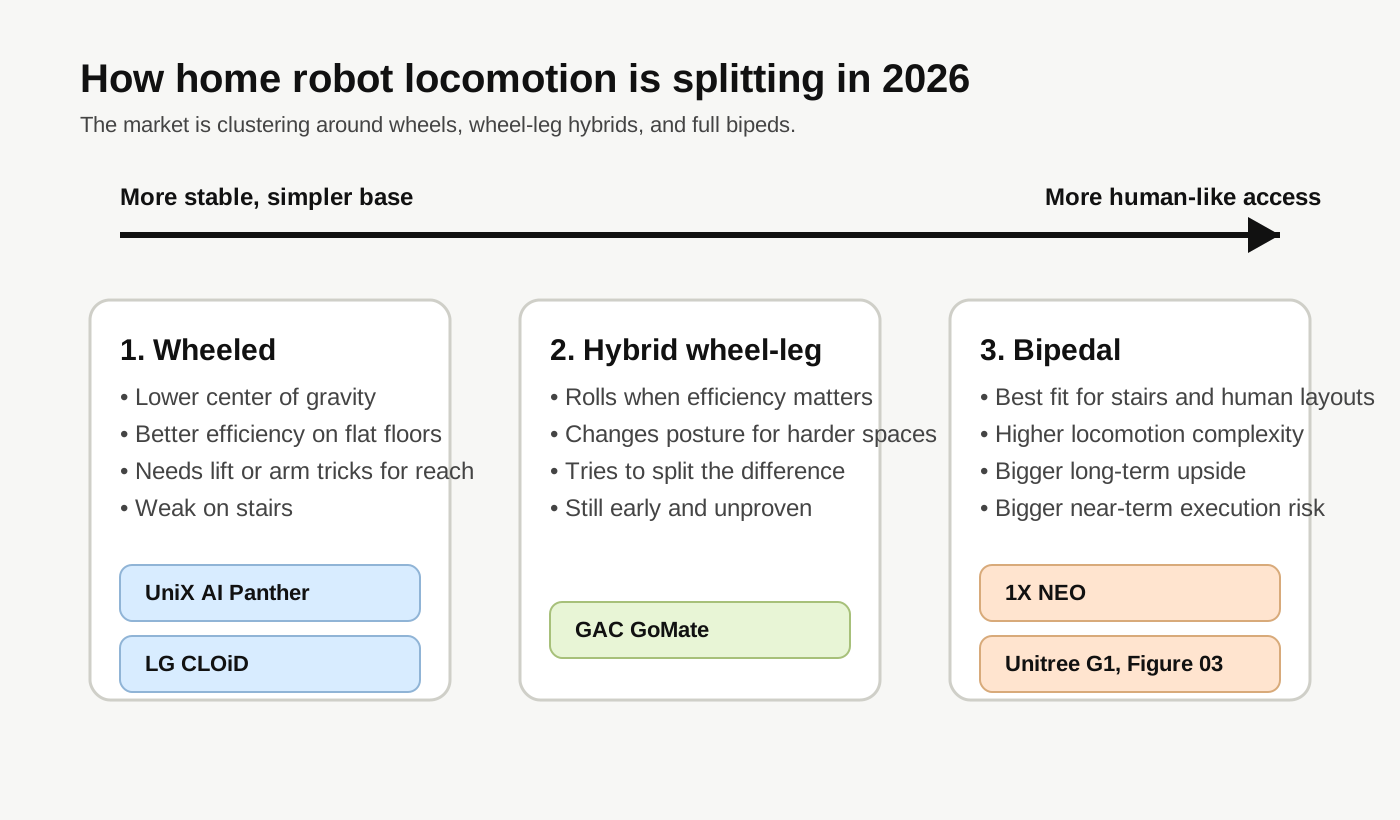
Why are some home robot makers choosing wheels on purpose?
Because a home robot does not actually need to walk like a person to be useful.
LG says it chose a wheeled base for CLOiD because it is more stable, safer, and more cost-effective, with a lower center of gravity if a child or pet bumps into it. That is a very different design philosophy from the viral-humanoid playbook. It treats the home as a safety-critical environment first, not a stage for human imitation.
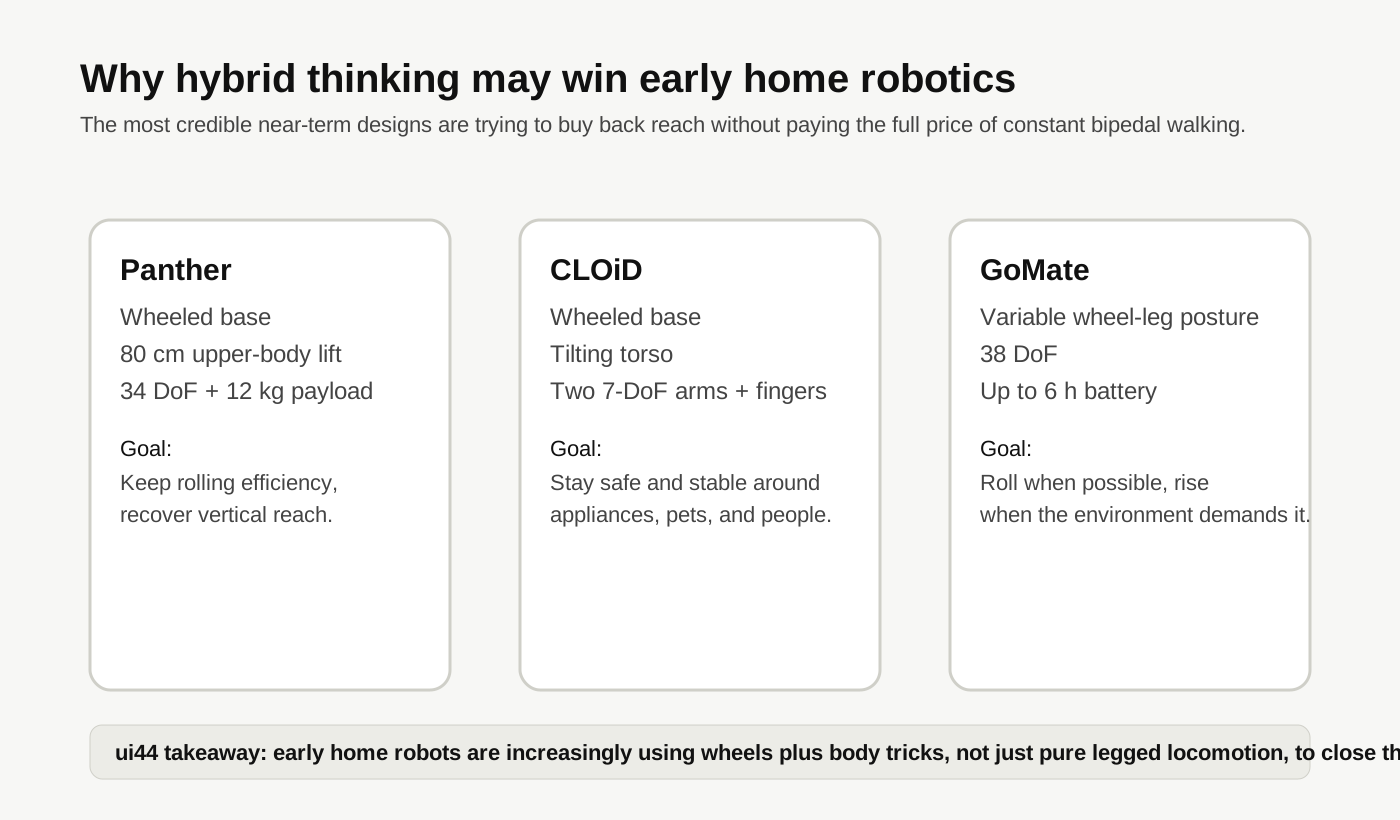
Panther pushes the same logic harder. According to UniX AI's official materials, it pairs an omnidirectional four-wheel chassis with an 80 cm upper-body lift, 34 joints, and up to 12 kg dual-arm payload. In plain English, the company is saying this: let the base handle mobility efficiently, then use the upper body for reach and manipulation.
That is not a crazy compromise. A lot of home chores happen on one floor and near fixed zones anyway: kitchen counters, tables, couches, laundry machines, and storage shelves. Wheels are often enough if the robot can raise, tilt, and reach well once it gets there. The question is not "can this robot run up stairs?" nearly as often as "can it safely move around furniture, stop in tight spaces, carry something without wobbling, and work for more than a short demo?"
There is also a buyer-trust angle here. In an IEEE Spectrum survey of 76 people in the U.S. and U.K., participants generally preferred special-purpose robots over humanoids because they felt safer, more private, and more comfortable in the home. That does not prove wheels will win. But it does suggest that the market may reward practical form factors before it rewards the most humanlike ones.
If you want the short version, wheels are showing up because they lower the engineering burden in exactly the areas home robots still struggle with most: stability, safety, battery efficiency, and real-world reliability.
ui44's current database shows three different locomotion bets
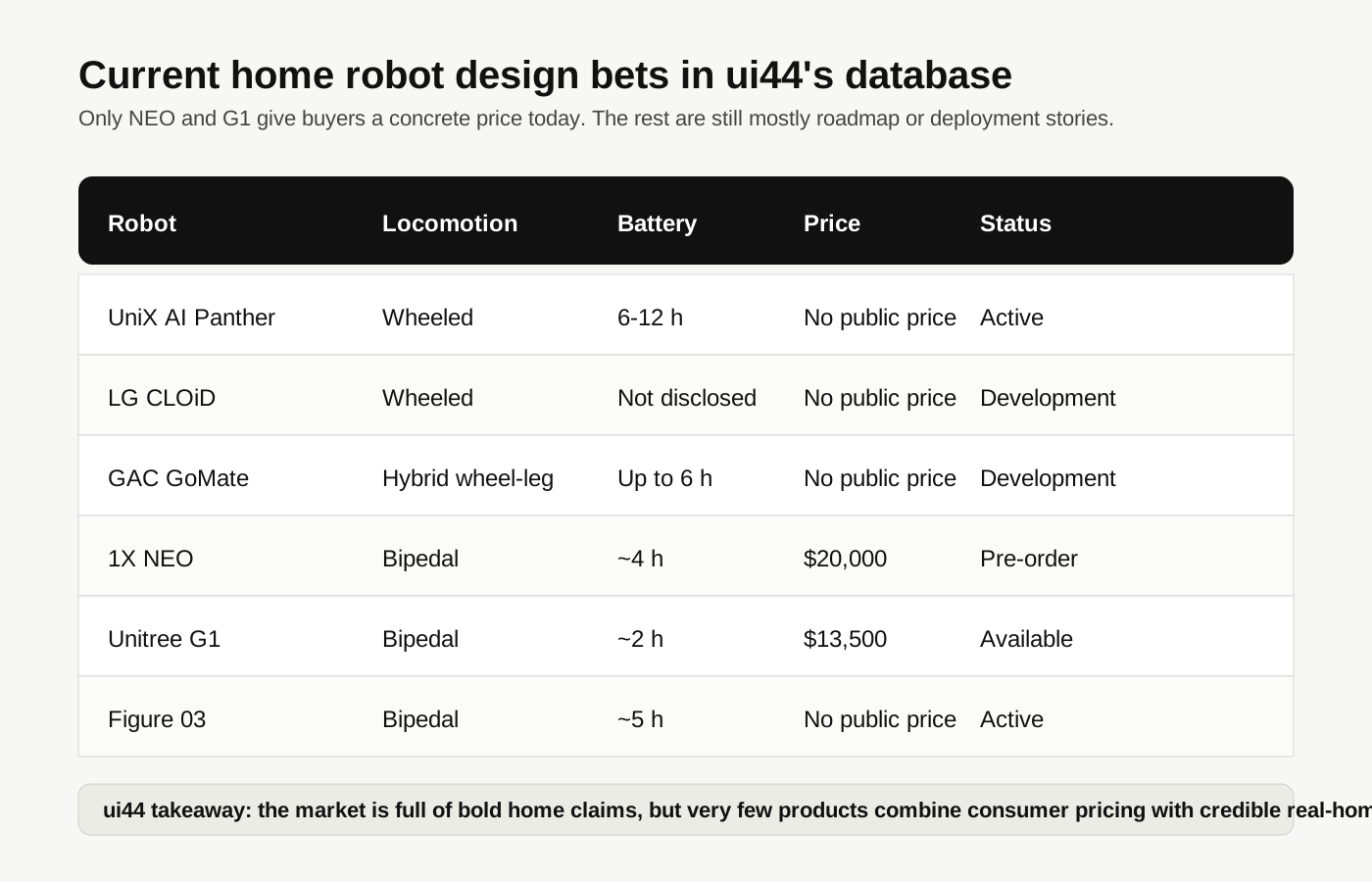
Here is the useful comparison. The market is no longer split into just "robots with legs" and "robots without legs." ui44 already tracks three distinct bets: wheeled, hybrid wheel-leg, and fully bipedal.
Robot
- Locomotion bet
- Wheeled humanoid
- Key ui44 data
- 1600-1750 mm height range, 34 DoF, 6-12 hour battery, 12 kg dual-arm payload, up to 2070 TOPS
- What that means in a home
- Strong case for flat-floor domestic work if the deployment claims hold up
Robot
- Locomotion bet
- Wheeled home manipulator
- Key ui44 data
- Wheeled base, two 7-DoF arms, five fingers per hand, ThinQ integration, no public price
- What that means in a home
- Probably the clearest big-brand argument for wheels-first home robotics
Robot
- Locomotion bet
- Hybrid wheel-leg
- Key ui44 data
- 38 DoF, variable posture, up to 6 hours battery, early focus on patrol and elder care
- What that means in a home
- Suggests the market may want wheel efficiency plus occasional leg-like flexibility
Robot
- Locomotion bet
- Bipedal home humanoid
- Key ui44 data
- $20,000, 167 cm, 30 kg, ~4 hour battery, pre-order
- What that means in a home
- Best-known home-first bipedal bet, but still early on actual whole-home autonomy
Robot
- Locomotion bet
- Compact bipedal humanoid
- Key ui44 data
- $13,500, 132 cm, 35 kg, ~2 hour battery
- What that means in a home
- More accessible on price, but still closer to a development platform than a finished home helper
Robot
- Locomotion bet
- Full-size bipedal humanoid
- Key ui44 data
- 168 cm, 60 kg, ~5 hour battery, no public price
- What that means in a home
- Strong manipulation story, but still not positioned as a consumer product
| Robot | Locomotion bet | Key ui44 data | What that means in a home |
|---|---|---|---|
| UniX AI Panther | Wheeled humanoid | 1600-1750 mm height range, 34 DoF, 6-12 hour battery, 12 kg dual-arm payload, up to 2070 TOPS | Strong case for flat-floor domestic work if the deployment claims hold up |
| LG CLOiD | Wheeled home manipulator | Wheeled base, two 7-DoF arms, five fingers per hand, ThinQ integration, no public price | Probably the clearest big-brand argument for wheels-first home robotics |
| GAC GoMate | Hybrid wheel-leg | 38 DoF, variable posture, up to 6 hours battery, early focus on patrol and elder care | Suggests the market may want wheel efficiency plus occasional leg-like flexibility |
| 1X NEO | Bipedal home humanoid | $20,000, 167 cm, 30 kg, ~4 hour battery, pre-order | Best-known home-first bipedal bet, but still early on actual whole-home autonomy |
| Unitree G1 | Compact bipedal humanoid | $13,500, 132 cm, 35 kg, ~2 hour battery | More accessible on price, but still closer to a development platform than a finished home helper |
| Figure 03 | Full-size bipedal humanoid | 168 cm, 60 kg, ~5 hour battery, no public price | Strong manipulation story, but still not positioned as a consumer product |
Only two robots in that table give buyers a concrete consumer-facing price today: NEO at $20,000 and G1 starting at $13,500. That matters. It is a reminder that many home-robot debates still happen far ahead of real purchase decisions.
It is also worth noticing that even companies with strong humanoid ambitions do not treat locomotion as a religion. 1X's industrial robot EVE uses a wheeled, self-balancing base, while NEO is bipedal and aimed at the home. That split looks less like inconsistency and more like a clue. Different environments may really want different bodies.
The spec sheet matters more than the walk cycle
This is the part buyers and even some reporters skip. The legs-versus-wheels argument sounds dramatic, but the specs usually tell you faster whether a robot is being designed for repeatable home work or for a more aspirational future.
Take Panther. ui44 lists it with 34 DoF (degrees of freedom, meaning the number of independently controlled joints or motion axes), an omnidirectional wheeled base, an 80 cm upper-body lift, up to 12 kg dual-arm payload, a stated 6-12 hour battery range, and up to 2070 TOPS (tera operations per second, a rough measure of onboard AI compute). Those numbers are not proof that Panther will dominate homes. But they do show where UniX AI is spending engineering effort: long runtime, stable movement, lift-and-reach compensation, and manipulation power. That is exactly what you would prioritize if you believed most real household value happens on flat floors near counters, tables, sofas, and appliances.
Now compare that to the bipedal side. 1X NEO is more explicitly consumer-facing because it has a public $20,000 preorder price and a home-oriented pitch, but ui44 still lists only about four hours of battery life. Unitree G1 is even more accessible on entry price at $13,500, yet its roughly two-hour battery figure shows how quickly the conversation shifts from "can it walk?" to "how long can it keep being useful before it needs to stop?" Figure 03 looks stronger on runtime at around five hours and keeps the classic full-size humanoid profile, but it still has no public consumer price and is not positioned like an off-the- shelf home appliance.
That is why locomotion should be read alongside three other signals.
- Runtime transparency: A robot can look amazing in a clip and still be a bad household fit if battery life is short or vague.
- Price transparency: Public pricing does not guarantee mass-market readiness, but missing pricing often means the real buying conversation is still earlier than the hype suggests.
- Manipulation strategy: Wheels become much more credible when paired with serious upper-body reach, payload, dexterity, or appliance integration.
CLOiD is a good example of that last point. LG did not just put arms on a cart and call it futuristic. It paired a wheeled base with two 7-degree-of-freedom arms, five-finger hands, and ThinQ smart-home integration. That package makes sense if the goal is not to mimic a person walking down a staircase, but to make an appliance-aware home helper that can move steadily and interact where people already need assistance.
GoMate is useful for a different reason. Its hybrid wheel-leg posture suggests some companies are already conceding the core truth of the debate: pure bipedal movement is still expensive and demanding, but pure rolling also leaves value on the table in less forgiving environments. The more you look at the current spec sheet landscape, the more the market seems to be saying that locomotion is not a brand identity issue. It is a systems-engineering trade.
Where do bipedal robots still win?
The case for legs is still real, and it is stronger than wheels-first advocates sometimes admit.
First, stairs matter. A wheeled base can be excellent in an apartment or a single-level home, but a true multi-floor family house still favors a robot that can handle steps without waiting for a human to carry it. That is why bipedal marketing remains so emotionally powerful. It maps onto the world people already live in.
Second, some home environments are full of awkward thresholds, cluttered corners, and human-height interaction points. Bipedal robots can theoretically approach a counter, pivot in place, bend, reach, and step around small obstacles without needing a large base footprint or a lifting mast. That promise is one reason 1X keeps pushing NEO as a home companion rather than an appliance on wheels.
Third, the human form still helps buyers imagine broader usefulness. NEO is soft and relatively light at 30 kg. Figure 03 is much heavier at 60 kg, but it keeps a familiar full-height humanoid profile while promising strong multi-step planning. Unitree G1 is smaller and cheaper than most rivals, which makes the bipedal idea feel less like science fiction and more like something developers can actually buy and test.
The catch is that bipedal robots are still asking buyers to trust a bigger leap. 1X's own site says NEO works autonomously by default, but also offers an "Expert Mode" where a 1X expert can guide chores it does not yet know. That is not a failure. It is an honest reminder that household autonomy remains hard. If a company still needs human backup to complete edge cases, the argument for a simpler and stabler base gets stronger, not weaker.
So yes, legs are still the better long-term answer if your goal is a robot that can truly use a human home like a human does. But they are also the riskier near-term answer if your goal is a robot that simply works day after day.
Hybrid designs may be the real tell
If you want to see where the market is probably heading, look less at ideology and more at hybrids.
GAC's GoMate is the clearest example in ui44's current database. Its wheel-leg platform can drop into a lower, more efficient rolling posture or rise into a taller working posture. That is a practical response to the actual problem. Home robots need efficiency most of the time, but they also need occasional flexibility when the layout stops being ideal.
Hybrid thinking shows up in other ways too. Panther uses a wheeled base but adds that large 80 cm upper-body lift to recover some of the reach advantages people usually associate with legs. CLOiD does something similar with its tilting torso and highly articulated arms. These are not legless shortcuts. They are attempts to buy back capability where it matters most while avoiding the hardest parts of constant bipedal locomotion.
This is why I think the real debate is not wheels versus legs. It is where you want to spend your engineering budget.
- Spend it on locomotion, and you get better stairs and more human-like access.
- Spend it on manipulation, safety, and runtime, and you may get a more useful first-generation home robot even if it looks less humanoid.
- Spend it on hybrid posture changes, and you may get the most commercially sane compromise.
That looks especially sensible for elder-care support, hospitality, and appliance-heavy homes, where a robot does not need to jog down the hallway. It needs to move safely, carry items reliably, and keep working long enough to be worth having.
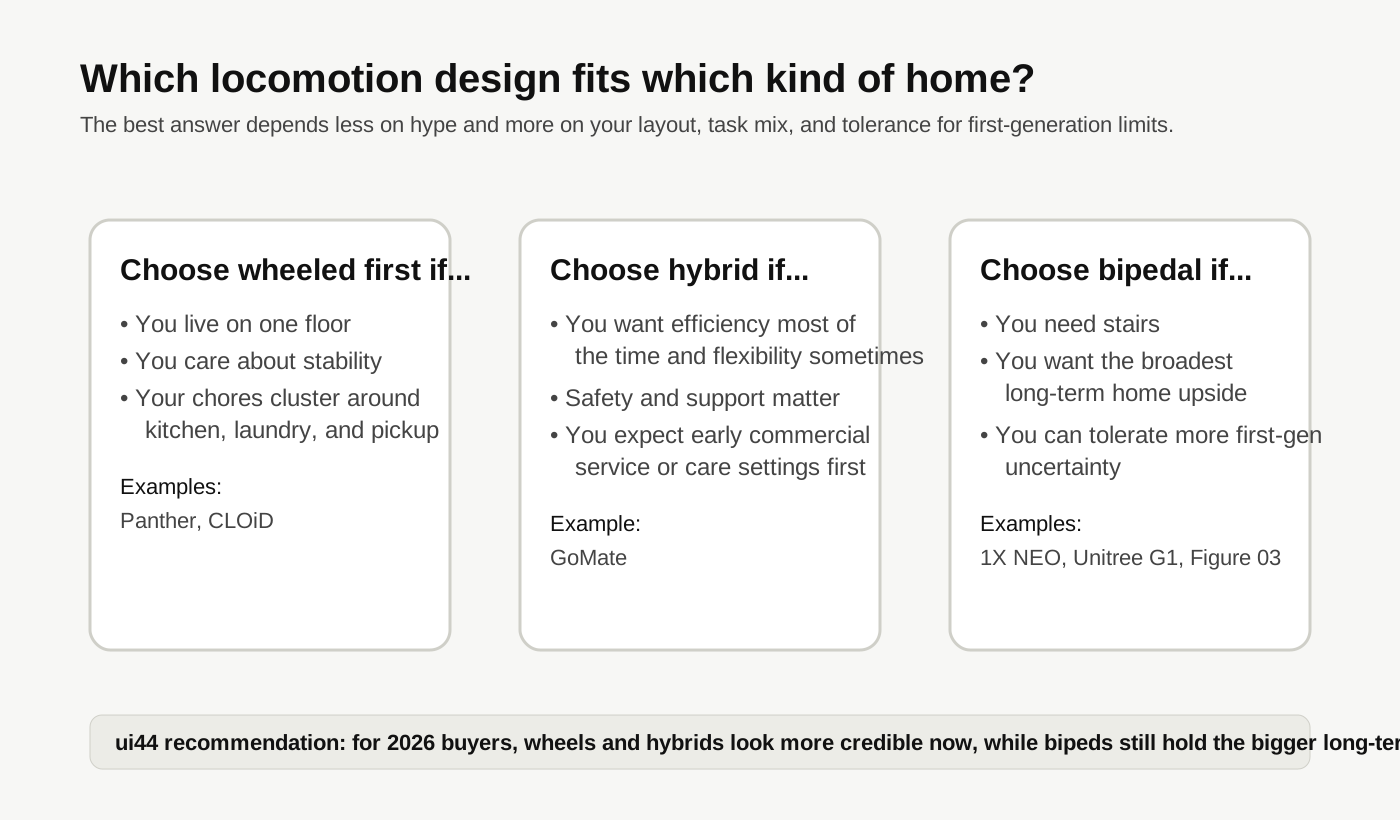
Which design fits different kinds of homes?
This is where the abstract debate becomes useful.
Single-level apartment or condo
A wheeled or hybrid design looks more convincing today.
That kind of home minimizes the biggest weakness of wheels, namely stairs, and maximizes the biggest strengths: stability, quieter movement, predictable navigation, and better battery efficiency. If your chores are mostly kitchen, laundry, light pickup, reminders, and smart-home coordination, Panther and CLOiD-style designs make more immediate sense than a general-purpose biped.
Multi-story family home
Bipedal still has the cleaner long-term argument.
A robot that cannot move between floors on its own will feel limited fast in a house with bedrooms upstairs, laundry in the basement, and cluttered transitions in between. That does not mean today's bipedal robots are ready. It means the problem definition itself favors legs if the robot is expected to work across the whole house without human help.
Assisted-living, elder-care, or appliance-centered support
Hybrid or wheels-first designs may be the smartest near-term fit.
The task list here usually rewards safety, predictable motion, and object handling over flashy locomotion. A low center of gravity, good arm reach, reliable voice interaction, and long runtime can matter more than full humanoid walking. That is exactly the kind of environment where CLOiD's appliance focus or GoMate's posture-switching logic feels more credible than a pure humanoid pitch.
Buyer who wants the broadest future upside
If you are buying a platform to bet on future capability, a bipedal robot still has the bigger theoretical upside. NEO and G1 are the clearest examples in this article because they at least give you a more direct path toward the fully human-shaped future most buyers imagine.
But if you are asking which design I would trust first to perform repeatable household work without drama, I would lean wheels or hybrid.
A practical buyer checklist before you get hypnotized by the walk cycle
If you are evaluating a home robot category for actual use, these questions are usually more useful than asking whether legs are cooler than wheels.
1. How much of your home is truly one-level in daily use?
A lot of people say they live in a "house," but the robot's real work zone is still mostly one floor: kitchen, living room, dining area, and maybe a nearby laundry space. In that case, a wheeled or hybrid robot may already cover most of the mission while gaining stability and runtime advantages. If the robot must move independently between upstairs bedrooms, downstairs utility rooms, and more chaotic transitions, the case for bipedal locomotion gets stronger fast.
2. Do you need long sessions or occasional bursts?
This question cuts through a lot of hype. ui44's current database entries in this comparison point to a clear pattern: wheels-first and hybrid approaches are often easier to pair with longer runtime, while compact bipeds can end up with shorter working windows. If you imagine a robot doing many small tasks across a whole day, endurance matters more than whether its gait looks human for ten seconds in a demo video.
3. Is your problem really locomotion, or is it manipulation?
Many household chores fail not because a robot could not walk to the room, but because it could not safely pick up, hold, place, open, align, or coordinate with appliances once it got there. That is why Panther's lift-plus-payload strategy, CLOiD's articulated arms, and GoMate's posture flexibility are so important. They suggest some companies think the real bottleneck is not just mobility, but what happens after mobility.
4. How much unpredictability will your household tolerate?
Homes with children, pets, clutter, and narrow furniture paths punish unstable movement. LG's explicit safety and lower-center-of-gravity framing matters here. A robot that is slightly less flexible but more predictable may be a better fit for a real household than a more capable biped that still needs a wider trust margin around falls, bumps, or recovery behavior.
5. Are you buying present utility or future upside?
This is probably the biggest dividing line in the whole market.
- If you want a robot that looks more ready for flat-floor domestic support today, wheels or hybrid designs look like the safer bet.
- If you want to buy into the broadest future vision of a robot that can use a human environment almost exactly as built, bipedal still has the stronger upside story.
- If you are comparing specific consumer-facing bets, it is worth pairing this article with ui44's 1X NEO review, because NEO is one of the clearest examples of a home-first bipedal pitch with a real preorder path.
Quick answers to the most common wheels-versus-legs questions
Are wheels just a sign the company could not solve walking?
Not necessarily. Sometimes they are a deliberate choice to spend engineering budget on runtime, safety, manipulation, and cost control instead of full-time bipedal locomotion. CLOiD is the clearest example of that logic, and Panther's whole product story leans the same way.
Can a wheeled robot still count as a humanoid?
In practice, many people will still call a robot humanoid if it has a humanlike upper body, arms, hands, head-like sensor placement, and human-oriented task framing, even if the base rolls instead of walks. The more useful question is not taxonomy. It is whether the design can perform household tasks credibly.
Will homes eventually favor legs anyway?
Probably yes, if the goal is full whole-home generality. Human homes really are built around stairs, thresholds, cabinets, and room transitions that favor the human form. But there is a big difference between the shape that probably wins in the long run and the shape that is easiest to ship reliably first.
The bottom line
The home-robot market is quietly admitting something important. Looking human is not the same thing as being practical in a human home.
Wheeled designs are not a retreat from the home-robot dream. In many cases they look like the most realistic path toward useful first-generation household robots, especially on one floor and around connected appliances. Bipedal robots still matter because homes really are built for legs, and any robot that wants to become a true generalist helper will eventually need to solve that problem.
But if you are judging 2026 products instead of 2030 promises, wheels look like the more credible near-term bet.
That is why Panther, CLOiD, and GoMate deserve more attention than they usually get in humanoid coverage. They may be less cinematic than a robot striding through the kitchen, but they are closer to answering the question buyers should actually ask: which design is most likely to work in a real home without turning your living room into a robotics lab?
If you want to compare the current field yourself, start with Panther, CLOiD, GoMate, 1X NEO, and Unitree G1, then use ui44's comparison tool to stack the trade-offs side by side.
Written by
ui44 Team
Published April 17, 2026
Share this article
Open a plain share link on X or Bluesky. No embeds, no widgets, no cookie baggage.