That distinction matters. A funding round can make a company visible, but it does not make a robot useful in a home. Homes are cramped, inconsistent, privacy-sensitive, and unforgiving. The interesting part of NEURA's strategy is that it is not betting on one body. The company is presenting a full-size humanoid, a compact humanoid, a wheeled assistant, and industrial robots as parts of the same Physical AI portfolio. For home buyers, that portfolio approach is more important than the headline number.
The current buyer question is not "Will NEURA build a robot?" It already has several. The question is which NEURA robot, if any, becomes a credible path into private homes.
The Real Signal Is A Platform, Not One Robot
NEURA's official Series C page frames the company around cognitive robotics, not just humanoid hardware. Its Automate 2026 announcement uses the same language: a complete Physical AI portfolio in action. That is a more realistic story than pretending one humanoid model will leap from factory demos to apartment chores.
For a home robot buyer, the platform matters in three ways.
First, a robot company needs enough fleet volume to learn from failures. A robot that only appears in polished launch videos is not collecting the messy edge cases that matter at home: shiny cabinet doors, pets crossing its path, uneven lighting, clutter, charging-dock misses, and human instructions that are half spoken and half implied.
Second, a household robot needs support infrastructure. A humanoid with arms is closer to a small appliance, computer, vehicle, and service contract at the same time. If the robot breaks, mis-grips, needs a battery replacement, or gets confused by a software update, the buyer needs more than a spec sheet.
Third, the same autonomy stack should ideally work across more than one body. NEURA's lineup lets it test perception, safety, navigation, voice, manipulation, and task software across wheeled assistants, compact humanoids, full-size humanoids, and commercial robots before any one model carries the whole consumer promise.
That is why the $1.4B story is interesting. It suggests NEURA wants the capital base to build a platform company, not just a demo company.
What ui44's Data Says About The Lineup
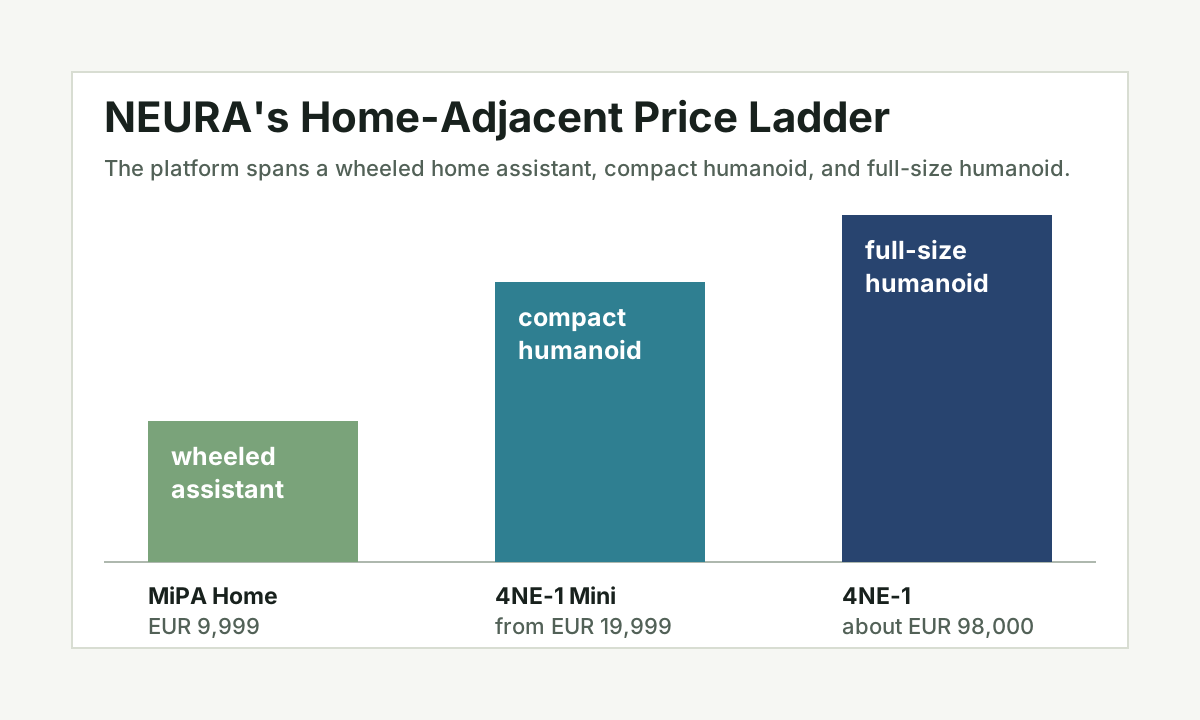
The most useful way to read NEURA's home-robot strategy is through the actual product ladder.

Robot
- ui44 category
- Home Assistants
- Price signal
- €9,999
- What it tells buyers
- The closest current NEURA product to an ordinary home-assistant shape
Robot
- ui44 category
- Humanoid
- Price signal
- €19,999 standard
- What it tells buyers
- A compact humanoid with a more reachable research and education price
Robot
- ui44 category
- Humanoid
- Price signal
- about €98,000
- What it tells buyers
- A full-size humanoid platform, not yet a normal household purchase
| Robot | ui44 category | Price signal | What it tells buyers |
|---|---|---|---|
| NEURA MiPA | Home Assistants | €9,999 | The closest current NEURA product to an ordinary home-assistant shape |
| NEURA 4NE-1 Mini | Humanoid | €19,999 standard | A compact humanoid with a more reachable research and education price |
| NEURA 4NE-1 | Humanoid | about €98,000 | A full-size humanoid platform, not yet a normal household purchase |
The 4NE-1 is the flagship signal. ui44 lists it as a 180 cm, 80 kg humanoid with roughly 2 hours of battery life and a 10-100 kg payload range in the current data record. That is not a countertop gadget. It is a human-scale machine that has to be judged like a serious robotics platform.
The 4NE-1 Mini is more relevant to near-term buyers because the price is not purely symbolic. ui44 lists the Mini at €19,999 for the standard version, with a Pro tier described in the database at €29,999. It is 132 cm tall, weighs 36 kg, has roughly 2.5 hours of battery life, and carries a 3 kg payload. Those numbers make it closer to the compact humanoid market that includes education, research, teleoperation, and controlled service roles.
Then there is MiPA. It is not a humanoid, but that is exactly why it matters. ui44 lists MiPA Home at €9,999 with 2-8 hours of motion endurance in the official datasheet wording. A wheeled, modular assistant may be less dramatic than a biped, but it has a simpler route into a house: move items, guide people, interact, serve, connect to IoT, and dock itself without solving every problem of legs and full-body balance.
Why MiPA May Be The Home Product To Watch
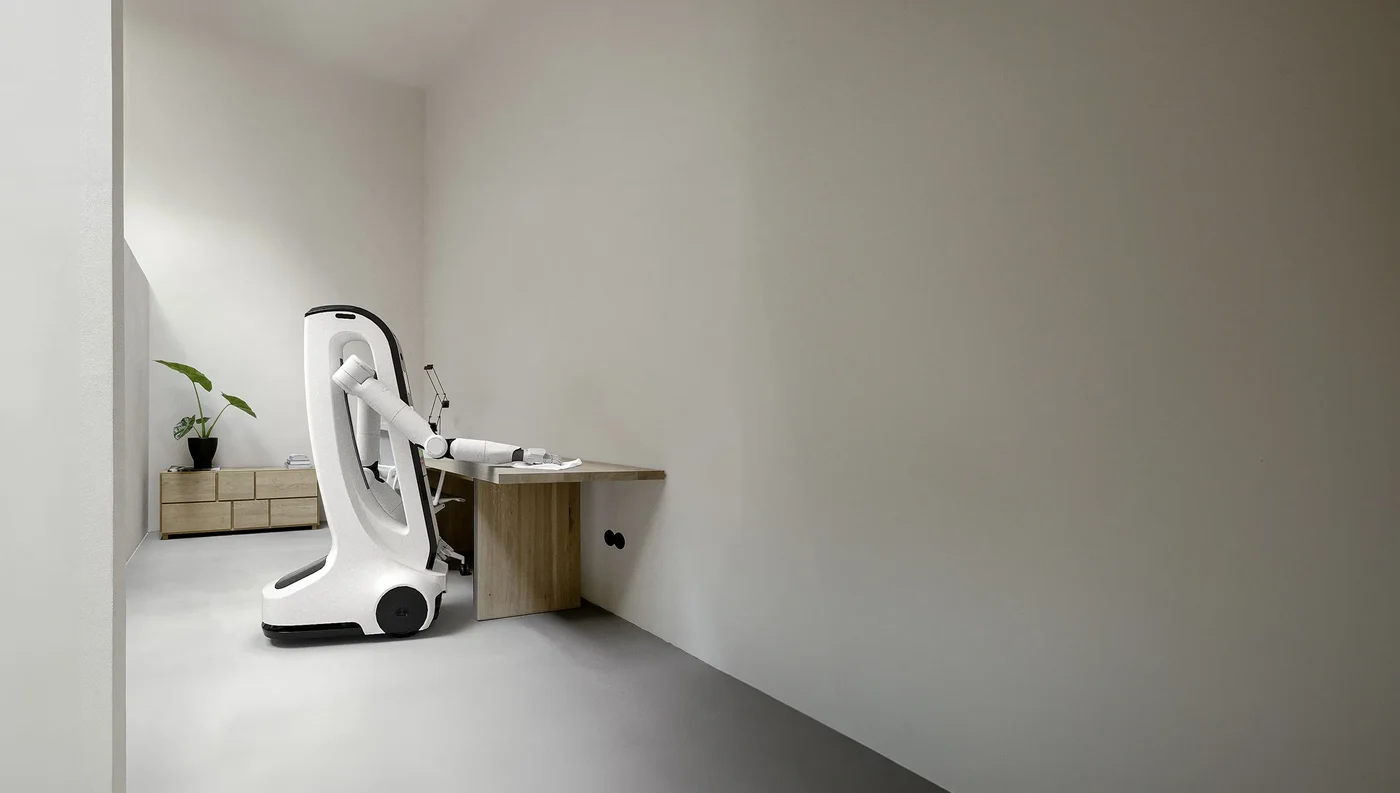
Humanoid robots dominate attention because they look like the general-purpose endpoint. MiPA is quieter, but it may be the more honest first home product. A wheeled robot does not need stairs, running, or two-legged recovery to be useful. It can still carry a tray, guide a visitor, recognize people, use a display, speak, listen, and integrate with smart-home systems.
That does not mean MiPA is automatically ready for a kitchen. The missing details still matter. ui44's database still treats exact height, weight, delivery regions, and production shipment status as unresolved. NEURA's current MiPA datasheet lists a 3 kg single-arm payload, but buyers still need real-world proof of what that means for trays, small bags, and repeated handoffs. Delivery region defines whether a reservation is a product path or a waiting list. Service terms define whether a household can live with the robot after the first month.
Still, MiPA shows a sensible route. If NEURA can put wheeled assistants into homes, care settings, hospitality, and retail with the same autonomy and interaction stack, it gets data that can help its humanoids later. The strongest home humanoid company may be the one that learns from non-humanoid robots first.
The Compact Humanoid Gap
The 4NE-1 Mini sits in the gap between a practical wheeled assistant and a full-size humanoid. That gap is important because compact humanoids are becoming the first serious buyer category. They are expensive, but not fantasy-priced. They can be used in labs, schools, developer programs, light service pilots, and carefully supervised demos.
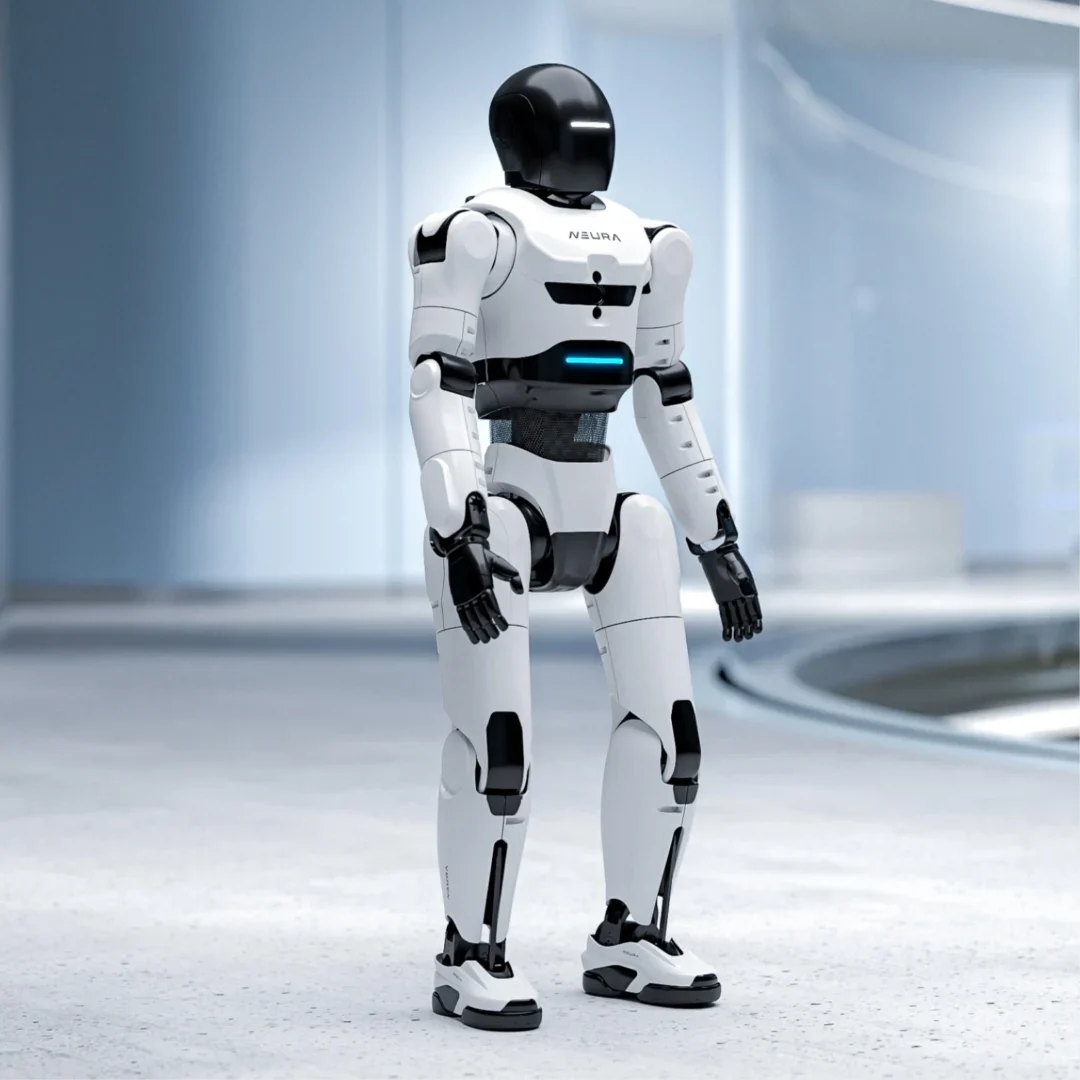
The Mini's 132 cm height and 36 kg weight are home-relevant because mass changes risk. A smaller robot is easier to move, recover, store, and supervise. Its 3 kg payload is not enough for every chore, but it is enough to test manipulation around lightweight household objects. Its roughly 2.5-hour runtime also makes the trade-off visible: useful robots will need either short mission cycles, frequent docking, or a clear division between active work and standby presence.
This is where NEURA's developer story matters. A compact humanoid becomes more valuable if it gives developers access to simulation, teleoperation, SDKs, and fleet learning. A home buyer will not care about the SDK directly, but they will care if it creates better skills, more integrations, and faster recovery from mistakes.
Funding Is Not The Same As Home Readiness
The $1.4B number should not be ignored. Robotics is capital hungry. Hardware tooling, safety testing, manufacturing, inventory, field support, and long software cycles are expensive. A European company with enough capital to keep building through slow adoption would be good for the market.
But buyers should separate runway from readiness.
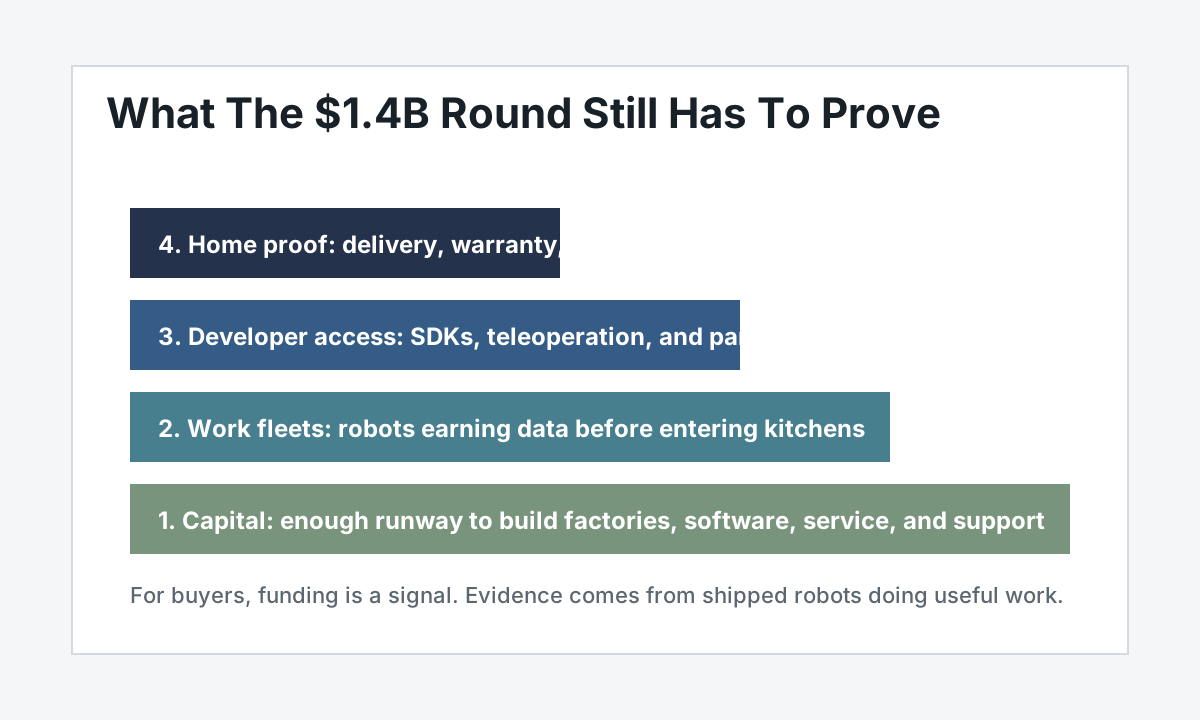
Home readiness needs evidence in four areas:
Evidence
Delivered units
- Why it matters at home
- Reservations and demos do not prove support, reliability, or repeat use
Evidence
Repeatable tasks
- Why it matters at home
- A robot must do the same chore on bad days, not only once on stage
Evidence
Clear safety limits
- Why it matters at home
- Human-scale robots need predictable force, speed, privacy, and stop behavior
Evidence
Service model
- Why it matters at home
- Buyers need warranty, parts, software updates, and local support
| Evidence | Why it matters at home |
|---|---|
| Delivered units | Reservations and demos do not prove support, reliability, or repeat use |
| Repeatable tasks | A robot must do the same chore on bad days, not only once on stage |
| Clear safety limits | Human-scale robots need predictable force, speed, privacy, and stop behavior |
| Service model | Buyers need warranty, parts, software updates, and local support |
NEURA has promising ingredients: European manufacturing ambition, a cognitive robotics brand, several robot bodies, official product pages, and price signals that make comparison possible. The missing piece is longitudinal proof. Which robots are deployed, how many are working outside controlled demos, what tasks are repeatable, and what happens when the robot fails?
Those answers matter more than whether the first household robot has legs.
What Should Home Robot Buyers Watch Next?
The clearest next signal would be MiPA delivery clarity. If NEURA confirms regions, timelines, service terms, real-world payload use cases, and home deployments for MiPA Home, it would create a practical foundation for the broader platform story.
The second signal is 4NE-1 Mini availability. A €19,999 compact humanoid from a European manufacturer would be meaningful if buyers can actually reserve, receive, program, and support it. The Mini does not need to solve every home chore. It needs to prove that NEURA can ship a humanoid platform at a price where schools, labs, developers, and early adopters can stress-test it.
The third signal is whether the full-size 4NE-1 shows useful work beyond industrial-style demos. At 180 cm, 80 kg, and about €98,000, it is closer to an enterprise or research platform than a consumer product. That is fine, but the proof should be work: manipulation, navigation, recovery, and safe operation around people.
For now, the best way to read NEURA is as a platform bet with three home-adjacent routes:
- MiPA for the near-term home assistant path.
- 4NE-1 Mini for compact humanoid development and supervised use.
- 4NE-1 for the long-term full-size humanoid platform.
That is more credible than betting everything on a single humanoid launch. It also gives buyers a better mental model. Do not ask only whether Europe can build a home humanoid. Ask whether NEURA can turn a family of robots into enough real-world evidence that a home buyer can trust the next one.
Related in the database
Use this article as a privacy verification workflow
Turn the article into a privacy verification pass grounded in the robots, manufacturers, and components it actually references.
NEURA's $1.4B Bet on European Home Humanoids already points you toward 3 linked robots, 1 manufacturer, and 1 country inside the ui44 database. That matters because strong buyer guidance is easier to apply when you can move immediately from a claim or warning into concrete product pages, manufacturer directories, component explainers, and country-level context instead of treating the article as an isolated opinion piece. The fastest next step is to turn the article into a shortlist workflow: open the linked robot pages, verify which specs are actually published for those models, then compare the surrounding manufacturer and component context before you decide whether the underlying claim changes your buying plan.
For this topic, the useful discipline is to separate the editorial lesson from the catalog evidence. The article gives you the framing, but the robot pages tell you what each product actually ships with today: sensor stack, connectivity methods, listed price, release timing, category, and support-relevant compatibility notes. The manufacturer pages then show whether you are looking at a one-off launch, a broader lineup pattern, or a company that spans multiple categories. That layered workflow reduces the risk of buying on a single marketing phrase or a single support FAQ.
Use the robot pages to confirm which products actually expose cameras, microphones, Wi-Fi, or voice systems, then use the manufacturer pages to decide how much of the privacy question seems product-specific versus brand-wide. On this route cluster, 4NE-1, 4NE-1 Mini, and MiPA form the fastest reality check. If you want a quick working shortlist, open Compare 4NE-1, 4NE-1 Mini, and MiPA next, then keep this article open as the reasoning layer while you compare structured data side by side.
Practical Takeaway
Every robot, manufacturer, category, component, and country reference below resolves to a real ui44 page, keeping the follow-up path grounded in database records rather than generic advice.
Suggested next steps in ui44
- Open 4NE-1 and note the listed sensors, connectivity methods, and voice stack before you interpret any policy claim.
- Cross-check the wider brand context on NEURA Robotics so you can see whether the privacy question touches one model or a broader lineup.
- Use the linked component pages to confirm how common the relevant sensors and connectivity layers are across the database.
- Keep a short note of which policy layers you checked, which device features are actually present on the robot page, and which items still depend on region- or app-level confirmation.
- Finish with Compare 4NE-1, 4NE-1 Mini, and MiPA so the policy reading sits next to structured product data.
Robot profiles worth opening next
Use the linked product pages as the evidence layer
The linked robot pages are where this article becomes operational. Instead of asking whether the headline is interesting, use the robot entries to inspect the actual mix of sensors, connectivity options, batteries, pricing, release timing, and stated capabilities attached to the products mentioned in the article. That is the easiest way to see whether the warning or opportunity described here affects one product family, a specific design pattern, or an entire buying lane.
4NE-1
NEURA Robotics · Humanoid · Pre-order
4NE-1 is tracked on ui44 as a pre-order humanoid robot from NEURA Robotics. The database currently records a listed price of €98,000, a release date of 2024, ~2 hours battery life, Not disclosed charging time, and a published stack that includes 3D Vision (360°), Force/Torque Sensors (all joints), and Sensor Skin plus Wi-Fi 6 and Ethernet.
For privacy-focused reading, this page matters because it shows the concrete device surface behind the policy discussion. Use it to verify whether 4NE-1 combines sensors and connectivity in a way that could change the in-home data footprint, and compare the listed capabilities such as 25 Degrees of Freedom, Autonomous Navigation, and Object Manipulation with any cloud, app, or voice layers, including Built-in Voice Recognition.
4NE-1 Mini
NEURA Robotics · Humanoid · Pre-order
4NE-1 Mini is tracked on ui44 as a pre-order humanoid robot from NEURA Robotics. The database currently records a listed price of €19,999, a release date of 2026-01-05, ~2.5 hours battery life, Not disclosed charging time, and a published stack that includes Multi-camera Array, Force/Torque Sensors, and 3D Vision plus Wi-Fi 6 and Gigabit Ethernet.
For privacy-focused reading, this page matters because it shows the concrete device surface behind the policy discussion. Use it to verify whether 4NE-1 Mini combines sensors and connectivity in a way that could change the in-home data footprint, and compare the listed capabilities such as 25 Degrees of Freedom, Autonomous Navigation, and Object Manipulation (Pro tier: 12-DOF dexterous hands) with any cloud, app, or voice layers, including Built-in Multi-language Voice Recognition.
MiPA
NEURA Robotics · Home Assistants · Pre-order
MiPA is tracked on ui44 as a pre-order home assistants robot from NEURA Robotics. The database currently records a listed price of €9,999, a release date of 2025, 2-8 hours motion endurance (official datasheet) battery life, Automatic recharging capability; charging time not officially disclosed charging time, and a published stack that includes SLAM-based mapping, LiDAR, and 360° perception plus Wi-Fi and Bluetooth.
For privacy-focused reading, this page matters because it shows the concrete device surface behind the policy discussion. Use it to verify whether MiPA combines sensors and connectivity in a way that could change the in-home data footprint, and compare the listed capabilities such as 16 Degrees of Freedom (base robot, without end-effectors), Autonomous Mobility, and SLAM Mapping and Path Planning with any cloud, app, or voice layers, including Multilanguage voice recognition.
Manufacturer context behind the article
Check whether this is one product story or a broader company pattern
Manufacturer pages add the privacy context that individual product pages cannot show on their own. They help you check whether cameras, microphones, cloud accounts, app controls, and policy assumptions appear across a broader lineup or stay tied to one specific product story.
NEURA Robotics
ui44 currently tracks 4 robots from NEURA Robotics across 3 categorys. The company is grouped under Germany, and the current catalog footprint on ui44 includes 4NE-1, 4NE-1 Mini, MiPA.
That wider brand context matters because privacy questions rarely stop at one FAQ page. A manufacturer route helps you see whether the article is centered on one premium model or on a company that has several relevant products and therefore more than one place where the same policy or app assumptions might matter. The category mix here currently points toward Humanoid, Home Assistants, Quadruped as the most useful next route if you want to see whether this article reflects a wider pattern inside the brand.
Broaden the scan without leaving the database
Categories, components, and countries add the wider context
Category framing
Category pages are useful when the article touches a buying pattern that shows up across brands. A category route helps you confirm whether the linked products sit in a narrow niche or whether the same question should be tested across a larger field of alternatives.
Humanoid
The Humanoid category page currently groups 129 tracked robots from 92 manufacturers. ui44 describes this lane as: Full-size bipedal humanoid robots built to work alongside people — from factory floors to household tasks. Compare the cutting edge of humanoid robotics.
That makes the category route a practical follow-up when you want to check whether the products linked in this article are typical for the lane or whether they sit at one edge of the market. Useful starting examples currently include NEO, EVE, Mornine M1.
Home Assistants
The Home Assistants category page currently groups 16 tracked robots from 14 manufacturers. ui44 describes this lane as: Arm-based household helpers — laundry folders, kitchen robots, and mobile manipulators that take on hands-on physical tasks around the home.
That makes the category route a practical follow-up when you want to check whether the products linked in this article are typical for the lane or whether they sit at one edge of the market. Useful starting examples currently include Robody, Futuring 2 (F2), Stretch 3.
Country and ecosystem context
Country pages give extra context when support practices, launch sequencing, regulatory posture, or manufacturer mix matter. They are not a substitute for model-level verification, but they do help you see which ecosystems cluster together and which manufacturers sit in the same regional field when you broaden the search beyond the article headline.
Germany
The Germany route currently groups 13 tracked robots from 9 manufacturers in ui44. That gives you a useful regional lens when the article points toward support practices, launch sequencing, or brand clusters that may share similar ecosystem assumptions.
On the current route, manufacturers like NEURA Robotics, Bosch, Agile Robots make the page a good way to broaden the scan without losing the regional context that often shapes availability, documentation style, and adjacent alternatives.
Questions to answer before you move from reading to buying
A follow-up FAQ built from the entities already linked in this article
Frequently Asked Questions
Which page should I open first after reading “NEURA's $1.4B Bet on European Home Humanoids”?
Start with 4NE-1. That gives you a concrete product anchor for the article’s main claim. From there, branch into the manufacturer and component pages so you can tell whether the article is describing one specific model, a repeated brand pattern, or a wider technology issue that affects multiple shortlist options.
How do the manufacturer pages change the buying decision?
NEURA Robotics help you zoom out from one article and one product. On ui44 they show lineup breadth, category spread, and the neighboring robots tied to the same company. That context is useful when you are deciding whether a risk belongs to a single model, whether it shows up across a brand’s portfolio, and whether you should keep looking at alternatives before committing.
When should I switch from reading to side-by-side comparison?
Move into Compare 4NE-1, 4NE-1 Mini, and MiPA as soon as you understand the article’s main warning or promise. The article explains what to watch for, but the compare view is where you can check whether price, status, battery life, connectivity, sensors, and category fit still make the robot a good match for your own home and budget.
Where to go next in ui44
Keep the research chain inside the database
If you want to keep going, these follow-on pages give you the cleanest expansion path from article to research session. Open the comparison route first if you are deciding between products today. Open the manufacturer, category, and component routes if you still need to understand the broader pattern behind the claim.
Written by
ui44 Team
Published July 9, 2026
Share this article
Open a plain share link on X or Bluesky. No embeds, no widgets, no cookie baggage.