The important word is "development." K1 is not being sold as a chore robot that unloads a dishwasher, folds laundry, or safely roams a house while nobody is watching. It is a compact biped for learning, demos, robotics software, AI experiments, and controlled indoor movement. For home-robot buyers, that makes it interesting for a narrower group of people than the price alone suggests.
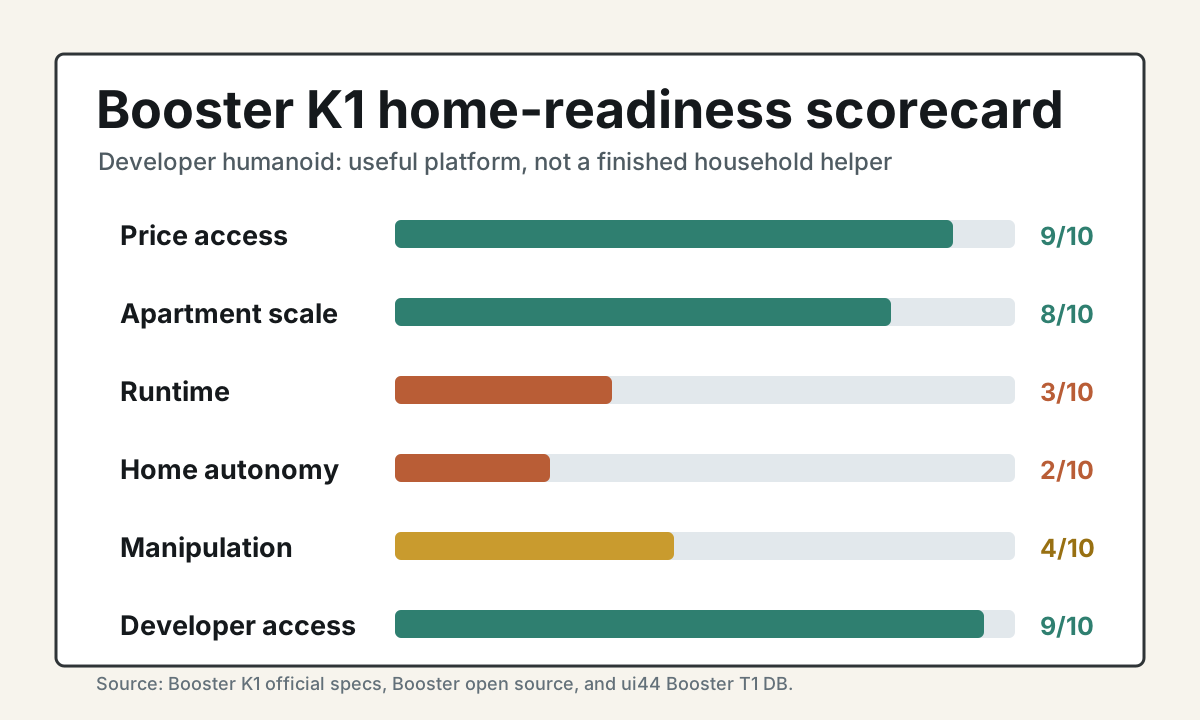
Here is the honest version: Booster K1 is one of the most approachable humanoid platforms we have seen for people who want to build with a robot. It is also a poor fit for anyone who wants a polished home helper. The difference matters because "under $6,000" sounds close to consumer electronics, while the actual ownership experience still looks much more like owning a robot development kit.
What Booster K1 Actually Is
Booster's official K1 page positions the robot as an "Introductory Embodied Development Platform" with a starting price of $5,999. The listed hardware puts it in the compact humanoid category: 95 cm tall, 19.5 kg, and 22 degrees of freedom. That is much smaller than a full adult-size humanoid, but it is still a heavy walking machine that needs space, supervision, and a user who understands that falls and test loops are part of the deal.
The official spec sheet lists a stereo depth camera, 9-axis IMU, circular 6-mic array with speaker, Bluetooth 5.2, Ethernet expansion, firmware upgrades, and secondary-development support. It also makes the runtime version-specific: the Geek version has a 2Ah battery and 30 minutes of walking runtime at 0.4 m/s, while the Education and Professional versions use 5Ah batteries and list 80 minutes of walking runtime at the same test speed. Booster's own open-source page points developers toward its SDK, ROS 2 SDK, app, Booster Gym, Booster Train, Booster Deploy, and robot assets.
Those numbers tell you how to read the product. K1 is a platform for making a humanoid move, sense, listen, speak, and run developer experiments. It is not a self-contained household worker. If you buy it, the project is the point.
Why The $5,999 Price Is A Big Deal
The consumer-humanoid market has been stuck between two uncomfortable extremes. On one side are serious humanoids that are inquiry-only, enterprise-focused, or clearly priced for labs. On the other side are toy-like desktop robots that are affordable but cannot teach much about bipedal locomotion, balance, or full-body control.
K1 lands in the gap between those categories. At a listed starting price of $5,999, it is still a major purchase, but it is now closer to a high-end computer workstation, camera kit, or serious educational lab purchase than a vehicle-class research robot. That matters for universities, after-school robotics programs, small AI labs, and home builders who have been waiting for a humanoid that is not purely a press-demo object.
The comparison with ui44's existing Booster T1 entry is useful. T1 is a larger Booster Robotics humanoid in our database: 118 cm tall, 30 kg, with 23 to 41 degrees of freedom depending on version, Intel Core i7-1370P plus NVIDIA Jetson AGX Orin compute, and a listed runtime of 2 hours walking or 4 hours standing. It is a more capable research-class platform, but ui44 has no verified current public price for T1 because Booster's official store flow is inquiry-only.
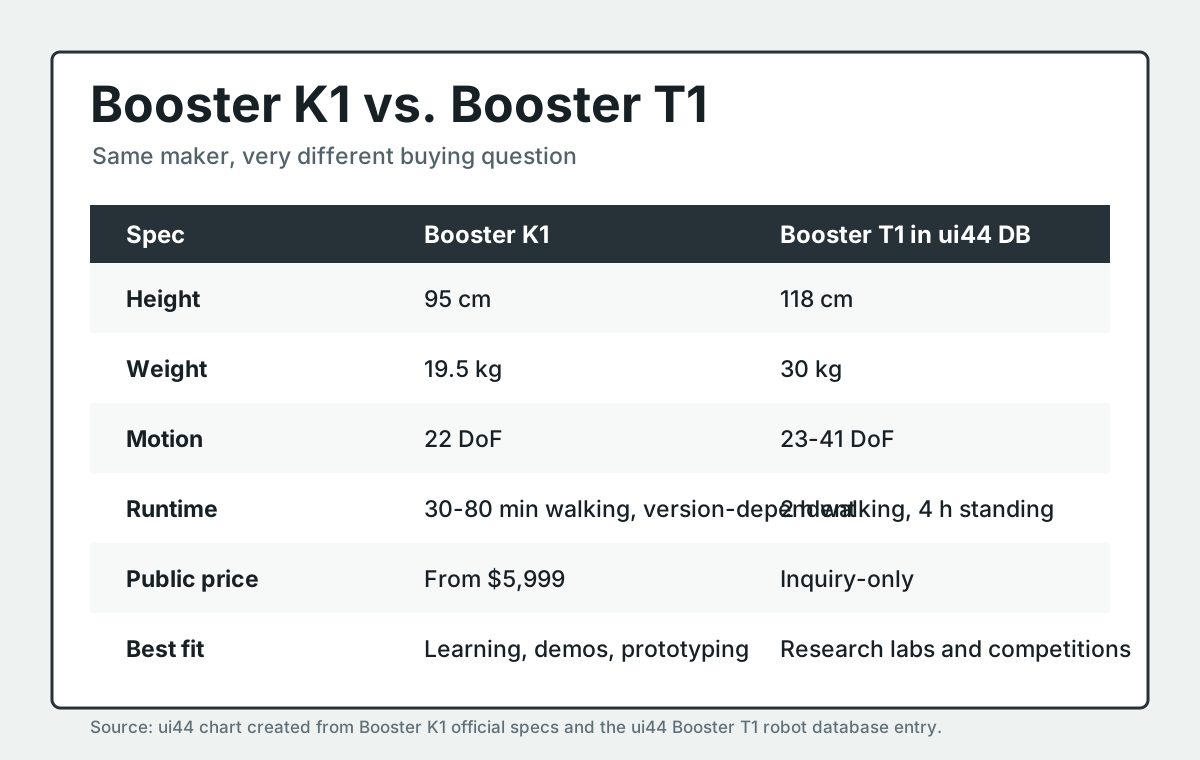
That makes K1's public starting price part of the story. Even if shipping, taxes, support, spare parts, and configuration options raise the real total, a visible entry price changes who can plan around the robot.
What K1 Could Be Useful For At Home
The strongest home use case is not "make dinner." It is learning. A technically comfortable buyer could use K1 for bipedal motion experiments, voice interaction prototypes, home-AI demos, robotics clubs, STEM education, and embodied-agent projects where the robot is supervised and the environment is controlled.
That kind of use can still be genuinely valuable. A small humanoid that can stand, walk, recover from simple movement routines, use depth sensing, accept SDK commands, and run through repeatable demos teaches things that a wheeled desktop companion cannot. If your real question is "How do humanoid robots behave in a kitchen-sized space?" K1 is far more relevant than a simulation alone.
The home angle gets weaker when the task involves useful manipulation. A 22-DoF compact humanoid can be impressive, but the current public materials do not make K1 look like a household manipulator built for reliable object handling. Buyers should assume that any fetching, carrying, cleaning, or tool-use workflow is a custom development project rather than a feature they can rely on.
That is not a criticism of the robot. It is a category boundary. A developer platform can be excellent while still being wrong for a normal buyer.
How It Compares With Other Humanoids In The Database
Against Unitree G1, K1 is smaller and cheaper at the entry level. ui44 lists G1 at $13,500 before tax and shipping, with a 132 cm standing height, 35 kg weight with battery, and roughly 2 hours of battery life. G1 is much closer to a full-size humanoid research platform, but it also crosses a very different budget line for most home experimenters.
1X NEO sits in another category again. ui44 lists NEO at $20,000 for early adopters, 167 cm tall, 30 kg, and roughly 4 hours of battery life. NEO is pitched around the home more directly, including a stronger story about household presence and supervised assistance. But price, availability, and maturity still make it a very different decision from buying a compact developer robot.
AGIBOT A2 is even farther from K1's role. In ui44's database it is a 169 cm, 69 kg humanoid with a 700 Wh swappable battery and a 2-hour runtime, with pricing handled through contact sales. That is the kind of platform that may shape where humanoids go, but it is not the practical comparison for a home lab buyer trying to decide whether to spend $5,999.
The pattern is clear: K1 is not winning by being the most capable humanoid. It wins attention because it makes real biped hardware more attainable.
The Runtime Question
Battery life is one of the places where buyers should slow down. Booster's official K1 specs list two different walking runtimes, not one universal number: 30 minutes at 0.4 m/s for the 2Ah Geek version, and 80 minutes at 0.4 m/s for the 5Ah Education and Professional versions. That makes configuration choice part of the buying decision, especially if the robot will be used for classes, public demos, or repeated lab sessions.
For home experimentation, that means runtime should be treated as a session constraint. A 30-minute walking window is enough for demos, class sessions, scripted movement tests, and short research loops. It is not enough for a robot that is supposed to be casually available around the home all afternoon.
The hidden practical question is not only battery capacity. It is how much time you will spend charging, updating, restarting, debugging, clearing floor space, and resetting failed behaviors. A consumer robot hides that friction. A developer humanoid exposes it.
The Safety And Supervision Reality
Any walking humanoid in a home has to be judged differently from a countertop device. K1's 19.5 kg weight is relatively light for a humanoid, but 19.5 kg is still enough mass to matter if the robot falls, bumps furniture, catches a cable, or steps near a person. Its compact size helps, but it does not remove the need for a controlled test area.
Good buyers will think about floor surface, pets, children, stairs, glass furniture, cable management, Wi-Fi reliability, emergency shutdown access, spare parts, and repair support before buying. Those details sound boring until a robot falls in the wrong place.
The safest interpretation is that K1 belongs in a home lab, classroom, studio, or open indoor test area, not loose in a normal living room.
Should You Buy Booster K1 For A Home Lab?
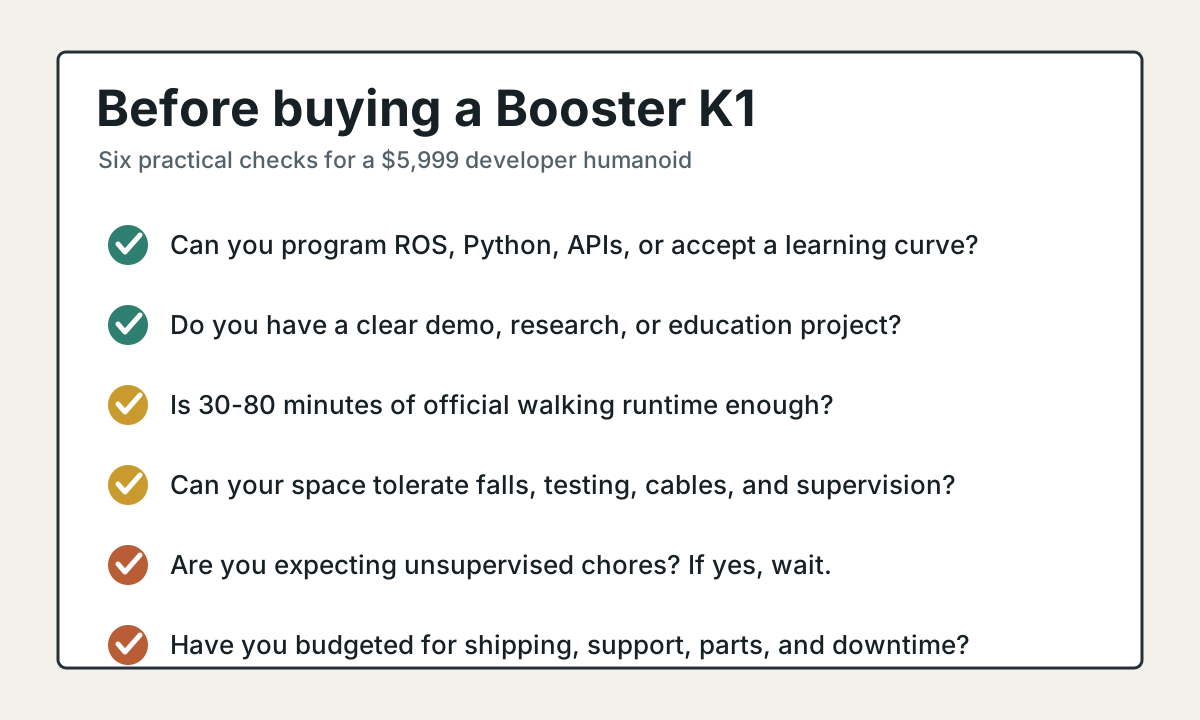
Before treating K1 as a good buy, answer these six questions:
Question
Can you program or learn ROS, Python, APIs, and robot SDKs?
- Why it matters
- The robot's value comes from development access, not finished chores.
Question
Do you have a specific project?
- Why it matters
- "Owning a humanoid" is not enough of a plan at this price.
Question
Is short walking runtime acceptable?
- Why it matters
- Official walking runtime is a session limit, not an all-day home presence.
Question
Can you supervise every test?
- Why it matters
- A walking humanoid needs controlled space and human oversight.
Question
Are you comfortable with maintenance?
- Why it matters
- Developer robots often require updates, debugging, and parts planning.
Question
Would a wheeled or tabletop robot solve the problem?
- Why it matters
- If yes, K1 may be an expensive way to learn the same lesson.
| Question | Why it matters |
|---|---|
| Can you program or learn ROS, Python, APIs, and robot SDKs? | The robot's value comes from development access, not finished chores. |
| Do you have a specific project? | "Owning a humanoid" is not enough of a plan at this price. |
| Is short walking runtime acceptable? | Official walking runtime is a session limit, not an all-day home presence. |
| Can you supervise every test? | A walking humanoid needs controlled space and human oversight. |
| Are you comfortable with maintenance? | Developer robots often require updates, debugging, and parts planning. |
| Would a wheeled or tabletop robot solve the problem? | If yes, K1 may be an expensive way to learn the same lesson. |
If those answers are mostly yes, K1 may be one of the most interesting humanoid purchases available right now. If those answers are mostly no, it is better to wait for a more finished home robot.
Verdict: A Real Step Toward Home Humanoids, Not A Home Helper Yet
Booster K1 is important because it lowers the price of entry for biped humanoid experimentation. A 95 cm, 19.5 kg, 22-DoF humanoid with depth sensing, audio, ROS/ROS 2 support, and a public starting price under $6,000 is a meaningful market signal.
But buyers should not confuse "more attainable" with "consumer ready." K1 is best understood as a serious educational and developer platform for people who want to build, test, and learn with humanoid hardware. It is not a household assistant in the way most buyers imagine that phrase.
For ui44 readers, the answer is therefore split. If you want a humanoid project, Booster K1 deserves attention. If you want a robot that makes home life easier without becoming your weekend engineering project, K1 is a preview of where the market is going, not the robot you should buy today.
Related in the database
Use this article as a market-reality workflow
Turn the article into a market-reality pass grounded in the robots, manufacturers, and countries it actually references.
Booster K1: Is a $5,999 Humanoid Useful at Home? already points you toward 5 linked robots, 4 manufacturers, and 2 countries inside the ui44 database. That matters because strong buyer guidance is easier to apply when you can move immediately from a claim or warning into concrete product pages, manufacturer directories, component explainers, and country-level context instead of treating the article as an isolated opinion piece. The fastest next step is to turn the article into a shortlist workflow: open the linked robot pages, verify which specs are actually published for those models, then compare the surrounding manufacturer and component context before you decide whether the underlying claim changes your buying plan.
For this topic, the useful discipline is to separate the editorial lesson from the catalog evidence. The article gives you the framing, but the robot pages tell you what each product actually ships with today: sensor stack, connectivity methods, listed price, release timing, category, and support-relevant compatibility notes. The manufacturer pages then show whether you are looking at a one-off launch, a broader lineup pattern, or a company that spans multiple categories. That layered workflow reduces the risk of buying on a single marketing phrase or a single support FAQ.
Launch claims age fast. The safest move is to pair the article with robot status, price, and manufacturer breadth checks inside ui44 so you can see whether Booster K1, Booster T1, and G1 are actually ready for a shortlist or still mostly launch-stage signals. If you want a quick working shortlist, open Compare Booster K1, Booster T1, and G1 next, then keep this article open as the reasoning layer while you compare structured data side by side.
Practical Takeaway
Every robot, manufacturer, category, component, and country reference below resolves to a real ui44 page, keeping the follow-up path grounded in database records rather than generic advice.
Suggested next steps in ui44
- Check each linked robot page for listed price, status, and release timing before you treat a launch announcement as a shipping reality.
- Open Booster Robotics to see whether the company’s ui44 footprint already shows a mature product lane or only a small launch cluster.
- Use country pages when the article spans several ecosystems, because launch timing and lineup depth often differ by region even when the headline sounds global.
- Finish with Compare Booster K1, Booster T1, and G1 so availability claims sit next to real product data.
- Treat every article as a live market snapshot. Re-check status and pricing before you move from interest to purchase intent.
Robot profiles worth opening next
Use the linked product pages as the evidence layer
The linked robot pages are where this article becomes operational. Instead of asking whether the headline is interesting, use the robot entries to inspect the actual mix of sensors, connectivity options, batteries, pricing, release timing, and stated capabilities attached to the products mentioned in the article. That is the easiest way to see whether the warning or opportunity described here affects one product family, a specific design pattern, or an entire buying lane.
Booster K1
Booster Robotics · Humanoid · Available
Booster K1 is tracked on ui44 as a available humanoid robot from Booster Robotics. The database currently records a listed price of $5,999, a release date of 2025-10-24, 30 min walking at 0.4 m/s (Geek, 2Ah); 80 min walking at 0.4 m/s (Education/Professional, 5Ah) battery life, Not disclosed charging time, and a published stack that includes Stereo Depth Camera, 9-axis IMU, and Circular 6-Mic Array plus Wi-Fi (Geek) and Wi-Fi 6 (Education/Professional).
For market and launch stories, this entry grounds the article in real product data. Use the combination of status, release timing, price, and published capabilities like 22 Degrees of Freedom, Bipedal Walking Platform, and Booster GYM 2.0 Locomotion Development to decide whether Booster K1 belongs on a live shortlist or should stay in the watchlist bucket a little longer.
Booster T1
Booster Robotics · Humanoid · Active
Booster T1 is tracked on ui44 as a active humanoid robot from Booster Robotics. The database currently records a listed price of $29,800, a release date of 2024, 2 hours walking, 4 hours standing battery life, Not disclosed charging time, and a published stack that includes Intel RealSense D455 RGBD Depth Camera, 9-axis IMU, and Circular 6-Mic Array plus Wi-Fi 6 and Bluetooth 5.2.
For market and launch stories, this entry grounds the article in real product data. Use the combination of status, release timing, price, and published capabilities like 23-41 Degrees of Freedom (version-dependent), Bipedal Walking & Running, and Self-Recovery (prone to standing) to decide whether Booster T1 belongs on a live shortlist or should stay in the watchlist bucket a little longer.
G1 is tracked on ui44 as a available humanoid robot from Unitree. The database currently records a listed price of $13,500, a release date of 2024-05-13, ~2 hours battery life, Not disclosed charging time, and a published stack that includes Depth Camera, 3D LiDAR, and 4 Microphone Array plus Wi-Fi 6 and Bluetooth 5.2.
For market and launch stories, this entry grounds the article in real product data. Use the combination of status, release timing, price, and published capabilities like Bipedal Walking, Object Manipulation, and Dexterous Hands (optional Dex3-1) to decide whether G1 belongs on a live shortlist or should stay in the watchlist bucket a little longer.
NEO
1X Technologies · Humanoid · Pre-order
NEO is tracked on ui44 as a pre-order humanoid robot from 1X Technologies. The database currently records a listed price of $20,000, a release date of 2025-10-28, ~4 hours battery life, Not disclosed charging time, and a published stack that includes RGB Cameras, Depth Sensors, and Tactile Skin plus Wi-Fi and Bluetooth.
For market and launch stories, this entry grounds the article in real product data. Use the combination of status, release timing, price, and published capabilities like Household Chores, Tidying Up, and Safe Human Interaction to decide whether NEO belongs on a live shortlist or should stay in the watchlist bucket a little longer.
A2 is tracked on ui44 as a available humanoid robot from AGIBOT. The database currently records a listed price of ¥198,000, a release date of 2024-08-18, 2 hours (700 Wh swappable battery) battery life, Charging supported via standby station; exact charging time not officially disclosed charging time, and a published stack that includes LiDAR, RGB-D Cameras, and Fisheye Cameras plus Remote control and Smartphone control.
For market and launch stories, this entry grounds the article in real product data. Use the combination of status, release timing, price, and published capabilities like Humanoid Human-Robot Interaction, Marketing and Customer Service, and Exhibition and Guided Presentations to decide whether A2 belongs on a live shortlist or should stay in the watchlist bucket a little longer.
Manufacturer context behind the article
Check whether this is one product story or a broader company pattern
Manufacturer pages add the market context that individual product pages cannot show on their own. They help you check whether a launch headline is backed by a deeper tracked lineup, a visible order path, and adjacent products that make the company look committed rather than opportunistic.
Booster Robotics
ui44 currently tracks 3 robots from Booster Robotics across 1 category. The company is grouped under China, and the current catalog footprint on ui44 includes Booster K1, Booster T2, Booster T1.
That wider brand context matters because launch headlines can obscure how deep or shallow a company’s actual product footprint is. The manufacturer route helps you tell the difference between a growing ecosystem and a single high-visibility announcement. The category mix here currently points toward Humanoid as the most useful next route if you want to see whether this article reflects a wider pattern inside the brand.
Unitree
ui44 currently tracks 2 robots from Unitree across 1 category. The company is grouped under China, and the current catalog footprint on ui44 includes H1, G1.
That wider brand context matters because launch headlines can obscure how deep or shallow a company’s actual product footprint is. The manufacturer route helps you tell the difference between a growing ecosystem and a single high-visibility announcement. The category mix here currently points toward Humanoid as the most useful next route if you want to see whether this article reflects a wider pattern inside the brand.
1X Technologies
ui44 currently tracks 2 robots from 1X Technologies across 1 category. The company is grouped under Norway, and the current catalog footprint on ui44 includes NEO, EVE.
That wider brand context matters because launch headlines can obscure how deep or shallow a company’s actual product footprint is. The manufacturer route helps you tell the difference between a growing ecosystem and a single high-visibility announcement. The category mix here currently points toward Humanoid as the most useful next route if you want to see whether this article reflects a wider pattern inside the brand.
AGIBOT
ui44 currently tracks 10 robots from AGIBOT across 3 categorys. The company is grouped under China, and the current catalog footprint on ui44 includes A2 Ultra, X2, Expedition A3.
That wider brand context matters because launch headlines can obscure how deep or shallow a company’s actual product footprint is. The manufacturer route helps you tell the difference between a growing ecosystem and a single high-visibility announcement. The category mix here currently points toward Humanoid, Quadruped, Commercial as the most useful next route if you want to see whether this article reflects a wider pattern inside the brand.
Broaden the scan without leaving the database
Categories, components, and countries add the wider context
Category framing
Category pages are useful when the article touches a buying pattern that shows up across brands. A category route helps you confirm whether the linked products sit in a narrow niche or whether the same question should be tested across a larger field of alternatives.
Humanoid
The Humanoid category page currently groups 129 tracked robots from 92 manufacturers. ui44 describes this lane as: Full-size bipedal humanoid robots built to work alongside people — from factory floors to household tasks. Compare the cutting edge of humanoid robotics.
That makes the category route a practical follow-up when you want to check whether the products linked in this article are typical for the lane or whether they sit at one edge of the market. Useful starting examples currently include NEO, EVE, Mornine M1.
Country and ecosystem context
Country pages give extra context when support practices, launch sequencing, regulatory posture, or manufacturer mix matter. They are not a substitute for model-level verification, but they do help you see which ecosystems cluster together and which manufacturers sit in the same regional field when you broaden the search beyond the article headline.
China
The China route currently groups 189 tracked robots from 87 manufacturers in ui44. That gives you a useful regional lens when the article points toward support practices, launch sequencing, or brand clusters that may share similar ecosystem assumptions.
On the current route, manufacturers like AGIBOT, Dreame, Unitree Robotics make the page a good way to broaden the scan without losing the regional context that often shapes availability, documentation style, and adjacent alternatives.
Norway
The Norway route currently groups 2 tracked robots from 1 manufacturers in ui44. That gives you a useful regional lens when the article points toward support practices, launch sequencing, or brand clusters that may share similar ecosystem assumptions.
On the current route, manufacturers like 1X Technologies make the page a good way to broaden the scan without losing the regional context that often shapes availability, documentation style, and adjacent alternatives.
Questions to answer before you move from reading to buying
A follow-up FAQ built from the entities already linked in this article
Frequently Asked Questions
Which page should I open first after reading “Booster K1: Is a $5,999 Humanoid Useful at Home?”?
Start with Booster K1. That gives you a concrete product anchor for the article’s main claim. From there, branch into the manufacturer and component pages so you can tell whether the article is describing one specific model, a repeated brand pattern, or a wider technology issue that affects multiple shortlist options.
How do the manufacturer pages change the buying decision?
Booster Robotics help you zoom out from one article and one product. On ui44 they show lineup breadth, category spread, and the neighboring robots tied to the same company. That context is useful when you are deciding whether a risk belongs to a single model, whether it shows up across a brand’s portfolio, and whether you should keep looking at alternatives before committing.
When should I switch from reading to side-by-side comparison?
Move into Compare Booster K1, Booster T1, and G1 as soon as you understand the article’s main warning or promise. The article explains what to watch for, but the compare view is where you can check whether price, status, battery life, connectivity, sensors, and category fit still make the robot a good match for your own home and budget.
Where to go next in ui44
Keep the research chain inside the database
If you want to keep going, these follow-on pages give you the cleanest expansion path from article to research session. Open the comparison route first if you are deciding between products today. Open the manufacturer, category, and component routes if you still need to understand the broader pattern behind the claim.
Written by
ui44 Team
Published July 7, 2026
Share this article
Open a plain share link on X or Bluesky. No embeds, no widgets, no cookie baggage.