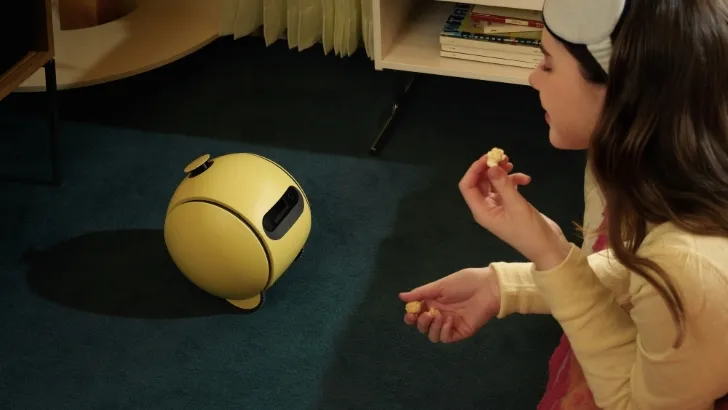
If you are searching for the Samsung Ballie release date, the honest answer is still a little frustrating.
Samsung has shown Ballie for years, refreshed it at CES 2024, and in April 2025 said the robot would be available to consumers in the United States and Korea that summer. But as of April 2026, Samsung still has no public Ballie price, no clearly published new retail date, and no normal checkout page that lets you simply buy one.
What Samsung does have is a live U.S. sign-up page for Ballie and a set of official feature claims that are more concrete than the usual CES concept-video hype. That makes Ballie worth tracking, but not yet worth treating like a fully buyable home robot.
For buyers, that distinction matters. On ui44, Ballie sits in a very unusual middle ground between shipping companion robots like Amazon Astro, Enabot EBO X, and LOVOT, and more ambitious still-developing home machines like LG CLOiD and 1X NEO.
The short answer on Samsung Ballie's release date
Here is the clearest official timeline I could verify.
Signal
CES 2024 refresh
- What Samsung officially said
- Samsung reintroduced Ballie as a rolling AI home companion with a built-in projector, smart-home control, video updates, and personalized assistance
- What buyers should take from it
- Ballie was no longer just the 2020 concept, but still not a retail product
Signal
April 2025 Samsung + Google Cloud announcement
- What Samsung officially said
- Samsung said Ballie would be available to consumers in the U.S. and Korea "this summer" and would use Gemini multimodal AI
- What buyers should take from it
- This was the strongest launch signal Ballie ever got, but it was still announcement-stage language
Signal
Current Samsung U.S. sign-up page
- What Samsung officially said
- Samsung is still collecting interest and asking buyers to register for updates
- What buyers should take from it
- That is closer to a waitlist than a store listing
| Signal | What Samsung officially said | What buyers should take from it |
|---|---|---|
| CES 2024 refresh | Samsung reintroduced Ballie as a rolling AI home companion with a built-in projector, smart-home control, video updates, and personalized assistance | Ballie was no longer just the 2020 concept, but still not a retail product |
| April 2025 Samsung + Google Cloud announcement | Samsung said Ballie would be available to consumers in the U.S. and Korea "this summer" and would use Gemini multimodal AI | This was the strongest launch signal Ballie ever got, but it was still announcement-stage language |
| Current Samsung U.S. sign-up page | Samsung is still collecting interest and asking buyers to register for updates | That is closer to a waitlist than a store listing |
So if your real question is "Can I buy Samsung Ballie today?" the answer is still no clear public retail flow.
That is why Ballie belongs in the same mental bucket as other high-interest home robots that have serious backing but incomplete retail execution. It is more real than a random concept render, but less concrete than a robot with a public price, checkout page, warranty flow, and broad regional availability.
Samsung's own U.S. sign-up form is revealing here. Instead of asking you to pick color, shipping option, or service plan, it asks which Ballie features interest you most, what matters most when buying a home robot, and which devices you want the robot to work with. That is market-building behavior, not mature retail fulfillment.
If you want a broader framework for separating announcement hype from real availability, ui44's launch-claims verification guide is still the right companion read.
What Samsung says Ballie can actually do
This is where Ballie gets more interesting. Samsung's official materials do not just say "AI robot" and stop there. They describe a fairly specific product shape.
1. Ballie is a mobile smart-home controller, not a humanoid helper
According to Samsung's CES 2024 and April 2025 materials, Ballie is designed to move around the home on its own and act as a personal assistant that stays near you instead of living on a shelf.
Samsung says Ballie can:
- navigate around the home autonomously
- control compatible smart-home devices through SmartThings
- greet people at the door
- personalize schedules and reminders
- send video updates of pets or family members when you are away
- answer phone calls and play music
That makes Ballie very different from a humanoid. It has no arms, so it is not trying to fold laundry, load a dishwasher, or pick up clutter. The bet is that a rolling robot with cameras, sensors, conversation, and home-control access may be useful enough for many households without the cost and complexity of a full-body machine.
That is a sensible product thesis. It is also a narrower thesis than some of the marketing language makes it sound.
2. The projector is one of Ballie's most distinctive features
Ballie's built-in projector is still the feature that most clearly separates it from other companion robots in ui44's database.
Samsung's official examples include Ballie projecting workout videos onto the wall or floor, showing schedules, and adjusting projected content to fit the space. That matters because most home robots can either move or display, but not blend both into the same experience.
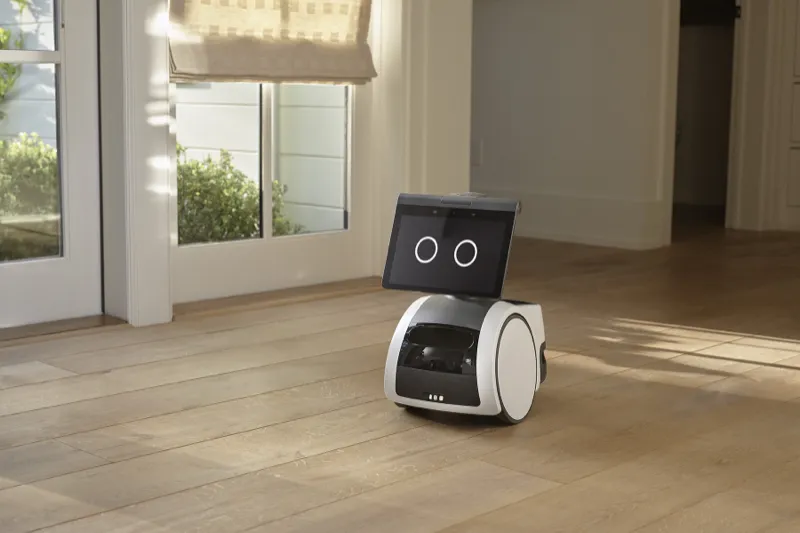
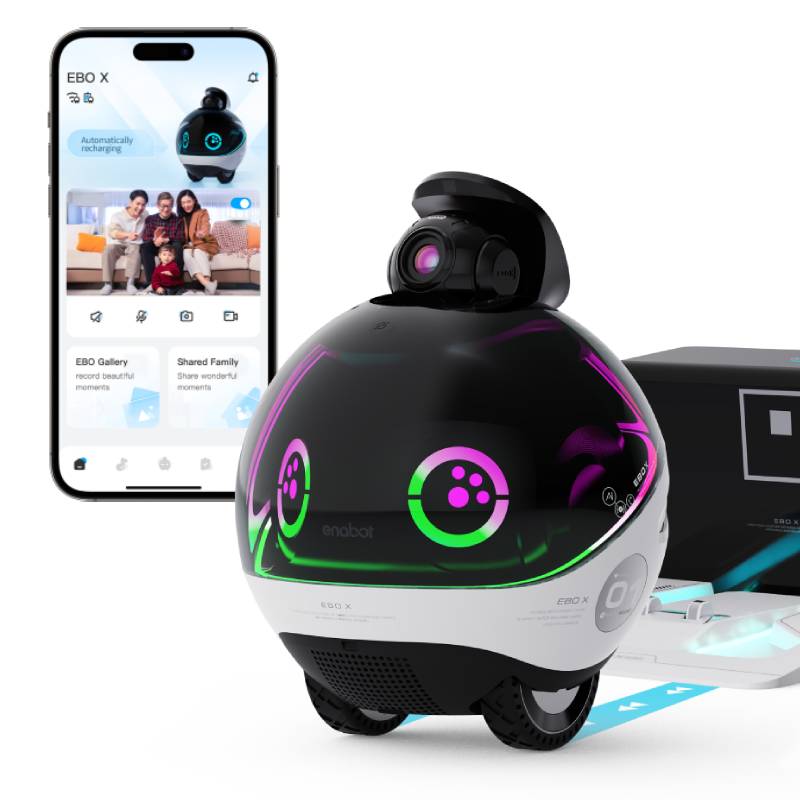
Amazon Astro, for example, has a screen and stronger security-monitoring positioning, but no projector. EBO X offers mobile video communication and a 4K camera at a much lower price point, but it also does not project content into the room. So when buyers ask what is actually unique about Ballie, the best answer is not just "Gemini." It is the combination of mobility, ambient assistance, and in-room projection.
3. Gemini gives Ballie a clearer AI story than earlier Samsung demos did
Samsung's April 2025 announcement added the missing AI layer.
The company says Ballie will combine Gemini's multimodal reasoning with Samsung's own language models. "Multimodal" here just means the robot is meant to combine more than one input type at once, including voice, camera data, and other environmental sensor signals.
Samsung's official examples are ambitious:
- you ask Ballie, "How do I look?"
- Ballie uses camera input to suggest styling changes
- you tell Ballie that you feel tired
- Ballie uses Gemini's grounding in Google Search to suggest wellness tips, sleep advice, or exercise guidance
That is much more specific than generic smart-speaker talk. It suggests Samsung wants Ballie to feel like a moving home AI interface, not just a robot with a few voice commands.
Still, buyers should keep one important line in mind: these are officially promised use cases, not yet broadly proven day-to-day retail behaviors. Samsung has described what Ballie is supposed to do. That is not the same thing as a year of public evidence showing how well it actually does it in messy real homes.
What is still missing before Ballie feels buyable
Ballie has enough official detail to be interesting. It still does not have enough commercial detail to feel settled.
Here are the biggest gaps.
Price is still missing
Samsung has not published a public Ballie price. That is a major omission, because Ballie's real competition changes depending on where it lands.
- At around $999, it would be fighting directly with EBO X on companion and monitoring value.
- At around $1,599, it would be much closer to Amazon Astro, which already has a more established security-monitoring identity.
- At several thousand dollars, Ballie would be competing less with consumer companions and more with premium novelty or early-adopter robots.
Without price, buyers cannot do the most basic value calculation.
A sign-up page is not the same as a live product page
A live Ballie sign-up page records interest. Its existence does not establish an ongoing consumer launch program or a completed retail release.
The practical read is simple: if Samsung were ready for broad consumer launch, you would expect a normal product page with pricing, ship timing, support terms, and retail availability. What exists instead is a reservation-style marketing flow.
Core specs are still thin
In ui44's current database, Ballie's officially disclosed specs are still fairly light. Height, weight, battery life, charging time, and max speed remain undisclosed. That is unusual for a product people are supposedly close to buying.
By contrast, ui44 already has clearer published data for several comparison robots:
- Amazon Astro is listed at $1,599.99, about 44 cm tall, and 9.35 kg
- EBO X is listed at $999 and 1.5 kg
- LOVOT starts at ¥577,500, stands 43 cm tall, and weighs 4.6 kg
- 1X NEO is listed at $20,000, 167 cm tall, and 30 kg
That comparison makes Ballie's current state easier to see. Samsung has explained its vision better than its hardware economics.
How Ballie compares with real ui44 robots right now
This is the most useful way to think about Ballie. Do not compare it to a science-fiction home robot. Compare it to products and near-products that solve similar parts of the same problem.
Robot
- Price in ui44 DB
- No price announced
- Status
- Prototype / unreleased
- What it is best at
- Smart-home control, projection, conversational home assistance
- Where Ballie looks different
- Projector plus mobile AI-assistant framing
Robot
- Price in ui44 DB
- $1,599.99
- Status
- Active
- What it is best at
- Home patrol, Alexa, Ring, remote monitoring
- Where Ballie looks different
- Ballie looks more lifestyle-oriented and less security-first
Robot
- Price in ui44 DB
- $999
- Status
- Available
- What it is best at
- Family monitoring, two-way communication, lower cost
- Where Ballie looks different
- Ballie promises deeper smart-home and projection features
Robot
- Price in ui44 DB
- ¥577,500 + care plan
- Status
- Available
- What it is best at
- Emotional companionship
- Where Ballie looks different
- Ballie is pitched as useful help, not affectionate presence
Robot
- Price in ui44 DB
- No price announced
- Status
- Development
- What it is best at
- Wheeled manipulation with dual arms
- Where Ballie looks different
- CLOiD is more about physical chores than ambient assistance
Robot
- Price in ui44 DB
- $20,000
- Status
- Pre-order
- What it is best at
- Full home humanoid vision
- Where Ballie looks different
- NEO aims much higher physically, with much more cost and risk
| Robot | Price in ui44 DB | Status | What it is best at | Where Ballie looks different |
|---|---|---|---|---|
| Samsung Ballie | No price announced | Prototype / unreleased | Smart-home control, projection, conversational home assistance | Projector plus mobile AI-assistant framing |
| Amazon Astro | $1,599.99 | Active | Home patrol, Alexa, Ring, remote monitoring | Ballie looks more lifestyle-oriented and less security-first |
| Enabot EBO X | $999 | Available | Family monitoring, two-way communication, lower cost | Ballie promises deeper smart-home and projection features |
| LOVOT | ¥577,500 + care plan | Available | Emotional companionship | Ballie is pitched as useful help, not affectionate presence |
| LG CLOiD | No price announced | Development | Wheeled manipulation with dual arms | CLOiD is more about physical chores than ambient assistance |
| 1X NEO | $20,000 | Pre-order | Full home humanoid vision | NEO aims much higher physically, with much more cost and risk |
A few things stand out from this table.
First, Ballie is probably not best understood as a direct humanoid rival. If you are deciding between Ballie and 1X NEO, you are really deciding between two different theories of home robotics. Ballie says conversation, mobility, projection, and smart-home coordination may be enough. NEO says buyers will eventually want arms and full-body physical work.
Second, Ballie does have a believable lane if Samsung executes. Many buyers do not actually need a robot to carry laundry baskets. They need a moving home interface that can monitor, remind, communicate, and control devices without feeling like a surveillance tower or an awkward humanoid roommate.
Third, the robots you can buy today still hold an important advantage: they are real products with clearer commercial terms. That matters more than keynote quality.
If you want to build your own shortlist, ui44's robot compare tool is the fastest way to put Ballie next to Astro, EBO X, LOVOT, or a home humanoid candidate.
What a real Ballie launch would need to include
This is the part many buyers skip when they get excited by a polished robot demo. A real consumer launch is not just a product video and a waitlist. It is an operational promise.
For Ballie to feel genuinely launch-ready, Samsung would need to publish at least five things clearly.
1. A public price and a normal purchase flow
A sign-up page creates curiosity. A live product page creates accountability.
Once Samsung publishes a Ballie price, buyers can finally compare it against:
- Amazon Astro if the main goal is home monitoring and Alexa-style convenience
- Enabot EBO X if the goal is lower-cost mobile communication and family check-ins
- LOVOT if the goal is emotional companionship
- premium early home robots if Ballie lands far above mainstream companion pricing
Right now, Ballie exists in a pricing vacuum. That makes it hard to judge whether Samsung is building a mass-market home product, a premium novelty, or a small-volume halo device.
2. A real regional availability plan
Samsung's April 2025 announcement named the U.S. and Korea. That is useful, but buyers still need normal launch details: which regions open first, whether rollout is limited, and whether support is direct-to-consumer, retailer-based, or invite-only.
That matters because many home robots create excitement globally but launch only in a narrow set of markets. A robot can be real and still be effectively unavailable to most households.
3. A clearer compatibility list
Ballie's promise becomes much stronger if it works cleanly with the devices people already own.
Samsung has already positioned Ballie around SmartThings and Gemini-powered assistance. The next logical proof point is a concrete compatibility page: which TVs, projectors, doorbells, appliances, lights, locks, and mobile devices work on day one, and which experiences are only promised for later.
Without that, Ballie risks being judged as a vague AI gadget instead of a home system product.
4. Hardware and battery specs
A robot that moves through the home needs more than a personality pitch. Buyers should know practical things like battery life, charging behavior, weight, travel speed, microphone/camera setup, and what happens when the robot loses network access or cannot reach its dock.
Samsung has been much clearer on Ballie's concept than on Ballie's ownership math. That gap is one reason the robot still feels pre-retail.
5. Privacy and support details that match the hardware
Ballie is not just a speaker on wheels. It is pitched as a mobile home AI system with camera input, environmental sensing, video updates, and smart-home access. That raises obvious buyer questions:
- what data stays local and what goes to the cloud?
- how are camera-triggered features handled?
- what account system and permissions will Ballie require?
- what happens to video history, logs, and household profiles?
- how will warranty and replacement support work?
Those details often decide whether a robot feels trustworthy in a real home. If you care about that side of ownership, ui44's home-robot privacy checklist and home-robot mapping data guide are still useful frameworks even before Samsung publishes Ballie's full policy stack.
Where Ballie could actually fit in a home
One reason Ballie still attracts so much attention is that Samsung's product thesis is easy to understand. It is not trying to be a general-purpose humanoid. It is trying to be a mobile layer on top of your existing home.
That could make sense in a few specific scenarios.
A moving smart-home control point
If you already use SmartThings heavily, Ballie could be more useful than a fixed speaker or display because it can come to you instead of waiting on a counter. A robot that follows routines, surfaces reminders, and controls devices from the room you are actually in is a different experience from shouting at a speaker in another part of the house.
A projection-first home assistant
The projector matters more than it first appears. A lot of consumer home-robot pitches are really disguised smart-display pitches. Ballie at least offers a reason to move around: project information where the activity is happening. That could mean fitness guidance in one room, calendar or recipe support in another, or visual cues for family communication without mounting another screen.
A softer alternative to full-time camera towers
Some buyers want occasional remote check-ins, family updates, or pet monitoring, but do not want every room dominated by fixed cameras or a more security-first robot identity. Ballie's design and marketing suggest Samsung wants it to feel friendlier and more ambient than a patrol-style machine.
That does not automatically make it more private or more useful. But it does help explain why Ballie keeps resurfacing even after repeated release delays. The category idea is plausible.
Not a chore robot, and probably not a security robot first
This is also where expectations need to stay grounded. Based on Samsung's own materials, Ballie is not the robot to wait for if your core goal is physical help around the house.
It will not replace the ambition behind robots like LG CLOiD or 1X NEO, which aim at much more hands-on physical assistance. And it is not identical to Amazon Astro, which is easier to understand as a monitoring and Alexa-extension device.
The cleanest way to think about Ballie is this: if Samsung executes, Ballie could become one of the first mainstream home-interface robots rather than one of the first mainstream home-labor robots. That is a smaller promise, but maybe a more realistic one.
Should you wait for Ballie?
My answer is: wait for Ballie only if Ballie's exact mix of features is what you want, and you are comfortable waiting through uncertainty.
Wait for Ballie if:
- you are already invested in Samsung SmartThings
- the projector matters to you, not just the robot form factor
- you want a robot that feels more like a mobile home interface than a pet or security device
- you are okay waiting for Samsung to publish price, retail terms, and a real ship path
Buy something else now if:
- you need mobile home monitoring today and want a clearer current product, in which case Amazon Astro or EBO X are easier to evaluate
- you want emotional companionship, where LOVOT is much clearer about what it is for
- you want physical household help, where Ballie is not the right category at all, and even robots like LG CLOiD and 1X NEO are still early

Bottom line
The most accurate current answer to "What is the Samsung Ballie release date?" is this:
- Samsung's last strong official timing signal was a summer 2025 U.S. and Korea launch window
- Samsung still has a live Ballie sign-up page in the U.S.
- Samsung still has no public Ballie price and no clearly published new consumer retail date that I could verify from current official pages
And the answer to "What can Samsung Ballie actually do?" is more promising than the release picture. Samsung has described a robot that can move through your home, control SmartThings devices, project content, send video updates, and use Gemini-powered multimodal AI for more natural conversation and contextual help.
That is enough to make Ballie one of the most interesting home robot products on ui44 right now. It is not enough to treat it like a finished consumer launch.
Frequently Asked Questions
Is Samsung Ballie available to buy now?
Not through a normal public retail checkout flow that I could verify. Samsung's
current U.S. Ballie page is a sign-up page for updates, not a standard product
purchase page.
How much will Samsung Ballie cost?
Samsung has not publicly announced a Ballie price.
Is Ballie a humanoid robot?
No. Ballie is a rolling companion robot. It is designed more for smart-home
control, communication, projection, and ambient assistance than for physical
chores.
Does Samsung Ballie use Gemini?
According to Samsung's April 2025 announcement with Google Cloud, Ballie is
supposed to combine Gemini's multimodal capabilities with Samsung's own language
models. That is a major part of the robot's current positioning.
What countries has Samsung named for Ballie?
Samsung's April 2025 announcement said Ballie would be available to consumers in
the United States and Korea that summer. I could not verify a newer public
retail launch schedule beyond that earlier timing signal.
What is the biggest reason to stay cautious about Ballie?
The biggest reason is simple: Samsung has described Ballie well, but it still
has not published the full retail picture. Until there is a price, a normal
product page, and a clear ship path, Ballie remains more concrete than a concept
and less concrete than a normal buyable home robot.
Sources & References
- Samsung U.S. Newsroom, "A Day in the Life With Ballie: An AI Companion Robot for the Home" (CES 2024 product framing): https://news.samsung.com/us/samsung-ballie-ai-companion-robot-home-video-ces-2024/
- Samsung U.S. Newsroom, "Samsung and Google Cloud Expand Partnership, Bring Gemini to Ballie" (April 2025 availability window and Gemini claims): https://news.samsung.com/us/samsung-google-cloud-expand-partnership-bring-gemini-ballie-home-ai-companion-robot-by-samsung/
- Samsung Global Newsroom, parallel Ballie + Gemini announcement: https://news.samsung.com/global/samsung-and-google-cloud-expand-partnership-bring-gemini-to-ballie-a-home-ai-companion-robot
- Samsung U.S. Ballie sign-up page (current update/reservation flow): https://www.samsung.com/us/projectors/home-robot-ballie/app/
- ui44 robot database entries used for comparison: Samsung Ballie, Amazon Astro, Enabot EBO X, LOVOT, LG CLOiD, and 1X NEO
Written by
ui44 Team
Published April 14, 2026
Share this article
Open a plain share link on X or Bluesky. No embeds, no widgets, no cookie baggage.