Sunday is making a practical bet. Memo uses wheels instead of legs, focuses on repetitive household chores instead of vague "general intelligence," and is being framed around a late-2026 beta instead of a fake-now retail launch. That makes it more believable than many humanoid demos.
It also still looks early. On ui44, Sunday Memo is tracked as Development status with no public price, no general retail launch date, and no public spec sheet detailed enough to compare it like a finished appliance.
So the right buyer framing is simple. Memo is one of the more interesting home robots to watch in 2026, but it is not one most households should plan to buy yet.
What is actually real about Sunday Memo today?
More than the average concept robot, but less than a normal preorder product.
Sunday's official site says "Beta launching late 2026" and positions Memo as a home robot for repetitive chores like clearing tables, loading dishwashers, folding laundry, and making coffee. The company's technology page also says it has shipped more than 2,000 Memory Gloves to contributors who record household movements as training data.
Those are concrete signals. Sunday is not just showing a single concept render. It has a live product narrative, a named beta program, a clear task list, and a specific training-data pipeline it wants people to believe in.
Sunday's March 12 Series B announcement also confirmed two important facts: the company raised $165 million and did so at a $1.15 billion valuation. The same post said public deployment starts with a beta rolling out to users in fall 2026. That does not prove Memo works in ordinary homes, but it does show the company is funding a real deployment push, not just a trade-show demo.
At the same time, buyers still do not have the basics they would expect from a real retail product page:
- no public retail price
- no broad consumer shipping date
- no detailed hardware spec sheet
- no published support or service terms
- no outside beta feedback yet
That is why Memo matters, but also why it still belongs in the watchlist category rather than the shopping list category.
Why does Memo look more practical than many humanoids?
Because it is solving a housework problem, not a stage problem.
A full humanoid body is great for headlines. It is less obviously great for a busy kitchen, a narrow apartment, or a home with pets, kids, chairs, and floor clutter. Sunday is making the opposite design choice. Memo uses a wheeled base and vertical manipulation instead of bipedal walking.
That costs Memo something. Stairs are the obvious example. If your robot must move between floors by itself, wheels are a real limitation.
But the wheeled approach also buys practical advantages:
- more stable motion around people and pets
- less energy wasted on balancing and walking
- simpler movement for repeated kitchen and dining-room chores
- lower fall risk than a tall bipedal robot
- a design that feels closer to an appliance than a humanoid experiment
That is why Memo reads as a more grounded first-generation home robot. It is not trying to win on spectacle. It is trying to look useful in the parts of the home where repetitive tasks actually pile up.
This is also why Memo fits a broader ui44 theme. The most believable household robots in 2026 do not always look the most futuristic. Sometimes the more credible robot is the one willing to be less dramatic.
How does Sunday Memo compare with 1X NEO, LG CLOiD, and SwitchBot?
This is where ui44's database helps. A lot of coverage throws every home robot into one bucket, but buyers do not really care about the bucket. They care about which company looks closest to shipping something useful.
If you want the broad market first, our guide to home humanoid robots that might actually ship in 2026 is the best place to start before zooming back in on Memo.
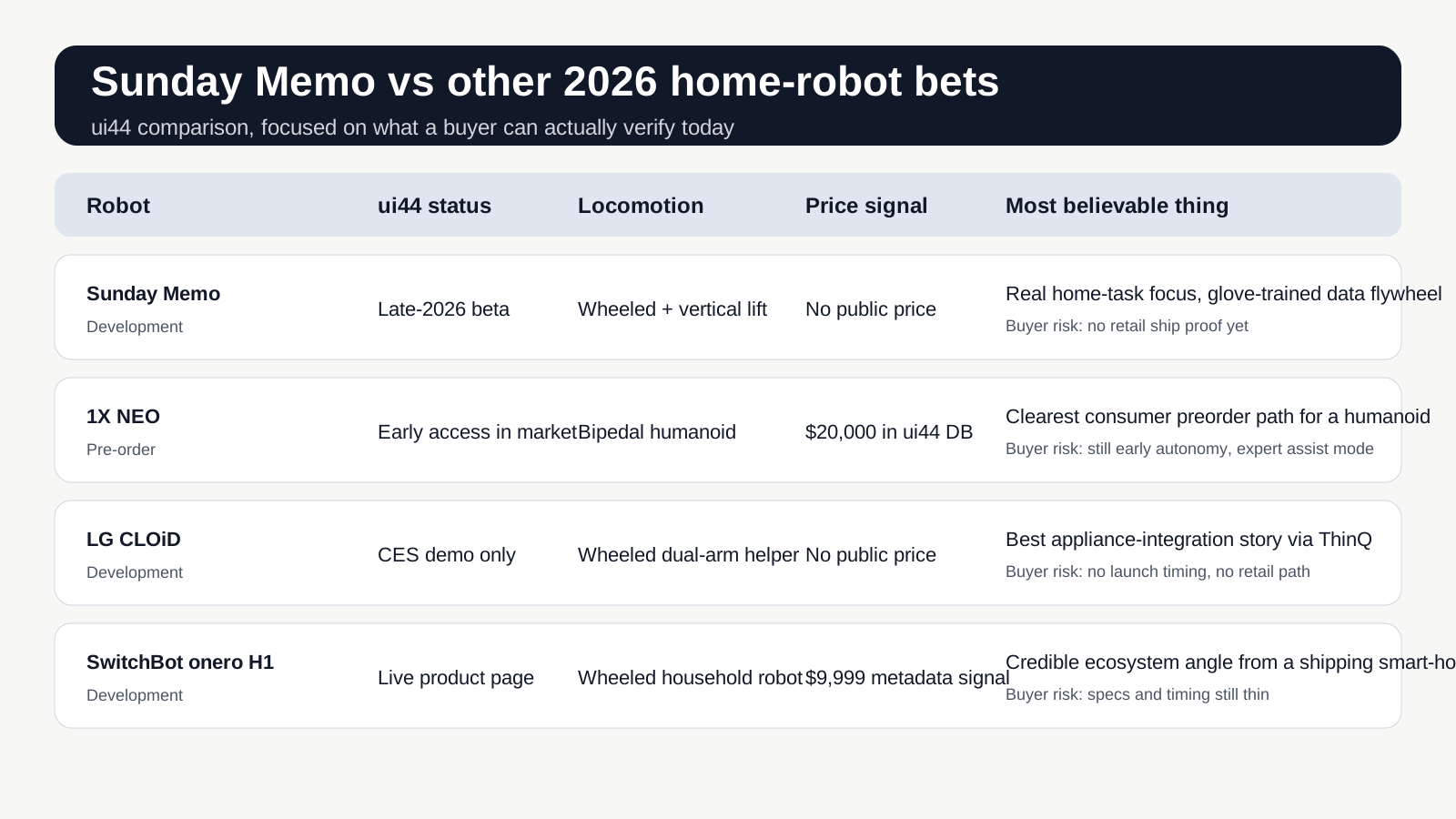
Robot
- ui44 status
- Development
- Price in DB
- No public price
- Locomotion
- Wheeled home robot
- What looks most credible today
- Official late-2026 beta plan and real-home training-data story
- Biggest buyer caution
- No retail proof yet
Robot
- ui44 status
- Pre-order
- Price in DB
- $20,000
- Locomotion
- Bipedal humanoid
- What looks most credible today
- Real preorder path and clearer consumer pricing
- Biggest buyer caution
- Early-autonomy risk and very high price
Robot
- ui44 status
- Development
- Price in DB
- No public price
- Locomotion
- Wheeled dual-arm helper
- What looks most credible today
- Strong appliance integration through LG ThinQ
- Biggest buyer caution
- No clear ordering path or launch timing
Robot
- ui44 status
- Development
- Price in DB
- $9,999 product-page metadata signal
- Locomotion
- Wheeled household robot
- What looks most credible today
- Comes from a company that already ships smart-home hardware
- Biggest buyer caution
- Timing and real-home performance still unclear
Robot
- ui44 status
- Available
- Price in DB
- $699
- Locomotion
- Wheeled modular platform
- What looks most credible today
- Already shipping and already useful in a narrower role
- Biggest buyer caution
- Not a general household manipulator
| Robot | ui44 status | Price in DB | Locomotion | What looks most credible today | Biggest buyer caution |
|---|---|---|---|---|---|
| Sunday Memo | Development | No public price | Wheeled home robot | Official late-2026 beta plan and real-home training-data story | No retail proof yet |
| 1X NEO | Pre-order | $20,000 | Bipedal humanoid | Real preorder path and clearer consumer pricing | Early-autonomy risk and very high price |
| LG CLOiD | Development | No public price | Wheeled dual-arm helper | Strong appliance integration through LG ThinQ | No clear ordering path or launch timing |
| SwitchBot onero H1 | Development | $9,999 product-page metadata signal | Wheeled household robot | Comes from a company that already ships smart-home hardware | Timing and real-home performance still unclear |
| SwitchBot K20+ Pro | Available | $699 | Wheeled modular platform | Already shipping and already useful in a narrower role | Not a general household manipulator |
A few things stand out immediately.
1X NEO still has the clearest premium buyer path. ui44 tracks NEO at $20,000, 167 cm, 30 kg, and about 4 hours of battery life. That is much more concrete than Memo today. But it also asks buyers to accept much more humanoid risk, both technically and financially. For that side of the market, our 1X NEO preorder guide is the best companion read.
LG CLOiD may be Memo's closest design cousin. LG's CES 2026 robot also uses a wheeled base, adds two 7-degree-of-freedom arms, and leans hard into appliance coordination through ThinQ. But CLOiD still feels like a polished ecosystem vision. Sunday, at least, is talking in beta-program terms instead of pretending launch is imminent.
SwitchBot onero H1 is the most useful comparison if you want the "smart-home brand versus robotics startup" debate. ui44 tracks it as a development-stage wheeled robot, and SwitchBot's product metadata has pointed to a $9,999 price signal even though the robot is still coming soon. That is not the same as a clean retail launch, but it is a more concrete consumer signal than Memo's current no-price posture.
Then there is the already-available SwitchBot K20+ Pro, which matters for a different reason. It is not a general household manipulator, but it shows how a narrower wheeled home robot can still be commercially real. Sometimes the most important competitor is not another ambitious humanoid. Sometimes it is a much simpler robot that already ships.

Is Sunday's anti-teleoperation pitch a real advantage?
Potentially, yes, but it needs to be framed carefully.
Sunday's technology page makes a very specific claim. It says Memo learns without teleoperation in its training pipeline, because Sunday is collecting human demonstrations through its Skill Capture Glove system instead of relying only on teleoperated robot data.
That is an important distinction.
It is not the same as proving Memo will run through the beta with no human help. In fact, Sunday's official beta page says the Founding Family program will experiment with a mix of supervision, collaboration, and complete hands-off Memo magic. That is much more nuanced than a simple "no teleoperation" story.
So the honest way to read Sunday's pitch is this:
- Sunday is arguing that its training-data strategy is less dependent on teleoperated robot collection than many rivals
- Sunday is not promising that every beta home gets a fully hands-off robot experience from day one
- buyers should separate Memo's data-collection story from Memo's real-world operating autonomy
That still leaves Sunday with a potentially real advantage. If its glove-based pipeline really helps it collect diverse home-task data faster, Memo could improve more quickly than robots trained mostly through tightly controlled demos.
But this remains a thesis until outside beta households report how often Memo can actually finish chores without intervention.
Where does Memo still look thin?
This is the section most buyers should read twice.
Memo is being positioned as a practical home robot, which means it will be judged like an appliance. That is harder than being judged like a research demo. And right now, several pieces are still missing.
1. No public retail price
This is the biggest missing piece. Price tells buyers what kind of product a robot actually is. Is Memo closer to a $10,000 early-adopter machine, a $20,000 premium robot like NEO, or something even higher-end? Until Sunday says so publicly, every comparison remains incomplete.
2. No broad consumer availability date
Sunday has a beta timeline, not a normal launch timeline. That matters. A late- 2026 beta is meaningful, but it is not the same as ordinary households being able to place an order.
3. No outside proof across messy homes
Sunday's official materials say Memo is trained in real homes and designed for real life. That is exactly the right claim to test. But until outside families show what happens in homes Sunday did not choreograph, buyers still only have Sunday's version of the story.
4. Wheels are practical, but not universal
If your home has stairs or important chores spread across multiple levels, a wheeled robot is still constrained. That does not make Memo a bad idea. It just means Sunday is optimizing for one slice of household usefulness, not every household layout.
That is also why smaller or narrower robots remain relevant. A wheeled helper that does fewer things reliably can still beat a more ambitious robot that does many things only in controlled demos.

Which homes are the best fit for Sunday Memo if it works?
This is the question more early coverage should answer. Not every household wants or needs the same kind of robot. Memo's promise makes the most sense in homes where daily chores repeat in a predictable layout.
The strongest fit looks like this:
- mostly single-floor living, or at least a main floor where kitchen and dining tasks happen in one zone
- households that care more about table clearing, dishwasher loading, and light routine help than about a robot walking like a person
- early adopters who are comfortable watching software improve over time instead of expecting a finished appliance on day one
- homes where stability matters more than dramatic mobility, especially around pets, kids, chairs, and narrow passages
That last point matters a lot. A wheeled base is less cinematic than a biped, but it often makes more sense indoors. Homes are full of surfaces, furniture, and fragile objects. A robot that stays balanced more easily and wastes less energy on locomotion may have a better shot at doing real work between the kitchen, dining table, and counter.
The weaker fit is just as important:
- multi-level homes that need autonomous stair travel
- buyers who want a published price before they pay attention
- households expecting a broad retail launch instead of a limited beta
- people who mainly want a general-purpose humanoid because it looks more future facing
- anyone who has little patience for support friction, supervised runs, or early-product quirks
This is where Memo starts to split the market. If you want the cleanest path to an early-adopter humanoid purchase, 1X NEO still looks more concrete because there is a real preorder path and public pricing. If you want the broader design debate, our wheeled vs bipedal home robot guide shows why the answer depends more on your layout and risk tolerance than on pure robotics ambition.
Memo's best-case audience is not "everyone who wants a home robot." It is the smaller group of buyers who think a practical wheeled helper could beat a more expensive humanoid in real rooms with real chores.
What would a credible Sunday Memo beta actually need to prove?
A beta does not need to prove perfection. It does need to prove that a product is moving from a story into a system.
For Memo, the late-2026 beta should answer five buyer questions better than any promo video can.
1. Can it finish the named chores with low intervention?
Sunday is already telling people what Memo is for: clearing tables, loading dishwashers, folding laundry, and making coffee. That is good because those are concrete tasks, not fuzzy "help around the house" language. The beta now needs to show how often Memo can finish those tasks without a person rescuing it, repositioning it, or correcting every other step.
A useful home robot does not need to be magical. It does need to be repeatable. If Memo can reliably handle the same few chores across different homes, that is much more important than a flashy one-off demo.
2. How much supervision does the beta really require?
Sunday's own wording is smarter than a lot of robotics marketing here. The beta page talks about supervision, collaboration, and hands-off operation instead of pretending autonomy is all-or-nothing. That honesty helps.
But buyers will still want the real ratio. Does "supervision" mean tapping a button once per task, or does it mean hovering nearby because dishes, pets, and chairs confuse the robot? That gap is huge. A credible beta is one where human help is occasional and understandable, not constant and exhausting.
3. Does it work in homes Sunday did not carefully stage?
This is the core test for every home robot. Controlled demos can hide a lot: clean counters, wide clearances, easy object placement, perfect lighting, no unexpected clutter. Real homes are messier.
The strongest Memo beta signal would be consistent performance in ordinary kitchens and living spaces that were not optimized around the robot. That means mixed furniture, cramped pathways, irregular dish loads, and the kind of small layout weirdness normal households barely notice until a robot hits it.
4. Does the support model feel like a product, not a lab project?
A beta can still feel trustworthy if setup, maintenance, issue reporting, and safety guidance are handled like a real consumer program. Early buyers do not just evaluate the robot body. They evaluate the whole ownership loop.
That includes questions like:
- how quickly problems are acknowledged
- whether the company explains known limitations clearly
- how updates are delivered
- what the recovery path looks like when a task fails
- whether support is calm and operational or vague and experimental
This is one reason published price and service terms matter so much. A home robot is not only hardware. It is also the support system around the hardware.
5. Does Memo beat simpler alternatives on actual usefulness?
The toughest comparison for Memo may not be another humanoid. It may be the bundle most people already understand: a robot vacuum, appliance automation, a smart speaker, and one or two narrower-purpose robots that already ship.
If Memo saves meaningful time in a kitchen or dining routine, it starts to look important fast. If it mostly recreates tasks people already handle with simpler cheaper tools, the pitch gets weaker no matter how interesting the robot looks.
That is why this beta matters beyond Sunday itself. The result will say something about whether the near-term home-robot winner is a general humanoid, a wheeled manipulator, or a collection of smaller systems.
Sunday Memo FAQ
Is Sunday Memo a humanoid robot?
Not in the usual sense. Memo is being presented as a wheeled household robot with vertical manipulation, not as a full bipedal humanoid. For buyers, that is not a downgrade by default. It is a design tradeoff. You give up natural stair travel and some human-like movement, but you may gain stability, efficiency, and a form factor that fits appliance-style chores better.
That distinction matters because many buyers search for home humanoids when what they really want is useful automation. Memo is closer to the practical end of that spectrum than to the "android in your house" fantasy.
Does Sunday Memo have a public price yet?
No. That is still one of the biggest reasons to treat Memo as a watchlist robot instead of a buying decision. Without a public price, it is hard to judge what kind of market Memo is really targeting.
A robot with no price can still be interesting, but it cannot be compared cleanly against robots with real early-adopter numbers like 1X NEO or even development-stage signals like SwitchBot onero H1. Price tells you whether a product is aiming for premium enthusiasts, luxury households, enterprise-adjacent pilots, or something broader.
Is Memo closer to LG CLOiD or to 1X NEO?
In physical philosophy, Memo looks closer to LG CLOiD because both lean toward a wheeled helper model instead of a biped. In buyer posture, Memo sits somewhere between the two. It feels more grounded than many humanoid demos, but less commercially concrete than NEO because there is still no public price or broad consumer ordering path.
That is why Memo is interesting. It combines a practical-looking hardware idea with an still-early market posture. If Sunday executes well, that middle ground could become one of the most important design lanes in home robotics.
Can a wheeled robot really be more useful than a biped at home?
Absolutely, depending on the home and the task. A biped has obvious advantages if the job requires human-style movement through stairs and spaces built only for legs. But many indoor chores do not require that. They require safe repeatable movement between counters, tables, appliances, and storage areas.
That is exactly why the wheeled-versus-biped debate matters so much in 2026. The most futuristic robot is not automatically the most useful one. In many homes, a stable wheeled machine that does three chores reliably would be a better product than a biped that can do ten things only under supervision.
Should early adopters try to join the beta or wait?
Most people should wait. That is the honest answer.
The users who should care most about the beta are the ones who actively want to help test the category, understand that early robotics means edge cases, and are comfortable measuring value in progress rather than polish. For almost everyone else, the smarter move is to watch what the beta reveals about price, support, intervention frequency, and real-home reliability.
If the late-2026 beta goes well, Memo could become a much more serious 2027 shopping conversation. If it does not, the most valuable thing the beta will do is save mainstream buyers from treating a compelling concept as a finished home product.
When can you buy Sunday Memo, and what should you do now?
Right now, you should treat Memo as a serious watchlist robot, not a purchase decision.
Sunday's official public promise is a limited Founding Family beta in late 2026, not broad retail availability. That alone tells you how early this still is.
So the practical next steps are:
- watch the beta, not just the marketing narrative
- compare Memo against 1X NEO, LG CLOiD, and SwitchBot onero H1, not just against generic future humanoids
- wait for public price, support terms, and real user case studies
- keep in mind that narrower robots often reach homes before general-purpose ones do
That last point matters a lot. In 2026, the practical competition for Memo may not be another humanoid at all. It may be a bundle of smaller systems that already work: a robot vacuum, a smart-home hub, a modular delivery platform, and appliance automation.
If Sunday can beat that bundle on real usefulness, Memo becomes one of the most important home-robot stories of the year. If it cannot, Memo becomes another smart-looking near miss.
If you want the broader side-by-side view, ui44's Compare tool is the fastest way to track how these home robots stack up as pricing and launch details change.
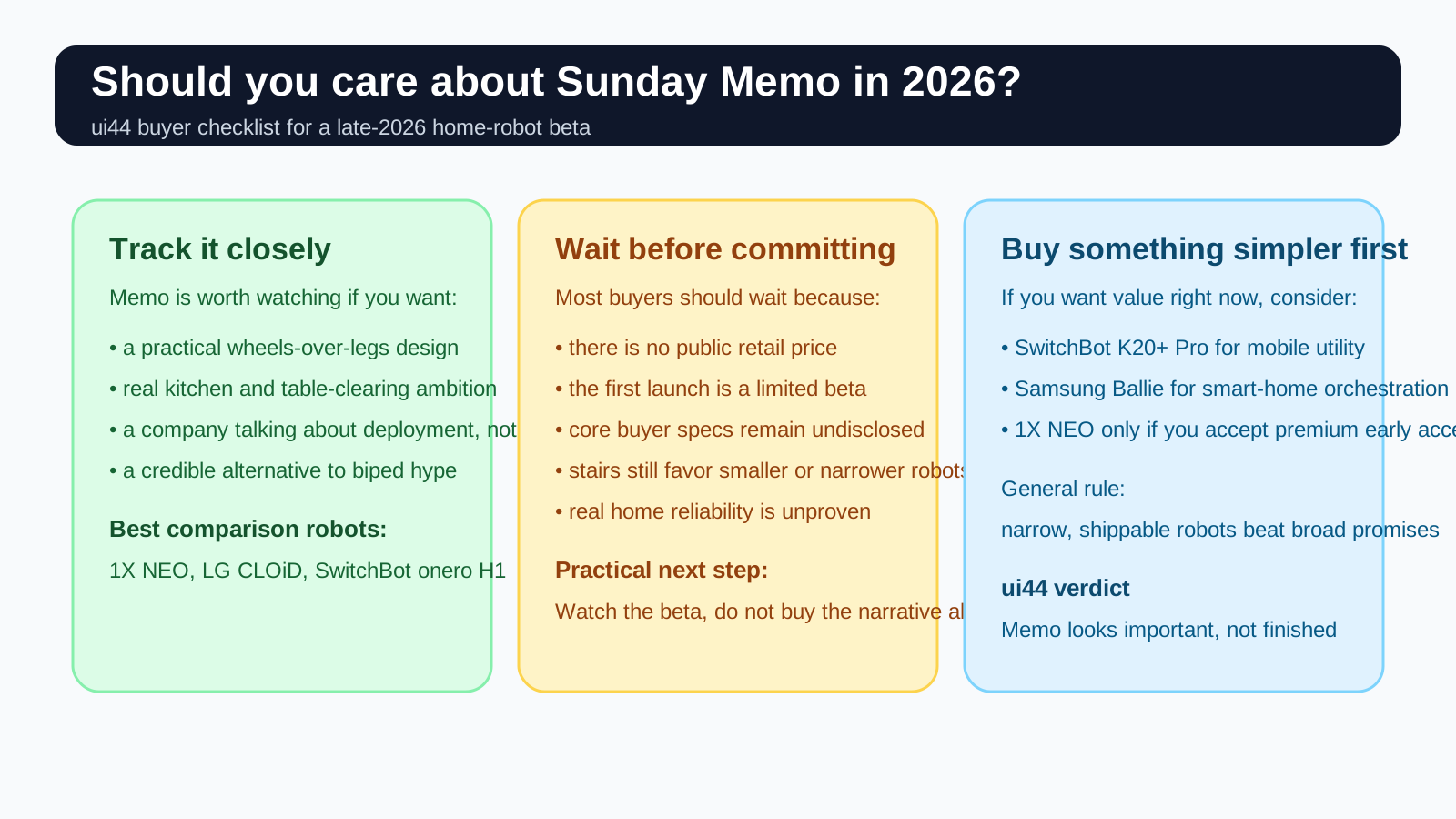
The bottom line
Sunday Memo is one of the few household robots in 2026 that feels designed around the boring realities of chores instead of the flashy optics of humanoid demos.
That is the good news.
The caution is that it is still a beta-stage robot with no public price and no broad consumer launch. Sunday has a more grounded story than many rivals, but buyers should not confuse a strong story with a finished product.
The clearest verdict today is this:
- Memo looks more practical than most home-humanoid pitches
- its late-2026 beta makes it worth tracking closely
- Sunday's glove-based training story is interesting, but it does not prove a fully hands-off beta experience
- most households should still wait for price, proof, and post-beta reality
That may sound conservative. It is. But in home robotics, conservative buying is usually the smart kind.
Written by
ui44 Team
Published April 21, 2026
Share this article
Open a plain share link on X or Bluesky. No embeds, no widgets, no cookie baggage.