The country's physical-AI strategy links memory chips, AI data centers, robot foundries, component suppliers, field-data factories, workforce training, and early deployments in factories, hospitals, hotels, logistics, shipbuilding, and home appliances. That combination matters more than any single demo video. Homes are not controlled assembly lines, but the robots that eventually enter them will be shaped by the infrastructure built for earlier, safer, more repetitive environments.
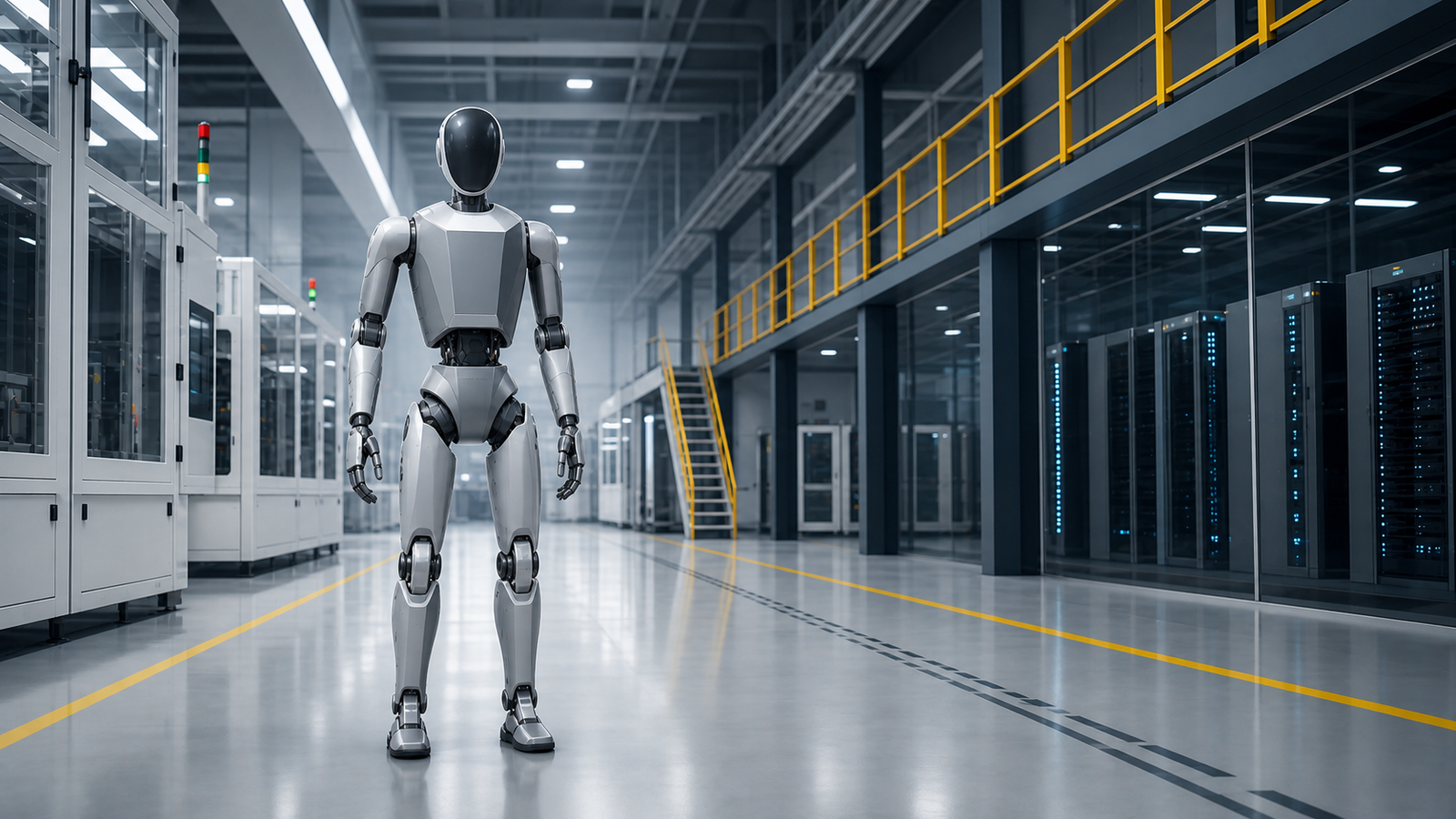
AI-generated editorial illustration for ui44, based on official product and infrastructure references. It is not a product photo and does not show verified home capability.
For home-robot buyers, the practical question is not "When can I buy the robot from the stage demo?" It is "When do the hardware supply chain, training data, safety case, repair model, and software update loop become boring enough to trust inside a house?" South Korea is trying to industrialize those boring parts.
What Korea Is Actually Building
Seoul Economic Daily's English edition reported that the government wants to commercialize humanoids specialized for 10 industries by 2028, build a physical-AI foundation model within three years, deploy 1,000 AI robots per year, train 10,000 AI robotics specialists over five years, and set up data factories for each target industry. The same report says Daegu and North Gyeongsang will anchor field testing, while Saemangeum will host robot foundry and parts-cluster work.
That is not a consumer-humanoid launch plan. It is an attempt to build the stack that consumer humanoids need later:
Infrastructure piece
Memory chips and AI data centers
- Why it matters for home robots
- Training and updating embodied models is compute-hungry, especially when video, simulation, and robot logs are involved.
Infrastructure piece
Robot foundries and parts clusters
- Why it matters for home robots
- Consumer pricing depends on repeatable production of actuators, hands, sensors, batteries, and frames.
Infrastructure piece
Industry test fields
- Why it matters for home robots
- Robots need thousands of hours of mundane failure data before they are trusted around people.
Infrastructure piece
Component localization
- Why it matters for home robots
- Hands, joints, and sensors are often the expensive, failure-prone parts of a humanoid.
Infrastructure piece
Workforce training
- Why it matters for home robots
- Deployment is not just AI research; it needs maintenance, safety engineering, teleoperation, data labeling, and field support.
| Infrastructure piece | Why it matters for home robots |
|---|---|
| Memory chips and AI data centers | Training and updating embodied models is compute-hungry, especially when video, simulation, and robot logs are involved. |
| Robot foundries and parts clusters | Consumer pricing depends on repeatable production of actuators, hands, sensors, batteries, and frames. |
| Industry test fields | Robots need thousands of hours of mundane failure data before they are trusted around people. |
| Component localization | Hands, joints, and sensors are often the expensive, failure-prone parts of a humanoid. |
| Workforce training | Deployment is not just AI research; it needs maintenance, safety engineering, teleoperation, data labeling, and field support. |
The data-factory idea may be the most important part. Generative AI scaled because the internet contained a huge amount of text and media. Physical AI has a thinner data base: torque readings, failed grasps, camera views from awkward angles, slips, recovery motions, human demonstrations, and object interactions. A home robot does not need to write a poem about a dishwasher. It needs to avoid dropping a wet plate.
Why This Starts In Factories, Not Kitchens
The first realistic wave of full-size humanoids is still factory-first. ui44's database shows the pattern clearly.
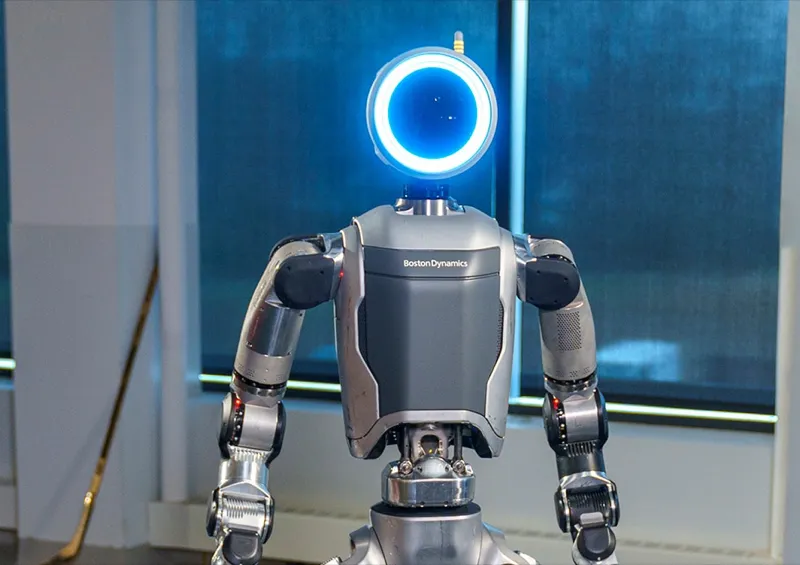
Boston Dynamics Atlas (Electric) is listed as an active industrial humanoid, not a consumer robot. ui44 tracks Atlas at 190 cm, 90 kg, roughly 4 hours of battery life, 56 degrees of freedom in its current database description, IP67 certification, and no public price. Its entry describes 2026 deployments as enterprise commitments, including Hyundai and Google DeepMind, rather than normal retail availability.
Agility Digit follows the same pattern. Digit is a 175 cm, 65 kg warehouse humanoid with about 4 hours of battery life, 16 kg box-carrying capability, LiDAR and RGB-D cameras, and enterprise RaaS availability through Agility's sales channel. It is designed around tote handling and logistics workflows, not carrying groceries through a child's bedroom.
Figure 03 is another useful comparison. ui44 lists it as a 173 cm, 61 kg humanoid with a roughly 5-hour battery life, 20 kg payload, stereo vision, depth cameras, force sensors, tactile arrays, and Figure's Helix VLA system. The stated deployment path remains industrial, with BMW evaluation after earlier Figure 02 factory work.
Those robots matter for homes precisely because they are not home products yet. Factories provide repeatable aisles, known containers, trained staff, safety zones, charging routines, and measurable productivity targets. A house provides pets, children, laundry piles, reflective appliances, stairs, glassware, guests, privacy expectations, and no robotics technician on the night shift.
Korea's Supplier Bet Could Change The Cost Curve
The Korea Herald reported that Boston Dynamics was evaluating Korean auto-parts suppliers and that Hyundai was targeting large-scale Atlas production. Seoul Economic Daily separately reported Samsung's 60 trillion won Yeongnam investment plan, including physical-AI and humanoid robot production lines in Gumi and a Samsung SDS AI data center.
The exact numbers will move as programs evolve, but the direction is clear: Korea is treating humanoids less like research prototypes and more like automotive-scale manufacturing.
That matters because home humanoids will not be affordable through software alone. A household robot needs motors that survive years of daily motion, joints that remain quiet and safe, hands that tolerate dust and moisture, batteries that charge predictably, cameras that work under normal indoor lighting, and covers that survive bumps without becoming sharp or ugly.
The current market shows the gap. 1X NEO, one of the few home-focused humanoids in ui44's database, is listed at $20,000 for Early Access ownership, with a $499/month subscription option shipping later and U.S. deliveries starting in 2026. NEO is relatively light for a full-size home robot at 167 cm and 30 kg, with about 4 hours of battery life, RGB cameras, depth sensors, tactile skin, and a microphone array.

NEO is interesting because it is designed for the home first. It is also a reminder that the first buyer-facing humanoids are likely to be expensive, limited, and partly dependent on remote assistance or staged task boundaries. For mainstream buyers, component scale is not a side story. It is the difference between a $20,000 early-access robot and something that feels closer to an appliance purchase.
Field Data Is The Hidden Constraint
Physical AI sounds abstract, but the shortage is concrete. Robots need data about how ordinary objects behave under contact. A towel stretches. A cup handle occludes part of a camera view. A drawer sticks. A shoe slides. A cable snags. A person steps into the path at the wrong moment.
South Korea's proposed industry data factories are important because they can collect that type of repeated, domain-specific experience without asking consumers to be beta testers in their living rooms. A hospital robot can learn corridor traffic. A hotel robot can learn linen carts and elevator etiquette. A factory robot can learn parts bins and tool stations. A home-appliance pilot can learn doors, shelves, buttons, and kitchen surfaces.
The home translation still will not be automatic. Household objects vary more than factory fixtures. Privacy expectations are higher. Failure costs are emotional as well as financial: a dropped laptop, a frightened child, a recorded private conversation, or a broken heirloom can destroy trust faster than a missed cycle time in a warehouse.
That is why data governance matters. A policy that encourages raw work-data collection needs clear consent, ownership, anonymization, retention, and compensation rules. More data helps robots, but unbounded data collection inside homes would be a bad bargain for buyers.
Hands And Actuators Are More Than Spec Sheet Details
The Seoul Economic Daily report specifically called out vulnerable components such as actuators, robot hands, and sensors. That list is exactly where home utility lives or dies.
Walking across a room is impressive. Folding clothes, loading a dishwasher, opening a sticky cabinet, lifting a saucepan, plugging in a charger, and sorting clutter are manipulation problems. They require grip force, touch sensing, wrist compliance, software recovery, and hardware durability.
This is where today's robots split into different buyer realities:
Robot
- ui44 status
- Pre-order, home-focused, $20,000
- Home relevance
- Closest to a direct home-humanoid offer, but still early and expensive.
Robot
- ui44 status
- Available, $13,500 research humanoid
- Home relevance
- Lower-cost access to humanoid hardware, but positioned for R&D rather than normal home chores.
Robot
- ui44 status
- Active enterprise humanoid, no public price
- Home relevance
- A signal for industrial physical-AI capability, not a consumer purchase.
Robot
- ui44 status
- Active enterprise logistics humanoid
- Home relevance
- Valuable proof that humanoids can do bounded repetitive work.
Robot
- ui44 status
- Active industrial humanoid
- Home relevance
- Shows the importance of whole-body manipulation and factory learning before homes.
Robot
- ui44 status
- Active industrial humanoid
- Home relevance
- Highlights battery swapping and continuous factory operation as infrastructure problems.
| Robot | ui44 status | Home relevance |
|---|---|---|
| 1X NEO | Pre-order, home-focused, $20,000 | Closest to a direct home-humanoid offer, but still early and expensive. |
| Unitree G1 | Available, $13,500 research humanoid | Lower-cost access to humanoid hardware, but positioned for R&D rather than normal home chores. |
| Atlas Electric | Active enterprise humanoid, no public price | A signal for industrial physical-AI capability, not a consumer purchase. |
| Digit | Active enterprise logistics humanoid | Valuable proof that humanoids can do bounded repetitive work. |
| Figure 03 | Active industrial humanoid | Shows the importance of whole-body manipulation and factory learning before homes. |
| UBTECH Walker S2 | Active industrial humanoid | Highlights battery swapping and continuous factory operation as infrastructure problems. |
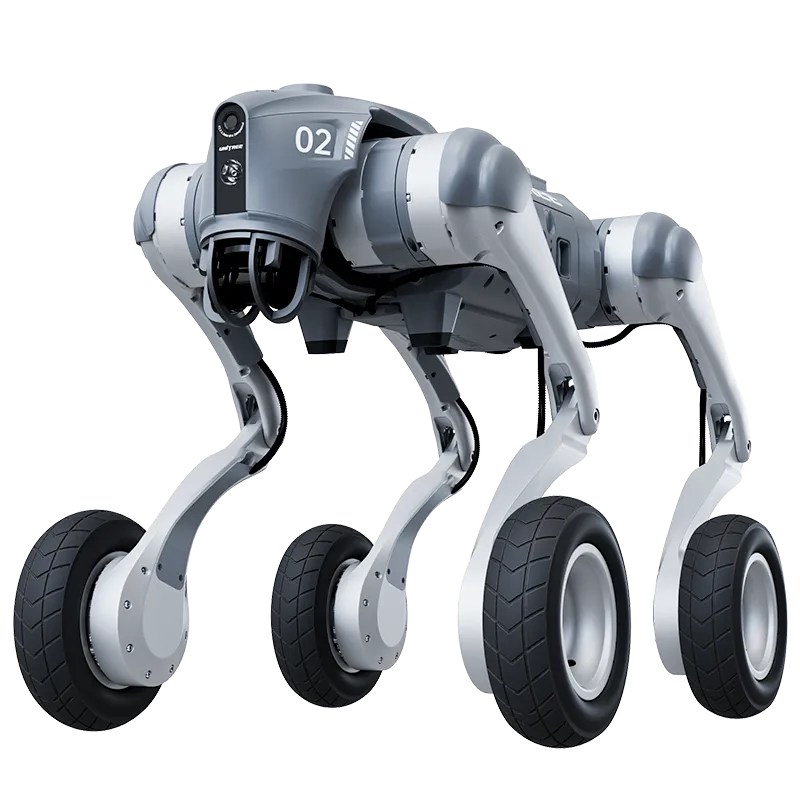
Unitree G1 is a useful affordability marker. ui44 lists it at $13,500 before tax and shipping, with a 132 cm, 35 kg body, about 2 hours of battery life, depth camera, 3D LiDAR, microphone array, and optional dexterous hands. That price is lower than early home-humanoid offers, but the category is still research and development. A buyer should not confuse "available to purchase" with "ready to run a household."
Labor Pushback Is A Product Signal
The labor story is not separate from home robots. Ars Technica, The Korea Times, and other outlets reported on Hyundai worker concerns around Atlas deployment, including demands tied to job security and working conditions. Whether any specific deployment timeline changes or not, the reaction points to a bigger truth: humanoids enter human systems, not empty technical environments.
For factories, that means collective bargaining, task redesign, safety procedures, retraining, and productivity measurement. For homes, it means privacy controls, remote-operator disclosure, guest consent, child safety, service plans, insurance, and clear boundaries around what the robot may record or do.
The companies that handle this transparently will have an advantage. A buyer can tolerate a robot that says, "I cannot do that yet." A buyer should be much less tolerant of vague claims that make teleoperation, human data work, or safety limitations invisible.
What Should Buyers Watch Next?
South Korea's physical-AI strategy gives home-robot watchers a better checklist than demo videos do.
First, watch production commitments. A pilot fleet can hide a lot of cost. A robot foundry, supplier cluster, or annual production target forces companies to solve yield, repair, parts availability, and quality control.
Second, watch hands. The home is a manipulation environment. Progress in actuators, tactile sensing, waterproofing, soft covers, and field-replaceable joints will matter more than acrobatics.
Third, watch data rights. If useful home autonomy depends on household video and teleoperation, buyers need plain-language controls: what is recorded, when humans can see it, where data is stored, how it is deleted, and whether the robot can be useful with stricter privacy settings.
Fourth, watch maintenance. A home robot is not only an AI product. It is a moving machine with batteries, joints, covers, cameras, and wear parts. The company that can service robots cheaply may beat the company with the flashier model.
Finally, watch boring industrial deployments. Hospitals, hotels, logistics centers, shipyards, and appliance factories may look less exciting than a robot making coffee in a kitchen. They are probably the route by which the robot learns to become safe, repairable, and affordable enough to enter the kitchen later.
The Bottom Line
South Korea is not proving that humanoids are ready for homes in 2028. It is trying to build the national infrastructure that makes that future less speculative: compute, suppliers, field data, component R&D, test sites, manufacturing capacity, and trained workers.
For ui44 readers, that is the important signal. The winner in home humanoids may not be the company with the best single demo. It may be the company, country, or supplier network that turns humanoids into maintainable products with reliable hands, honest autonomy claims, durable parts, privacy-respecting data loops, and a cost structure normal buyers can live with.
Until then, treat every humanoid home claim as a stack question. Ask not only what the robot can do on camera, but where its parts come from, how it learns, who repairs it, what data it collects, how much human help is hidden behind the interface, and whether the same behavior can survive 10,000 ordinary days instead of one perfect demo.
Written by
ui44 Team
Published July 19, 2026
Share this article
Open a plain share link on X or Bluesky. No embeds, no widgets, no cookie baggage.