The official YOR docs describe it as a fully open-source mobile manipulator with an approximately $10,000 bill of materials, an adjustable lift, and a 6-DOF bimanual setup. The accompanying arXiv paper is more specific: YOR combines an omnidirectional base, a telescopic vertical lift, and two arms with grippers, and the authors report a bill of materials under $10,000.
That makes YOR awkward to compare with normal consumer robots. It is not a robot vacuum. It is not a finished home humanoid. It is a buildable research platform aimed at mobile manipulation, which is exactly the capability gap most home robots still have.
What YOR Actually Is
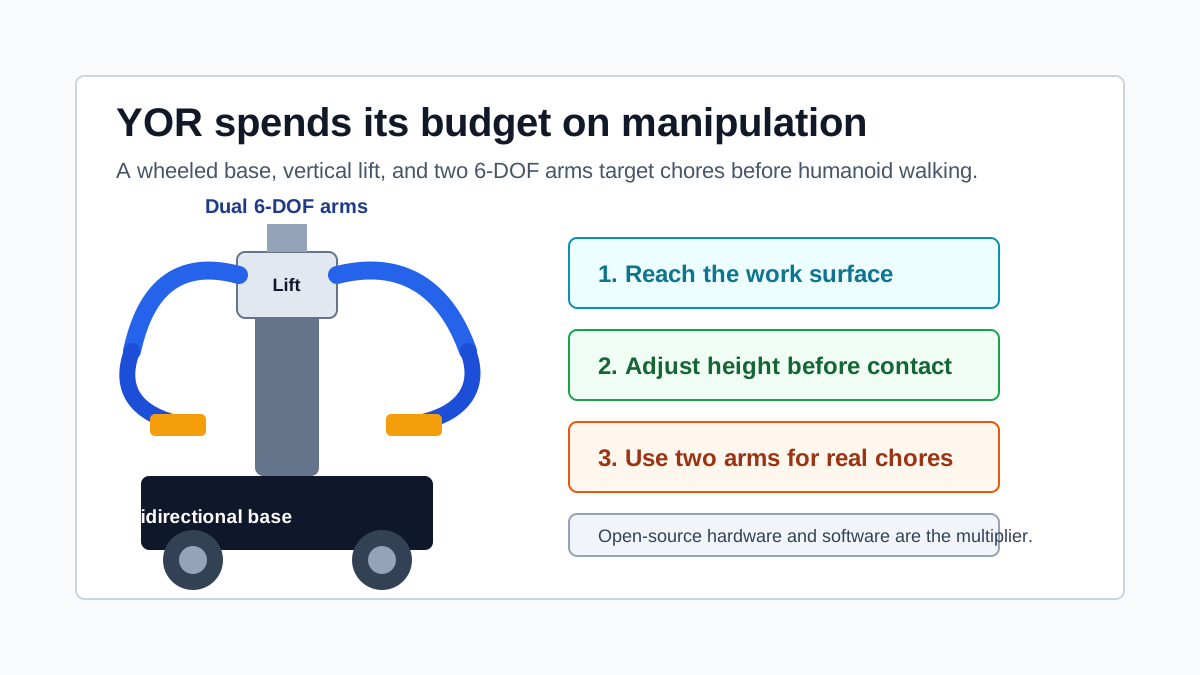
YOR, short for Your Own Robot, is a dual-arm mobile manipulator. Its job is not to look human. Its job is to bring a manipulation workspace to the right place in a room, adjust its working height, and use two arms together.
The design matters because household chores are rarely pure navigation problems. A robot that only moves around a home can map, patrol, vacuum, or deliver a small object if someone loads it first. A robot that can manipulate can start to touch the messy part of domestic work: grasping, opening, placing, clearing, carrying, and stabilizing objects while doing another action.
YOR's architecture is built around four pieces:
Subsystem
Omnidirectional wheeled base
- Why it matters at home
- Repositions around counters, tables, appliances, and narrow workspaces without needing a human gait stack.
Subsystem
Telescopic vertical lift
- Why it matters at home
- Changes arm working height for shelves, counters, bins, drawers, and seated users.
Subsystem
Two 6-DOF arms with grippers
- Why it matters at home
- Enables bimanual tasks such as holding an object with one arm while manipulating it with the other.
Subsystem
Open-source build
- Why it matters at home
- Lets researchers and advanced builders modify hardware, software, and task pipelines instead of waiting for a closed product roadmap.
| Subsystem | Why it matters at home |
|---|---|
| Omnidirectional wheeled base | Repositions around counters, tables, appliances, and narrow workspaces without needing a human gait stack. |
| Telescopic vertical lift | Changes arm working height for shelves, counters, bins, drawers, and seated users. |
| Two 6-DOF arms with grippers | Enables bimanual tasks such as holding an object with one arm while manipulating it with the other. |
| Open-source build | Lets researchers and advanced builders modify hardware, software, and task pipelines instead of waiting for a closed product roadmap. |
That does not make YOR a plug-in home helper. It makes it a useful benchmark for how much capability can be bought below the price of many humanoid development platforms.
The Price Context: $10K Is Not Automatically "Cheap"
YOR's headline is the sub-$10,000 bill of materials. For a hobbyist, that is expensive. For mobile manipulation research, it is disruptive. For a future home-care buyer, it is a clue about which hardware costs are falling fastest.
In the ui44 database, the closest public-price reference points are mixed. The Unitree R1 starts at $4,900, but it is primarily a locomotion-first humanoid and not a full household manipulation platform. The Unitree G1 is listed at $13,500 and is a compact humanoid R&D platform. 1X NEO is listed at $20,000 for early adopters and is the clearest home-focused humanoid in this comparison. Galaxea R1 Pro, a wheeled dual-arm humanoid/mobile manipulator for labs and industrial R&D, is listed at $69,999.
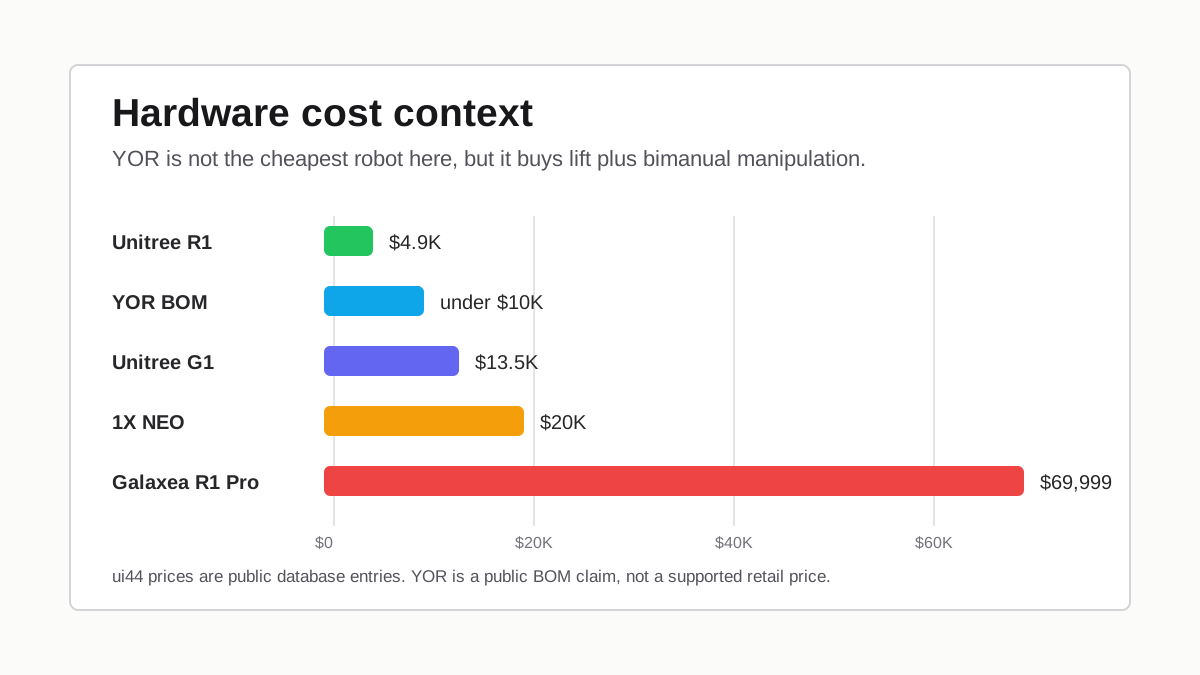
The important comparison is not "YOR beats every humanoid." It does not. The comparison is that YOR spends its hardware budget on arms, lift, and mobile manipulation, while many low-cost humanoids spend much of their complexity budget on legs, balance, and whole-body agility.
That trade-off is easy to miss if every robot with a face-shaped head is treated as more advanced than every wheeled robot. For chores, the question is not whether the robot can walk across a demo stage. It is whether it can reach the object, grip it reliably, adjust to the work height, and recover when the environment is slightly wrong.
Can Wheels Beat Legs For Early Home Chores?
Homes were built for humans, so it is tempting to assume a home robot must be humanoid. Stairs, thresholds, furniture, cabinets, and appliances all seem to reward a human-shaped body. But most early useful robot work happens on a single floor and around a small number of repeatable task zones: kitchen counter, dining table, laundry area, bedside, storage shelves, entryway, and charging dock.
In those zones, legs are not always the best first investment. A wheeled base can be stable, power efficient, and easier to make predictable around people. An omnidirectional base can align the arms without performing a multi-step walking adjustment. A vertical lift can cover a surprising amount of human-height variation without needing knees, hips, and dynamic balance.
The harder part is manipulation. A single arm can pick and place, but many chores are bimanual by nature. Opening a container, pulling fabric, holding a bowl while scraping it, stabilizing a package, or moving an awkward object often requires two contact points. YOR's two-arm layout is why it belongs in the home-robot conversation even if it is not sold as a consumer appliance.
This is also where the comparison with humanoids becomes sharper. A bipedal platform such as Unitree G1 or 1X NEO has the form-factor story buyers immediately understand. YOR has the chore-mechanics story: base, lift, two arms, grippers, and open access to the stack.
Where YOR Looks Strong
YOR's strongest case is as a platform for learning the chores that future home robots will need to perform. It is priced low enough for more labs, builders, and possibly advanced prosumer groups to experiment with mobile manipulation. It is open enough that failures can be inspected instead of hidden behind an app screen.
That matters because home autonomy is not a single feature. It is a pile of small, stubborn problems:
Chore capability
Picking clutter from a table
- Why it is hard
- Objects vary in shape, weight, pose, reflectivity, and fragility.
Chore capability
Loading or unloading a basket
- Why it is hard
- The robot must reach into a container without snagging or crushing items.
Chore capability
Opening doors or drawers
- Why it is hard
- The contact point moves while the robot applies force.
Chore capability
Tidying a shelf
- Why it is hard
- The robot must choose a stable placement, not just release the object.
Chore capability
Handing items to a person
- Why it is hard
- The robot must coordinate navigation, timing, grip force, and human motion.
| Chore capability | Why it is hard |
|---|---|
| Picking clutter from a table | Objects vary in shape, weight, pose, reflectivity, and fragility. |
| Loading or unloading a basket | The robot must reach into a container without snagging or crushing items. |
| Opening doors or drawers | The contact point moves while the robot applies force. |
| Tidying a shelf | The robot must choose a stable placement, not just release the object. |
| Handing items to a person | The robot must coordinate navigation, timing, grip force, and human motion. |
YOR's combination of mobility, lift, and bimanual manipulation lets researchers test these problems in a form factor that is closer to a home helper than a fixed lab arm. A robot arm bolted to a table can teach grasping. It cannot teach a robot how to approach a cabinet, reposition, raise its workspace, and use both arms while the base is part of the task.
Where YOR Is Not Ready For Buyers
The buyer answer is simple: most people should not buy or build YOR as a home helper today.
The reason is not that the design is unimportant. It is that a bill of materials is not a product. The official framing is open-source access and mobile manipulation research. A household buyer needs support, safety validation, warranty handling, setup, recovery behavior, polished software, and clear boundaries on what the robot can and cannot do around children, pets, glassware, stairs, water, knives, and clutter.
There is also a reliability gap between "can perform a task in a research demonstration" and "can perform a task in a real kitchen every Tuesday without supervision." A mobile manipulator may be physically closer to the right chore form factor, but autonomy, perception, safety, and maintenance still decide whether it is useful.
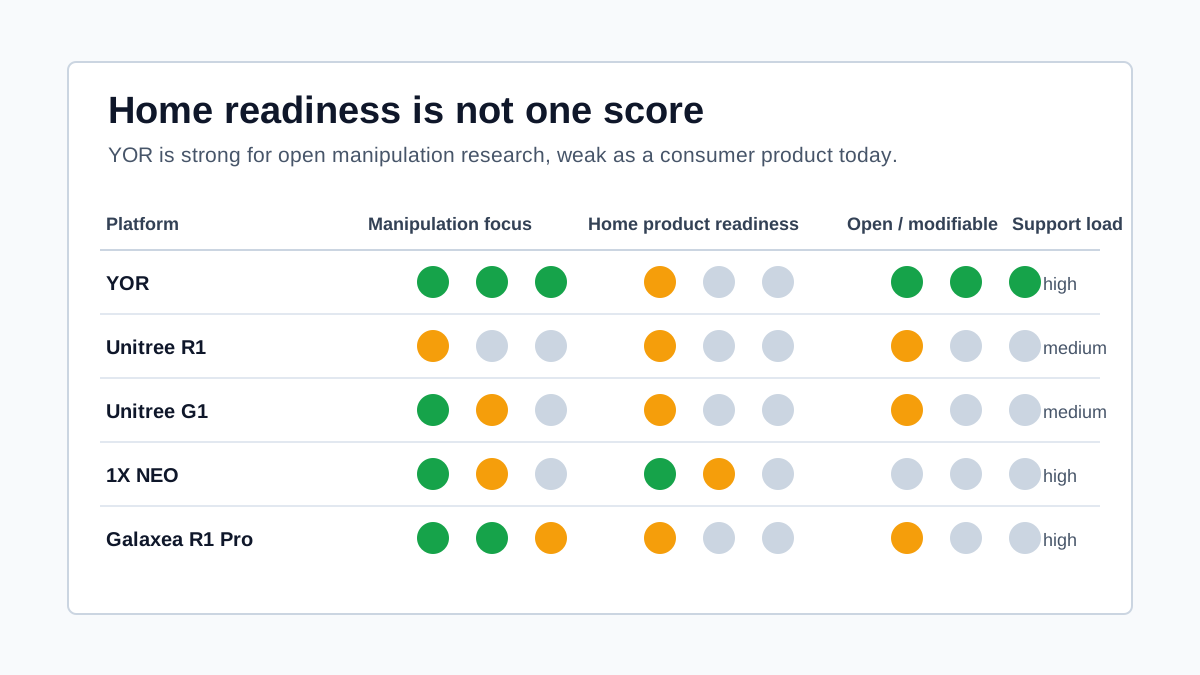
The most honest way to read YOR is as a signpost. It shows that capable mobile-manipulation hardware can be assembled at a price that is no longer limited to giant lab budgets. It does not show that general-purpose home chores are solved.
How YOR Compares With Humanoids In The ui44 Database
Here is the practical comparison for someone following home robots rather than academic platforms:
Robot
YOR
- ui44 listed price
- Under $10,000 BOM claimed by project
- Core bet
- Wheeled mobile manipulation with two arms
- Home relevance
- Best as a buildable research signal, not a consumer product.
Robot
- ui44 listed price
- From $4,900
- Core bet
- Low-cost agile humanoid locomotion
- Home relevance
- Impressive price, but manipulation depth is not the main story.
Robot
- ui44 listed price
- $13,500
- Core bet
- Compact humanoid R&D platform
- Home relevance
- More humanoid form factor, higher public price, still developer-oriented.
Robot
- ui44 listed price
- $20,000 early-adopter price
- Core bet
- Soft home-focused humanoid
- Home relevance
- The clearest consumer-home positioning, but still early and expensive.
Robot
- ui44 listed price
- $69,999
- Core bet
- Wheeled dual-arm embodied-AI platform
- Home relevance
- Similar manipulation direction, but priced for labs and R&D.
| Robot | ui44 listed price | Core bet | Home relevance |
|---|---|---|---|
| YOR | Under $10,000 BOM claimed by project | Wheeled mobile manipulation with two arms | Best as a buildable research signal, not a consumer product. |
| Unitree R1 | From $4,900 | Low-cost agile humanoid locomotion | Impressive price, but manipulation depth is not the main story. |
| Unitree G1 | $13,500 | Compact humanoid R&D platform | More humanoid form factor, higher public price, still developer-oriented. |
| 1X NEO | $20,000 early-adopter price | Soft home-focused humanoid | The clearest consumer-home positioning, but still early and expensive. |
| Galaxea R1 Pro | $69,999 | Wheeled dual-arm embodied-AI platform | Similar manipulation direction, but priced for labs and R&D. |
This table is why YOR deserves attention. It sits between low-cost humanoid curiosity and expensive lab mobile manipulators. If the project remains open and reproducible, it could help more teams test the exact work that home robots need: reaching, grasping, repositioning, coordinating two arms, and failing safely.
What A Home Buyer Should Watch Next
YOR is probably not the robot you put in your living room. It is the robot you watch to understand what might make future home robots useful.
The first thing to watch is replication. A low bill of materials matters only if other teams can actually build the robot, calibrate it, and reproduce meaningful tasks. Open-source robotics projects often look cheaper on paper than they feel in a workshop once spare parts, tools, machining delays, failed prints, damaged actuators, and debugging time are included.
The second thing to watch is task diversity. A platform that can do one polished demo is interesting. A platform that can support many imperfect chores across many homes is much more important. The useful signal will be boring at first: clearing simple objects, opening repeatable handles, moving items between surfaces, recovering from failed grasps, and doing all of that without needing a robotics PhD beside it.
The third thing to watch is safety documentation. Arms in homes are different from arms in labs. Even a relatively light manipulator can pinch, drop, scrape, spill, or collide. Before any YOR-like platform becomes home-relevant, it needs clear force limits, emergency stops, collision behavior, supervision rules, and understandable setup guidance.
Finally, watch how humanoid companies respond. If wheeled dual-arm systems keep demonstrating credible chores at lower hardware cost, humanoid companies will need to justify legs with more than visual familiarity. Legs may still win in multi-floor homes, uneven spaces, and human-like tool use. But the early chore race may be decided by manipulation reliability long before walking becomes the hard part buyers care about.
Bottom Line
YOR does not beat home humanoids as a finished product. It beats many of them as a question.
For roughly the price range between a high-end hobby robot and a serious humanoid developer platform, YOR concentrates on the part of home robotics that matters most: moving to a task, changing height, and using two arms. That is a more grounded path to chores than another walking demo with no useful hands.
For buyers, the answer is caution. Do not treat YOR as a consumer home robot. Treat it as a preview of the hardware stack that could make future home robots worth buying.
For the market, the message is sharper: the next useful home robot may not look like a person. It may look like a practical mobile manipulator that finally has enough reach, lift, and bimanual control to do work.
Written by
ui44 Team
Published June 6, 2026
Share this article
Open a plain share link on X or Bluesky. No embeds, no widgets, no cookie baggage.