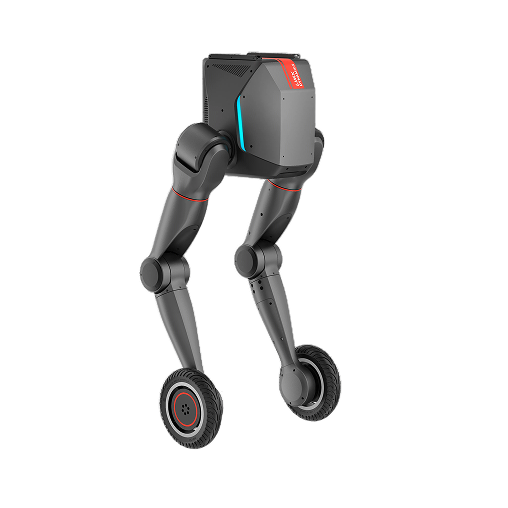
That is why LimX Dynamics' TRON 2 is interesting even though it is not a normal consumer home product. LimX calls it a three-in-one embodied robot: dual arms, dual wheel-leg mode, and bipedal mode. The buyer-facing question is bigger than one Chinese research platform: should future home robots choose one body, or should they be modular enough to use the right body for the job?

The short answer: modularity is promising, but it is not magic. A transformable robot still has to be safe, repairable, affordable, and useful in the messy rooms people actually live in. For now, treat modular robots as a serious form factor signal rather than a reason to wait for one perfect transformer.
What does LimX TRON 2 actually show?
LimX's official TRON 2 page describes a platform with three configurations: dual arms, dual wheel-legs, and bipedal movement. The official specification page is more useful than the marketing headline because it shows where the trade-offs live.
In arm mode, TRON 2 lists 7 degrees of freedom per arm, a maximum end-effector payload of 5 kg per arm in an extended posture, a 3 kg rated payload, 5 m/s maximum end-effector speed, ±0.5 mm repeat positioning accuracy, VR teleoperation through Oculus Quest 3, and gripper or dexterous-hand end effectors. In mobility mode, LimX lists 2-3 m/s for bipedal movement, 3-5 m/s for wheel-leg movement, 15° maximum slope in biped mode, 30° in wheel-leg mode, 20 cm maximum step height, 30 kg payload on flat ground, and 20 kg while climbing stairs.
Those numbers are not a promise that TRON 2 is ready to carry groceries in a normal apartment. LimX frames the product around research, data collection, vision-language-action (VLA) workflows, ROS/ROS2, Python and C++ development, and simulation support for NVIDIA Isaac Sim, MuJoCo, and Gazebo. Its official news headline says preorders start from 49,800 yuan, but the product is still aimed at developers and institutions, not families buying a finished domestic helper.
That distinction matters. TRON 2 is useful evidence because it makes a design idea concrete: one robot body can be optimized for different modes instead of forcing every task through a single locomotion choice.
Why modularity may matter more than humanoid purity
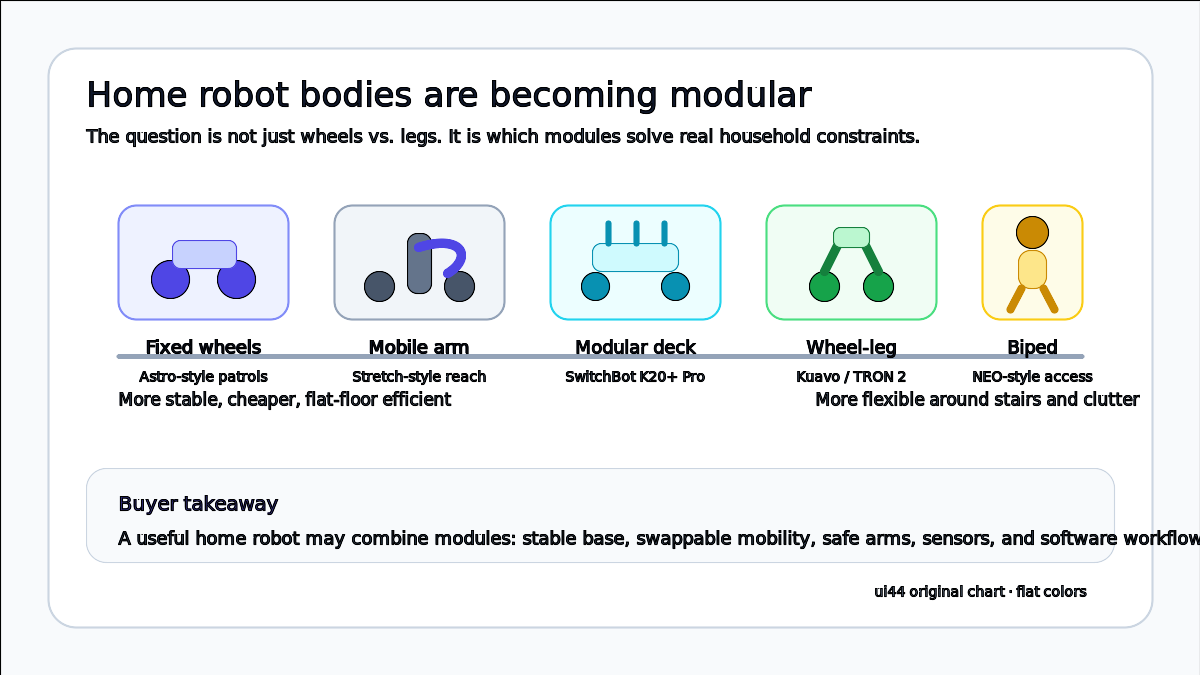
ui44 already has a published guide on the wheeled-versus-bipedal home robot debate. The modular question is different. It asks whether a home robot should be allowed to stop being one thing.
A home does not ask for one kind of body. It asks for several:
Household problem
Flat-floor movement
- Best near-term body trait
- Wheels or tracks
- Why it matters
- Stable, efficient, less risky around people and pets
Household problem
Stairs and thresholds
- Best near-term body trait
- Legs, wheel-legs, or a separate floor strategy
- Why it matters
- Multi-story homes punish robots that cannot change floors
Household problem
Counter and shelf interaction
- Best near-term body trait
- Long reach, torso lift, or articulated arms
- Why it matters
- Most useful chores happen at human-height surfaces
Household problem
Carrying objects
- Best near-term body trait
- Payload plus stable base, not just hand dexterity
- Why it matters
- A robot must move safely while holding weight
Household problem
Learning chores
- Best near-term body trait
- Sensors, teleop, and data tools
- Why it matters
- Manipulation improves through demonstrations and correction
Household problem
Maintenance
- Best near-term body trait
- Swappable modules and accessible parts
- Why it matters
- Home products fail when repair becomes too expensive
| Household problem | Best near-term body trait | Why it matters |
|---|---|---|
| Flat-floor movement | Wheels or tracks | Stable, efficient, less risky around people and pets |
| Stairs and thresholds | Legs, wheel-legs, or a separate floor strategy | Multi-story homes punish robots that cannot change floors |
| Counter and shelf interaction | Long reach, torso lift, or articulated arms | Most useful chores happen at human-height surfaces |
| Carrying objects | Payload plus stable base, not just hand dexterity | A robot must move safely while holding weight |
| Learning chores | Sensors, teleop, and data tools | Manipulation improves through demonstrations and correction |
| Maintenance | Swappable modules and accessible parts | Home products fail when repair becomes too expensive |
That is the attraction of modular hardware. Instead of pretending one perfect humanoid body solves every room, a modular platform can spend its engineering budget where the task actually needs it. Roll on flat floors. Extend an arm for a cabinet. Stand, step, or change configuration only when the layout demands it.
The ui44 database already shows this trend
TRON 2 is not in the ui44 database as a consumer product yet, but the underlying pattern is already visible across tracked robots.
Robot
- Modular or hybrid signal
- Swappable biped / wheeled lower body
- Key ui44 data
- 173 cm, 63.5 kg, $38,000 biped estimate, 1 hour walking endurance, 5 km/h wheeled speed
- Home relevance
- Shows that full-size humanoid makers are exploring mode-specific lower bodies
Robot
- Modular or hybrid signal
- Compact bipedal robot with a wheeled mobility base
- Key ui44 data
- $2,899 preorder, 494 mm tall, ~2 hours runtime, 0.05 m/s bipedal and 0.6 m/s wheeled
- Home relevance
- A consumer-facing example where wheels are not a defeat; they are how the small robot moves
Robot
- Modular or hybrid signal
- Modular mobile deck around a compact robot vacuum
- Key ui44 data
- From $699.99, FusionPlatform, up to 8 kg payload, Matter-compatible smart-home ecosystem
- Home relevance
- The most practical home example: make existing devices mobile instead of building a humanoid
Robot
- Modular or hybrid signal
- Mobile manipulator rather than transforming humanoid
- Key ui44 data
- $24,950, 24.5 kg, 33 × 34 cm footprint, 2 kg payload, 2-5 hour runtime
- Home relevance
- Proves that reach, teleoperation, and home navigation can matter more than legs
Robot
- Modular or hybrid signal
- Historical walking-to-wheeled transformation
- Key ui44 data
- 170 cm, 80 kg, ~3 km/h wheeled mode, ~1.5 km/h walking, stair and tool tasks
- Home relevance
- A reminder that walk-roll hybrid thinking predates the current home-robot hype cycle
Robot
- Modular or hybrid signal
- Wheeled household robot with articulated manipulation demos
- Key ui44 data
- $9,999 metadata, 22 DoF, on-device OmniSense VLA model, development status
- Home relevance
- Shows why smart-home companies may favor stable mobile bases for domestic manipulation
Robot
- Modular or hybrid signal
- LimX humanoid platform lineage with COSA and motion learning
- Key ui44 data
- 165 cm, 55 kg, COSA agentic OS; Luna adds 5 km/h max speed and VGM video-to-motion
- Home relevance
- Useful context: LimX is building a platform family, not just a one-off transformable demo
| Robot | Modular or hybrid signal | Key ui44 data | Home relevance |
|---|---|---|---|
| Leju Kuavo 5 | Swappable biped / wheeled lower body | 173 cm, 63.5 kg, $38,000 biped estimate, 1 hour walking endurance, 5 km/h wheeled speed | Shows that full-size humanoid makers are exploring mode-specific lower bodies |
| Zeroth Robotics M1 | Compact bipedal robot with a wheeled mobility base | $2,899 preorder, 494 mm tall, ~2 hours runtime, 0.05 m/s bipedal and 0.6 m/s wheeled | A consumer-facing example where wheels are not a defeat; they are how the small robot moves |
| SwitchBot K20+ Pro | Modular mobile deck around a compact robot vacuum | From $699.99, FusionPlatform, up to 8 kg payload, Matter-compatible smart-home ecosystem | The most practical home example: make existing devices mobile instead of building a humanoid |
| Hello Robot Stretch 3 | Mobile manipulator rather than transforming humanoid | $24,950, 24.5 kg, 33 × 34 cm footprint, 2 kg payload, 2-5 hour runtime | Proves that reach, teleoperation, and home navigation can matter more than legs |
| KAIST DRC-HUBO+ | Historical walking-to-wheeled transformation | 170 cm, 80 kg, ~3 km/h wheeled mode, ~1.5 km/h walking, stair and tool tasks | A reminder that walk-roll hybrid thinking predates the current home-robot hype cycle |
| SwitchBot onero H1 | Wheeled household robot with articulated manipulation demos | $9,999 metadata, 22 DoF, on-device OmniSense VLA model, development status | Shows why smart-home companies may favor stable mobile bases for domestic manipulation |
| LimX Oli and Luna | LimX humanoid platform lineage with COSA and motion learning | 165 cm, 55 kg, COSA agentic OS; Luna adds 5 km/h max speed and VGM video-to-motion | Useful context: LimX is building a platform family, not just a one-off transformable demo |
The table points to the same conclusion from different directions. Some robots are modular in hardware, some in attachments, some in software and developer workflows. But the market is clearly moving away from the idea that a home robot has to be a single fixed silhouette.
The best home robot body may depend on the room
A one-bedroom apartment, a suburban house, and an elder-care setting do not ask the same thing from a robot.
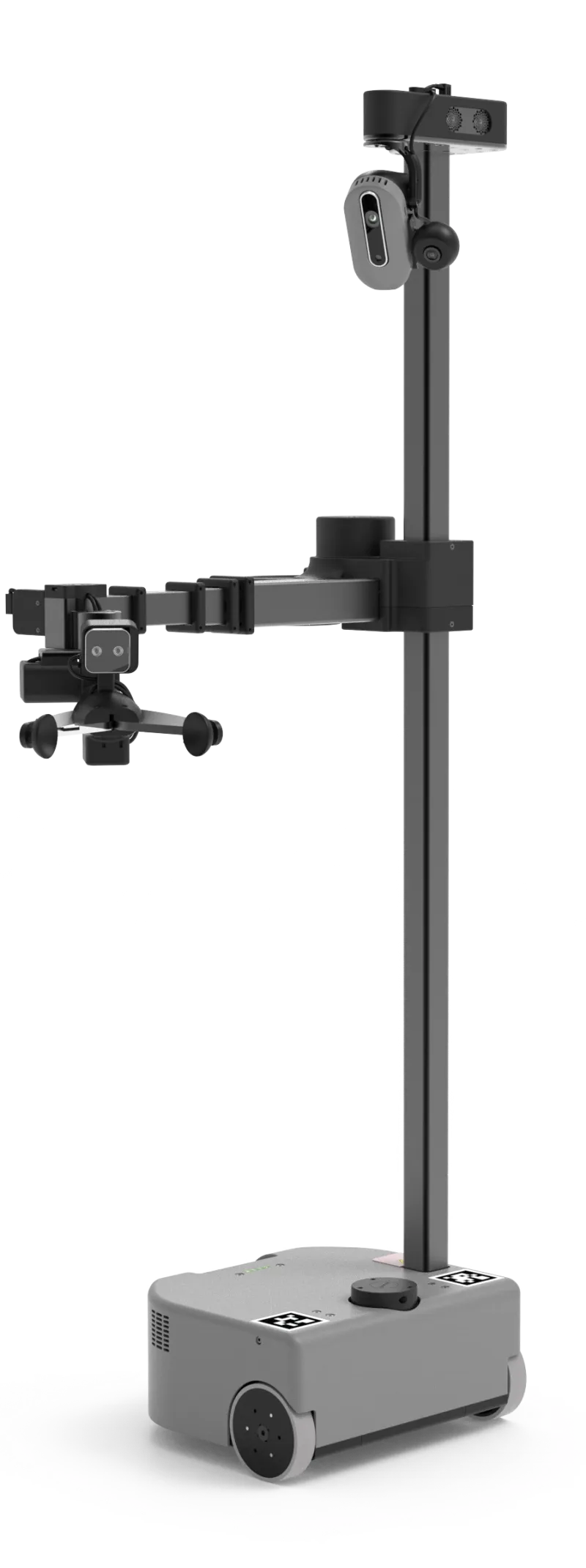
In a single-level apartment, a wheeled robot with a good arm may be more useful than a bipedal robot with weak runtime. That is why Hello Robot Stretch 3 is such an important reference point. It does not look like a person, but it has a compact 33 × 34 cm footprint, a vertical lift, a telescoping arm, RGB-D cameras, LiDAR, ROS 2 support, web teleoperation, and a 2 kg payload. For many assistive tasks, that combination is more relevant than walking.
In a multi-story home, legs still matter. A robot that cannot move from the kitchen to an upstairs bedroom will feel limited unless the home has ramps, elevators, duplicate robots, or a clear floor-by-floor task plan. That is why bipedal and wheel-leg platforms remain compelling. The catch is that legs add cost, energy use, failure modes, and safety questions.
For smart-home chores, modularity can be even simpler. SwitchBot K20+ Pro starts from a robot vacuum base and adds a FusionPlatform that can carry an air purifier, fan, camera, or other accessory. That is not as spectacular as a humanoid changing into a wheel-leg platform, but it is far closer to a real home product. It asks a practical question: what if the first modular home robot is not a person-shaped machine, but a reliable mobile dock for useful devices?
That is the lens buyers should use. Do not ask which body is coolest. Ask which body makes the robot useful in your actual rooms.
Modularity also creates new problems
There is a reason most home products avoid reconfiguration unless it clearly pays off. More modes mean more ways to fail.
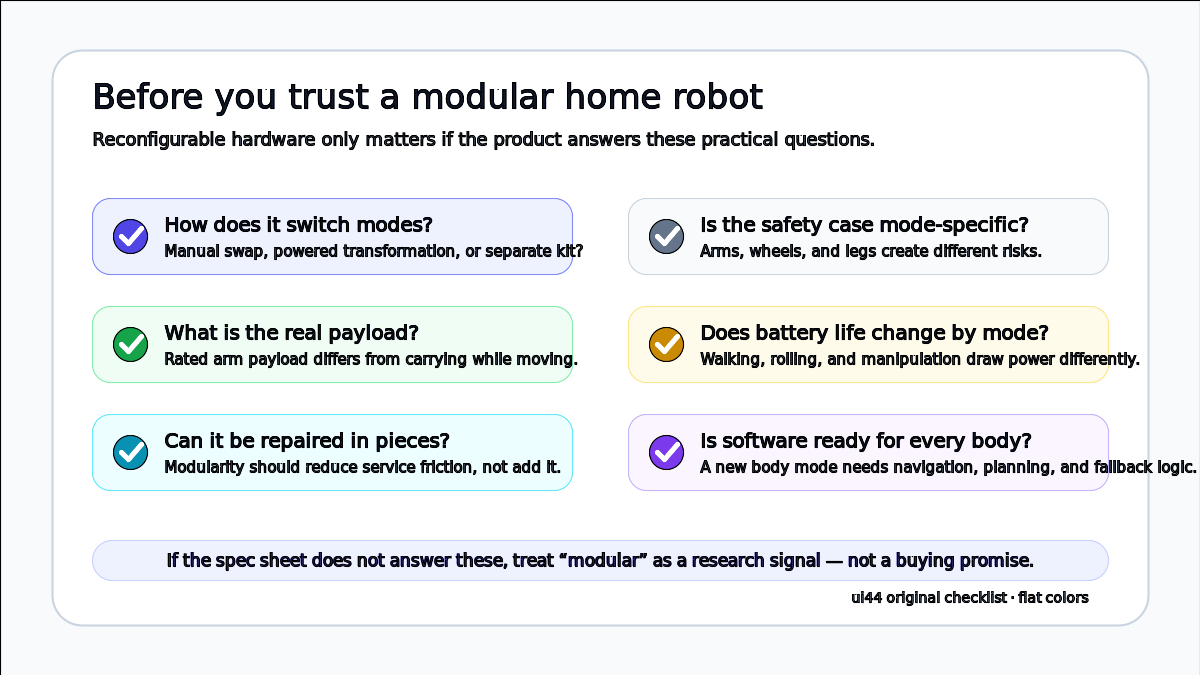
A robot that has arms, wheels, and legs needs separate safety logic for each mode. An arm can pinch or hit. A wheel can roll over a cable or a pet toy. A leg can fall, kick, or place weight where it should not. A mode switch can introduce alignment, calibration, and maintenance problems that a simpler robot avoids.
Battery claims also become harder to interpret. TRON 2 lists fast charging from 20-80% in 30 minutes and 20-100% in 54 minutes, with a 46.8 V, 9 Ah ternary lithium battery pack. Useful numbers, but a buyer still needs to know how long the robot lasts while manipulating, rolling, walking, carrying payload, and switching modes. The same issue appears in smaller products: Zeroth M1's specification separates bipedal speed from wheeled speed because the modes are not equivalent.
Then there is service. In theory, modular hardware should make repair easier: swap a wheel module, replace a gripper, upgrade a sensor. In practice, modular systems only help if the manufacturer sells parts, publishes repair paths, and keeps software compatible across revisions. Otherwise, modularity becomes a marketing word attached to a more complicated machine.
What should buyers watch next?
If modular home robots keep moving from research platforms toward real products, watch five signals.
First, watch whether companies publish mode-specific specs. A serious robot should not just say it is fast or strong. It should tell you speed, runtime, payload, slope handling, step height, and safety limits by configuration.
Second, watch whether the robot can change modes without a lab bench. If a technician has to rebuild the lower body, that is still modular engineering, but it is not consumer modularity.
Third, watch whether the product has a clear home task story. TRON 2 is useful as a developer platform because it supports data collection, VLA workflows, ROS/ROS2, simulation, and teleoperation. A home robot needs all that plus an answer to a simpler question: what can it reliably do for a household on Tuesday afternoon?
Fourth, watch the fallback plan. The early home-robot market is full of remote help, teleoperation, and guided modes. That is not automatically bad. But it should be disclosed clearly, especially when a robot's body has more ways to create risk.
Fifth, watch price discipline. A 49,800 yuan developer robot, a $2,899 compact companion, a $699.99 mobile accessory platform, and a $24,950 research manipulator are not competing for the same buyer. Modularity will matter more when it makes products easier to own, not just more impressive to demo.
Bottom line: the future may be less humanoid and more configurable
LimX TRON 2 is not the home robot most people should wait to buy. It is a research and developer signal. But it points toward a sensible future: home robots that borrow from humanoids, mobile manipulators, robot vacuums, wheel-legged platforms, and smart-home accessories instead of treating one shape as destiny.
That may be good news for buyers. A robot does not need to look human to be helpful. It needs the right body for the job, honest specs, safe behavior around people, and enough useful work to justify the cost. Modularity could help with that — as long as companies use it to solve household problems, not just to make better demo videos.
Written by
ui44 Team
Published April 30, 2026
Share this article
Open a plain share link on X or Bluesky. No embeds, no widgets, no cookie baggage.