That does not mean every preorder is reckless. Some early buyers get access to genuinely useful machines before the broader market catches up. The point is to separate a credible hardware plan from a cinematic demo with a payment button.
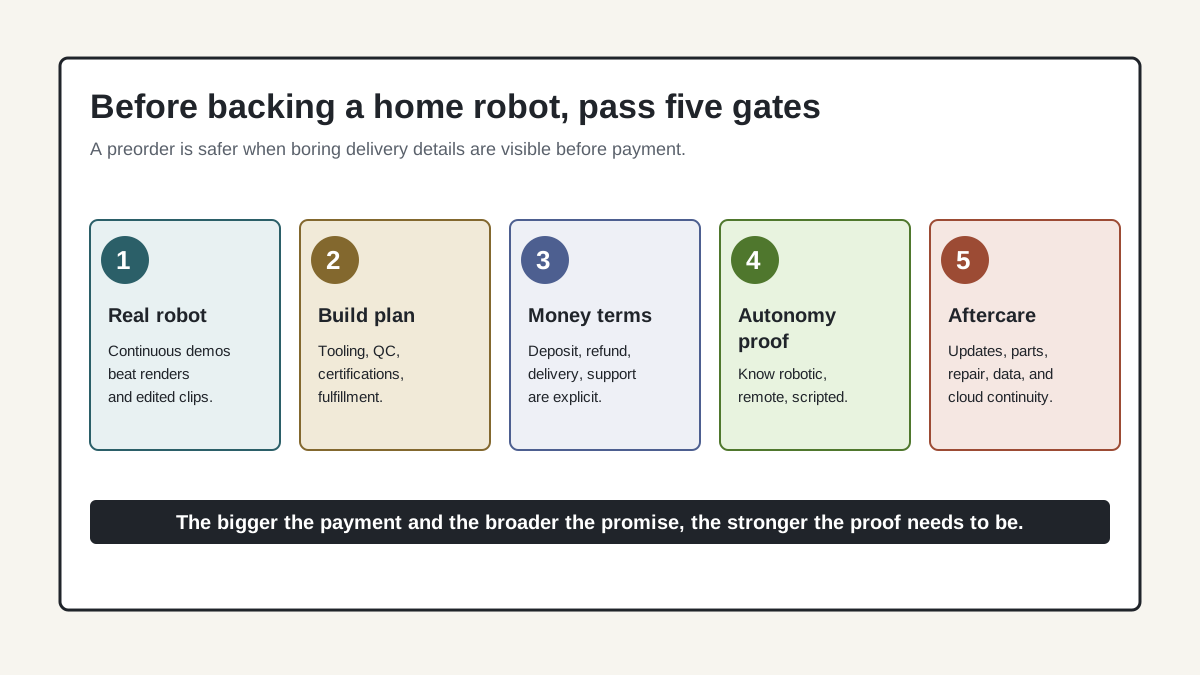
The short version: back only when the team has shown a working robot, named the real delivery dependencies, explained the money terms, and proved the capability you actually want in a normal home setting. If one of those pieces is missing, treat the campaign as a waitlist, not a purchase.
Why Home Robots Are Riskier Than Normal Gadgets
Home robots combine several hard things at once: mobile hardware, sensors, batteries, software, cloud or on-device AI, safety behavior around people, after-sales support, and sometimes manipulation. A smart speaker can ship with a software flaw and still be useful. A robot that cannot map your house, avoid a pet bowl, recover from a failed task, or receive replacement parts is a much bigger problem.
General hardware launch economics already leave little room for fantasy. Blazon Agency's 2026 hardware launch guide notes that new hardware programs often face minimum order quantities in the 1,000 to 5,000 unit range, tooling bills in the $10,000 to $50,000 range, and certification work that can take weeks before wireless or safety products can ship. Its crowdfunding transition guide also calls out a familiar failure pattern: campaigns can raise money successfully and still struggle later with margins, fulfillment, customer support, and the shift from campaign buzz to a real operating business.
Robots amplify those problems. They have moving parts that wear, software stacks that must keep improving, and user expectations shaped by highly edited demos. A preorder page can show a robot folding laundry, carrying a tray, recognizing a face, or having a fluent conversation. The buyer question is not "did the demo happen?" The question is "what exactly will the shipped unit do, in my house, without an engineer standing nearby?"
Start With The Amount At Risk
The right level of skepticism depends on how much money is locked up and how reversible the decision is. A small refundable deposit can be a useful signal of buyer interest. A non-refundable large deposit for an unproven machine deserves a much higher bar.
ui44's database shows the spread. Matic, a vision-first robot vacuum and mop, is listed at $1,245 in official product data. 1X NEO, a home-focused humanoid, is recorded at $20,000 for early adopters. Unitree H2, a full-size humanoid, is listed at $29,900. Realbotix David, a modular humanoid companion robot, is tracked at $95,000 in the ui44 database, while Realbotix's public robots page lists its broader M-Series from $95,000 and F-Series from $125,000, plus a $199.99 monthly AI plan.
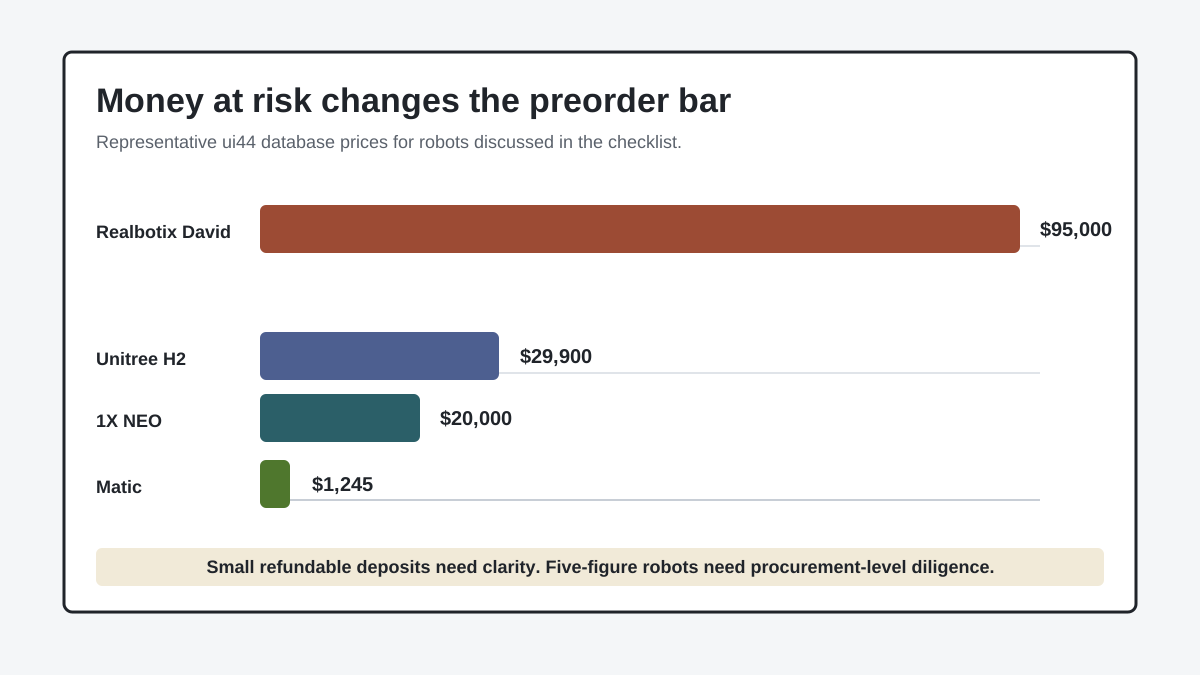
That price spread changes the checklist. For a $5 or $99 refundable reservation, the key questions are whether the company communicates clearly and whether the deposit converts into real purchase value. For a $1,000-plus device, you need shipping terms, support terms, warranty language, and evidence that the robot can already do the core job. For a five-figure humanoid or companion robot, you should expect a procurement-style diligence process: contract terms, cancellation rights, delivery milestones, service coverage, software dependency disclosure, and a real contact at the company.
Should You Back A Crowdfunded Home Robot?
1. Is There A Real Robot, Or Just A Render?
Do not treat photorealistic renders, edited sizzle reels, or "future capability" text as proof. Look for long, continuous footage of the robot doing the promised task. If the campaign claims the robot can tidy a room, look for a messy room, not a tabletop demo. If it claims conversation, look for latency, interruption handling, multilingual support, and what happens when the model misunderstands. If it claims manipulation, look for real objects with awkward shapes, not only a scripted handoff.
The best signal is third-party handling: trade show footage, reviewer demos, lab visits, or customer clips where the robot is not fully controlled by the company. The second-best signal is a clear explanation of what is teleoperated, what is autonomous, and what is not ready yet. Teleoperation is not automatically bad. Hidden teleoperation is.
2. Are Manufacturing And Certification Treated As Work, Not Magic?
A credible robot launch explains how the machine will be built. It should mention production status, tooling, supplier constraints, certifications, quality control, spare parts, and where service will happen. If the team avoids all manufacturing detail, assume the timeline is fragile.
Blazon's hardware launch playbook describes post-2024 consumer-electronics lead times around 12 to 16 weeks for production, with additional shipping and customs time for imported components. Its fulfillment guide frames delivery as several overlapping phases, starting with pre-campaign manufacturer and logistics planning. For a home robot, add more complexity: sensor calibration, battery safety, locomotion testing, packaging that protects actuators, and firmware updates after the unit leaves the factory.
A practical question: if the company sells 5,000 units, what breaks first? Assembly labor? Motor supply? FCC or CE certification? Battery transport rules? Support staffing? The campaign does not need to reveal every vendor contract, but it should show that the team knows where the bottlenecks are.
3. Are The Payment Terms Clear Enough To Explain To Someone Else?
Before paying, write down the answer to five questions:
Question
What am I paying today?
- Green signal
- Deposit, preorder, or full purchase is clearly labeled
- Red signal
- "Reserve now" without legal meaning
Question
Can I cancel?
- Green signal
- Refund deadline and process are explicit
- Red signal
- Refunds are vague or discretionary
Question
What happens if delivery slips?
- Green signal
- Milestones and communication cadence are stated
- Red signal
- Silence, no delay policy, no backup plan
Question
What is included?
- Green signal
- Hardware, accessories, software, and support are itemized
- Red signal
- Core functions require later paid add-ons
Question
Who services it?
- Green signal
- Warranty, parts, and support region are clear
- Red signal
- No repair path or only "contact us"
| Question | Green signal | Red signal |
|---|---|---|
| What am I paying today? | Deposit, preorder, or full purchase is clearly labeled | "Reserve now" without legal meaning |
| Can I cancel? | Refund deadline and process are explicit | Refunds are vague or discretionary |
| What happens if delivery slips? | Milestones and communication cadence are stated | Silence, no delay policy, no backup plan |
| What is included? | Hardware, accessories, software, and support are itemized | Core functions require later paid add-ons |
| Who services it? | Warranty, parts, and support region are clear | No repair path or only "contact us" |
Realbotix is a good example of why this matters at the high end. Its robot page describes starting prices for bust, modular, and full-bodied configurations, notes that customization can add cost, and lists subscription-based AI access. That kind of recurring cost may be acceptable, but it should be part of the buyer's total cost calculation, not a surprise after delivery.
4. Does The Claimed Autonomy Match The Use Case?
Home robot campaigns often blur three different things: remote control, scripted automation, and real autonomy. A robot can be impressive in all three modes, but they are not the same buyer promise.
For a vacuum like Matic, autonomy means it can map, clean, avoid obstacles, switch between vacuuming and mopping, and handle waste without sending camera data to the cloud. For NEO, the claim is much broader: household chores, tidying, safe coexistence, and adaptive learning. For Realbotix David, the value is conversation, expression, face recognition, and companion behavior. For Unitree H2, the public price and humanoid hardware are striking, but a buyer still has to ask which home tasks are supported out of the box and which require developer work.
The more general the promise, the more proof you should demand. "Can fetch a bottle from a known counter in a staged demo" is not the same as "can help around the house." "Supports third-party language models" is not the same as "will have reliable memory, safety boundaries, privacy controls, and updates for years."
5. Is There A Support Plan After The First Shipment?
The moment a robot ships, the company becomes a service organization. Buyers need firmware updates, replacement batteries, repair parts, account support, and sometimes cloud infrastructure. A robot company that has a campaign plan but no support plan is not ready for homes.
This is where subscriptions, data policies, and spare parts matter. Ask whether the robot keeps working if the cloud account changes, if the AI plan is cancelled, if the company changes model providers, or if a motor fails outside warranty. A strong campaign answers these questions before buyers ask them.
A Simple Scoring System
Use this as a quick triage tool. Give each category 0, 1, or 2 points.
Category
Working hardware
- 0 points
- Render or edited clips only
- 1 point
- Prototype shown in controlled demos
- 2 points
- Continuous real-world footage or third-party demo
Category
Manufacturing plan
- 0 points
- No production detail
- 1 point
- Some supplier or timeline detail
- 2 points
- Clear production, certification, QC, and fulfillment plan
Category
Money terms
- 0 points
- Vague deposit or refund language
- 1 point
- Basic terms, some gaps
- 2 points
- Clear refund, delivery, warranty, and support terms
Category
Capability proof
- 0 points
- Broad claims
- 1 point
- Narrow demos
- 2 points
- Shipped or independently verified core task
Category
Support plan
- 0 points
- No repair/update story
- 1 point
- Email support and general warranty
- 2 points
- Parts, repair path, update policy, and data/cloud continuity
| Category | 0 points | 1 point | 2 points |
|---|---|---|---|
| Working hardware | Render or edited clips only | Prototype shown in controlled demos | Continuous real-world footage or third-party demo |
| Manufacturing plan | No production detail | Some supplier or timeline detail | Clear production, certification, QC, and fulfillment plan |
| Money terms | Vague deposit or refund language | Basic terms, some gaps | Clear refund, delivery, warranty, and support terms |
| Capability proof | Broad claims | Narrow demos | Shipped or independently verified core task |
| Support plan | No repair/update story | Email support and general warranty | Parts, repair path, update policy, and data/cloud continuity |
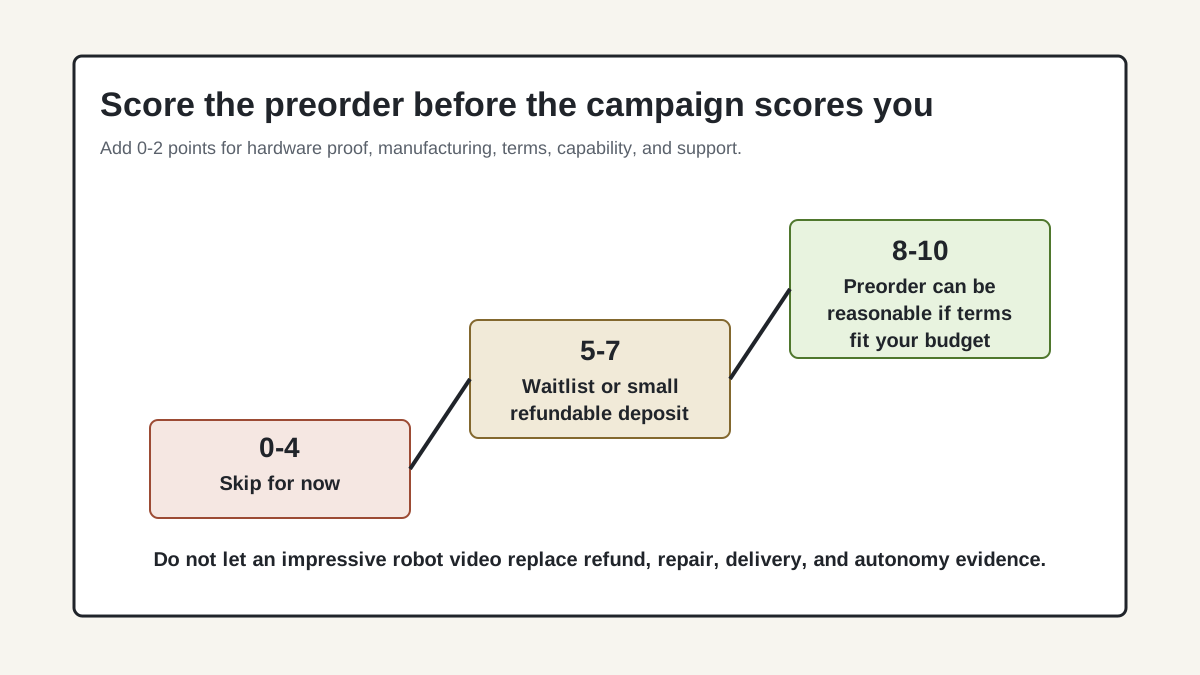
Interpret the score conservatively:
Score
0-4
- Decision
- Skip for now. Follow the company, but do not put money down.
Score
5-7
- Decision
- Join a free waitlist or use only a small refundable deposit.
Score
8-10
- Decision
- A preorder can be reasonable if the robot solves a real need and the terms fit your budget.
| Score | Decision |
|---|---|
| 0-4 | Skip for now. Follow the company, but do not put money down. |
| 5-7 | Join a free waitlist or use only a small refundable deposit. |
| 8-10 | A preorder can be reasonable if the robot solves a real need and the terms fit your budget. |
The score is not a guarantee. It is a way to slow yourself down before the campaign video does all the thinking.
What To Ask The Company Before A Large Preorder
For anything above a few hundred dollars, send the company a short list of questions and save the reply. Good teams answer plainly. Weak teams reply with more hype.
Ask:
- What functions will be available on delivery day, not "later this year"?
- Which functions require teleoperation, cloud AI, or a paid subscription?
- What is the refund deadline, and what happens if delivery slips by 6 or 12 months?
- Where will service and repairs happen for my country?
- Which parts are user-replaceable, and how long will parts be available?
- What data leaves my home, and can the robot run in a local-only mode?
- What certifications are complete, pending, or not required?
- How many units have already been produced or delivered?
If the robot is a companion or care product, add privacy and safety questions. Who can access logs? Can the camera or microphone be disabled physically? What happens if the robot misidentifies a person, falls, blocks a hallway, or gives bad advice? A good home robot should make those boundaries boringly clear.
When Backing Early Makes Sense
Early backing can make sense when the robot is narrow, useful, and already close to shipping. A privacy-first cleaning robot with a clear price, production units, and defined support terms is a very different risk from a humanoid that promises general chores but has not shown unscripted household work.
It can also make sense when you are not buying a finished consumer appliance. Researchers, developers, educators, and robotics hobbyists may knowingly buy an early platform such as a humanoid or quadruped because experimentation is the point. That is a valid purchase, but it should be framed honestly. You are buying access, not certainty.
The danger zone is a campaign that borrows the language of finished consumer products while carrying the risk profile of a lab prototype. That is where buyers get hurt: they expect a home helper and receive a developer kit, a delayed shipment, or a product dependent on software that is still being invented.
The Bottom Line
Do not ask whether a crowdfunded home robot is exciting. Of course it is. Ask whether the company has reduced enough uncertainty for the amount of money it wants today.
Use the simple rule: the larger the payment and the broader the promise, the stronger the proof must be. For a small refundable reservation, clear communication may be enough. For a $1,245 cleaning robot, expect product-level evidence and service terms. For a $20,000 to $95,000 humanoid or companion robot, expect a documented buying process, support commitments, and direct answers about autonomy, subscriptions, repairs, and delivery risk.
The best home robot preorder is not the one with the most impressive video. It is the one where the boring details are already solved.
Sources & References
Database context
Use this article as a privacy verification workflow
Turn the article into a real verification pass
Should You Back a Crowdfunded Home Robot? already points you toward 4 linked robots, 4 manufacturers, and 3 countries inside the ui44 database. That matters because strong buyer guidance is easier to apply when you can move immediately from a claim or warning into concrete product pages, manufacturer directories, component explainers, and country-level context instead of treating the article as an isolated opinion piece. The fastest next step is to turn the article into a shortlist workflow: open the linked robot pages, verify which specs are actually published for those models, then compare the surrounding manufacturer and component context before you decide whether the underlying claim changes your buying plan.
For this topic, the useful discipline is to separate the editorial lesson from the catalog evidence. The article gives you the framing, but the robot pages tell you what each product actually ships with today: sensor stack, connectivity methods, listed price, release timing, category, and support-relevant compatibility notes. The manufacturer pages then show whether you are looking at a one-off launch, a broader lineup pattern, or a company that spans multiple categories. That layered workflow reduces the risk of buying on a single marketing phrase or a single support FAQ.
Use the robot pages to confirm which products actually expose cameras, microphones, Wi-Fi, or voice systems, then use the manufacturer pages to decide how much of the privacy question seems product-specific versus brand-wide. On this route cluster, NEO, Matic, and David form the fastest reality check. If you want a quick working shortlist, open Compare NEO, Matic, and David next, then keep this article open as the reasoning layer while you compare structured data side by side.
Practical Takeaway
Every robot, manufacturer, category, component, and country reference below resolves to a real ui44 page, keeping the follow-up path grounded in database records rather than generic advice.
Suggested next steps in ui44
- Open NEO and note the listed sensors, connectivity methods, and voice stack before you interpret any policy claim.
- Cross-check the wider brand context on 1X Technologies so you can see whether the privacy question touches one model or a broader lineup.
- Use the linked component pages to confirm how common the relevant sensors and connectivity layers are across the database.
- Keep a short note of which policy layers you checked, which device features are actually present on the robot page, and which items still depend on region- or app-level confirmation.
- Finish with Compare NEO, Matic, and David so the policy reading sits next to structured product data.
Database context
Robot profiles worth opening next
Use the linked product pages as the evidence layer
The linked robot pages are where this article becomes operational. Instead of asking whether the headline is interesting, use the robot entries to inspect the actual mix of sensors, connectivity options, batteries, pricing, release timing, and stated capabilities attached to the products mentioned in the article. That is the easiest way to see whether the warning or opportunity described here affects one product family, a specific design pattern, or an entire buying lane.
NEO
1X Technologies · Humanoid · Pre-order
NEO is tracked on ui44 as a pre-order humanoid robot from 1X Technologies. The database currently records a listed price of $20,000, a release date of 2025-10-28, ~4 hours battery life, Not disclosed charging time, and a published stack that includes RGB Cameras, Depth Sensors, and Tactile Skin plus Wi-Fi and Bluetooth.
For privacy-focused reading, this page matters because it shows the concrete device surface behind the policy discussion. Use it to verify whether NEO combines sensors and connectivity in a way that could change the in-home data footprint, and compare the listed capabilities such as Household Chores, Tidying Up, and Safe Human Interaction with any cloud, app, or voice layers.
Matic
Matic Robots · Cleaning · Available
Matic is tracked on ui44 as a available cleaning robot from Matic Robots. The database currently records a listed price of $1,245, a release date of 2026-04, Not officially disclosed; official materials say Matic can run for hours autonomously battery life, Not officially disclosed charging time, and a published stack that includes On-device computer-vision cameras, Real-time 3D floor mapping, and Surface and mess detection for automatic cleaning-mode switching plus Matic mobile app control and scheduling and iOS app listed in official product-page copy.
For privacy-focused reading, this page matters because it shows the concrete device surface behind the policy discussion. Use it to verify whether Matic combines sensors and connectivity in a way that could change the in-home data footprint, and compare the listed capabilities such as Vacuuming, Mopping, and Automatic Vacuum/Mop Switching with any cloud, app, or voice layers.
David is tracked on ui44 as a available companions robot from Realbotix. The database currently records a listed price of $95,000, a release date of 2026-01, F-Series product page lists an estimated 4–8 hours from the built-in battery; Realbotix's April 2026 delivery update separately says robots can have up to 10 hours and can operate continuously when plugged in battery life, Not disclosed charging time, and a published stack that includes Patented Eye-Tracking Vision System, AI Vision for Face Recognition, and Emotion Interpretation Cameras plus Wi-Fi.
For privacy-focused reading, this page matters because it shows the concrete device surface behind the policy discussion. Use it to verify whether David combines sensors and connectivity in a way that could change the in-home data footprint, and compare the listed capabilities such as Autonomous Multilingual Conversation, Facial Expression (14+ actuated points), and Face Recognition & Memory with any cloud, app, or voice layers, including Realbotix Custom AI.
Unitree H2
Unitree Robotics · Humanoid · Available
Unitree H2 is tracked on ui44 as a available humanoid robot from Unitree Robotics. The database currently records a listed price of $29,900, a release date of 2025, About 3 hours battery life, Not officially disclosed charging time, and a published stack that includes Binocular Camera (Wide FOV), Array Microphone, and IMU plus Wi-Fi 6 and Bluetooth 5.2.
For privacy-focused reading, this page matters because it shows the concrete device surface behind the policy discussion. Use it to verify whether Unitree H2 combines sensors and connectivity in a way that could change the in-home data footprint, and compare the listed capabilities such as 31 Degrees of Freedom, 360 N·m Peak Leg Joint Torque, and 120 N·m Peak Arm Joint Torque with any cloud, app, or voice layers, including Built-in Voice Interaction.
Database context
Manufacturer context behind the article
Check whether this is one product story or a broader company pattern
Manufacturer pages add the privacy context that individual product pages cannot show on their own. They help you check whether cameras, microphones, cloud accounts, app controls, and policy assumptions appear across a broader lineup or stay tied to one specific product story.
1X Technologies
ui44 currently tracks 2 robots from 1X Technologies across 1 category. The company is grouped under Norway, and the current catalog footprint on ui44 includes NEO, EVE.
That wider brand context matters because privacy questions rarely stop at one FAQ page. A manufacturer route helps you see whether the article is centered on one premium model or on a company that has several relevant products and therefore more than one place where the same policy or app assumptions might matter. The category mix here currently points toward Humanoid as the most useful next route if you want to see whether this article reflects a wider pattern inside the brand.
Matic Robots
ui44 currently tracks 1 robot from Matic Robots across 1 category. The company is grouped under USA, and the current catalog footprint on ui44 includes Matic.
That wider brand context matters because privacy questions rarely stop at one FAQ page. A manufacturer route helps you see whether the article is centered on one premium model or on a company that has several relevant products and therefore more than one place where the same policy or app assumptions might matter. The category mix here currently points toward Cleaning as the most useful next route if you want to see whether this article reflects a wider pattern inside the brand.
Realbotix
ui44 currently tracks 1 robot from Realbotix across 1 category. The company is grouped under USA, and the current catalog footprint on ui44 includes David.
That wider brand context matters because privacy questions rarely stop at one FAQ page. A manufacturer route helps you see whether the article is centered on one premium model or on a company that has several relevant products and therefore more than one place where the same policy or app assumptions might matter. The category mix here currently points toward Companions as the most useful next route if you want to see whether this article reflects a wider pattern inside the brand.
Unitree Robotics
ui44 currently tracks 9 robots from Unitree Robotics across 3 categorys. The company is grouped under China, and the current catalog footprint on ui44 includes B2, B1, Go2.
That wider brand context matters because privacy questions rarely stop at one FAQ page. A manufacturer route helps you see whether the article is centered on one premium model or on a company that has several relevant products and therefore more than one place where the same policy or app assumptions might matter. The category mix here currently points toward Quadruped, Humanoid, Research as the most useful next route if you want to see whether this article reflects a wider pattern inside the brand.
Database context
Broaden the scan without leaving the database
Categories, components, and countries add the wider context
Category framing
Category pages are useful when the article touches a buying pattern that shows up across brands. A category route helps you confirm whether the linked products sit in a narrow niche or whether the same question should be tested across a larger field of alternatives.
Humanoid
The Humanoid category page currently groups 108 tracked robots from 78 manufacturers. ui44 describes this lane as: Full-size bipedal humanoid robots designed to work alongside humans. From factory floors to household tasks, these machines represent the cutting edge of robotics.
That makes the category route a practical follow-up when you want to check whether the products linked in this article are typical for the lane or whether they sit at one edge of the market. Useful starting examples currently include NEO, EVE, Mornine M1.
Cleaning
The Cleaning category page currently groups 59 tracked robots from 25 manufacturers. ui44 describes this lane as: Robot vacuums, mops, pool cleaners, and window cleaners. The workhorses of home automation that keep your spaces spotless.
That makes the category route a practical follow-up when you want to check whether the products linked in this article are typical for the lane or whether they sit at one edge of the market. Useful starting examples currently include Scuba V3, EcoSurfer S2, AquaSense X.
Country and ecosystem context
Country pages give extra context when support practices, launch sequencing, regulatory posture, or manufacturer mix matter. They are not a substitute for model-level verification, but they do help you see which ecosystems cluster together and which manufacturers sit in the same regional field when you broaden the search beyond the article headline.
Norway
The Norway route currently groups 2 tracked robots from 1 manufacturers in ui44. That gives you a useful regional lens when the article points toward support practices, launch sequencing, or brand clusters that may share similar ecosystem assumptions.
On the current route, manufacturers like 1X Technologies make the page a good way to broaden the scan without losing the regional context that often shapes availability, documentation style, and adjacent alternatives.
USA
The USA route currently groups 75 tracked robots from 59 manufacturers in ui44. That gives you a useful regional lens when the article points toward support practices, launch sequencing, or brand clusters that may share similar ecosystem assumptions.
On the current route, manufacturers like iRobot, Boston Dynamics, Faraday Future make the page a good way to broaden the scan without losing the regional context that often shapes availability, documentation style, and adjacent alternatives.
China
The China route currently groups 170 tracked robots from 78 manufacturers in ui44. That gives you a useful regional lens when the article points toward support practices, launch sequencing, or brand clusters that may share similar ecosystem assumptions.
On the current route, manufacturers like Dreame, AGIBOT, Unitree Robotics make the page a good way to broaden the scan without losing the regional context that often shapes availability, documentation style, and adjacent alternatives.
Database context
Questions to answer before you move from reading to buying
A follow-up FAQ built from the entities already linked in this article
Frequently Asked Questions
Which page should I open first after reading “Should You Back a Crowdfunded Home Robot?”?
Start with NEO. That gives you a concrete product anchor for the article’s main claim. From there, branch into the manufacturer and component pages so you can tell whether the article is describing one specific model, a repeated brand pattern, or a wider technology issue that affects multiple shortlist options.
How do the manufacturer pages change the buying decision?
1X Technologies help you zoom out from one article and one product. On ui44 they show lineup breadth, category spread, and the neighboring robots tied to the same company. That context is useful when you are deciding whether a risk belongs to a single model, whether it shows up across a brand’s portfolio, and whether you should keep looking at alternatives before committing.
When should I switch from reading to side-by-side comparison?
Move into Compare NEO, Matic, and David as soon as you understand the article’s main warning or promise. The article explains what to watch for, but the compare view is where you can check whether price, status, battery life, connectivity, sensors, and category fit still make the robot a good match for your own home and budget.
Database context
Where to go next in ui44
Keep the research chain inside the database
If you want to keep going, these follow-on pages give you the cleanest expansion path from article to research session. Open the comparison route first if you are deciding between products today. Open the manufacturer, category, and component routes if you still need to understand the broader pattern behind the claim.
Written by
ui44 Team
Published June 7, 2026
Share this article
Open a plain share link on X or Bluesky. No embeds, no widgets, no cookie baggage.