That is good news only if you know where the update boundary is. Firmware can add Matter support, improve map handling, tune obstacle recognition, or change how a dock washes mop pads. It cannot add a missing camera, make a weak battery new again, or turn a shallow threshold climber into a stair robot.
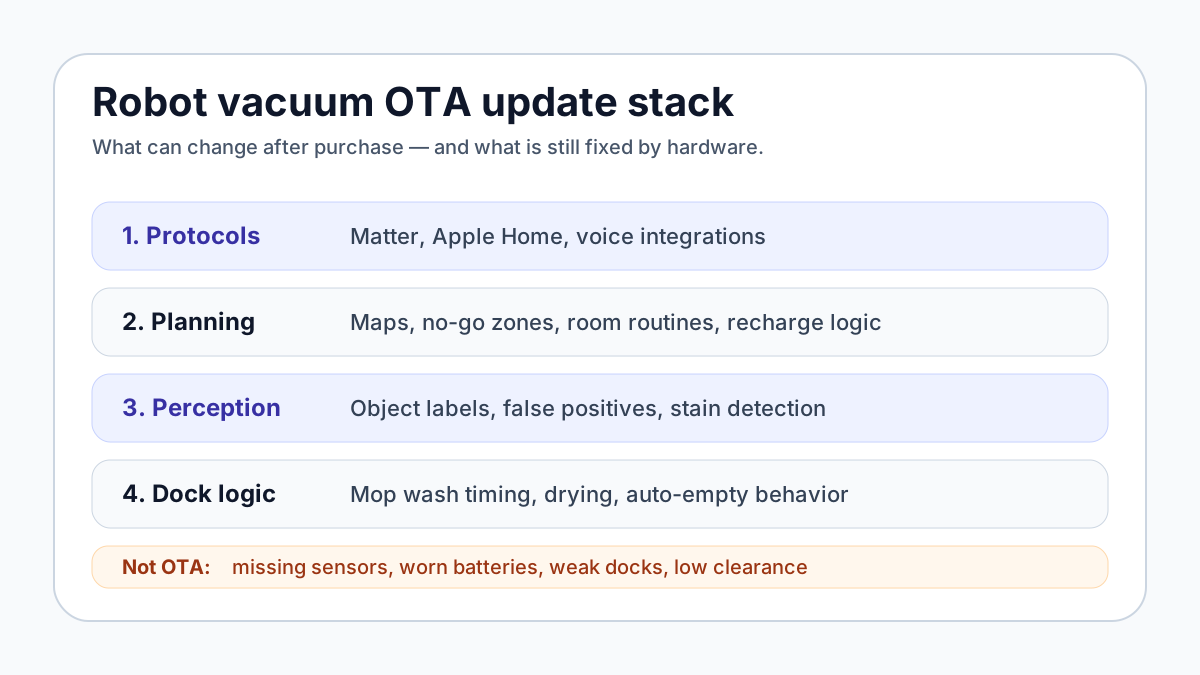
The practical question for buyers is simple: should software support change which robot vacuum you buy? Yes — but only after the current hardware, current features, and the manufacturer's update track record already make sense.
What OTA updates can actually improve
A robot vacuum OTA update is usually a firmware or app-controlled software package delivered through the brand's mobile app. Ecovacs' support guidance is a typical example: the robot needs to be in the base station, online, on a good Wi-Fi connection, and above 50% battery before the update starts. That alone is a useful reminder that updates are part of the product's connected-home infrastructure, not a magic background process.
The most meaningful update categories are these:
Update area
Smart-home protocols
- What can improve
- Matter, Apple Home, Alexa, Google Home, Siri support
- What to verify before buying
- Is the feature live today or promised by OTA?
Update area
Mapping and routines
- What can improve
- Multi-floor maps, room names, no-go zones, recharge-and-resume behavior
- What to verify before buying
- Does the app expose update history or release notes?
Update area
Perception
- What can improve
- Object labels, cable/shoe avoidance, pet or stain recognition
- What to verify before buying
- Does the robot have camera, structured light, ToF, or LiDAR hardware?
Update area
Dock behavior
- What can improve
- Mop-wash temperature, drying time, auto-empty timing, tray cleaning
- What to verify before buying
- Does the dock hardware already support the claimed behavior?
Update area
Reliability and security
- What can improve
- Bug fixes, pairing fixes, connectivity fixes, privacy patches
- What to verify before buying
- Does the brand still support older models?
| Update area | What can improve | What to verify before buying |
|---|---|---|
| Smart-home protocols | Matter, Apple Home, Alexa, Google Home, Siri support | Is the feature live today or promised by OTA? |
| Mapping and routines | Multi-floor maps, room names, no-go zones, recharge-and-resume behavior | Does the app expose update history or release notes? |
| Perception | Object labels, cable/shoe avoidance, pet or stain recognition | Does the robot have camera, structured light, ToF, or LiDAR hardware? |
| Dock behavior | Mop-wash temperature, drying time, auto-empty timing, tray cleaning | Does the dock hardware already support the claimed behavior? |
| Reliability and security | Bug fixes, pairing fixes, connectivity fixes, privacy patches | Does the brand still support older models? |
The first row is the easiest to validate. Ecovacs says its global lineup including DEEBOT X2, T50, T50 Max, and X8 will gain Matter 1.4 support in phases. Its own US Matter guide also says later models such as the DEEBOT X8 Pro Omni will get the update. That is a concrete OTA promise: a named protocol, named models, and a public manufacturer statement.
The perception layer is more complicated. A robot with RGB cameras, structured light, or ToF sensing has more room for software improvement than a robot that only bumps into objects. But the update still depends on the manufacturer's model, testing process, and willingness to ship improvements to existing owners. Treat claims like "AI obstacle avoidance will improve over time" as a maybe unless the brand names the robot, the feature, and the release path.
The current database picture: who has software headroom?
The ui44 database makes the software question easier because it puts OTA-relevant hardware next to price and availability. These are the models worth comparing if you care about updates after purchase:
Robot
- ui44 status and price
- Available, $1,099.99 official US listing
- OTA-relevant signal
- Matter via OTA in ui44 data; AIVI 3D 3.0 camera/structured-light stack; YIKO-GPT voice system
Robot
- ui44 status and price
- Available, AUD $2,799 listed for Australia; US not confirmed
- OTA-relevant signal
- Matter protocol support is planned via a future OTA update; Reactive AI for 200+ objects
Robot
- ui44 status and price
- Available, $1,599.99 MSRP
- OTA-relevant signal
- StarSight 2.0 with embedded 3D ToF LiDAR, RGB camera, VertiBeam lateral avoidance, and 300+ object types
Robot
- ui44 status and price
- Available, $1,699.99 official US price
- OTA-relevant signal
- Dual AI cameras, lateral 3D structured light, proactive illumination, 280+ object recognition
Robot
- ui44 status and price
- Available, $1,399.99 official US price
- OTA-relevant signal
- Matter-enabled with Apple Home support already listed in ui44 data
| Robot | ui44 status and price | OTA-relevant signal |
|---|---|---|
| Ecovacs Deebot X8 Pro Omni | Available, $1,099.99 official US listing | Matter via OTA in ui44 data; AIVI 3D 3.0 camera/structured-light stack; YIKO-GPT voice system |
| Roborock Qrevo Edge 2 Pro | Available, AUD $2,799 listed for Australia; US not confirmed | Matter protocol support is planned via a future OTA update; Reactive AI for 200+ objects |
| Roborock Saros 20 | Available, $1,599.99 MSRP | StarSight 2.0 with embedded 3D ToF LiDAR, RGB camera, VertiBeam lateral avoidance, and 300+ object types |
| Dreame X60 Max Ultra Complete | Available, $1,699.99 official US price | Dual AI cameras, lateral 3D structured light, proactive illumination, 280+ object recognition |
| Roomba Combo 10 Max | Available, $1,399.99 official US price | Matter-enabled with Apple Home support already listed in ui44 data |
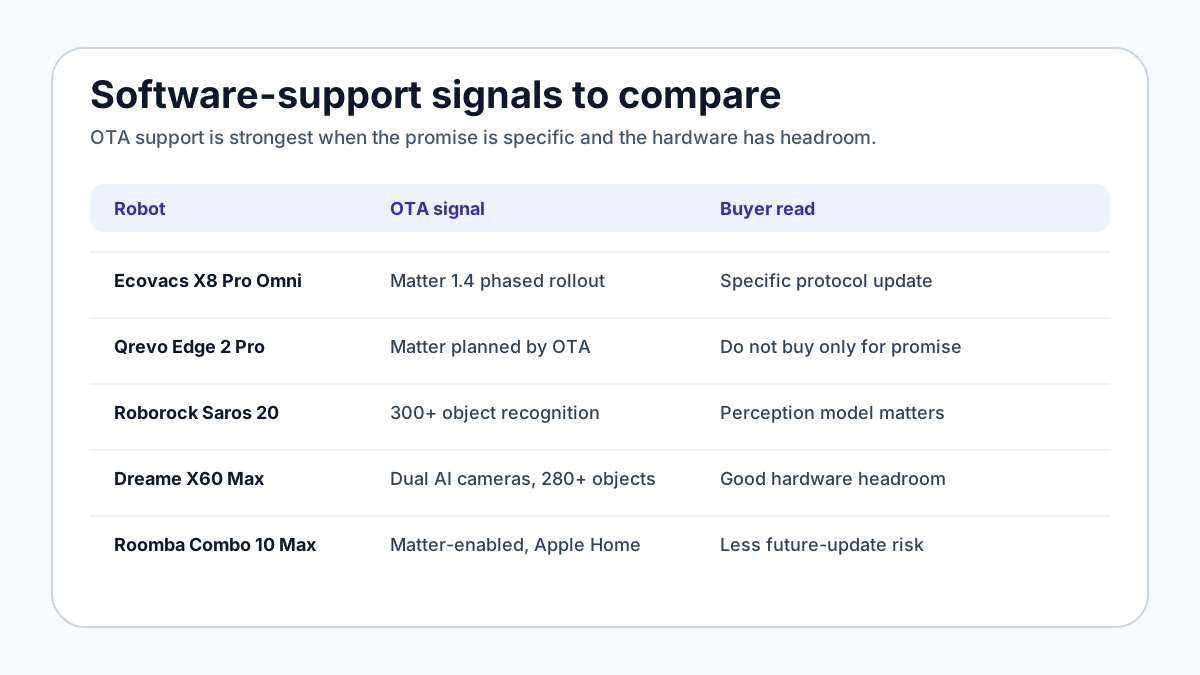
This does not mean the most updateable robot is automatically the best robot. It means some robots have more software headroom than others. A robot with dual AI cameras and 280+ object recognition classes, like the Dreame X60 Max Ultra Complete, gives software more to work with than a basic bump-and-random model. A robot with an explicitly promised Matter update, like the Qrevo Edge 2 Pro, gives you a feature to track. A robot with Matter already listed, like Roomba Combo 10 Max, reduces the risk that you are buying a future promise instead of a current capability.
What OTA updates cannot fix
The biggest mistake is treating firmware as a warranty against bad hardware. Software can tune behavior inside the limits of the robot. It cannot remove those limits.
Start with sensors. If a robot does not have a front camera, structured light, 3D ToF, or another perception system, an update cannot make it recognize cables like a vision-equipped flagship. It may get better at slowing down, wall following, or map handling, but it will not suddenly see socks under a sofa.
The same rule applies to docks. If the base station lacks a mop-wash system, OTA cannot add hot-water washing. If it lacks an auto-refill path, OTA cannot turn it into a plumbing-ready dock. If the dust path clogs because the physical channel is narrow, software can change timing but not the duct geometry.
Thresholds are another hard boundary. Roborock Saros 20 uses AdaptiLift Chassis 3.0 and a climbing arm for double-layer thresholds up to about 8.8 cm. Dreame X60 Max Ultra Complete claims up to 8.8 cm double-layer threshold crossing with its legged chassis. That is hardware. A firmware update may make approach angles smoother, but it cannot give a flat, low-cost robot the same mechanical clearance.
Finally, firmware does not erase battery wear. Over time, shorter runtime may be a battery, dirty filter, worn brush, or charging-contact issue rather than a software problem. A good update history is valuable, but it is not a substitute for replaceable parts and reasonable maintenance costs.
The buyer rule: buy the robot you get today
OTA promises are useful as a tie-breaker, not as the foundation of the purchase. If two robot vacuums are both good today, choose the one with clearer software support. If one robot is mediocre today but promises a future update, be careful. You are lending the manufacturer money against an undefined roadmap.
A good promise has four traits:
- It names the feature. "Matter 1.4 support" is stronger than "future smart home improvements."
- It names the model. "X8 Pro Omni will get this update" is stronger than "select models."
- It has a support path. The app or help center explains how firmware is installed.
- The current robot is already worth buying. If the update never ships, the purchase should still make sense.
The Ecovacs Deebot X8 Pro Omni is a useful case study. The current robot already has 18,000 Pa suction, OZMO Roller self-washing mopping, AIVI 3D 3.0, YIKO-GPT, and a dock with auto-emptying and hot-air drying. Ecovacs also says X8 is part of its phased Matter lineup. The OTA story adds value because the base product is already specified.
By contrast, if a listing says "coming soon by OTA" for the one feature you most want, price it as if the feature does not exist. That is especially important for smart-home integration. If you need Apple Home or Matter control today, a robot that is already Matter-enabled is lower risk than a robot waiting for a future firmware package.
How to check update quality before you buy
Do not just ask, "Does it get updates?" Ask what kind of updates the brand ships and how visible they are.
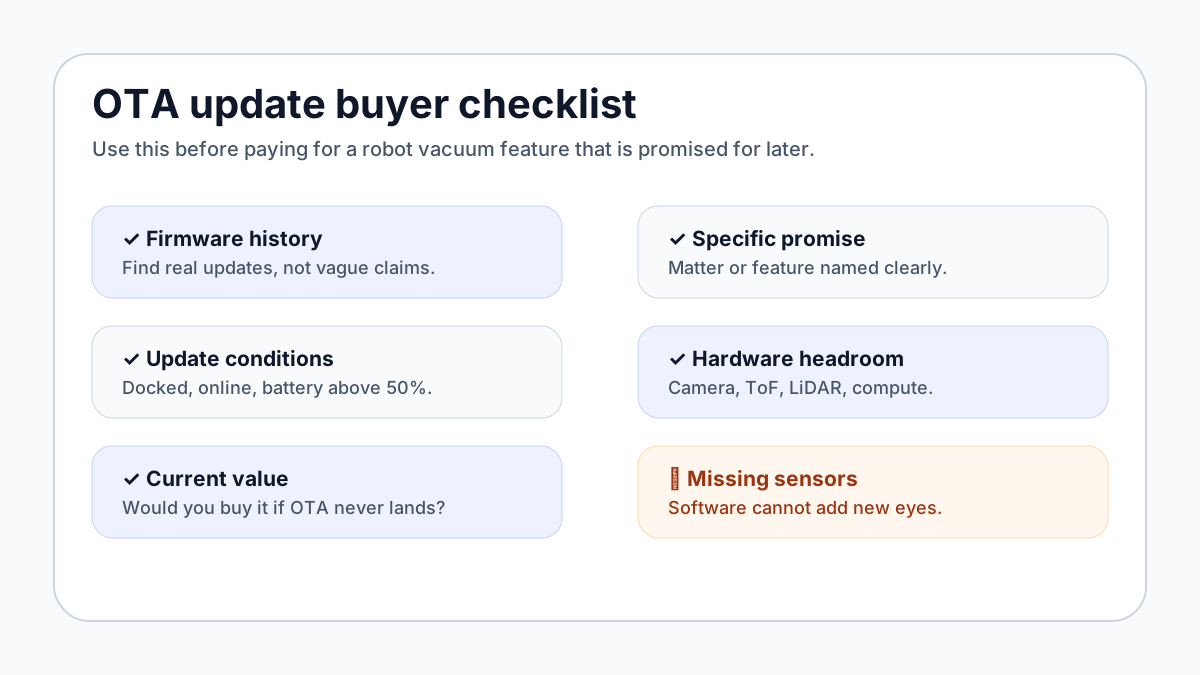
Use this checklist before checkout:
- Look for named protocols. Matter, Apple Home, Alexa, Google Home, and Siri support should be explicit. Vague "smart home ready" language is not enough.
- Check whether the feature is live or planned. In ui44, we separate current compatibility from notes such as "planned via future OTA update."
- Prefer public support instructions. Ecovacs documents firmware upgrades through the Ecovacs Home App and lists battery/Wi-Fi conditions. That is more reassuring than a product page that never mentions updates.
- Check sensor hardware. AI claims are stronger when the robot has cameras, structured light, ToF, LiDAR, or clear object-recognition specs.
- Screenshot the firmware version after setup. If behavior changes later, you need to know which version caused the change.
- Wait a week on non-urgent updates. For mission-critical schedules, let early adopters find app bugs before updating, unless the release is a security or safety fix.
For a deeper side-by-side, use /compare with the robots you are considering. Put current features first: suction, dock automation, sensors, height, threshold handling, voice support, and price. Then use OTA support as the software confidence layer.
Which buyers should care most?
OTA support matters most if your home depends on integration. If you want the robot to pause when a doorbell rings, start when everyone leaves, avoid rooms at certain times, or fit into a Matter-based smart home, updates can change the experience dramatically.
It also matters if you are buying a flagship perception robot. Models such as Roborock Saros Z70, Saros 20, Dreame X60 Max Ultra Complete, and Ecovacs X8 Pro Omni have complex perception stacks. Their software decides whether a cable is avoided, a stain is re-mopped, a pet zone is handled carefully, or a room is cleaned in a sensible order. Better hardware creates the opportunity; better firmware determines how much of it you actually feel.
OTA support matters less if you want a simple, cheap cleaner for one open floor. For that buyer, reliability, consumable cost, easy parts replacement, and a good return policy may matter more than app features. A basic vacuum that works every day beats a flagship that is always waiting for the next patch.
Bottom line
Robot vacuum OTA updates are real, and they are becoming more important. The best updates can add smart-home protocols, refine object recognition, improve app routines, and make dock behavior more reliable. But OTA is not a reason to ignore hardware. Buy the robot that already solves your cleaning problem, then give extra credit to brands that publish specific update paths and support existing models after launch.
The simplest buying test is this: if the promised update never arrives, would you still be happy owning this robot for the next three years? If the answer is yes, OTA support is a bonus. If the answer is no, you are not buying a robot vacuum — you are buying a roadmap.
Sources & References
- ui44 database records for Roborock Saros Z70, Roborock Saros 20, Roborock Qrevo Edge 2 Pro, Dreame X50 Ultra, Dreame X60 Max Ultra Complete, Ecovacs Deebot X8 Pro Omni, Ecovacs Deebot X12 OmniCyclone, Roomba Combo 10 Max, and Roomba Max 705 Vac.
- Ecovacs official Matter announcement: https://www.ecovacs.com/global/newsroom/official-news/60
- Ecovacs robot-vacuums-with-Matter guide: https://www.ecovacs.com/us/blog/robot-vacuums-with-matter
- Ecovacs firmware-upgrade support guidance: https://help.ecovacs.com/global/support/faq-detail?id=425
- Ecovacs Deebot X8 Pro Omni product page: https://www.ecovacs.com/us/deebot-robotic-vacuum-cleaner/deebot-x8-pro-omni
- Roborock Saros Z70 official product page: https://us.roborock.com/products/roborock-saros-z70
- Roborock Saros 20 official product page: https://us.roborock.com/products/roborock-saros-20
- Dreame X60 Max Ultra Complete official product page: https://www.dreametech.com/products/x60-max-ultra-complete-robot-vacuum
Related in the database
Use this article as a privacy verification workflow
Turn the article into a privacy verification pass grounded in the robots, manufacturers, and components it actually references.
Robot Vacuum OTA Updates: What Actually Improves already points you toward 9 linked robots, 4 manufacturers, and 2 countries inside the ui44 database. That matters because strong buyer guidance is easier to apply when you can move immediately from a claim or warning into concrete product pages, manufacturer directories, component explainers, and country-level context instead of treating the article as an isolated opinion piece. The fastest next step is to turn the article into a shortlist workflow: open the linked robot pages, verify which specs are actually published for those models, then compare the surrounding manufacturer and component context before you decide whether the underlying claim changes your buying plan.
For this topic, the useful discipline is to separate the editorial lesson from the catalog evidence. The article gives you the framing, but the robot pages tell you what each product actually ships with today: sensor stack, connectivity methods, listed price, release timing, category, and support-relevant compatibility notes. The manufacturer pages then show whether you are looking at a one-off launch, a broader lineup pattern, or a company that spans multiple categories. That layered workflow reduces the risk of buying on a single marketing phrase or a single support FAQ.
Use the robot pages to confirm which products actually expose cameras, microphones, Wi-Fi, or voice systems, then use the manufacturer pages to decide how much of the privacy question seems product-specific versus brand-wide. On this route cluster, Deebot X8 Pro Omni, Qrevo Edge 2 Pro, and Saros 20 form the fastest reality check. If you want a quick working shortlist, open Compare Deebot X8 Pro Omni, Qrevo Edge 2 Pro, and Saros 20 next, then keep this article open as the reasoning layer while you compare structured data side by side.
Practical Takeaway
Every robot, manufacturer, category, component, and country reference below resolves to a real ui44 page, keeping the follow-up path grounded in database records rather than generic advice.
Suggested next steps in ui44
- Open Deebot X8 Pro Omni and note the listed sensors, connectivity methods, and voice stack before you interpret any policy claim.
- Cross-check the wider brand context on Ecovacs so you can see whether the privacy question touches one model or a broader lineup.
- Use the linked component pages to confirm how common the relevant sensors and connectivity layers are across the database.
- Keep a short note of which policy layers you checked, which device features are actually present on the robot page, and which items still depend on region- or app-level confirmation.
- Finish with Compare Deebot X8 Pro Omni, Qrevo Edge 2 Pro, and Saros 20 so the policy reading sits next to structured product data.
Robot profiles worth opening next
Use the linked product pages as the evidence layer
The linked robot pages are where this article becomes operational. Instead of asking whether the headline is interesting, use the robot entries to inspect the actual mix of sensors, connectivity options, batteries, pricing, release timing, and stated capabilities attached to the products mentioned in the article. That is the easiest way to see whether the warning or opportunity described here affects one product family, a specific design pattern, or an entire buying lane.
Deebot X8 Pro Omni
Ecovacs · Cleaning · Available
Deebot X8 Pro Omni is tracked on ui44 as a available cleaning robot from Ecovacs. The database currently records a listed price of $1,100, a release date of 2025-01, Up to 291 minutes (low power mode) battery life, 4h37min charging time, and a published stack that includes dToF LiDAR (Embedded), AIVI 3D 3.0 Camera, and Dual Structured Light plus Wi-Fi and Bluetooth.
For privacy-focused reading, this page matters because it shows the concrete device surface behind the policy discussion. Use it to verify whether Deebot X8 Pro Omni combines sensors and connectivity in a way that could change the in-home data footprint, and compare the listed capabilities such as 18,000 Pa Suction Power, OZMO Roller Instant Self-Washing Mopping, and ZeroTangle 2.0 Anti-Hair-Wrap with any cloud, app, or voice layers, including YIKO-GPT (built-in LLM assistant) and Amazon Alexa.
Qrevo Edge 2 Pro
Roborock · Cleaning · Available
Qrevo Edge 2 Pro is tracked on ui44 as a available cleaning robot from Roborock. The database currently records a listed price of Price TBA, a release date of 2026-02, Up to 240 minutes (runtime varies by mode) battery life, ~4 hours charging time, and a published stack that includes PreciSense Spinning LiDAR (RetractSense), 3D Structured Light, and RGB Camera plus Wi-Fi and Bluetooth.
For privacy-focused reading, this page matters because it shows the concrete device surface behind the policy discussion. Use it to verify whether Qrevo Edge 2 Pro combines sensors and connectivity in a way that could change the in-home data footprint, and compare the listed capabilities such as 25,000 Pa HyperForce Suction, RetractSense Retractable LiDAR Tower, and 7.98 cm Ultra-Slim Design with any cloud, app, or voice layers, including Hello Rocky (onboard, offline) and Amazon Alexa.
Saros 20 is tracked on ui44 as a available cleaning robot from Roborock. The database currently records a listed price of $1,600, a release date of 2026-03, Up to 190 minutes battery life, Not officially disclosed charging time, and a published stack that includes Embedded 3D ToF LiDAR (StarSight 2.0), VertiBeam Lateral Obstacle Avoidance, and RGB Camera plus Wi-Fi and Bluetooth.
For privacy-focused reading, this page matters because it shows the concrete device surface behind the policy discussion. Use it to verify whether Saros 20 combines sensors and connectivity in a way that could change the in-home data footprint, and compare the listed capabilities such as 36,000 Pa HyperForce Suction, AdaptiLift Chassis 3.0 (wheel lifting + climbing arm), and Double-Layer Threshold Crossing (up to ~3.46 in / 8.8 cm) with any cloud, app, or voice layers, including Hello Rocky (onboard) and Amazon Alexa.
X60 Max Ultra Complete
Dreame · Cleaning · Available
X60 Max Ultra Complete is tracked on ui44 as a available cleaning robot from Dreame. The database currently records a listed price of $1,700, a release date of 2026-02, 6,400 mAh battery battery life, 80 minutes (official fast-charge claim) charging time, and a published stack that includes VersaLift DToF, Dual AI Cameras, and Lateral 3D Structured Light plus its listed connectivity stack.
For privacy-focused reading, this page matters because it shows the concrete device surface behind the policy discussion. Use it to verify whether X60 Max Ultra Complete combines sensors and connectivity in a way that could change the in-home data footprint, and compare the listed capabilities such as 35,000 Pa Vormax Suction, 79.5 mm Ultra-Slim Body, and VersaLift Retractable DToF Navigation with any cloud, app, or voice layers, including Built-in 'OK, Dreame' and Amazon Alexa.
Roomba Combo 10 Max
iRobot · Cleaning · Available
Roomba Combo 10 Max is tracked on ui44 as a available cleaning robot from iRobot. The database currently records a listed price of $1,400, a release date of 2024-07, Not officially disclosed battery life, Automatically recharges via AutoWash Dock charging time, and a published stack that includes Camera, Detection Sensors, and PrecisionVision Navigation plus Wi-Fi and iRobot Home App.
For privacy-focused reading, this page matters because it shows the concrete device surface behind the policy discussion. Use it to verify whether Roomba Combo 10 Max combines sensors and connectivity in a way that could change the in-home data footprint, and compare the listed capabilities such as Vacuum + Mop (2-in-1), Cleaning modes: Vacuum only, Mop only, or Vacuum & Mop simultaneously, and AutoWash Dock (empty, refill, wash, dry, self-clean) with any cloud, app, or voice layers, including Amazon Alexa and Google Assistant.
Manufacturer context behind the article
Check whether this is one product story or a broader company pattern
Manufacturer pages add the privacy context that individual product pages cannot show on their own. They help you check whether cameras, microphones, cloud accounts, app controls, and policy assumptions appear across a broader lineup or stay tied to one specific product story.
Ecovacs
ui44 currently tracks 7 robots from Ecovacs across 3 categorys. The company is grouped under China, and the current catalog footprint on ui44 includes Deebot X8 Pro Omni, Deebot X12 OmniCyclone, Deebot T90 Pro Omni.
That wider brand context matters because privacy questions rarely stop at one FAQ page. A manufacturer route helps you see whether the article is centered on one premium model or on a company that has several relevant products and therefore more than one place where the same policy or app assumptions might matter. The category mix here currently points toward Cleaning, Lawn & Garden, Companions as the most useful next route if you want to see whether this article reflects a wider pattern inside the brand.
Roborock
ui44 currently tracks 6 robots from Roborock across 2 categorys. The company is grouped under China, and the current catalog footprint on ui44 includes Saros Z70, Saros Rover, Saros 20.
That wider brand context matters because privacy questions rarely stop at one FAQ page. A manufacturer route helps you see whether the article is centered on one premium model or on a company that has several relevant products and therefore more than one place where the same policy or app assumptions might matter. The category mix here currently points toward Cleaning, Lawn & Garden as the most useful next route if you want to see whether this article reflects a wider pattern inside the brand.
Dreame
ui44 currently tracks 10 robots from Dreame across 2 categorys. The company is grouped under China, and the current catalog footprint on ui44 includes X50 Ultra, A3 AWD Pro, X60 Max Ultra Complete.
That wider brand context matters because privacy questions rarely stop at one FAQ page. A manufacturer route helps you see whether the article is centered on one premium model or on a company that has several relevant products and therefore more than one place where the same policy or app assumptions might matter. The category mix here currently points toward Cleaning, Lawn & Garden as the most useful next route if you want to see whether this article reflects a wider pattern inside the brand.
iRobot
ui44 currently tracks 5 robots from iRobot across 1 category. The company is grouped under USA, and the current catalog footprint on ui44 includes Roomba j9+, Roomba Combo j5+, Roomba Combo 10 Max.
That wider brand context matters because privacy questions rarely stop at one FAQ page. A manufacturer route helps you see whether the article is centered on one premium model or on a company that has several relevant products and therefore more than one place where the same policy or app assumptions might matter. The category mix here currently points toward Cleaning as the most useful next route if you want to see whether this article reflects a wider pattern inside the brand.
Broaden the scan without leaving the database
Categories, components, and countries add the wider context
Category framing
Category pages are useful when the article touches a buying pattern that shows up across brands. A category route helps you confirm whether the linked products sit in a narrow niche or whether the same question should be tested across a larger field of alternatives.
Cleaning
The Cleaning category page currently groups 62 tracked robots from 27 manufacturers. ui44 describes this lane as: Robot vacuums, mops, pool cleaners, and window cleaners — the workhorses of home automation that keep every surface spotless.
That makes the category route a practical follow-up when you want to check whether the products linked in this article are typical for the lane or whether they sit at one edge of the market. Useful starting examples currently include Scuba V3, EcoSurfer S2, Scuba V3 Ultra.
Country and ecosystem context
Country pages give extra context when support practices, launch sequencing, regulatory posture, or manufacturer mix matter. They are not a substitute for model-level verification, but they do help you see which ecosystems cluster together and which manufacturers sit in the same regional field when you broaden the search beyond the article headline.
China
The China route currently groups 189 tracked robots from 87 manufacturers in ui44. That gives you a useful regional lens when the article points toward support practices, launch sequencing, or brand clusters that may share similar ecosystem assumptions.
On the current route, manufacturers like AGIBOT, Dreame, Unitree Robotics make the page a good way to broaden the scan without losing the regional context that often shapes availability, documentation style, and adjacent alternatives.
USA
The USA route currently groups 89 tracked robots from 69 manufacturers in ui44. That gives you a useful regional lens when the article points toward support practices, launch sequencing, or brand clusters that may share similar ecosystem assumptions.
On the current route, manufacturers like Faraday Future, iRobot, Boston Dynamics make the page a good way to broaden the scan without losing the regional context that often shapes availability, documentation style, and adjacent alternatives.
Questions to answer before you move from reading to buying
A follow-up FAQ built from the entities already linked in this article
Frequently Asked Questions
Which page should I open first after reading “Robot Vacuum OTA Updates: What Actually Improves”?
Start with Deebot X8 Pro Omni. That gives you a concrete product anchor for the article’s main claim. From there, branch into the manufacturer and component pages so you can tell whether the article is describing one specific model, a repeated brand pattern, or a wider technology issue that affects multiple shortlist options.
How do the manufacturer pages change the buying decision?
Ecovacs help you zoom out from one article and one product. On ui44 they show lineup breadth, category spread, and the neighboring robots tied to the same company. That context is useful when you are deciding whether a risk belongs to a single model, whether it shows up across a brand’s portfolio, and whether you should keep looking at alternatives before committing.
When should I switch from reading to side-by-side comparison?
Move into Compare Deebot X8 Pro Omni, Qrevo Edge 2 Pro, and Saros 20 as soon as you understand the article’s main warning or promise. The article explains what to watch for, but the compare view is where you can check whether price, status, battery life, connectivity, sensors, and category fit still make the robot a good match for your own home and budget.
Where to go next in ui44
Keep the research chain inside the database
If you want to keep going, these follow-on pages give you the cleanest expansion path from article to research session. Open the comparison route first if you are deciding between products today. Open the manufacturer, category, and component routes if you still need to understand the broader pattern behind the claim.
Written by
ui44 Team
Published May 17, 2026
Share this article
Open a plain share link on X or Bluesky. No embeds, no widgets, no cookie baggage.