Commercial model
Pricing not public
Not yet announced. Co-founder Colin Angle says the price will be comparable to the cost of owning a dog.. That usually means the final commercial package depends on deployment scope, services, or negotiated terms.

A quadruped companion robot from Familiar Machines & Magic, the startup founded by iRobot co-founder and former CEO Colin Angle. About the size of a small dog with a bear-like appearance, the Familiar is covered in a touch-sensitive, 3D-knitted fuzzy exterior inspired by sneaker-industry materials. It features 23 degrees of freedom and walks autonomously around the home. Rather than relying on screens or voice, the Familiar communicates through body language, posture, and context-aware behavior — a nudge when you're doomscrolling, an excited greeting when you come home, or a nuzzle when you're stressed. An edge AI system with a compact multimodal model interprets facial expressions, gestures, and tone of voice to read the room and respond appropriately. Each Familiar develops a distinct personality that evolves over time through continued interaction, with a behavior engine trained on thousands of narrative vignettes. All processing runs locally on-device for privacy. The team behind Familiar includes alumni from iRobot (50 million+ Roombas shipped), Disney Imagineering, MIT, and Boston Dynamics. The company is based in Woburn, Massachusetts. First availability is planned for 2027.
Listed price
Price TBA
Not yet announced. Co-founder Colin Angle says the price will be comparable to the cost of owning a dog.
Release window
Jan 1, 2027
Current status
Development
Familiar Machines & Magic
Last verified
May 5, 2026
Share this robot
Open a plain share composer on X or Bluesky for this robot profile.
Technical overview
A fast read on the mechanical profile, sensing package, and platform integrations behind Familiar.
Height
Small dog size (exact dimensions not disclosed)
Weight
Not disclosed
Battery Life
Not disclosed
Charging Time
Not disclosed
Max Speed
Not disclosed
Operational profile
Capabilities
12
Connectivity
1
Key capabilities
Ecosystem fit
Explore further
Benchmark set
Shortcuts to the closest alternatives in the current ui44 set.
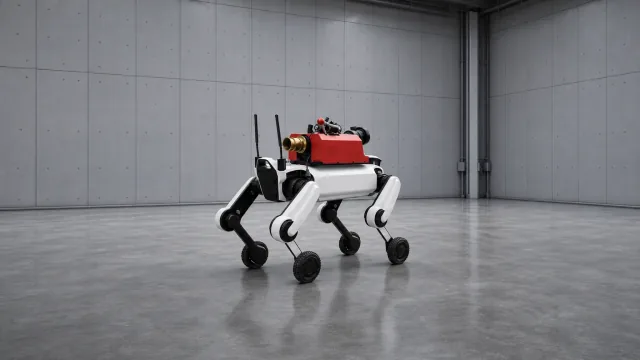
Quadruped
Hypertron-T01
Astrall Dynamics
Price TBA
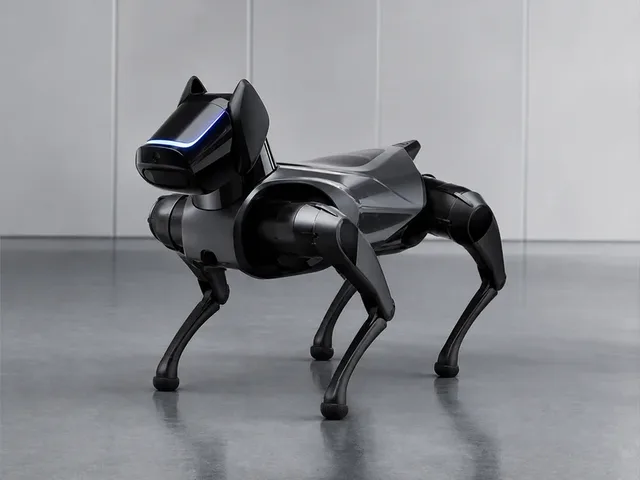
Quadruped
CyberDog 2
Xiaomi
Price TBA
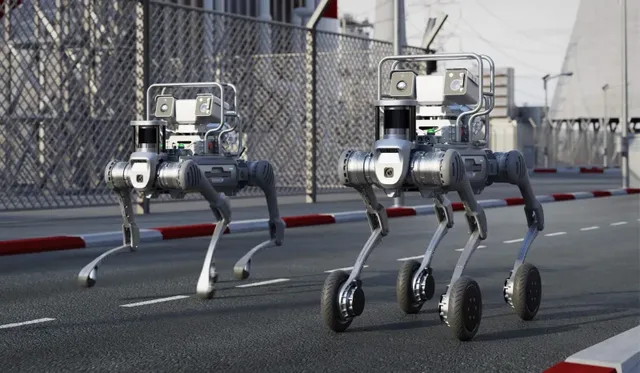
Quadruped
B1
Unitree Robotics
Price TBA
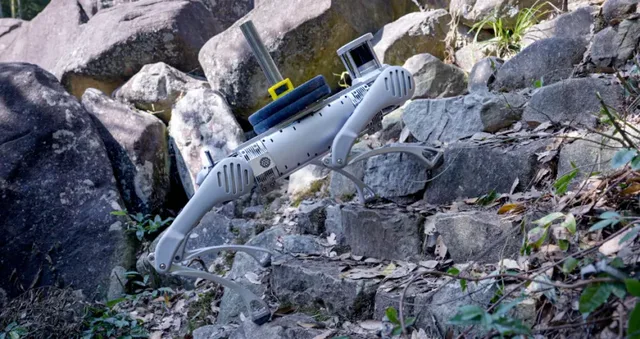
Quadruped
B2
Unitree Robotics
Price TBA
Coverage
Reporting and explainers linked to Familiar.
Blog
2026-06-09 · ui44 Team
INFFNI Rover X1 Buyer Guide: $2,199 Robot Dog
Blog
2026-06-08 · ui44 Team
Can a Home Robot Be a Habit Coach?
Blog
2026-05-27 · ui44 Team
Mirokaï: Social Humanoid for Senior Living?
Blog
2026-05-19 · ui44 Team
Will Game Characters Become Home Robots?
Blog
2026-05-18 · ui44 Team
Can Home Robots Safely Work Around People?
The Familiar is a Quadruped robot built by Familiar Machines & Magic. A quadruped companion robot from Familiar Machines & Magic, the startup founded by iRobot co-founder and former CEO Colin Angle. About the size of a small dog with a bear-like appearance, the Familiar is covered in a touch-sensitive, 3D-knitted fuzzy exterior inspired by sneaker-industry materials. It features 23 degrees of freedom and walks autonomously around the home. Rather than relying on screens or voice, the Familiar communicates through body language, posture, and context-aware behavior — a nudge when you're doomscrolling, an excited greeting when you come home, or a nuzzle when you're stressed. An edge AI system with a compact multimodal model interprets facial expressions, gestures, and tone of voice to read the room and respond appropriately. Each Familiar develops a distinct personality that evolves over time through continued interaction, with a behavior engine trained on thousands of narrative vignettes. All processing runs locally on-device for privacy. The team behind Familiar includes alumni from iRobot (50 million+ Roombas shipped), Disney Imagineering, MIT, and Boston Dynamics. The company is based in Woburn, Massachusetts. First availability is planned for 2027.
Pricing has not been publicly disclosed — typical for robots still in development. See all Familiar Machines & Magic robots on the Familiar Machines & Magic page.
Detailed specifications for the Familiar
Height
Small dog size (exact dimensions not disclosed)At Small dog size (exact dimensions not disclosed), the Familiar is sized for its intended operating environment and use cases.
The Familiar uses Edge AI — compact multimodal model (vision + audio) with behavior engine trained on narrative vignettes; all processing runs on-device as its intelligence backbone. This AI platform powers the robot's decision-making, perception processing, and autonomous behavior. The sophistication of the AI stack directly impacts how well the robot handles unexpected situations and adapts to new environments.
The Familiar integrates 3 sensor types, forming the perceptual foundation that enables autonomous operation.
This sensor configuration enables the Familiar to navigate unstructured terrain, detect obstacles, build environment maps, and maintain stability on varied surfaces. Multiple sensor modalities provide redundancy and more robust perception than any single sensor type alone.
Explore sensor technologies: components glossary · full components directory
Four-legged robots excel in environments where wheeled robots struggle — stairs, rough terrain, construction sites, and industrial facilities. Their biological-inspired locomotion provides stability and adaptability that makes them versatile platforms for a wide range of applications.
The Familiar offers 12 distinct capabilities, each contributing to the robot's practical utility.
These capabilities work together with the robot's 3 onboard sensor types and Edge AI — compact multimodal model (vision + audio) with behavior engine trained on narrative vignettes; all processing runs on-device AI platform to deliver practical, real-world performance.
The Familiar integrates with the following platforms and ecosystems, extending its utility beyond standalone operation.
This ecosystem compatibility enables the Familiar to work as part of a broader automation setup rather than operating in isolation.
12
Capabilities
3
Sensor Types
AI
Edge AI — compact multimodal…
Autonomous navigation allows the Familiar to move through its environment without human guidance, planning efficient paths around obstacles and adapting to changes in real time. For a quadruped robot, this involves simultaneous localization and mapping (SLAM) to build and maintain environmental models, path planning algorithms to find efficient routes, and reactive obstacle avoidance for unexpected situations. The complexity of autonomous navigation scales dramatically with the environment — navigating a structured warehouse is substantially different from navigating a cluttered home or outdoor space. The Familiar's navigation system must handle the specific challenges of its intended deployment scenarios reliably and repeatedly.
How the Familiar communicates with your network, smart home devices, cloud services, and companion apps.
The Familiar by Familiar Machines & Magic integrates 5 distinct technology components across sensing, connectivity, intelligence, and interaction layers. The physical platform features a height of Small dog size (exact dimensions not disclosed), providing the foundation on which this technology stack operates.
The perception layer is built on Vision (facial expression and gesture recognition), Audio (tone of voice analysis), Touch-sensitive exterior (3D-knitted fuzzy covering). These work in concert to give the robot a detailed understanding of its operating environment. This multi-sensor approach provides redundancy and enables the robot to function reliably even when individual sensors encounter challenging conditions such as low light, reflective surfaces, or cluttered spaces.
For communications, the Familiar relies on Not disclosed. This connectivity stack ensures the robot can communicate with cloud services, local smart home devices, mobile apps, and other networked systems in its environment.
Edge AI — compact multimodal model (vision + audio) with behavior engine trained on narrative vignettes; all processing runs on-device serves as the computational brain, processing sensor data, making navigation decisions, and orchestrating the robot's autonomous behaviors. The quality of this AI platform directly influences how well the robot handles novel situations, adapts to changes in its environment, and improves its performance over time through learning.
Quadruped robots are primarily purchased by industrial and enterprise customers for inspection, patrol, and data collection in environments too dangerous or tedious for humans. Some companion-oriented quadrupeds target tech-savvy consumers.
Terrain adaptability, payload capacity for sensor payloads, runtime per charge, IP rating for outdoor/industrial use, and autonomous navigation in unstructured environments are key factors. For industrial use, consider integration with existing asset management and inspection workflows.
Pricing
The Familiar is currently in active development. Follow Familiar Machines & Magic for updates on when the robot will become available for purchase or pre-order.
Engineering compromises and where this quadruped robot excels
With 12 distinct capabilities, the Familiar is designed as a versatile platform rather than a single-task device. This breadth means the robot can handle varied scenarios and workflows, reducing the need for multiple specialized robots and increasing its utility across different situations.
Familiar Machines & Magic has not published a public price for the Familiar. While common for enterprise-class robotics, the absence of transparent pricing can complicate budgeting and comparison shopping. Prospective buyers will need to engage directly with the manufacturer for quotes, which may vary by configuration and volume.
The Familiar is not yet available as a finished, shipping product. Specifications may change before commercial release, and timelines for availability are subject to revision. Early adopters should account for this uncertainty in their planning.
Note: This strengths and trade-offs assessment is based on the Familiar's documented specifications as tracked in the ui44 database. Real-world performance depends on deployment conditions, firmware maturity, and environmental factors. For the most current information, check the Familiar Machines & Magic manufacturer page or visit the official product page. Use the comparison tool to evaluate these trade-offs against competing robots in the same category.
Understanding the engineering behind this category
Four-legged robots represent a biomimetic approach to mobility — taking inspiration from nature's most versatile terrestrial locomotion strategy. Unlike wheeled or tracked robots, quadrupeds can navigate stairs, step over obstacles, traverse rough terrain, and recover from stumbles. The engineering behind these machines combines advanced control theory, real-time computation, and rugged mechanical design into platforms that go where other robots simply cannot.
Quadruped navigation combines classical SLAM with proprioceptive terrain sensing. The robot builds environment maps using LiDAR and cameras while simultaneously using force sensors in its feet and joint torque measurements to understand ground conditions beneath each footstep. This dual approach — seeing ahead while feeling underfoot — enables navigation through environments that would confuse purely vision-based systems, like muddy terrain or surfaces covered in snow. Path planning for legged robots is more complex than for wheeled platforms because the planner must consider foothold locations, body clearance, and dynamic stability at every step.
AI in quadruped robots increasingly relies on learned locomotion policies trained in simulation and transferred to real hardware. Rather than hand-coding gait controllers for every terrain type, modern systems use reinforcement learning to develop robust walking behaviors that generalize across surfaces. This sim-to-real approach has dramatically improved quadruped agility and robustness. Higher-level AI handles mission planning, autonomous inspection routines, anomaly detection, and integration with enterprise software systems for industrial applications.
Quadruped robots carry sophisticated sensor payloads combining environmental perception with proprioceptive awareness. Outward-facing sensors (LiDAR, cameras, depth sensors) map the environment and identify obstacles. Inward-facing sensors (joint encoders, IMUs, force/torque sensors) monitor the robot's own state — its balance, footing, and body orientation. The fusion of external and internal sensing is uniquely important for legged robots because stable locomotion requires constant feedback about both where the robot is going and how its body is responding to each step. Payload-mounted inspection sensors (thermal cameras, gas detectors, acoustic sensors) add application-specific perception on top of the mobility platform.
Legged locomotion is energy-intensive, and battery life is a critical constraint for quadruped robots. Most commercial quadrupeds offer one to two hours of active operation per charge. Power consumption varies significantly with gait speed, terrain difficulty, and payload weight. Battery-swap systems are common in industrial deployments, allowing continuous operation through multiple battery packs. Some facilities install automatic charging stations where the robot can dock and recharge between patrol routes. Efficient gait selection — using the least energy-consuming walking pattern appropriate for current terrain — is an active optimization area.
Quadruped robots operating in industrial and public environments must handle safety across multiple dimensions. Physical safety features include compliant leg designs that absorb unexpected impacts, emergency stop buttons, and speed-limiting zones around detected humans. Autonomous safety behaviors include automatic sit-down when battery reaches critical levels, return-to-base when communication is lost, and avoidance of detected hazards. For outdoor operation, IP ratings (typically IP54 or higher) ensure resistance to dust and water. Operational geofencing ensures the robot stays within approved areas.
Quadruped robotics is moving toward greater autonomy, longer endurance, and expanded manipulation capability. The addition of robotic arms to quadruped platforms is creating mobile manipulation systems that can not only inspect but also interact with the environment — turning valves, pressing buttons, or collecting samples. Improved batteries and more efficient actuators are extending operational windows. Fleet coordination of multiple quadrupeds for large-area coverage is becoming practical. As costs decrease, quadruped robots are expanding from premium industrial inspection tools into more accessible commercial and even consumer applications.
The Familiar by Familiar Machines & Magic incorporates many of these technology pillars. For a detailed look at the specific sensors and components used in the Familiar, see the sensor analysis and connectivity sections above, or browse the complete components glossary for explanations of every technology used across the robotics industry.
How this robot compares in the quadruped landscape
Familiar Machines & Magic has not publicly disclosed pricing for the Familiar, which is typical for enterprise-focused robotics platforms that offer customized solutions and direct-sales relationships.
The Familiar's 3 sensor types provide solid perceptual coverage for its intended use cases. This mid-range sensor suite balances cost with capability, covering the essential modalities needed for quadruped applications.
As a robot still in development, the Familiar represents Familiar Machines & Magic's vision for where quadruped robotics is heading. Specifications may evolve before commercial release, and early performance demonstrations should be evaluated with this context in mind.
Side-by-side specs, capability overlap analysis, and key differentiators.
For the full picture of Familiar Machines & Magic's portfolio and market strategy, visit the Familiar Machines & Magic manufacturer page.
What the public profile tells you, and what still needs direct vendor confirmation
From a buying and rollout perspective, the Familiar should be read as a quadruped platform aimed at inspection routes and terrain that challenge wheeled platforms. ui44 currently tracks 12 capability signals, 3 sensor inputs, and a last verification date of 2026-05-05. That mix gives buyers a useful first-pass picture, but it is still only the public layer of due diligence, especially when procurement, uptime, and support commitments are decided directly with Familiar Machines & Magic.
Commercial model
Pricing not public
Not yet announced. Co-founder Colin Angle says the price will be comparable to the cost of owning a dog.. That usually means the final commercial package depends on deployment scope, services, or negotiated terms.
Integration posture
1 connectivity option
The profile lists Not disclosed, plus Edge AI — compact multimodal model (vision + audio) with behavior engine trained on narrative vignettes; all processing runs on-device as the AI stack. That is enough to infer the basic network posture, but buyers should still confirm APIs, fleet management, and workflow integration details. ui44 currently tracks 1 declared compatibility link.
Spec disclosure
0/7 core specs public
ui44 currently has 0 of 7 core physical and operating specs filled in for this model, leaving 7 gaps that matter for deployment planning. Missing runtime, charge, speed, or payload details can materially change staffing and site-readiness assumptions.
The current profile is useful for scouting, but it still leaves meaningful operational unknowns. If this robot is heading toward a pilot or purchase discussion, the next step should be a structured vendor Q&A that fills the remaining runtime, charging, payload, safety, or integration blanks before anyone builds ROI assumptions around it.
If you want a faster apples-to-apples read, compare the Familiar against nearby alternatives in ui44's compare view, then cross-check the underlying AI, sensor, and subsystem terms in the components glossary. For manufacturer-level context, the Familiar Machines & Magic profile helps anchor this robot inside the wider product lineup.
Practical guide from day one through years of ownership
Quadruped robot setup typically involves professional installation or detailed guided procedures. Initial steps include unpacking and physical inspection, charging the battery fully before first use, installing any payload accessories (sensors, cameras, manipulators), connecting to the control network, running joint calibration and self-test routines, and mapping the initial operating environment. Industrial deployments may require integration with facility networks, security systems, and asset management platforms. Plan for a multi-day setup process for enterprise installations, including operator training and safety protocol establishment.
Quadruped robots require more frequent maintenance than wheeled platforms due to the mechanical complexity of their legs. Weekly checks should include joint inspection for unusual sounds or play, foot pad condition assessment, sensor cleaning, and battery health verification. Monthly maintenance includes more thorough mechanical inspection, firmware updates, and locomotion performance benchmarking. Legs and joints are the primary wear points — monitor for vibration changes that might indicate bearing wear or actuator degradation. Keep a detailed maintenance log, as patterns in the data can predict component failures before they cause operational disruption.
Quadruped robot software updates can significantly improve locomotion performance, autonomous navigation capability, and mission execution efficiency. Gait improvements based on real-world deployment data can make the robot faster, more stable, and more energy-efficient. Security patches are particularly important for robots operating in sensitive industrial or commercial environments. Coordinate updates with your deployment schedule to avoid disruption, and test updates in a controlled area before returning the robot to active duty.
Maximizing the service life of a quadruped robot requires attention to both mechanical and environmental factors. Operate within specified payload limits to avoid accelerated joint wear. Use appropriate gaits for the terrain — running on flat floors when a walk would suffice wastes energy and increases mechanical stress. Keep the robot's IP-rated seals in good condition for outdoor operation. Battery care is critical: follow the manufacturer's charging guidelines, avoid deep discharges, and replace batteries when capacity drops below 80% of original. A service contract with the manufacturer ensures access to replacement parts and expert maintenance that can keep the robot operational for many years.
For Familiar Machines & Magic-specific support resources and documentation, visit the Familiar Machines & Magic page on ui44 or check the manufacturer's official website at Familiar Machines & Magic's product page.
All Familiar data on ui44 is verified against official Familiar Machines & Magic sources, including spec sheets, product pages, and press releases. Last verified: 2026-05-05. Official source: Familiar Machines & Magic product page. If you find outdated or incorrect information, please let us know — accuracy is our top priority.
See how the Familiar stacks up — compare specs, browse the quadruped category, or search the full database.