Commercial model
Pricing not listed
A price is not listed for the Locus Array. No public price is listed; Locus positions Array as enterprise warehouse automation delivered through its Robots-as-a-Service model.
Payload
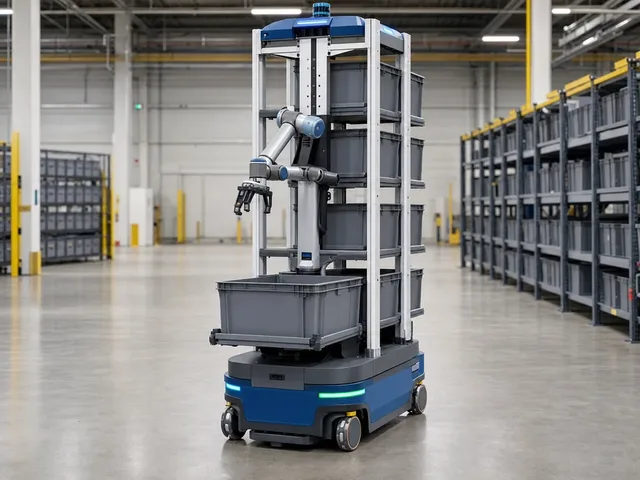
Six active order totes; DHL deployment reporting described totes up to 66 lb (29.9 kg), while NeuraGrasp item handling is described up to 5 lb (2.2 kg).
Locus Array is Locus Robotics' fully autonomous Robots-to-Goods warehouse mobile manipulator. The system combines an autonomous mobile base, robotic picking arm, AI-powered vision, real-time decision-making, and LocusONE orchestration to execute in-aisle fulfillment workflows such as picking, putaway, induction, drop-off, slotting, and replenishment. Locus says Array made its European debut at LogiMAT 2026 and North American/global launch at MODEX 2026; the company also says the robot is already live in customer deployments. A May 2026 Nexera Robotics acquisition adds NeuraGrasp, a patented soft-membrane gripper intended to broaden Array's SKU coverage beyond suction-friendly items.
Listed price
Price TBA
No public price is listed; Locus positions Array as enterprise warehouse automation delivered through its Robots-as-a-Service model.
Release window
Apr 1, 2026
Current status
Active
Locus Robotics
Last verified
May 28, 2026
Share this robot
Open a plain share composer on X or Bluesky for this robot profile.
Technical overview
A fast read on the mechanical profile, sensing package, and listed platform details for Locus Array.
Height
Not publicly disclosed
Weight
Not publicly disclosed
Dimensions
Not fully disclosed; Locus describes a compact 10 ft operating profile for standard mezzanines and multi-level warehouse environments.
Battery Life
Not publicly disclosed
Charging Time
Not publicly disclosed
Max Speed
Not publicly disclosed
Payload
Six active order totes; DHL deployment reporting described totes up to 66 lb (29.9 kg), while NeuraGrasp item handling is described up to 5 lb (2.2 kg).
Operational profile
Capabilities
10
Connectivity
1
Key capabilities
Listed platforms & ecosystem
Explore further
Benchmark set
Shortcuts to the closest alternatives in the current ui44 set.
Commercial
Titan
RoboForce
Price TBA
Commercial
VSee AI Robot
VSee Health
Price TBA

Commercial
aeo
Aeolus Robotics
Price TBA
Commercial
G2 Air
AGIBOT
Price TBA
Coverage
Reporting and explainers linked to Locus Array.
The Locus Array is a Commercial robot built by Locus Robotics. Locus Array is Locus Robotics' fully autonomous Robots-to-Goods warehouse mobile manipulator. The system combines an autonomous mobile base, robotic picking arm, AI-powered vision, real-time decision-making, and LocusONE orchestration to execute in-aisle fulfillment workflows such as picking, putaway, induction, drop-off, slotting, and replenishment. Locus says Array made its European debut at LogiMAT 2026 and North American/global launch at MODEX 2026; the company also says the robot is already live in customer deployments. A May 2026 Nexera Robotics acquisition adds NeuraGrasp, a patented soft-membrane gripper intended to broaden Array's SKU coverage beyond suction-friendly items.
A price is not listed for the Locus Array. No public price is listed; Locus positions Array as enterprise warehouse automation delivered through its Robots-as-a-Service model. See all Locus Robotics robots on the Locus Robotics page.
Detailed specifications for the Locus Array
Dimensions
Not fully disclosed; Locus describes a compact 10 ft operating profile for standard mezzanines and multi-level warehouse environments.The overall dimensions of Not fully disclosed; Locus describes a compact 10 ft operating profile for standard mezzanines and multi-level warehouse environments. define the robot's physical footprint and determine what spaces it can navigate and what clearances it requires for operation.
Payload Capacity
Six active order totes; DHL deployment reporting described totes up to 66 lb (29.9 kg), while NeuraGrasp item handling is described up to 5 lb (2.2 kg).A payload capacity of Six active order totes; DHL deployment reporting described totes up to 66 lb (29.9 kg), while NeuraGrasp item handling is described up to 5 lb (2.2 kg). determines what the robot can carry or manipulate. This is a critical spec for delivery and transport tasks, defining the weight of items the robot can move.
The Locus Array uses Physical AI stack using AI-powered vision, real-time decision-making, robotic manipulation, LocusONE fleet orchestration, and NeuraGrasp AI-driven grasp planning for variable SKU handling. as its intelligence backbone. This AI platform powers the robot's decision-making, perception processing, and autonomous behavior. The sophistication of the AI stack directly impacts how well the robot handles unexpected situations and adapts to new environments.
The profile lists the sensor descriptions below. These entries do not establish physical sensor counts, sensor fusion, redundancy, or performance.
Consult the linked profile sources for hardware configuration and tested behavior. A technology label alone does not verify an operating capability.
Explore sensor technologies: components glossary · full components directory
Commercial robots handle tasks in business environments — delivering food in restaurants, guiding visitors in hotels, transporting supplies in hospitals, and moving inventory in warehouses. Their value is measured in operational efficiency, labor cost savings, and improved service consistency.
The Locus Array offers 10 distinct capabilities, each contributing to the robot's practical utility.
These are the capabilities listed in the profile. Hardware configuration and demonstrated performance should be checked against the linked sources.
These are the platforms, communities, or ecosystem relationships listed in the profile. A listed name or protocol alone does not confirm home-device interoperability or automation support.
10
Capabilities
AI
Physical AI stack using…
The Locus Array profile lists the following communication and voice-system descriptions.
The Locus Array by Locus Robotics has the following technology descriptions in its profile.
The profile lists AI-powered vision/perception, Computer vision, NeuraGrasp onboard sensory inputs. Hardware quantities, integration, and tested behavior require separate source evidence.
The connectivity descriptions listed for the Locus Array are LocusONE platform. Specific services and device interoperability require separate documentation.
Commercial robots are acquired by businesses including restaurants, hotels, hospitals, retail stores, and logistics facilities. Purchasing decisions typically involve operations managers and IT departments evaluating ROI against human labor costs.
Reliability and uptime, navigation in crowded dynamic environments, payload capacity, integration with business systems (POS, inventory management), ease of deployment and maintenance, and total cost of ownership (including service contracts) are the primary factors.
Listed pricing
The Locus Array is listed as Active. This status alone does not confirm public purchase availability or operational reliability. Contact Locus Robotics for current access options and any purchase or participation requirements.
Engineering compromises and where this commercial robot excels
With 10 distinct capabilities, the Locus Array is designed as a versatile platform rather than a single-task device. This breadth means the robot can handle varied scenarios and workflows, reducing the need for multiple specialized robots and increasing its utility across different situations.
With a payload capacity of Six active order totes; DHL deployment reporting described totes up to 66 lb (29.9 kg), while NeuraGrasp item handling is described up to 5 lb (2.2 kg)., the Locus Array can handle meaningful physical tasks. This capacity enables practical applications like carrying tools, transporting materials, or supporting equipment mounts that lighter robots simply cannot accommodate.
A price is not listed for the Locus Array. No public price is listed; Locus positions Array as enterprise warehouse automation delivered through its Robots-as-a-Service model.
Note: This strengths and trade-offs assessment is based on the Locus Array's documented specifications as tracked in the ui44 database. Real-world performance depends on deployment conditions, firmware maturity, and environmental factors. For the most current information, check the Locus Robotics manufacturer page or visit the official product page. Use the comparison tool to evaluate these trade-offs against competing robots in the same category.
Understanding the engineering behind this category
Commercial robots operate in the demanding intersection of technology and business operations. From restaurant servers to warehouse movers, these robots must perform reliably in dynamic, crowded environments while delivering measurable return on investment. The technology behind commercial robots emphasizes reliability, integration with business systems, and graceful handling of the unpredictable situations that characterize human-occupied commercial spaces.
Commercial robots navigate environments that are significantly more challenging than typical homes — crowded restaurant floors, busy hotel lobbies, and dense warehouse aisles all present unique navigation challenges. These robots typically use LiDAR combined with depth cameras for robust obstacle detection, with special attention to detecting low-height obstacles (children, pets, dropped items) and moving obstacles (people walking unpredictably). Commercial-grade navigation includes fleet coordination — multiple robots sharing maps and position data to avoid congestion and optimize collective efficiency. Elevator integration allows robots to serve multiple floors autonomously.
AI in commercial robots focuses on operational efficiency and customer interaction. Route optimization minimizes delivery times in restaurants. Task prioritization ensures urgent orders are handled first. Customer-facing AI must handle natural language interaction in noisy environments, provide useful information, and maintain a professional and brand-appropriate demeanor. Back-end AI integrates with business systems — restaurant POS (Point of Sale), hotel PMS (Property Management System), warehouse WMS (Warehouse Management System) — to receive tasks and report completions automatically. Predictive AI anticipates demand patterns, pre-positioning robots where they will be needed based on historical data.
Commercial robots combine navigation sensors (LiDAR, cameras, ultrasonic) with application-specific sensors. Restaurant delivery robots use weight sensors to confirm payload presence and tilt sensors to maintain tray stability. Warehouse robots use barcode or RFID readers for inventory tracking. Hotel robots may include temperature sensors for room-service food. All commercial robots share the need for robust human detection — they must navigate safely around unpredictable human movement while maintaining efficient operation. Edge-case handling is critical: a restaurant robot must correctly respond to a child running into its path, a guest stepping backward without looking, or a server carrying a full tray through a narrow aisle.
Commercial operations demand high uptime, making power management a business-critical concern. Robots serving during peak hours cannot afford lengthy charging breaks. Solutions include fast-charging docks positioned at strategic locations, hot-swappable battery packs for zero-downtime operation, and intelligent charging schedules that top up during naturally low-demand periods. Fleet management systems monitor battery levels across all robots and redistribute tasks to ensure no single robot runs critically low during service. Power consumption monitoring also feeds into TCO (Total Cost of Ownership) calculations that businesses use to evaluate robot deployment ROI.
Commercial robots operate in regulated business environments with specific safety requirements. Food-handling robots must meet hygiene standards. Robots in public spaces must comply with accessibility requirements, avoiding blocking wheelchair paths or emergency exits. Speed limits are typically set below walking pace in pedestrian areas. Visual and audio signals indicate the robot's presence and intent — lights, gentle sounds, or voice announcements warn nearby people. Payload security ensures items being transported cannot fall. In warehouse environments, safety zones around humans trigger automatic speed reduction or stopping. Integration with building fire alarm and evacuation systems ensures robots do not obstruct emergency procedures.
Commercial robotics is moving toward greater specialization and deeper business system integration. Rather than general-purpose commercial platforms, expect more robots designed specifically for restaurant table service, hotel room delivery, warehouse aisle picking, or retail shelf scanning. Fleet orchestration — coordinating dozens of robots across a large facility — will become more sophisticated. The business model is also evolving, with Robotics-as-a-Service (RaaS) subscriptions replacing upfront purchases, lowering the barrier to adoption for small and medium businesses.
These are category-level technology examples; they do not establish the capabilities of the Locus Array. For its recorded hardware details, see the sensor analysis and connectivity sections above. Check model-specific documentation from Locus Robotics for supported behavior, or use the components glossary to look up terminology.
How this robot compares in the commercial landscape
A price is not listed for the Locus Array. No public price is listed; Locus positions Array as enterprise warehouse automation delivered through its Robots-as-a-Service model.
The Locus Array is listed as Active. This status alone does not confirm public purchase availability or operational reliability. Contact Locus Robotics for current access options and any purchase or participation requirements.
Side-by-side specs, capability overlap analysis, and key differentiators.
For the full picture of Locus Robotics's portfolio and market strategy, visit the Locus Robotics manufacturer page.
What the public profile tells you, and what still needs direct vendor confirmation
From a buying and rollout perspective, the Locus Array should be read as a commercial platform aimed at service operations that need predictable task throughput. ui44 currently tracks 10 capability signals and a last verification date of 2026-05-28. That mix gives buyers a useful first-pass picture, but it is still only the public layer of due diligence, especially when procurement, uptime, and support commitments are decided directly with Locus Robotics.
Commercial model
Pricing not listed
A price is not listed for the Locus Array. No public price is listed; Locus positions Array as enterprise warehouse automation delivered through its Robots-as-a-Service model.
Integration posture
1 connectivity option
The profile lists LocusONE platform, plus Physical AI stack using AI-powered vision, real-time decision-making, robotic manipulation, LocusONE fleet orchestration, and NeuraGrasp AI-driven grasp planning for variable SKU handling. as the AI description. These labels do not establish APIs, fleet-management features, or workflow integration. These are the platforms, communities, or ecosystem relationships listed in the profile. A listed name or protocol alone does not confirm home-device interoperability or automation support.
Spec disclosure
2/7 core specs public
ui44 currently has 2 of 7 core physical and operating specs filled in for this model, leaving 5 gaps that matter for deployment planning. Missing runtime, charge, speed, or payload details can materially change staffing and site-readiness assumptions.
The current profile is useful for scouting, but it still leaves meaningful operational unknowns. If this robot is heading toward a pilot or purchase discussion, the next step should be a structured vendor Q&A that fills the remaining runtime, charging, payload, safety, or integration blanks before anyone builds ROI assumptions around it.
If you want a faster apples-to-apples read, compare the Locus Array against nearby alternatives in ui44's compare view, then cross-check the underlying AI, sensor, and subsystem terms in the components glossary. For manufacturer-level context, the Locus Robotics profile helps anchor this robot inside the wider product lineup.
Practical guide from day one through years of ownership
Commercial robot deployment is a project, not just a setup. Begin with a site assessment covering floor plans, traffic patterns, integration requirements, and staff training needs. Map the operating environment with the robot, marking restricted areas, service points, and charging stations. Integrate with business systems — POS for restaurants, PMS for hotels, WMS for warehouses. Train staff on robot interaction, troubleshooting, and emergency procedures. Run a supervised pilot period before transitioning to full autonomous operation. Gather and address staff and customer feedback during the pilot to optimize the deployment before scaling.
Commercial robots earn their keep through consistent operation, making maintenance an operational priority rather than an afterthought. Establish daily visual inspection routines for operations staff. Schedule weekly maintenance windows for thorough cleaning, sensor calibration, and software updates. Track key performance indicators — delivery times, task completion rates, customer feedback — to detect performance degradation before it becomes noticeable. For food-handling robots, follow strict hygiene protocols including regular sanitization of tray surfaces and contact points. Multi-robot deployments benefit from staggered maintenance schedules to maintain coverage.
Commercial robot updates can add new capabilities, improve navigation in your specific environment, and fix operational edge cases. The manufacturer may release updates based on fleet-wide learning — improvements discovered at one deployment benefiting all customers. Test significant updates during low-traffic periods before deploying to your full fleet. Keep communication channels open with your robot vendor's support team to provide feedback that can drive improvement in future updates.
Commercial robots in daily operation can last three to five years or more with proper care. The primary wear items are wheels, motors, and batteries. Maintain a spare parts inventory for consumables to minimize downtime. Track operating hours and correlate with maintenance needs to develop predictive maintenance schedules specific to your deployment conditions. Consider the total cost of ownership over the deployment lifetime when evaluating robot vendors — the cheapest robot up front may cost more over five years if parts are expensive or support is limited.
Find product and source links on the Locus Robotics page on ui44 or open Locus Robotics's product page. Use model-specific manufacturer documentation for setup, cleaning, and service instructions.
All Locus Array data on ui44 is verified against official Locus Robotics sources, including spec sheets, product pages, and press releases. Last verified: 2026-05-28. Official source: Locus Robotics product page. If you find outdated or incorrect information, please let us know — accuracy is our top priority.
See how the Locus Array stacks up — compare specs, browse the commercial category, or search the full database.