Commercial model
$1,200 list price
A published price gives buyers a starting point for budgeting, ROI modeling, and peer comparison before deeper vendor conversations begin.
Height
110 mm
Battery
up to 200 min
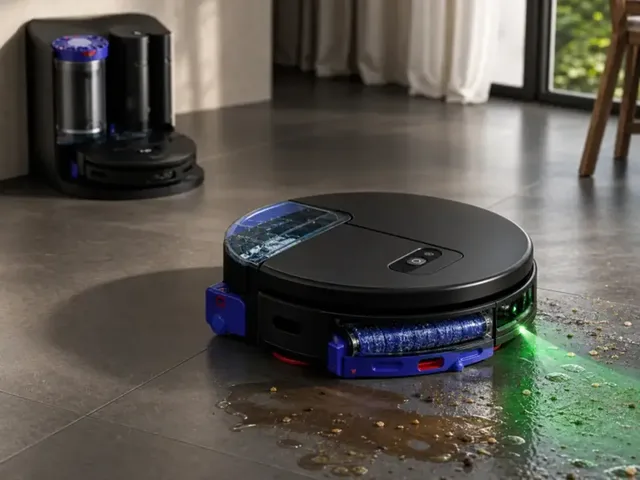
Dyson's first wet-and-dry robot vacuum and mop, replacing the 360 Vis Nav. The Spot+Scrub Ai features an AI-powered camera that identifies nearly 200 household substance and stain types, detects stains in real time, and automatically adjusts suction and mop passes. A self-cleaning wet roller mop with a 12-point hydration system uses fresh water to rinse debris into a dirty-water tank as it rotates, and extends 40 mm to the side for edge cleaning. Green LED illumination highlights fine dust on hard floors — a first for Dyson's robot line and rarely seen in competitors. The bagless Omni-style dock uses Dyson's cyclone technology to empty the robot's 3-litre onboard bin without disposable bags, while also washing the mop roller, refilling clean water, and collecting wastewater. At 18,000 Pa suction, it sits below the 22,000 Pa class leaders but delivers solid vacuuming on both hard floors and carpets. LiDAR-based navigation enables quick, accurate home mapping via the MyDyson app, a significant improvement over the 360 Vis Nav's slower mapping process. The dock holds approximately 300 days' worth of dust according to Dyson, with a 2.3-litre clean-water tank and 2.1-litre dirty-water tank.
Listed price
$1,200
$1,199.99 US; £1,049.99 UK. Same launch price as the preceding 360 Vis Nav.
Release window
Mar 12, 2026
Current status
Available
Dyson
Last verified
Apr 26, 2026
Share this robot
Open a plain share composer on X or Bluesky for this robot profile.
Technical overview
A fast read on the mechanical profile, sensing package, and platform integrations behind Spot+Scrub Ai.
Height
110 mm
Weight
Not officially disclosed
Dimensions
370 × 373 × 110 mm
Battery Life
up to 200 min
Charging Time
3 h
Max Speed
Not officially disclosed
Operational profile
Capabilities
13
Connectivity
2
Key capabilities
Ecosystem fit
Explore further
Benchmark set
Shortcuts to the closest alternatives in the current ui44 set.
Cleaning
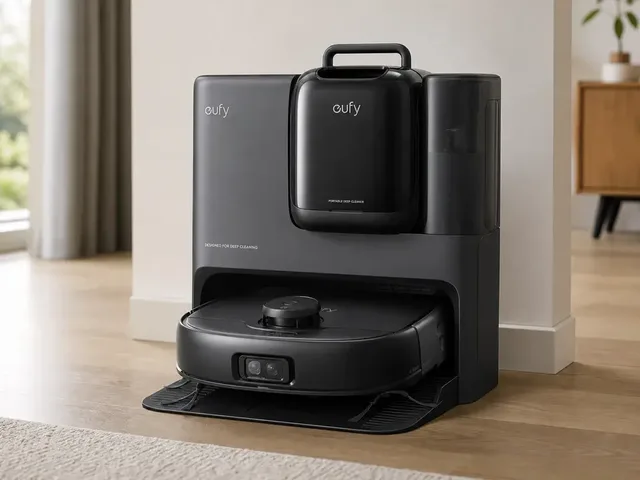
Robot Vacuum Omni E28
eufy
$1,400
Cleaning
Vicon 3-in-1 AI Cordless Pool Cleaning Robot
Vicon Technology
$1,499
Cleaning
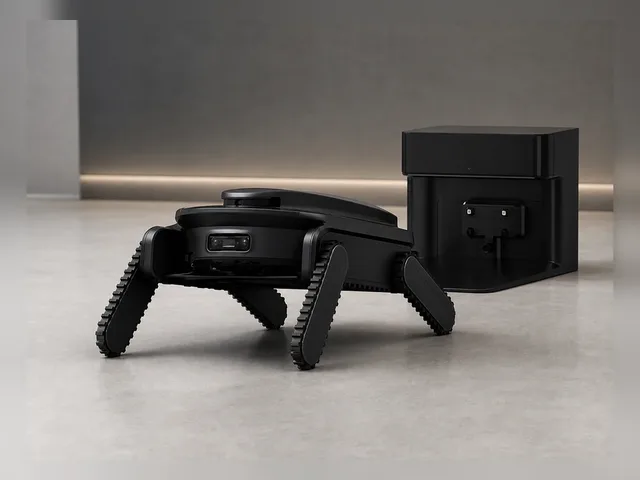
Cyber X
Dreame
€1,199
Cleaning
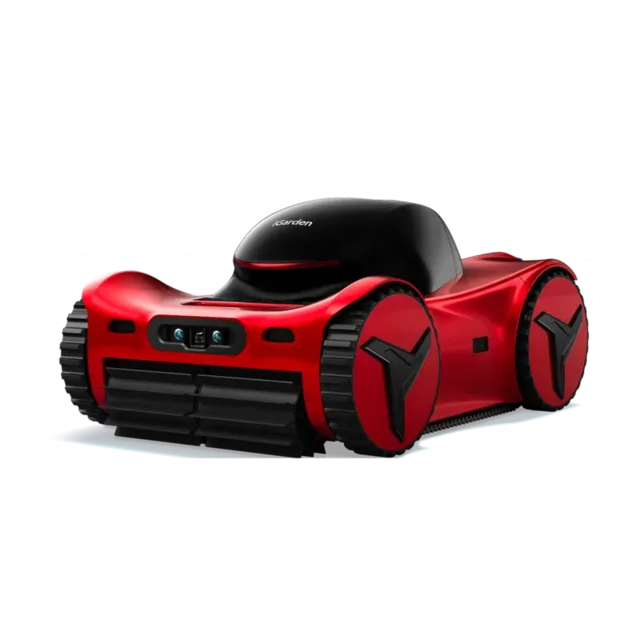
M1-AI 90
iGarden
$1,399
Coverage
Reporting and explainers linked to Spot+Scrub Ai.
Blog
2026-05-18 · ui44 Team
Dyson Spot+Scrub Ai vs Premium Robot Vacuums
Blog
2026-05-17 · ui44 Team
Low-Profile Robot Vacuums: What Fits Under Furniture
Blog
2026-05-15 · ui44 Team
Home Robot Noise Specs: What Quiet Really Means
Blog
2026-04-14 · ui44 Team
Can a Robot Vacuum Replace Your Regular Vacuum?
The Spot+Scrub Ai is a Cleaning robot built by Dyson. Dyson's first wet-and-dry robot vacuum and mop, replacing the 360 Vis Nav. The Spot+Scrub Ai features an AI-powered camera that identifies nearly 200 household substance and stain types, detects stains in real time, and automatically adjusts suction and mop passes. A self-cleaning wet roller mop with a 12-point hydration system uses fresh water to rinse debris into a dirty-water tank as it rotates, and extends 40 mm to the side for edge cleaning. Green LED illumination highlights fine dust on hard floors — a first for Dyson's robot line and rarely seen in competitors. The bagless Omni-style dock uses Dyson's cyclone technology to empty the robot's 3-litre onboard bin without disposable bags, while also washing the mop roller, refilling clean water, and collecting wastewater. At 18,000 Pa suction, it sits below the 22,000 Pa class leaders but delivers solid vacuuming on both hard floors and carpets. LiDAR-based navigation enables quick, accurate home mapping via the MyDyson app, a significant improvement over the 360 Vis Nav's slower mapping process. The dock holds approximately 300 days' worth of dust according to Dyson, with a 2.3-litre clean-water tank and 2.1-litre dirty-water tank.
At a listed price of $1,200, it positions itself in the mid-range segment of the cleaning market. See all Dyson robots on the Dyson page.
Detailed specifications for the Spot+Scrub Ai
Height
110 mmAt 110 mm, the Spot+Scrub Ai maintains a low profile designed to navigate under furniture and tight spaces.
Dimensions
370 × 373 × 110 mmThe overall dimensions of 370 × 373 × 110 mm define the robot's physical footprint and determine what spaces it can navigate and what clearances it requires for operation.
Battery Life
Up to 200 minutesWith a battery life of Up to 200 minutes, the Spot+Scrub Ai can operate for full cleaning sessions before needing to return to its dock. Battery life is measured under typical operating conditions and may vary based on workload intensity and environmental factors.
Charging Time
3 hoursA charging time of 3 hours means the ratio of operation to downtime is an important consideration for applications requiring near-continuous availability. Some deployments use multiple robots in rotation to maintain uninterrupted service.
The Spot+Scrub Ai uses AI-powered camera with green-spectrum LED illumination identifies nearly 200 hidden household substances and stains, adapts cleaning in real time, and checks between passes before moving on as its intelligence backbone. This AI platform powers the robot's decision-making, perception processing, and autonomous behavior. The sophistication of the AI stack directly impacts how well the robot handles unexpected situations and adapts to new environments.
The Spot+Scrub Ai integrates 7 sensor types, forming the perceptual foundation that enables autonomous operation.
This sensor configuration enables the Spot+Scrub Ai to map rooms, detect obstacles, identify furniture and floor types, and avoid hazards like stairs and cables. Multiple sensor modalities provide redundancy and more robust perception than any single sensor type alone.
Explore sensor technologies: components glossary · full components directory
Cleaning robots handle the repetitive task of floor maintenance — vacuuming, mopping, or both — on a daily or scheduled basis. The best models learn your home layout, avoid obstacles intelligently, and integrate with your existing smart home ecosystem.
The Spot+Scrub Ai offers 13 distinct capabilities, each contributing to the robot's practical utility.
These capabilities work together with the robot's 7 onboard sensor types and AI-powered camera with green-spectrum LED illumination identifies nearly 200 hidden household substances and stains, adapts cleaning in real time, and checks between passes before moving on AI platform to deliver practical, real-world performance.
The Spot+Scrub Ai integrates with the following platforms and ecosystems, extending its utility beyond standalone operation.
This ecosystem compatibility enables the Spot+Scrub Ai to work as part of a broader automation setup rather than operating in isolation.
13
Capabilities
7
Sensor Types
AI
AI-powered camera with…
How the Spot+Scrub Ai communicates with your network, smart home devices, cloud services, and companion apps.
The Spot+Scrub Ai by Dyson integrates 12 distinct technology components across sensing, connectivity, intelligence, and interaction layers. The physical platform features a height of 110 mm, providing the foundation on which this technology stack operates.
The perception layer is built on LiDAR pulsed lasers, Ultrasonic floor-type sensors, AI-powered front-facing HD camera, Green-spectrum LED illumination, Dual-line laser system, Drop sensors, Edge-to-edge wall follow sensors. These work in concert to give the robot a detailed understanding of its operating environment. This multi-sensor approach provides redundancy and enables the robot to function reliably even when individual sensors encounter challenging conditions such as low light, reflective surfaces, or cluttered spaces.
AI-powered camera with green-spectrum LED illumination identifies nearly 200 hidden household substances and stains, adapts cleaning in real time, and checks between passes before moving on serves as the computational brain, processing sensor data, making navigation decisions, and orchestrating the robot's autonomous behaviors. The quality of this AI platform directly influences how well the robot handles novel situations, adapts to changes in its environment, and improves its performance over time through learning.
Voice interaction is handled through Amazon Alexa and Google Assistant, providing natural language understanding and speech synthesis that enable conversational control and integration with broader smart home ecosystems.
Cleaning robots are among the most accessible consumer robotics products, purchased by homeowners and renters looking to automate routine floor maintenance. They range from budget-friendly models for small apartments to premium systems for large multi-story homes.
Navigation intelligence (LiDAR vs camera-based), suction power, battery life, dustbin capacity, and smart home integration are the primary factors for cleaning robots. Consider multi-floor support, no-go zone capability, and whether the robot handles both vacuuming and mopping. Self-emptying dock availability is increasingly a baseline expectation.
Price Context
The Spot+Scrub Ai is currently available for purchase. Check the manufacturer's website or authorized retailers for the latest stock and ordering information.
Engineering compromises and where this cleaning robot excels
With 7 sensor types onboard, the Spot+Scrub Ai has one of the more comprehensive perception systems in the cleaning category. This multi-modal approach enables robust environmental awareness, redundant obstacle detection, and reliable autonomous operation even in challenging conditions. More sensor diversity generally translates to better real-world adaptability.
With 13 distinct capabilities, the Spot+Scrub Ai is designed as a versatile platform rather than a single-task device. This breadth means the robot can handle varied scenarios and workflows, reducing the need for multiple specialized robots and increasing its utility across different situations.
A battery life of Up to 200 minutes provides substantial operational runway. For cleaning applications, this means longer work sessions between charges, fewer interruptions, and the ability to complete larger tasks or cover more area in a single charge cycle.
Unlike many robots that remain in development or prototype stages, the Spot+Scrub Ai is available for purchase today. This means you can evaluate the actual shipping product rather than making decisions based on projected specifications that may change before release.
At $1,200, the Spot+Scrub Ai is competitively priced within the cleaning market. This price point makes the technology accessible to a broader audience and represents a lower barrier to entry for those exploring cleaning robotics.
Supporting 2 voice assistant platforms (Amazon Alexa, Google Assistant) means the Spot+Scrub Ai integrates with whichever voice ecosystem you already use. This flexibility avoids platform lock-in and enables broader smart home interoperability.
Note: This strengths and trade-offs assessment is based on the Spot+Scrub Ai's documented specifications as tracked in the ui44 database. Real-world performance depends on deployment conditions, firmware maturity, and environmental factors. For the most current information, check the Dyson manufacturer page or visit the official product page. Use the comparison tool to evaluate these trade-offs against competing robots in the same category.
Understanding the engineering behind this category
Modern cleaning robots are far more sophisticated than the random-bounce machines of a decade ago. Today's best models use technologies borrowed from self-driving cars and industrial automation to systematically clean homes with minimal human intervention. Understanding the technology inside your cleaning robot helps you make the most of its capabilities and choose the right model for your needs.
Cleaning robots use two primary navigation approaches: LiDAR-based and camera-based. LiDAR navigation spins a laser sensor on top of the robot to create accurate 2D floor plans, enabling systematic back-and-forth cleaning patterns that cover the entire floor efficiently. Camera-based navigation (also called vSLAM or visual SLAM) uses an upward or forward-facing camera to identify ceiling and wall features for positioning. LiDAR systems generally provide more accurate mapping and better performance in dark rooms, while camera systems can sometimes detect obstacles at greater range and enable advanced features like 3D object recognition. Premium models increasingly combine both approaches along with AI-powered obstacle recognition to identify and avoid specific objects like shoes, cables, and pet waste.
AI in cleaning robots has evolved from basic route optimization to genuine environmental understanding. Current AI systems can identify room types, adjust suction power based on floor surface detection, recognize specific obstacle types, and learn cleaning patterns from user behavior. Machine learning models trained on millions of images help the robot distinguish between a sock (avoid) and a dust bunny (clean). Some robots even use AI to predict when rooms will need cleaning based on household activity patterns, and automatically schedule sessions when you're away from home.
A typical modern cleaning robot combines multiple sensor types for comprehensive environmental awareness. Floor-facing infrared or ultrasonic cliff sensors prevent falls down stairs. Forward-facing bumper sensors detect contact with obstacles. Side-wall sensors maintain consistent edge-cleaning distance. A top-mounted LiDAR or camera provides mapping data. Some premium models add 3D structured-light sensors for obstacle height detection, carpet-detection sensors for automatic suction boost, and even dirty-spot sensors that identify areas needing extra attention. The cleaning robot's software fuses all these inputs to build a complete picture of your home's layout, surfaces, and obstacles.
Cleaning robots typically run on lithium-ion batteries providing one to three hours of continuous operation. Smart power management adjusts suction power based on surface type — lower power on hard floors, maximum suction on carpets — to extend runtime. Recharge-and-resume functionality allows the robot to return to its dock, recharge, and then continue cleaning from where it left off, enabling full-home cleaning even with shorter battery life. Self-emptying dock stations add another dimension of automation by removing the need to manually empty the dustbin after every session.
Cleaning robots are designed for unsupervised operation in homes with children and pets. Safety features include cliff sensors preventing staircase falls, gentle bumper impacts that avoid damaging furniture, automatic shutoff when lifted or flipped, and child-lock features on companion apps. For homes with pets, look for models with tangle-free brush designs that resist hair wrapping, and anti-trap features that free the robot if it becomes stuck under furniture. Modern robots also implement virtual boundaries (no-go zones) to keep the robot away from sensitive areas like pet food bowls or fragile items.
Cleaning robot technology continues to advance in several directions. Self-washing and self-drying mop systems are becoming standard. Dock stations are gaining capabilities like hot-water washing and automatic detergent dispensing. AI obstacle recognition is improving to handle more edge cases. Future innovations may include robotic arms for picking up objects before cleaning, integration with home air quality monitoring, and cooperative multi-robot cleaning systems for larger homes. The trend toward fully autonomous floor maintenance — from cleaning to self-maintenance — continues to accelerate.
The Spot+Scrub Ai by Dyson incorporates many of these technology pillars. For a detailed look at the specific sensors and components used in the Spot+Scrub Ai, see the sensor analysis and connectivity sections above, or browse the complete components glossary for explanations of every technology used across the robotics industry.
How this robot compares in the cleaning landscape
Priced at $1,200, the Spot+Scrub Ai sits in the mid-range of the cleaning market — a competitive tier where buyers expect a strong balance of features and value.
With 7 sensor types, the Spot+Scrub Ai has an extensive sensor suite. This comprehensive sensing capability places it among the more perception-capable robots in the cleaning category, enabling more robust autonomous operation in varied conditions.
Being currently available for purchase gives the Spot+Scrub Ai a practical advantage over competitors still in development or prototype stages. Buyers can evaluate the actual product rather than relying on spec-sheet promises that may change before release.
Side-by-side specs, capability overlap analysis, and key differentiators.
For the full picture of Dyson's portfolio and market strategy, visit the Dyson manufacturer page.
What the public profile tells you, and what still needs direct vendor confirmation
From a buying and rollout perspective, the Spot+Scrub Ai should be read as a cleaning platform aimed at homes or facilities that need repeatable floor-care automation. ui44 currently tracks 13 capability signals, 7 sensor inputs, and a last verification date of 2026-04-26. That mix gives buyers a useful first-pass picture, but it is still only the public layer of due diligence, especially when procurement, uptime, and support commitments are decided directly with Dyson.
Commercial model
$1,200 list price
A published price gives buyers a starting point for budgeting, ROI modeling, and peer comparison before deeper vendor conversations begin.
Integration posture
2 connectivity options
The profile lists Wi-Fi, Bluetooth, plus AI-powered camera with green-spectrum LED illumination identifies nearly 200 hidden household substances and stains, adapts cleaning in real time, and checks between passes before moving on as the AI stack. That is enough to infer the basic network posture, but buyers should still confirm APIs, fleet management, and workflow integration details. ui44 currently tracks 3 declared compatibility links.
Spec disclosure
4/7 core specs public
ui44 currently has 4 of 7 core physical and operating specs filled in for this model, leaving 3 gaps that matter for deployment planning. Missing runtime, charge, speed, or payload details can materially change staffing and site-readiness assumptions.
The current profile is useful for scouting, but it still leaves meaningful operational unknowns. If this robot is heading toward a pilot or purchase discussion, the next step should be a structured vendor Q&A that fills the remaining runtime, charging, payload, safety, or integration blanks before anyone builds ROI assumptions around it.
If you want a faster apples-to-apples read, compare the Spot+Scrub Ai against nearby alternatives in ui44's compare view, then cross-check the underlying AI, sensor, and subsystem terms in the components glossary. For manufacturer-level context, the Dyson profile helps anchor this robot inside the wider product lineup.
Practical guide from day one through years of ownership
Setting up a cleaning robot typically takes 15 to 30 minutes. Download the companion app, connect the robot to your Wi-Fi network, place the charging dock against a wall with clearance on both sides, and initiate the first mapping run. During the initial map, walk through your home to ensure doors are open and the robot can access all rooms you want cleaned. After mapping, use the app to name rooms, set no-go zones around pet bowls or delicate furniture, and configure your cleaning schedule. For combo vacuum-mop robots, set up the water tank and mop pads according to the manual. If you have a self-emptying dock, ensure the dustbag is properly installed.
Weekly maintenance takes just a few minutes: empty the dustbin (if not self-emptying), remove hair tangles from the main brush, and wipe sensor windows with a dry cloth. Monthly tasks include washing or replacing filters, checking side brushes for wear, and cleaning the charging contacts. For mopping models, replace mop pads when they show signs of wear and clean the water tank to prevent mineral buildup. Every three to six months, replace the main brush and filters according to the manufacturer's schedule. Keeping up with this simple routine ensures consistent cleaning performance and extends the robot's lifespan.
Cleaning robot manufacturers regularly release app and firmware updates that improve navigation, add features, and fix bugs. Enable automatic updates in the app to ensure you always have the latest improvements. Major updates occasionally add significant features — some robots have gained new room types, improved carpet detection, or enhanced obstacle avoidance through software updates alone. Keep the companion app updated as well, as new app versions often unlock features that require both app and firmware coordination.
Most cleaning robots last three to five years with proper maintenance. To maximize longevity: keep the robot's environment clear of small objects that could jam the brush or damage the suction motor, clean sensors regularly for accurate navigation, avoid running the robot over wet spills (unless it is designed for mopping), and replace consumable parts on schedule rather than waiting for performance degradation. Store replacement brushes, filters, and mop pads so they are ready when needed. If the battery noticeably loses capacity after two to three years, a battery replacement (often available from the manufacturer) can extend the robot's useful life significantly.
For Dyson-specific support resources and documentation, visit the Dyson page on ui44 or check the manufacturer's official website at Dyson's product page.
All Spot+Scrub Ai data on ui44 is verified against official Dyson sources, including spec sheets, product pages, and press releases. Last verified: 2026-04-26. Official source: Dyson product page. If you find outdated or incorrect information, please let us know — accuracy is our top priority.
See how the Spot+Scrub Ai stacks up — compare specs, browse the cleaning category, or search the full database.