Category lead
Cleaning · 64%
The route is deepest in Cleaning, with Companions as the next strongest follow-through.
6 manufacturers and 11 tracked robots, shaped into a country brief that shows where Singapore is deepest, how much of the route is actually sourceable, and which maker pages deserve the next serious click.
Catalog rank
#5
Listed Available
7/11
Recorded numeric price
9/11
What matters first
Use the top-line signals here to judge whether this country already gives you enough breadth, price visibility, and vendor depth to build a serious shortlist.
Recorded numeric prices
Multiple currencies (EUR, USD)
Release window
2024–2026
Source coverage
11/11 official links
Category lead
The route is deepest in Cleaning, with Companions as the next strongest follow-through.
Coverage quality
82% with recorded numeric prices and 91% image-backed, which tells you how quickly this route can turn into a shortlist instead of a research backlog.
Maker concentration
eufy contributes the biggest slice of tracked models, so this route is broad enough to compare beyond one flagship.
Open next
Peer routes
Start with the deepest categories and the strongest coverage signals before drilling into individual models.
6
Manufacturers
5
Tracked categories
7
Listed Available
9/11
Models with numeric prices
Category counts, availability mix, and price range reworked for a quicker first pass.
Singapore can look dominant in this route simply because it is better represented in the ui44 catalog. Treat the counts as a shortlisting aid, then validate the winners on model pages and vendor material.
11 tracked models, restructured into a shortlist-first flow with featured picks up top and denser rows for the long tail.
Start with the models that are easiest to validate — the ones with live imagery, public pricing, or enough documentation to justify a deeper click. Then use the compact rows below to sweep the rest of the market without turning the page into a wall of oversized cards.
Listed Available
7
Numeric price recorded
9
With imagery
10
Manufacturers
6
How to scan this section
Best first clicks
These models score highest on status order, public detail quality, and image clarity, so they orient the route faster than a purely alphabetical sweep.
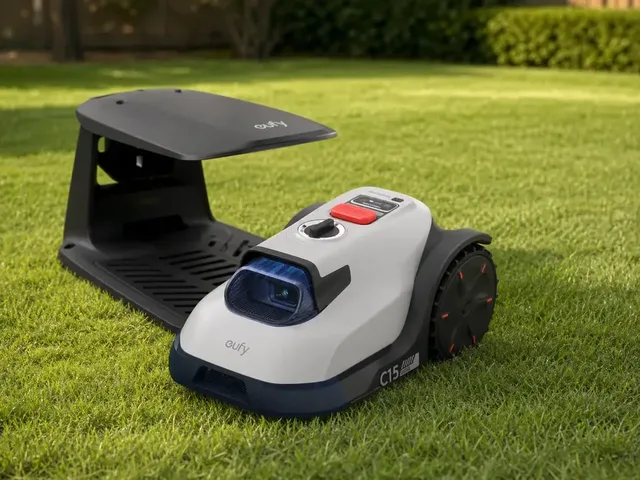
The eufy C15 is an entry-level boundary-wire-free robotic lawn mower unveiled at MWC 2026, positioned as eufy's most affordable robot mower for smaller yards up to 500 m² (0.12 acres). It uses eufy's Vision FSD (Full-Surround Detection) camera-based navigation system — the same technology found in the more expensive E15 and E18 models — to map and navigate lawns without a perimeter wire. The onboard camera detects and avoids obstacles including people, pets, and trees. Users can set mowing schedules, manage maps, and monitor operation via the eufy smartphone app, with physical buttons on the device for manual control. The mower handles slopes up to 32%. Official European eufy pages moved from May 2026 early-bird/pre-sale messaging to active store pages with add-to-cart and buy-now purchase options. Listed as Available with a recorded price; confirm current ordering and delivery terms.
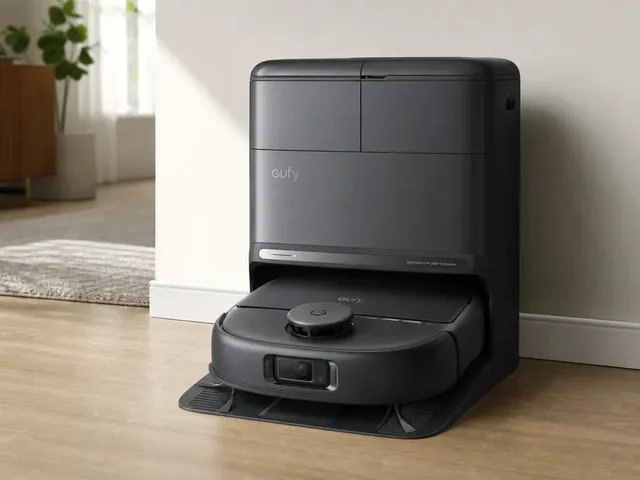
The eufy Omni C28 is a lower-cost robot vacuum and mop that brings several of eufy's higher-end cleaning features into the C-series. Official materials highlight a HydroJet self-cleaning roller mop, 15,000 Pa suction, DuoSpiral anti-tangle brushes, and a 5-in-1 Omni Station that automates dust emptying, mop washing, hot-air drying, clean-water refilling, and wastewater collection. It uses eufy's iPath 2.0 navigation with LDS+ laser mapping and obstacle avoidance, positioning it as a more affordable full-service cleaner for mixed hard-floor and carpet homes. Listed as Available with a recorded price; confirm current ordering and delivery terms.
Full directory
Sorted by status, then currency code and price within each currency; unlisted prices come last within each status.
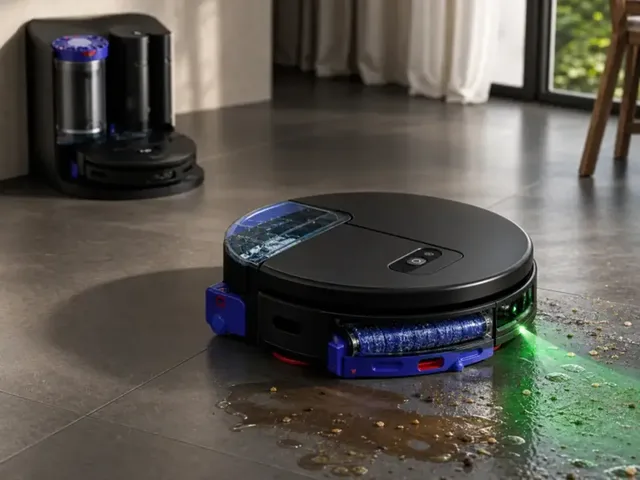
Dyson's first wet-and-dry robot vacuum and mop, replacing the 360 Vis Nav. The Spot+Scrub Ai features an AI-powered camera that identifies nearly 200 household substance and stain types, detects stains in real time, and automatically adjusts suction and mop passes. A self-cleaning wet roller mop with a 12-point hydration system uses fresh water to rinse debris into a dirty-water tank as it rotates, and extends 40 mm to the side for edge cleaning. Green LED illumination highlights fine dust on hard floors — a first for Dyson's robot line and rarely seen in competitors. The bagless Omni-style dock uses Dyson's cyclone technology to empty the robot's 3-litre onboard bin without disposable bags, while also washing the mop roller, refilling clean water, and collecting wastewater. At 18,000 Pa suction, it sits below the 22,000 Pa class leaders but delivers solid vacuuming on both hard floors and carpets. LiDAR-based navigation enables quick, accurate home mapping via the MyDyson app, a significant improvement over the 360 Vis Nav's slower mapping process. The dock holds approximately 300 days' worth of dust according to Dyson, with a 2.3-litre clean-water tank and 2.1-litre dirty-water tank. Listed as Available with a recorded price; confirm current ordering and delivery terms.
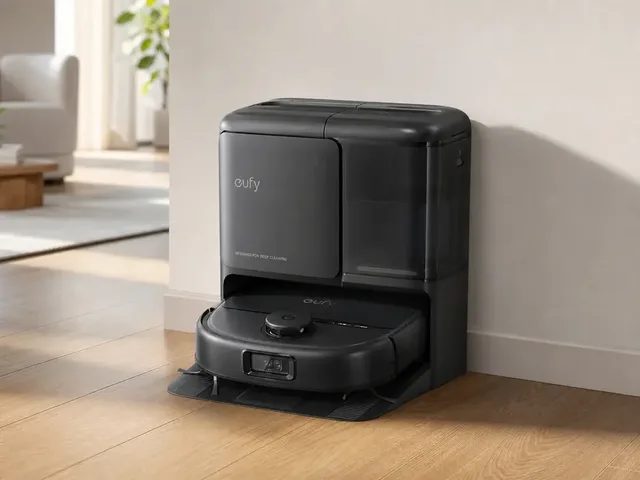
The eufy Robot Vacuum Omni E25 is a mid-range robot vacuum and mop in eufy's E series. Official product materials highlight a HydroJet self-cleaning roller mop, 20,000 Pa suction, AI.See obstacle avoidance with RGB visual recognition, and iPath laser navigation. Independent reviews also describe a CornerRover extending side brush, DuoSpiral anti-tangle rollers, and an all-in-one dock that automates dust emptying, mop washing and drying, and water refills, positioning the E25 as a feature-rich all-in-one cleaner below eufy's top flagship tier. Listed as Available with a recorded price; confirm current ordering and delivery terms.
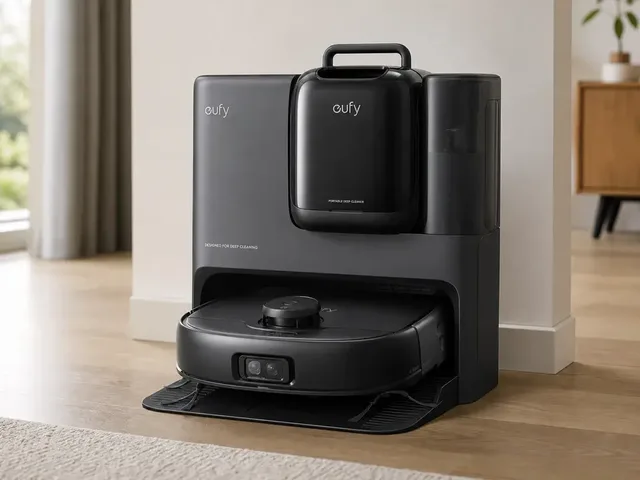
The eufy Robot Vacuum Omni E28 is a premium robot vacuum-and-mop whose standout feature is the FlexiOne detachable portable deep cleaner integrated into the Omni Station. That spot-cleaning module lets the same floor-care system handle carpets, upholstery, stairs, and fabric stains in addition to normal autonomous floor cleaning. Official eufy materials also list a HydroJet self-cleaning roller mop, 20,000 Pa suction, DuoSpiral anti-tangle brushes, a CornerRover extending side brush, RGB+LED obstacle avoidance, iPath laser navigation, Matter support, and an all-in-one station that empties dust, washes and dries the mop, refills water, dispenses detergent, and collects wastewater. Listed as Available with a recorded price; confirm current ordering and delivery terms.
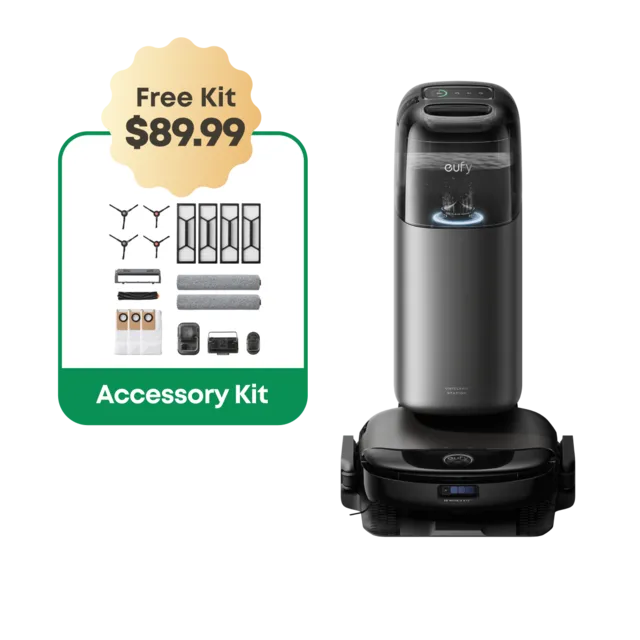
eufy's Omni S1 Pro is a premium robot vacuum-and-mop with HydroJet rolling-mop cleaning, a 10-in-1 UniClean station, and camera-based obstacle avoidance. The robot is positioned as a high-end all-in-one cleaner with strong automation: automatic washing/drying, auto-emptying, auto-refilling, and app-controlled cleaning workflows. Official product specs list up to 216 minutes runtime in vacuum mode (140 minutes in vacuum+mop standard mode), 8,000 Pa suction, and a square-bodied design intended to improve edge coverage. Listed as Available with a recorded price; confirm current ordering and delivery terms.
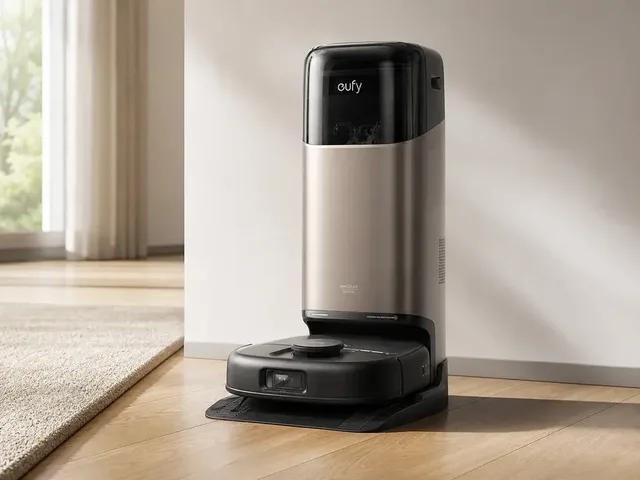
The eufy Omni S2 is eufy's 2026 flagship robot vacuum and mop, succeeding the Omni S1 Pro. It features 30,000 Pa AeroTurbo 2.0 suction (100 AW) with multi-cyclone airflow for sustained performance, a HydroJet 2.0 self-cleaning roller mop that applies 15 N of downward pressure and extends toward baseboards, and CleanMind AI navigation using 3D MatrixEye 2.0 vision with ToF sensors for 3D mapping and detection of 200+ obstacle types. The robot can cross thresholds up to 42 mm and auto-lift its mop on carpets up to 2 in thick. Its UniClean station automates dust emptying, hot-water mop washing, heated-air drying, water refilling, detergent dispensing, and electrolyzed-water sterilization (99.99% germ reduction). A built-in aromatherapy system — a first for robot vacuums — releases fragrance during cleaning cycles. The DuoSpiral anti-tangle brush handles pet hair up to 20 in long without wrapping. Listed as Available with a recorded price; confirm current ordering and delivery terms.
HYTRON is Primech AI's autonomous restroom-cleaning robot for high-traffic commercial facilities. Official materials describe a compact mobile manipulator that cleans toilets, urinals, sinks, mirrors, countertops, and targeted floor areas rather than acting as a generic floor scrubber. Primech's CES 2026 launch release lists a 400 mm universal-access width, on-device NVIDIA Jetson Orin Super AI processing, adaptive 2D navigation, obstacle detection, fixture-level cleaning, self-charging, automatic water management, door navigation, electrolyzed-water/e-water jet cleaning, and independently tested disinfection performance exceeding 99% bacterial reduction. Primech said mass production would begin in Q1 2026, and a May 2026 three-year Singapore public-sector lease marked HYTRON's first recurring-revenue live commercial deployment; public pricing and most physical specifications remain undisclosed. Active in the catalog; verify the latest media and rollout details.

Pophie is InsBotics' desk-sized AI companion robot, publicly shown at CES 2026 and now marketed as the company's first home-focused 'AI Lifeform' ahead of a planned crowdfunding launch. Official materials describe a plush companion that combines rotating vision, microphones, touch and posture sensing, long-term memory, and proactive interaction so it can greet users, track gaze, respond to gestures, and handle multi-person conversations without relying on a wake word. Rather than acting like a mobile chore robot, Pophie is positioned as an emotionally expressive desk or room companion with five degrees of expressive motion, physical camera privacy behavior when its eyes close, and a split edge-plus-cloud AI stack for real-time reactions plus deeper reasoning. Commercial intent is clear, but delivery timing should be validated.
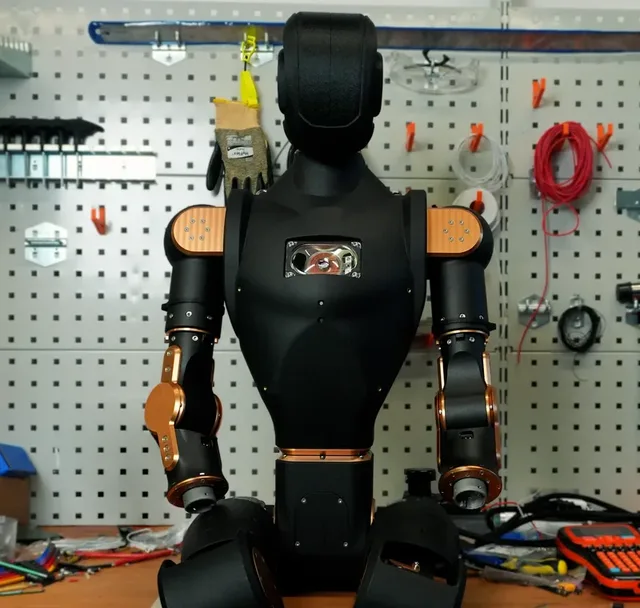
Menlo Research's Asimov DIY Kit (Here Be Dragons Edition) is an open-source humanoid hardware kit aimed at advanced hobbyists, developers, and research teams who want to build and modify a full humanoid robot themselves. The kit ships unassembled and includes the structural frame, actuators, motors, sensors, wiring harness, assembly manual, and build videos, with the company positioning it as a faster path into the broader Asimov full-body platform. Official materials emphasize off-the-shelf parts, simple 3D-printable components, and an open hardware/software approach intended to make repair, modification, and iteration easier than on closed commercial humanoid platforms. The official manual frames Asimov 1 around data collection, basic teleoperated walking, Cloud API custom agents, and a Virtual Asimov digital twin, with hands/grippers, advanced locomotion, and onboard training explicitly out of scope. Commercial intent is clear, but delivery timing should be validated.

Sharpa North is a 67-DoF full-body humanoid robot debuted at CES 2026 for autonomous fine-manipulation research and future service work. Sharpa demonstrated North in live, unscripted sessions playing autonomous ping-pong, operating an instant camera, dealing cards, and assembling paper windmills in a more-than-30-step task using the company’s Wave dexterous hands and CraftNet vision-tactile-language-action model. The official North page emphasizes smooth whole-body control, real-time visual and language input, and end-to-end execution from perception to result, while Sharpa says the production version is expected in mid-2026. Pricing and core hardware specifications have not been disclosed. Useful for roadmap scanning, not yet a clean near-term shortlist.
Ranked signals and price structure replace the old sprawling chip walls so the data reads faster on both mobile and desktop.
| # | Name | Usage |
|---|---|---|
| 1 | RGB camera | 3 · 27% |
| 2 | LED assist light | 2 · 18% |
| 3 | LiDAR navigation sensor | 2 · 18% |
| # | Name | Usage |
|---|---|---|
| 1 | Wi-Fi | 9 · 82% |
| 2 | Bluetooth | 8 · 73% |
| 3 | App control | 6 · 55% |
| 4 | Matter | 3 · 27% |
| # | Name | Usage |
|---|---|---|
| 1 | Vacuum + mop cleaning | 5 · 45% |
| 2 | Auto dust emptying | 3 · 27% |
| 3 | Auto recharge and resume | 3 · 27% |
| 4 | HydroJet self-cleaning roller mop | 3 · 27% |
| 5 | 180 RPM rolling mop | 2 · 18% |
| 6 | 20,000 Pa suction | 2 · 18% |
USD only: 8 priced of 11 total · 1 priced in other currencies (excluded) · 2 without a recorded numeric price
| # | Name | Share |
|---|---|---|
| 1 | Available | 7 · 64% |
| 2 | Pre-order | 2 · 18% |
| 3 | Active | 1 · 9% |
| 4 | Development | 1 · 9% |
Use peer routes to widen discovery only when they genuinely add more depth or a different market shape.
Decision lens
Use peer routes to add meaningful category overlap, more manufacturer breadth, or different published currency coverage. If the current route already answers those questions, wider browsing usually adds noise faster than it adds signal.
Catalog rank
#5
Share of tracked robots
3%
Avg shared categories
4.3
What to watch
Stay here when
You already have enough mature candidates, enough manufacturer depth, and enough price visibility to build a shortlist.
Compare outward when
The route is thin in your target category, clustered around one maker, or clearly skewed toward missing prices.
Best next click
Open the peer that changes the search shape the most — not just the next biggest route by raw robot count.
Peer route
Broader catalog depth · High category overlap
Common ground: Humanoid, Cleaning +3
Open routePeer route
Broader catalog depth · High category overlap
Common ground: Humanoid, Research +3
Open routePeer route
Broader catalog depth · High category overlap
Common ground: Companions, Research +1
Open routePeer route
Similar catalog depth · High category overlap
Common ground: Humanoid, Cleaning +2
Open routeOpen another country route
Need the full directory? Browse all country pages.
This route is a structured view of ui44 dataset entries whose manufacturer headquarters label maps to Singapore. The numbers on the page are generated from the catalog itself, not from outside shipment estimates or broad market-share reports. In practice, that means the route is best used for discovery and shortlisting inside this database: how many manufacturers are represented, how many robots are listed, which categories appear most often, and which lifecycle statuses show up across those records. It is useful because it compresses search time, but it should not be treated as proof that Singapore leads the global robotics market in absolute terms.
Not by itself. A higher count here only indicates stronger representation in the ui44 catalog. It does not automatically prove global production leadership, deployment leadership, or shipment volume across every region. The practical value is relative orientation: if Singapore has more entries than another country route in this catalog, you have a broader internal shortlisting surface to explore before you need outside research. Treat the count as a catalog-depth signal, then validate market importance with model-level evidence, current vendor activity, and real deployment references.
Available listings: 7. Pre-order listings: 2. Active records: 1. Available indicates an ordering listing, not confirmed stock. Pre-order indicates a reservation listing, not immediate delivery. Active status alone does not confirm public purchase availability or deployment. Other statuses do not establish a current purchase listing. Confirm regional access, stock, reservation terms, and delivery with the manufacturer.
Recorded numeric prices by currency: EUR €899; USD $249–$15k. 9 of 11 records have a recorded numeric price. Ranges and averages cover only those records and are calculated separately within each currency; no currency conversion or cross-currency affordability ranking is implied. Missing numeric prices do not establish a budget tier or the absence of other pricing terms. Check individual model pricing notes for membership, lease, quote or other terms. Confirm applicable charges and terms with the manufacturer.
Many robotics vendors publish capabilities without publishing a universal list price. Enterprise and service robots often depend on integration scope, software packages, service bundles, deployment country, or support contract terms. For that reason, a missing price should be read as “no numeric price recorded”, not as “cheap,” “premium,” or “not for sale.” Check individual model pricing notes for membership, lease, quote or other terms. Where a quote is needed, request a consistent cost breakdown. Ask each vendor for the same structure — hardware, accessories, onboarding, software, maintenance, and training — so the comparison stays apples to apples.
Yes. The route is useful because it compresses a large amount of catalog coverage into a cleaner planning sequence. Start with category concentration to see where the route is deepest, then use the robot cards to understand maturity and price posture, and then branch into manufacturer pages for documentation depth and product-family context. That path lets a team move from broad market scanning to a more disciplined shortlist without losing the reason each candidate advanced. It is not a substitute for pilots, but it is a strong way to reduce search time before pilots begin.
A practical stack is: (1) robot count share, (2) manufacturer count, (3) category overlap, and (4) price posture. This avoids over-indexing on a single number. A country can have a large catalog footprint and still be narrow in category variety, or it can have strong overlap with Singapore but a much smaller pool of vendors. The peer-country table on this page is built for exactly that question: when is the current route enough, and when does a second country route add real search value? The answer should always be based on overlap and options, not on raw count alone.
Use the manufacturer links as a decision funnel. First, eliminate makers whose categories clearly do not fit your target workflow. Second, prioritize makers with model statuses aligned to your timeline. Third, inspect documentation depth on the manufacturer route: number of tracked robots, link quality, and whether the catalog shows breadth or a single flagship model. Finally, move only the strongest makers into structured outreach. That process turns a long route into a smaller, evidence-backed vendor set instead of an endless browse session.
Open peer-country routes when you need deeper category overlap, more manufacturer options, or a meaningfully different listed price profile. If the current route already covers your target workload with enough mature candidates, widening the search too early can create noise. If the route is strong in one segment but thin in another, or if the strongest candidates are clustered around a single manufacturer, that is a good signal to compare another country route before vendor outreach. The goal is not maximal browsing. The goal is enough market breadth to create a resilient shortlist.
Sensor stacks usually follow task design. Cleaning robots lean on LiDAR, vision, cliff sensing, and proximity systems to manage navigation and obstacle avoidance. Humanoid and quadruped systems tend to add richer perception, force feedback, or balance-oriented sensors. Delivery and patrol robots often mix cameras, positioning, and environmental sensing for wider-area coverage. The ranked signal tables on this route help with pattern detection, but the final evaluation should always ask whether a sensor suite matches your environment: indoor versus outdoor use, lighting conditions, floor changes, obstacle density, and how much autonomy you actually expect on day one.
Most modern robots expose Wi‑Fi and Bluetooth as baseline options, while higher-end systems may add cellular links, more advanced fleet connectivity, or integration-specific interfaces. The important question is not whether a connectivity term appears in the catalog; it is whether that connectivity fits your security policy, latency needs, facility coverage, and support model. For teams in enterprise or regulated environments, network segmentation, update policy, remote diagnostics, and account governance often matter more than the presence of a single radio standard. Treat connectivity labels as a starting filter, then verify integration details directly on the robot page and with the vendor.
Total cost of ownership is usually far larger than base hardware price. A good TCO model includes integration engineering, onboarding, operator training, software fees, consumables, replacement parts, maintenance windows, and downtime risk. For larger deployments, it may also include facility changes, charging infrastructure, support response commitments, or workflow redesign. The value of this route is that it helps you compare the catalog’s listed price posture quickly, but budgeting should never stop there. Normalize every quote into the same cost structure before ranking vendors, especially when some models publish price and others do not.
AI matters most when it improves a task in a way your team can actually verify. In practice, that may mean navigation quality, better object handling, stronger voice interaction, more resilient path planning, or better adaptation to changing environments. Some vendors push more on-device intelligence, while others rely on cloud services for heavier processing. The core buying question is not whether “AI” appears in the marketing copy; it is whether the implementation matches your latency expectations, privacy requirements, connectivity assumptions, and failure handling model. Use AI claims as a hypothesis generator, not as a substitute for proofs during pilot work.
Not necessarily. In this project, the country route is driven by the manufacturer headquarters label used for catalog organization. Manufacturing, integration, and service footprints can span several regions, and those realities do not always map cleanly to a single headquarters country. That means this route is excellent for navigation and initial analysis, but it is not enough for supply-chain, compliance, or local-service decisions. If geography matters for your deployment, verify model-level sourcing, support region, and service coverage directly with the vendor before committing budget.
Low representation is still meaningful. It may signal a narrow route with a small but relevant set of candidates, or it may indicate that the strongest options for your use case live somewhere else in the catalog. In those cases, use the current route for orientation, then widen the shortlist through category pages, manufacturer pages, and peer-country comparisons. The important thing is to keep the original reason for the search intact. A smaller route is not useless; it simply changes how quickly you should branch into the rest of the database.
Revisit at every major decision gate: initial discovery, post-RFI narrowing, and pre-pilot signoff. Country routes are especially useful for spotting newly represented manufacturers, new models, or lifecycle changes that can change the shortlist after the first pass. That cadence helps teams avoid stale screenshots, old notes, or memory-driven assumptions. A route review does not need to be long. It just needs to be consistent enough that the shortlist reflects the current catalog rather than a one-time snapshot taken weeks earlier.
The common mistake is treating country rank as a substitute for fit. A country can look strong by count and still be a poor match for your workload, budget, support constraints, or deployment environment. The better sequence is layered: use the country route for orientation, manufacturer and category routes for narrowing, robot detail pages for proof, and pilot work for final selection. That keeps the process fast without allowing a high-level catalog signal to overpower the operational reality of the deployment.