Source dates: 1X published its engineering announcement on July 9, 2026. The official sources below were checked on October 11, 2026.
What the manufacturer states
1X's July 9 engineering article describes 22 actuated finger-and-palm degrees of freedom plus three at the wrist: 25 with the wrist included. It reports tendon drives, force control, tactile and shear sensing, and an IP68 rating with food-safe materials. These are manufacturer statements, not measurements independently verified by ui44.
The same source says hundreds of hands had been made and gives capacity for 10,000 hands in 2026. Capacity is not completed output; hands are not complete robots or customer deliveries. Its examples of manipulation do not establish a household task success rate, assistance frequency or delivered capability set.
The NEO product page lists 22 hand DOF per side, so read that count alongside the engineering article's explicit wrist-inclusive definition. Compare like definitions before comparing numbers across robots. The page also describes basic autonomy for early owners and scheduled remote expert supervision for unfamiliar complex tasks. A capable hand does not remove that stated supervision model.
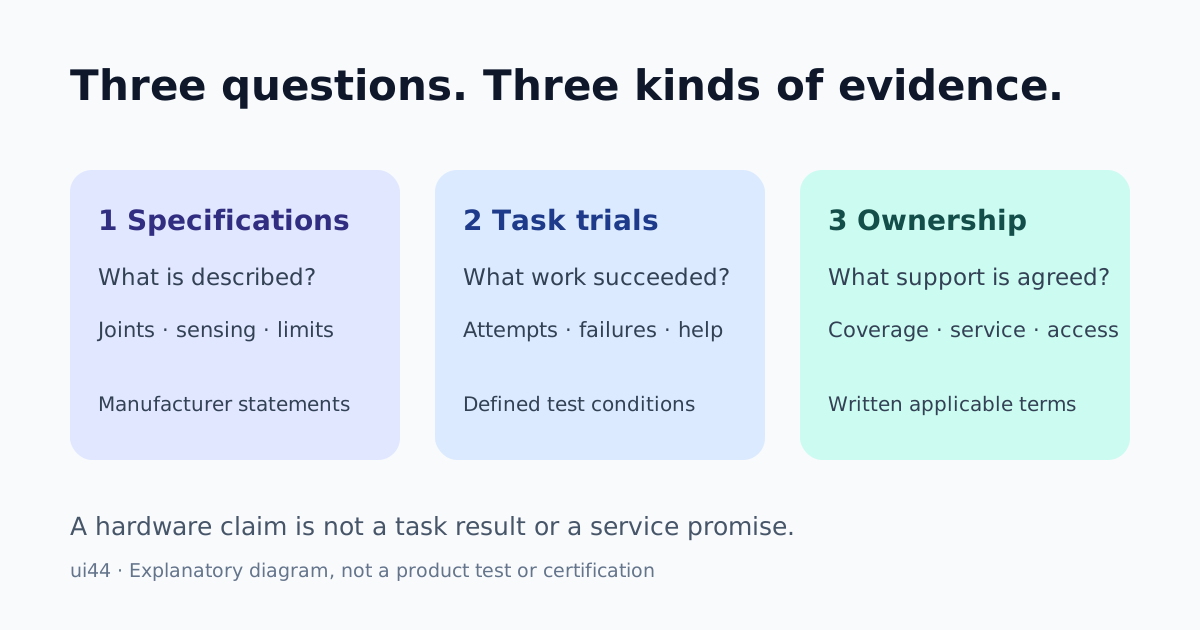
Three questions that should stay separate
Evidence layer
Hand specification
- What to inspect
- Which joints, sensors and operating limits the statement describes
- What it cannot establish by itself
- Successful completion of a household chore
Evidence layer
Whole-task trial
- What to inspect
- Objects, setting, finish condition, duration, failures and human help
- What it cannot establish by itself
- Long-term service quality or suitability for every home
Evidence layer
Ownership terms
- What to inspect
- Delivered configuration, supervision arrangements and written repair coverage
- What it cannot establish by itself
- A task success rate
| Evidence layer | What to inspect | What it cannot establish by itself |
|---|---|---|
| Hand specification | Which joints, sensors and operating limits the statement describes | Successful completion of a household chore |
| Whole-task trial | Objects, setting, finish condition, duration, failures and human help | Long-term service quality or suitability for every home |
| Ownership terms | Delivered configuration, supervision arrangements and written repair coverage | A task success rate |
Take a drinking glass as an example. Pressure against a fingertip and a glass starting to slide are different signals. 1X says its tactile skin measures contact force and shear, helping the controller detect slipping. It also says its backdrivable tendon drive lets an external push travel back through the transmission as force feedback. Those are useful design claims to investigate when assessing a grasp; they do not tell us how often NEO carries a glass across a room without spilling it.
A useful demonstration can still leave important questions open. For example, a successful object pickup may show an interesting grasp, while the household job also requires finding the object, choosing its destination, moving safely through the room and leaving it in an acceptable final state. Ask which parts were included in the evaluation rather than assuming that a short clip covers the complete job.
Ask for a task, not a collection of impressive motions
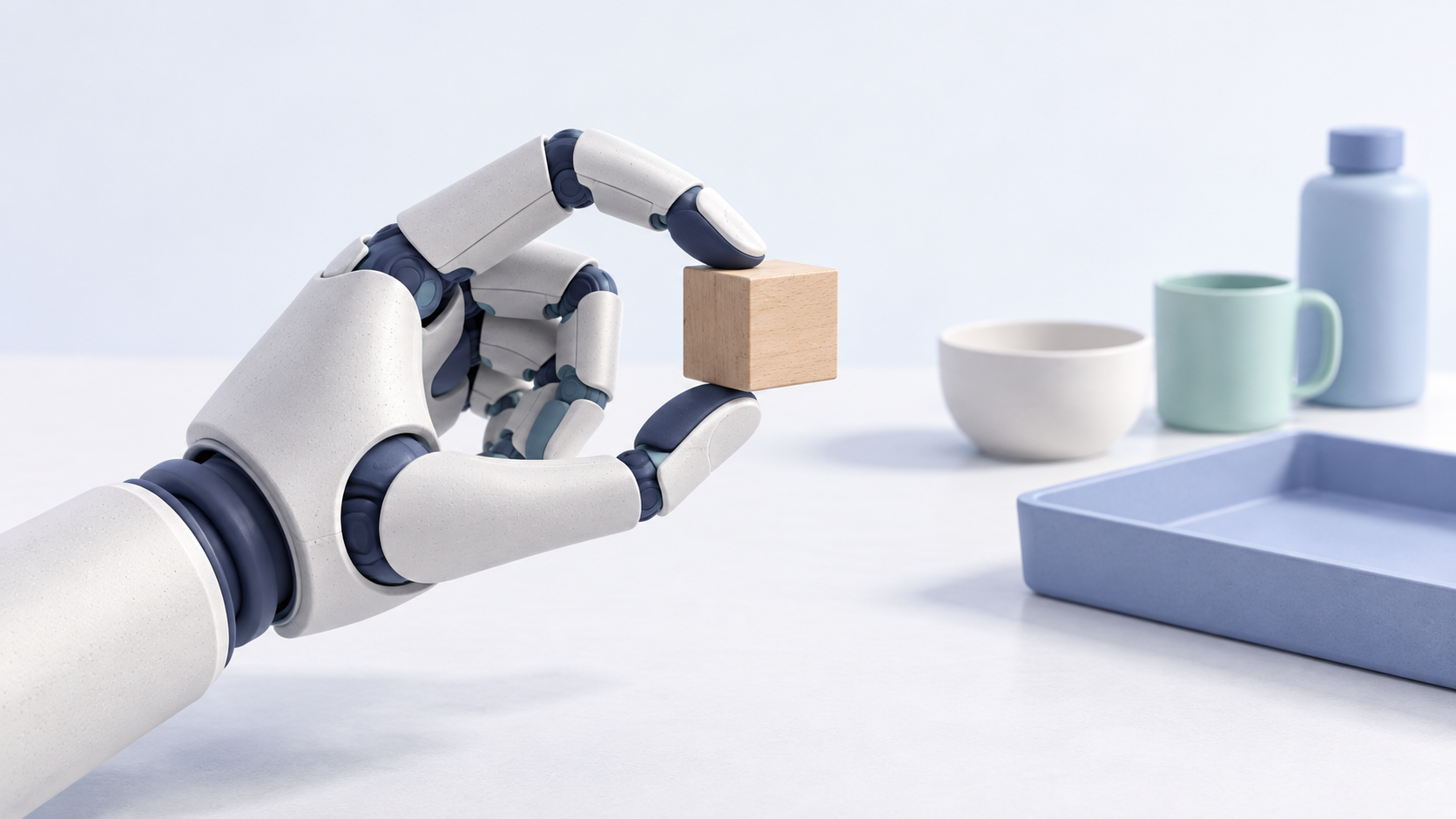
AI-generated conceptual illustration, not NEO photography or capability evidence. Grasping one object is only part of a household task.
Choose a chore you actually want performed and define its end condition before looking at a score. For tidying, identify the objects and their destinations. For laundry, distinguish lifting fabric from folding it to your standard and putting it away. For dishes, distinguish moving an item from completing your particular loading or storage workflow. These are evaluation examples, not claims that NEO can perform them independently.
Then request an account of the attempts, not just the successful examples. A result is easier to interpret when the evaluator states how many trials were attempted, what counted as failure, and whether the same objects and setup were repeated. A total without those definitions can obscure a change in task rather than a change in performance.
Useful details to request include:
- The starting arrangement, object types and intended finish condition.
- Whether the robot had practiced that task, home or object configuration.
- The time allowed and treatment of incomplete attempts.
- How many attempts needed an operator, reset, repositioned object or other help.
- Whether failed attempts and recovery were included in the reported result.
- What changed between the tested configuration and the version offered to an owner.
Do not combine results with different definitions into a ranking. One trial may allow a person to prepare every object while another includes searching through clutter. Both can be informative, but they answer different questions. Similarly, a clip selected to explain a hand mechanism should not be interpreted as a random sample of everyday performance.
Supervision belongs in the result
The official description of scheduled Expert Mode is a reason to ask how work is divided between the robot and people. It is not, by itself, evidence that all shown behavior is teleoperated or that all routine behavior is autonomous. Label the mode for each evaluated task and leave it unknown when the source does not specify it.
For a household decision, distinguish direct expert control, other remote assistance, owner setup and owner cleanup. Those demands can affect whether a chore is useful to delegate. Ask for the amount and timing of help rather than trying to infer it from how natural the motion looks.
A practical record would put the task outcome beside the assistance used. If a robot finished only after someone moved a basket, that intervention should be visible in the record. If an expert handled an unfamiliar step, record it without treating the whole session as an unassisted success. Keep the task outcome and the assistance together when comparing trials.
For broader questions about remote access, privacy and scheduling, see our Expert Mode guide. Check the applicable terms for who can access the robot, what recordings are retained and which controls the owner receives.
Hand-specific service questions
A hand's published engineering characteristics are not a service promise. Before relying on it for a recurring chore, ask what happens when a finger, tendon or tactile surface needs attention. Request the answer for the offered configuration and your location, rather than extrapolating from a demonstration or a general statement about durability.
Ownership question
Which hand configuration will arrive?
- Evidence to request
- Written hardware version and included sensing/features
Ownership question
What maintenance is expected?
- Evidence to request
- Owner instructions, intervals and tasks reserved for service personnel
Ownership question
What damage or wear is covered?
- Evidence to request
- Hand-specific warranty inclusions, exclusions and consumable definitions
Ownership question
How is a fault handled?
- Evidence to request
- Diagnostic process, transport arrangements, repair location and written timing terms
Ownership question
What does a replacement require?
- Evidence to request
- Parts, labor, calibration and any return-to-use procedure specified by the supplier
| Ownership question | Evidence to request |
|---|---|
| Which hand configuration will arrive? | Written hardware version and included sensing/features |
| What maintenance is expected? | Owner instructions, intervals and tasks reserved for service personnel |
| What damage or wear is covered? | Hand-specific warranty inclusions, exclusions and consumable definitions |
| How is a fault handled? | Diagnostic process, transport arrangements, repair location and written timing terms |
| What does a replacement require? | Parts, labor, calibration and any return-to-use procedure specified by the supplier |
The official order page currently advertises USD 20,000 ownership with a three-year warranty, a USD 499 monthly subscription option, a refundable USD 200 deposit and U.S. deliveries starting in 2026. These are advertised terms checked October 11, not verification that deliveries have begun or that a particular hand repair is included. A warranty duration alone does not answer the table's questions.
Keep the stated ingress rating attached to the component it describes; it does not establish permission for every cleaning method or kitchen use. Request the manufacturer's applicable operating and cleaning instructions. Softness, backdrivability and material claims alone do not establish household safety.
Our NEO deposit guide covers the wider ordering decision, and the service-network checklist covers support beyond the hands. Those questions remain separate from whether a particular grasp looks convincing.
What would make the evidence more useful?
The most useful next information would connect a specified hand and software configuration to repeatable whole-task results, disclose intervention frequency and explain service obligations. A broader list of possible motions would not answer those same questions.
For now, use the July engineering note to understand what 1X says it designed. Use task-level evidence to judge the work you want done. Use written terms to judge the support and supervision you would be accepting. Where those records are unavailable, retain the unknown rather than turning a specification into a promise.
See the NEO profile for the catalog record and our tactile-sensing explainer for the broader technical context.
Written by
ui44 Team
Published October 11, 2026
Share this article
Open a plain share link on X or Bluesky. No embeds, no widgets, no cookie baggage.