Why it matters
What it tends to unlock
Hands-free control, accessibility, and ambient routines, smarter placement in homes already built around voice platforms, and simpler day-one setup for households that stay inside one ecosystem.
Bixby appears across 2 tracked robots, concentrated in Cleaning and Companions. Use this page to understand why the signal matters, who relies on it most, and which live profiles deserve the first comparison click.
Tracked robots
2
Listed Available
1
Manufacturers
1
Public prices
1
Why it matters
Hands-free control, accessibility, and ambient routines, smarter placement in homes already built around voice platforms, and simpler day-one setup for households that stay inside one ecosystem.
What to verify
Regional support, account requirements, and supported commands, whether voice is primary control or just a convenience layer, and how well the robot still works outside the preferred ecosystem.
Coverage
The heaviest concentration is in Cleaning (1) and Companions (1). Top manufacturers include Samsung (2).
Research brief
The useful questions here are how common Bixby really is, which robot classes depend on it, and which live profiles are worth opening before you compare the whole stack.
Verified 30d
1
1 in the last 90 days
Top category
Cleaning
1 tracked robots
Paired most often with
Smartthings, Wi-Fi, and Active Stereo 3D Obstacle Sensing (dual cameras + dual light patterns)
Market snapshot
Category concentration, manufacturer repetition, and the strongest adjacent signals.
Dense inventory
Featured first clicks up top, then the full scannable robot table below.
Browse the full Voice Assistant layer
Open the workbench when this one component is too narrow for the decision.
Compare the clearest profiles
Use the strongest ready-now matches as the fastest comparison anchor.
Decision brief
Where it helps most
What to validate
Evidence basis
Source pack
Use the structure first: which categories lean on Bixby, which manufacturers repeat it, and what usually ships beside it.
Lead category
1 tracked robots currently anchor this label.
Most repeated manufacturer
2 tracked robots make this the clearest manufacturer-level signal on the route.
Most common adjacent signal
2 shared robots pair this component with Smartthings.
| # | Name | Usage |
|---|---|---|
| 1 | Cleaning | 1 robot |
| 2 | Companions | 1 robot |
| # | Name | Usage |
|---|---|---|
| 1 | Samsung | 2 robots |
| # | Name | Shared robots |
|---|---|---|
| 1 | Smartthings | 2 robots |
| 2 | Wi-Fi | 2 robots |
| 3 | Active Stereo 3D Obstacle Sensing (dual cameras + dual light patterns) | 1 robot |
| 4 | Bluetooth | 1 robot |
| 5 | Camera | 1 robot |
| 6 | Dtof LiDAR Navigation Sensor | 1 robot |
How to read the market
Category concentration tells you where the component is actually doing work, manufacturer repetition shows whether the signal is market-wide or vendor-specific, and pairings reveal which neighboring technologies usually ship alongside it.
The old card wall is replaced with a featured first-click strip and a dense inventory table so the route behaves like a serious directory.
Directory briefing
Open the clearest profiles first, then sweep the full inventory in a denser table. Featured cards are selected by listed status, image presence, and official link presence. Check each profile for purchase terms and supporting sources.
Listed Available
1
Public price
1
Official links
2
Featured now
2
How to scan this directory
Best first clicks
These robots rank highest on listed status, public detail presence, and image presence. Open their profiles to explore how Bixby shows up in practice.
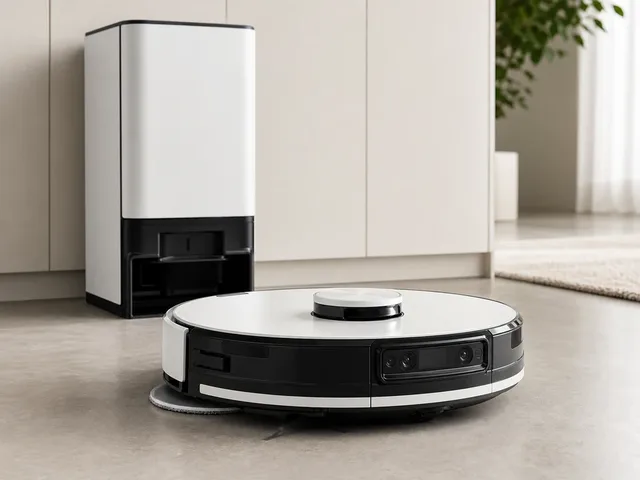
Samsung's flagship robot vacuum for 2026, first previewed at IFA 2025 and detailed at CES 2026. The Bespoke AI Jet Bot Steam Ultra is the first Samsung robot vacuum to feature 100°C steam cleaning, combining vacuuming, mopping, and steam sanitization in a single autonomous device. Powered by a Qualcomm Dragonwing AI processor, it uses deep learning for AI Object Recognition to distinguish between humans, pets, cables, and rugs, and introduces AI Liquid Recognition that detects liquid spills and contextually decides whether to clean or avoid them based on user preferences. The EasyPass Wheel system raises the robot's body and lowers its wheels to climb thresholds up to 2.4 inches, addressing one of the most common robot vacuum limitations. Additional features include AI Floor Detect, Stained Area Deep Cleaning, a self-cleaning Clean Station, SmartThings Pet Care, Safety Patrol with Bluetooth call, Bixby voice control, and Samsung Knox security. Samsung Korea lists package SKU VR90F01AAG98C in stock at ₩1,907,000 KRW, making current availability and pricing Korea-specific. Listed as Available with a recorded price; confirm current ordering and delivery terms.

Unreleased; consumer launch reportedly shelved. Samsung introduced Ballie as a rolling home-robot concept at CES 2020 and presented a redesigned version at CES 2024. Samsung's promotional materials described home navigation, connected-appliance control, projection, pet and family video updates, calls, music, and personalized behavior. Its April 9, 2025 announcement with Google Cloud proposed Gemini alongside Samsung language models and promised consumer availability in the United States and Korea in summer 2025. Bloomberg reported indefinite shelving on January 7, 2026. The sources reviewed do not establish a consumer retail release or a primary Samsung confirmation of permanent cancellation. Samsung's current Korean promotional page warns that staged scenes, features, functions, and behavior may differ from the actual product. Listed capabilities describe announcements and demonstrations, not verified performance of a released consumer model. Best treated as an exploratory lead until field readiness improves.
Compact mobile scan: status, price, standout context, and links stay visible without sideways scrolling.
Samsung · Cleaning
Price
KRW ₩1,907,000
Standout
Official source linked
Samsung · Companions
Price
Price TBA
Standout
Official source linked
Sorted by listed status first; status alone does not confirm stock or delivery.
| Robot | Status | Price | Link |
|---|---|---|---|
Bespoke AI Jet Bot Steam Ultra Samsung · Cleaning |
Available | KRW ₩1,907,000 | Official |
Ballie Samsung · Companions |
Prototype | Price TBA | Official |
Quick answers
The short version of what this label means in the ui44 catalog, where it matters, and how to compare it without over-reading the marketing copy.
Bixby currently appears on 2 tracked robots across 1 manufacturers. That makes this route useful for both deep research and fast shortlist scanning, not just one-off editorial reading.
The strongest concentration is in Cleaning (1) and Companions (1). Category mix is the fastest clue for whether this component behaves like baseline plumbing or a more selective differentiator.
Available listings: 1. Pre-order listings: 0. Active records: 0. Available indicates an ordering listing, not confirmed stock. Pre-order indicates a reservation listing, not immediate delivery. Active status alone does not confirm public purchase availability or deployment. Other statuses do not establish a current purchase listing. Confirm regional access, stock, reservation terms, and delivery with the manufacturer. These counts describe robot profiles carrying this component label. Component presence does not establish that the component is sold separately.
Start with listed status, supporting official sources, and the standout spec column in the inventory table. On component routes, those three signals usually remove weak profiles faster than reading every descriptive paragraph.
The strongest shared-stack signals here are Smartthings (2), Wi-Fi (2), and Active Stereo 3D Obstacle Sensing (dual cameras + dual light patterns) (1). Use those pairings to branch into adjacent component pages when one label is too narrow for the decision.
Published robot prices: KRW ₩1.9M. 1 of 2 records have a usable listed price. Ranges and averages are calculated separately within each currency; no currency conversion or cross-currency affordability ranking is implied. Missing prices do not establish a budget tier. Confirm configuration, taxes, regional access and current terms with the manufacturer. These are robot prices, not the cost of the component alone.
Start with Samsung (2). Repetition across manufacturers is often the clearest signal that the component is part of a stable market pattern rather than a one-off marketing callout.
The original long-form component research is still here, but collapsed so the main route can prioritize hierarchy and scan speed.
The baseline explanation of what Bixby is, why it matters, and how to think about it before comparing implementations.
Bixby is a voice assistant component found in 2 robots tracked in the ui44 Home Robot Database. As a voice assistant technology, Bixby plays a specific role in enabling robot perception, interaction, or operation depending on its implementation in each platform.
Component Type
Used By
2 robots
Manufacturer
Categories
Published prices
KRW ₩1.9M
Listed Available
1 robot
Voice assistants are the conversational interface layer of a robot. They enable hands-free interaction through natural language, allowing users to give commands, ask questions, control smart home devices, and receive spoken responses.
In the ui44 database, Bixby is categorized under Voice Assistant components. For a comprehensive explanation of all component types, consult the components glossary.
Voice interaction is often the primary way users communicate with home robots. A good voice assistant makes the robot feel intuitive and accessible, while a limited one creates friction. It also shapes accessibility, privacy expectations, and everyday convenience.
Platform choice determines smart home ecosystem compatibility
Quality of voice recognition directly affects daily usability
Alexa-integrated robots work seamlessly with Alexa-compatible devices
Used in 2 robots across 2 categories (Companions, Cleaning), indicating targeted adoption across the robotics industry.
Voice assistants use a pipeline of technologies that process speech in stages. This pipeline may run partially on-device and partially in the cloud.
Wake word detection
Continuously listens for the trigger phrase on a low-power processor
Speech recognition (ASR)
Converts the audio stream into text using neural network models
Natural language understanding
Extracts intent and relevant entities from the transcribed text
Dialog management
Maintains conversation context and determines the appropriate response
Text-to-speech (TTS)
Generates natural-sounding audio output with human-like prosody
Bixby Integration
Implementation varies by robot platform and manufacturer. Each robot integrates Bixby differently depending on system architecture, use case, and target tasks. Integration with other onboard voice interfaces and the main processing unit determines real-world performance.
Deeper technical framing, matched technology profiles, and the longer use-case treatment for Bixby.
Beyond the high-level overview, understanding the technical foundations of voice assistant technologies like Bixby helps buyers and researchers evaluate implementations more critically.
Voice assistant technology involves a complex pipeline of signal processing and AI working in sequence.
Real-world voice performance can differ significantly from laboratory benchmarks.
Voice assistants have evolved from rigid command syntax to genuinely conversational interfaces.
Early: rigid command syntax — 'robot, move forward three meters'
Statistical language models enabled more flexible recognition
Platform integration (Alexa, Google) brought vast skill ecosystems to robots
LLM integration: handling ambiguous requests, following context, explaining actions
On-device processing improvements reducing cloud dependency and latency
Voice assistants face several well-documented limitations.
Key application domains for voice assistant technologies like Bixby.
Voice assistants allow users to control their robot without touching a screen or phone. Commands like 'start cleaning,' 'go to the kitchen,' or 'play music' can be executed entirely by voice, which is especially valuable when users are busy with other tasks or have mobility limitations.
A robot with a voice assistant can serve as a mobile smart home controller, carrying the voice interface from room to room. Unlike fixed smart speakers, a mobile robot brings voice control to wherever you are in the house, enabling commands like 'turn off the bedroom lights' from any location.
Voice assistants provide quick access to information — weather, news, timers, reminders, calendar events, and general knowledge questions — all without requiring the user to find and use a screen-based device. This ambient information access is one of the most commonly used voice assistant features.
Voice interfaces are a critical accessibility feature, making robot technology usable for people with visual impairments, limited mobility, or difficulty with touchscreen interfaces. The ability to control a robot entirely by voice significantly broadens the user base and real-world utility of home robots.
Advanced voice assistants can recognize different voices, personalizing responses and access levels for each household member. This enables features like individual calendars, personalized music preferences, and age-appropriate content filtering for children.
Visit each robot's detail page to see which capabilities are available on specific models.
Manufacturer mix, specs context, price context, category overlap, and adjacent components worth branching into next.
Bixby is used by 1 manufacturer — showing how widely this technology is deployed across the industry.
| Manufacturer | Models |
|---|---|
| Samsung | 2 robots |
Side-by-side comparison of all 2 robots using Bixby.
| Robot | Price | Status |
|---|---|---|
| Ballie | Pricing not listed | Prototype |
| Bespoke AI Jet Bot Steam Ultra | KRW ₩1.9M | Available |
Bixby spans 2 robot categories — from consumer to research platforms.
Technologies most often paired with Bixby across 2 robots.
Browse the full components directory or see the components glossary for detailed explanations of each technology.
Published robot prices: KRW ₩1.9M. 1 of 2 records have a usable listed price. Ranges and averages are calculated separately within each currency; no currency conversion or cross-currency affordability ranking is implied. Missing prices do not establish a budget tier. Confirm configuration, taxes, regional access and current terms with the manufacturer. These are robot prices, not the cost of the component alone.
KRW · 1 listed price
Range: KRW ₩1.9M
Mean: KRW ₩1.9M
76 other voice assistant technologies tracked in ui44, ranked by adoption.
34 robots
24 robots
9 robots
8 robots
4 robots
3 robots
2 robots
2 robots
Browse all Voice Assistant components or use the robot comparison tool to evaluate how different voice assistant configurations perform across specific robot models.
The voice assistant market in robotics reflects the broader smart speaker industry, where Amazon Alexa, Google Assistant, and Apple Siri maintain dominant positions.
On-device processing
Reducing cloud dependency for faster response and better privacy — accelerated by privacy regulations
LLM integration
Large language models enable genuinely conversational interactions beyond simple command-and-response
Multi-language support
A key competitive differentiator for manufacturers targeting global markets
Industry Adoption Snapshot
Bixby is adopted by 2 robots from 1 manufacturer in the ui44 database, providing a data-driven view of real-world deployment patterns.
Certifications carried by robots incorporating Bixby, indicating compliance with safety, EMC, and quality standards.
Platform compatibility, voice integration, and AI capabilities across robots with Bixby.
The long-form buyer, maintenance, and troubleshooting material kept available without forcing it into the main scan path.
If Bixby is an important factor in your robot selection, here are key considerations to guide your decision.
Platform compatibility
Does it work with your existing smart home setup?
Language support
Does it understand your preferred language and accent?
Offline capability
Can it handle basic commands without internet?
Privacy controls
Can you disable the mic, review recordings, or opt out of data collection?
Third-party skills
Can the assistant be extended with additional capabilities?
Available listings: 1. Pre-order listings: 0. Active records: 0. Available indicates an ordering listing, not confirmed stock. Pre-order indicates a reservation listing, not immediate delivery. Active status alone does not confirm public purchase availability or deployment. Other statuses do not establish a current purchase listing. Confirm regional access, stock, reservation terms, and delivery with the manufacturer. These counts describe robot profiles carrying this component label. Component presence does not establish that the component is sold separately.
A component is only as good as its integration. Check how the manufacturer has incorporated Bixby into the overall robot design and software stack.
Review what other voice assistant technologies are paired with Bixby in each robot — see the related components section.
Make sure the robot's category matches your use case. Bixby serves different roles in different robot types.
Consider the manufacturer's reputation for software updates, support, and component reliability.
Compare Before You Buy
Use the ui44 comparison tool to evaluate robots with Bixby side by side.
Voice assistant longevity is closely tied to platform sustainability. Since most robot voice assistants depend on cloud-based services from major technology companies, the maintenance model differs significantly from purely on-device components. Understanding the dependency structure helps assess long-term reliability.
The hardware side of voice assistants — microphone arrays and speakers — is quite durable. MEMS microphones have no moving parts and typically last for decades.
Physical maintenance of voice hardware is minimal — occasionally cleaning microphone ports to prevent dust blockage is the primary requirement. Software maintenance is more involved: voice assistants require ongoing cloud connectivity and depend on platform provider updates for speech recognition improvements, new language support, and skill additions.
The biggest future-proofing risk with voice assistants is platform discontinuation or degradation. If a cloud-based voice service is shut down or significantly changed, robots depending on it may lose voice capabilities entirely.
For the 2 robots in the ui44 database using Bixby, we recommend checking the individual robot pages for manufacturer-specific maintenance guidance and support documentation. Each manufacturer has different support policies, update frequencies, and warranty terms that affect the long-term ownership experience of their voice assistant technologies.
Voice assistant issues in robots range from minor annoyances like occasional misrecognition to significant problems like complete unresponsiveness. Since voice assistants depend on multiple subsystems — microphones, processing hardware, network connectivity, and cloud services — diagnosing issues requires checking each layer systematically.
Likely Causes
Resolution
Likely Causes
Resolution
Likely Causes
Resolution
For model-specific troubleshooting, visit the individual robot pages for the 2 robots using Bixby. Each manufacturer provides model-specific support resources and diagnostic tools for their voice assistant implementations.
What to do next
This page should hand you off to the next useful comparison step, not strand you at the bottom of a long detail route.
Widen the layer
Open the full voice assistant workbench when Bixby is only one part of the decision and you need the broader market map.
Side-by-side check
Move from label-level research into direct robot comparison once you know which profiles are documented well enough to trust.
Adjacent signal
This is the most common neighboring component on robots that already use Bixby, so it is the fastest next branch if you need stack context.