This guide examines the conditions behind the one-video claim, compares the reported detection results, and separates those measurements from the robot sorting demonstration. It is an explanation of research evidence, not a review of a consumer teach mode or a recommendation to buy a particular robot.
Research checked: October 11, 2026. The paper's first arXiv version is dated March 13, 2026; RAI's explanatory article is dated June 10, 2026. Those are research-source dates, not this guide's publication date.
What is learned, and what is already available?
RAI's approach uses human interaction to build training examples. HOIST-Former identifies handled objects; SAMURAI tracks them; the resulting labels support fine-tuning a pretrained Faster R-CNN detector. The output is a manipulated objects detector, or MOD, specialized for those objects. This is adaptation on top of existing models, not a system acquiring vision from scratch.
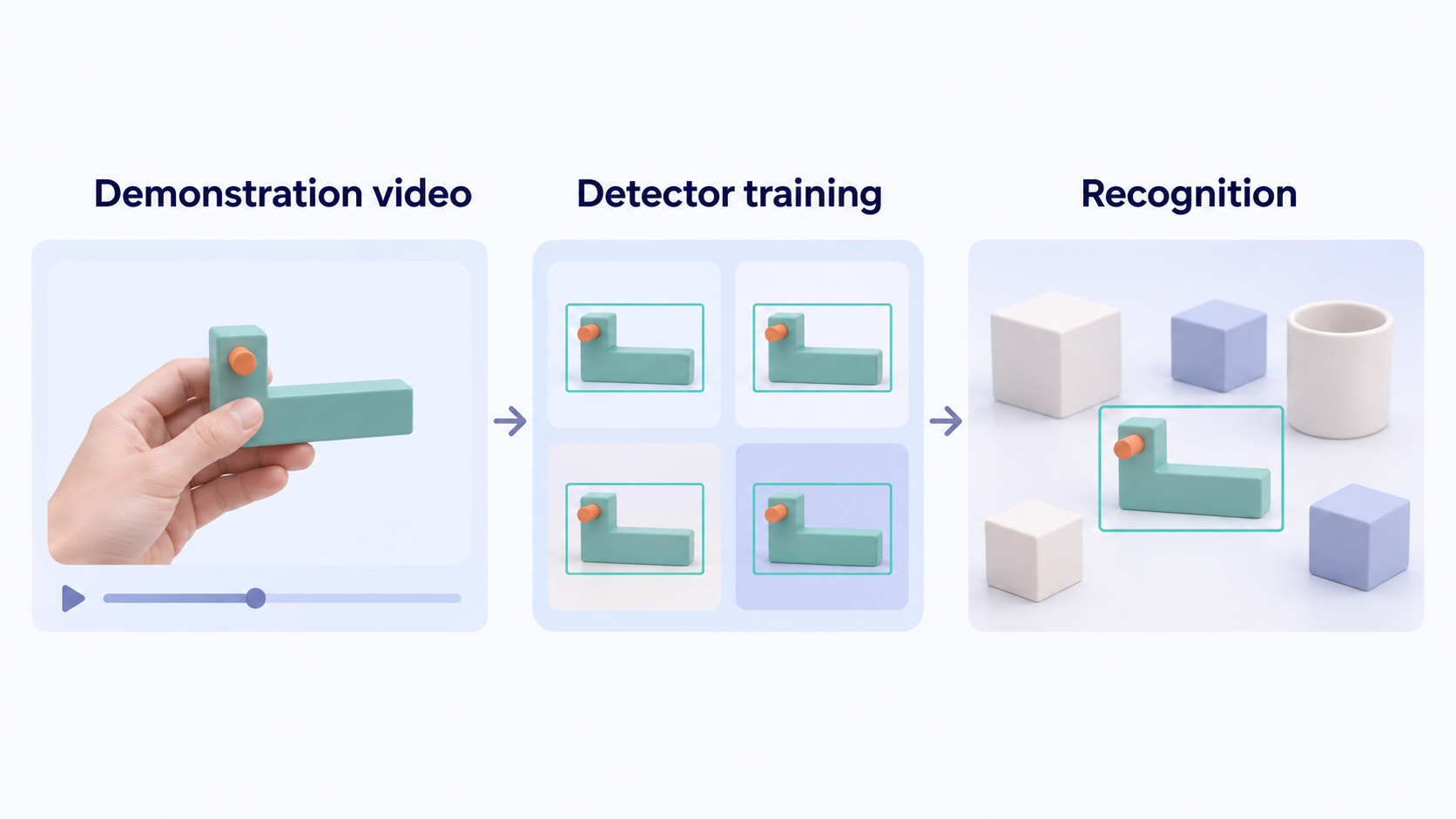
AI-generated conceptual illustration: demonstration video → detector training → recognition. The object and training views are illustrative, not experiment footage or results. Recognizing an object does not establish a learned household chore.
The institute also demonstrates a sorting application: a language model parses the pick-and-place sequence, and the robot uses the new detector during execution. RAI explicitly acknowledges missed detections, object confusion and remaining human supervision. Its explanation presents possible assembly and kitting applications; it does not document a consumer product feature. Source: RAI's method and limitations.
For a reader evaluating a demonstration, the useful question is which part changed after the video? A system could acquire a new object identity while using an existing grasp routine and an existing way to move to a destination. Calling all of that “learning a task” hides the division of work. Calling the recognition improvement trivial would hide its contribution too: a capable arm still needs an appropriate target.
Consider a hypothetical desk with two homemade ornaments. “Pick up the blue one” might identify neither unambiguously if both contain blue pieces. Showing the intended ornament supplies a different kind of information from writing a longer description. Yet identifying it does not specify its weight, whether a piece is loose, where a gripper should make contact, or where it belongs. These are separate questions to ask of a proposed application, not properties that follow from a correct label.
The one-video conditions and measured results
- Input: one video per detector: 15 seconds for sorting, 20-second Meccano snippets. Sorting participants move each object once, one-handed, rotating twice. MOD learns manipulated objects; untouched destinations use a separate vision-language model.
- Training: ImageNet-pretrained weights; 4–7-minute pipeline, including 3–4-minute fine-tuning on four T4 GPUs.
- Setup: rigid, top-down-graspable objects, one instance each. Existing Spot grasping, a GraspGen grasp-generation fallback and planning remain. Normally, all MOD objects must be detected simultaneously before the system accepts its map of the scene; operators can disable this requirement.
- Assistance: viewpoint mismatch can require teleoperation; operators can correct identities, detections and plans. Task-success and intervention rates are unreported.
Detection dataset
In-house 1
- MOD mAP
- 0.10
- Comparison mAP
- RexOmni-GPT: 0.06
Detection dataset
In-house 2
- MOD mAP
- 0.15
- Comparison mAP
- RexOmni-GPT: 0.09
Detection dataset
Meccano
- MOD mAP
- 0.06
- Comparison mAP
- Human-prompted GroundingDINO: 0.19
| Detection dataset | MOD mAP | Comparison mAP |
|---|---|---|
| In-house 1 | 0.10 | RexOmni-GPT: 0.06 |
| In-house 2 | 0.15 | RexOmni-GPT: 0.09 |
| Meccano | 0.06 | Human-prompted GroundingDINO: 0.19 |
mAP uses IoU 0.5–0.95; other metrics have different winners. Separately, GroundingDINO/Detic succeeded on 20.6% of 249 novel-object prompt trials initially, 57% within five attempts; positional descriptions were prohibited. A prompt counted as successful when either detector reached IoU ≥ 0.5.
Source: paper methods, Table I, robot application and appendices.
How to read the numbers without turning them into chore accuracy
Mean average precision (mAP) summarizes a detector's precision–recall performance across categories and matching thresholds. Precision asks how many reported detections are correct; recall asks how many reference objects are found. Intersection over union (IoU) measures the overlap of a predicted box and its reference box, divided by their union area (counting overlap once). Higher matching thresholds demand tighter localization. The 0.5–0.95 range averages results over several thresholds rather than judging boxes at just one tolerance. Metric reference: COCO evaluation implementation.
In-house 1 tests human-to-Spot-camera transfer; In-house 2 uses human videos; Meccano contains assembly footage. The table selects comparisons rather than reproducing every baseline. The named Meccano baseline beats MOD, so a universal “showing beats telling” conclusion would contradict the table. A value of 0.10 is not 10% chore completion: a box-localization evaluation does not measure whether an object was carried to the correct destination.
The prompt experiment answers another question: how readily could participants produce a successful description within that protocol? It does not measure the new detector's grasping success. It also does not establish how every current vision-language model, every prompting interface or every household user would perform. Treat the trial population and permitted information as part of the result, rather than optional details attached to a memorable failure number.
For practical comparisons, ask for the same target outcome from each candidate. A text-only interface and an interface that accepts an example photograph do not receive identical information. Likewise, giving one system a changed viewpoint while showing another its teaching view does not make a clean comparison of teaching methods. A useful demonstration makes those differences visible instead of burying them in a single score.
What the sorting demonstration can and cannot establish
A robot executing a sequence can illustrate how perception connects to action. To assess that demonstration, separate three questions: did it identify the intended object, did it execute the intended movement, and did the final arrangement match the goal? Success at one stage does not logically establish success at the next. A wrong identity and a failed grasp also call for different corrections, even when both leave the same object on the table.
This is why an edited successful sequence and a task-success benchmark serve different purposes. A sequence shows an execution. A benchmark needs a defined set of attempts and a rule for counting their outcomes. Without that accounting, a viewer cannot calculate a completion rate or determine how representative the shown attempt is. The appropriate response is to leave that quantity unknown, not to assume either perfect autonomy or complete unreliability.
Operator involvement deserves the same precision. Help can occur before an attempt, during search, after a wrong recognition, or when an action fails. Those interventions have different implications for how the system would be used. A remote correction of the target identity is different from physically moving an object into view; neither should disappear from a claim of unattended operation. A useful report would state the kind of help, when it occurred and how often it was needed.
For this article, the distinction also sets a clear boundary around household interpretation. A successful sorting example should not be presented as proof that a robot can independently decide how to tidy a room. “Where this object belongs” is information that a recognition label alone does not supply. A household user would need a way to express that preference, change it and check that the robot followed it.
How to judge transfer beyond a teaching video
“Works somewhere else” becomes much more informative when the change is named. Moving an object on the same table, changing the camera's viewing angle, introducing a similar-looking distractor and moving to another room are separate tests. Passing one does not settle the others. Readers should look for a description of what was held fixed as well as what changed.
A useful hypothetical recognition check would begin with the teaching scene and then vary one condition at a time. Present the target from another side. Place a similar object nearby. Remove the target entirely. Record whether the system finds the intended object, selects a distractor, or correctly reports that it has no target. This is a suggested way to interrogate a capability claim, not an additional experiment reported by RAI.
The absent-target case is especially useful as an evaluation question. Asking only “can it find this?” can conceal how the interface behaves when the answer should be “it is not here.” For a system that might trigger an action, the response to uncertainty matters alongside successful recognition. Ask whether it can decline, request another view or ask the user to choose between candidates; do not infer those behaviors from a confident-looking detection box.
Changes to an object also need explicit treatment. Suppose the ornament in the earlier example is rebuilt or partly covered. Does the owner expect it to count as the same object, a different one, or an uncertain match? That is a product requirement worth stating before a test. A developer and a household user could otherwise call the same recognition output correct or incorrect for different reasons.
Questions worth asking about an eventual teach mode
A research result can suggest useful questions without proving that a retail feature exists. For a proposed product, request documentation for its exact model and software. An unanswered question remains an evidence gap; it is not proof of a particular model architecture.
What does teaching change? Ask whether the interface stores a name, learns a visual identity, records a destination or changes an action policy. Request an example of the input and the resulting supported behavior. The word “learn” is too broad to substitute for that description.
What must the user do? Ask how the object must be presented, whether several views are needed, what happens when the recording is rejected, and whether someone else prepares the training data. Count preparation and corrections as well as the duration of the recorded clip. There is no universal acceptable teaching time; judge the burden against the intended use.
Where does processing happen? Ask which device receives the video, where training runs, whether a network connection is required and what is retained. A statement about local processing should be checked separately from retention, access and deletion policies. This paper is not a product privacy specification.
How does correction work? Ask how to undo an incorrect identity, introduce a replacement object and check that an old example no longer controls behavior. A recognition feature needs an understandable correction path to be useful to someone who did not build it. Request the supported procedure rather than assuming that another demonstration will automatically repair every mistake.
How this fits with related robot-learning questions
Object recognition is one part of a larger discussion. Our guide to teaching a home robot new chores covers broader demonstration-learning choices. The guide to talking through a chore examines language coaching. Neither question should be collapsed into the number of videos used to adapt a detector.
Recognizing a visible unfamiliar object also differs from deciding where to look for something that cannot currently be seen. For that distinction, see searching for objects hidden by clutter. For evidence about whole-task performance in new surroundings, see our separate unseen-home evaluation discussion. These are related problems, but they need their own tests and claims.
Frequently Asked Questions
Does one video mean no previous training?
No. The relevant distinction is between the new examples supplied for a specific
adaptation and the capabilities already built into the system. When comparing
one-demonstration claims, ask what was pretrained and what changed afterward.
Counting only the user's recording leaves out that distinction.
Is showing an object always better than describing it?
The evidence does not support a universal rule. Keep the named dataset,
comparison method and permitted input attached to each result. For an actual
interface, evaluate the supported ways of supplying information instead of
assuming that the word “video” or “language” determines performance.
Research references and dates
Primary source
Show, Don't Tell: Detecting Novel Objects by Watching Human Videos
- Role
- Version-specific methods, detection results and robot limitations
- Source date
- March 13, 2026 (v1)
- Accessed
- October 11, 2026
Primary source
RAI Institute's explanatory article
- Role
- Authors' explanation of the method and intended applications
- Source date
- June 10, 2026
- Accessed
- October 11, 2026
Primary source
COCO evaluation implementation
- Role
- Detection metric definitions
- Source date
- Undated implementation
- Accessed
- October 11, 2026
| Primary source | Role | Source date | Accessed |
|---|---|---|---|
| Show, Don't Tell: Detecting Novel Objects by Watching Human Videos | Version-specific methods, detection results and robot limitations | March 13, 2026 (v1) | October 11, 2026 |
| RAI Institute's explanatory article | Authors' explanation of the method and intended applications | June 10, 2026 | October 11, 2026 |
| COCO evaluation implementation | Detection metric definitions | Undated implementation | October 11, 2026 |
The practical evaluation questions above are ui44's interpretation. They should not be read as additional experiments, measured outcomes or product features.
Written by
ui44 Team
Published October 11, 2026
Share this article
Open a plain share link on X or Bluesky. No embeds, no widgets, no cookie baggage.