Commercial model
$2,875 list price
A published price gives buyers a starting point for budgeting, ROI modeling, and peer comparison before deeper vendor conversations begin.
Height
18.9 in
Weight
28 lb
Battery
Approx. 7 hours / 19–22 miles of continuous travel
Speed
6 mph
Payload
20 lb (9.1 kg) / 1,000 in³ cargo bin
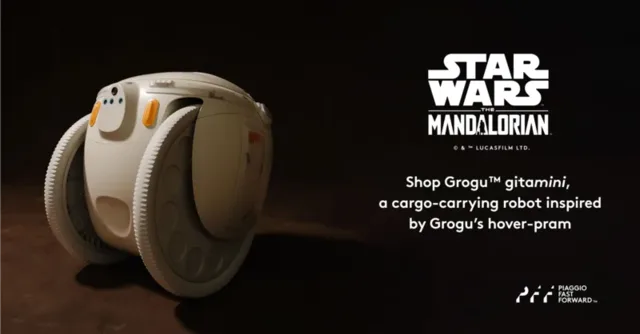
Grogu™ gitamini is a Star Wars-themed version of Piaggio Fast Forward's compact personal cargo-following robot, developed with Disney Consumer Products and styled after Grogu's pram from The Mandalorian. The consumer robot uses cameras and sensors to identify its operator, follow them, avoid obstacles, and adjust speed while carrying up to 20 lb of gear in a small cargo bin. Piaggio Fast Forward's official product page lists a $2,875 USD price, live inventory, app-based registration/settings, Wi-Fi, Bluetooth, over-the-air updates, a built-in Bluetooth speaker, and USB phone charging. Disney Store corroborates the same payload, camera/sensor following behavior, 28 lb weight, roughly seven-hour / ~21-mile runtime, under-two-hour charging, and 6 mph top speed. The product launched publicly in May 2026 as a licensed Disney/Star Wars edition of the gitamini platform.
Listed price
$2,875
Official Piaggio Fast Forward shop lists Grogu™ gitamini at $2,875 USD with inventory available; Disney Store also lists the product but shows shipping restrictions for some regions.
Release window
May 14, 2026
Current status
Available
Piaggio Fast Forward
Last verified
May 16, 2026
Share this robot
Open a plain share composer on X or Bluesky for this robot profile.
Technical overview
A fast read on the mechanical profile, sensing package, and platform integrations behind Grogu™ gitamini.
Height
18.9 in
Weight
28 lb
Dimensions
17.9 x 16.5 x 18.9 in (L x W x H)
Battery Life
Approx. 7 hours / 19–22 miles of continuous travel
Charging Time
Under 2 hours
Max Speed
6 mph
Payload
20 lb (9.1 kg) / 1,000 in³ cargo bin
Operational profile
Capabilities
10
Connectivity
4
Key capabilities
Ecosystem fit
Explore further
Benchmark set
Shortcuts to the closest alternatives in the current ui44 set.
Home Assistants
Isaac 0
Weave Robotics
$3,999
Home Assistants
Nosh One
Nosh Robotics
$1,499

Home Assistants
Lume
Syncere
$1,999
Home Assistants
W1
Zeroth Robotics
$7,999
Coverage
Reporting and explainers linked to Grogu™ gitamini.
The Grogu™ gitamini is a Home Assistants robot built by Piaggio Fast Forward. Grogu™ gitamini is a Star Wars-themed version of Piaggio Fast Forward's compact personal cargo-following robot, developed with Disney Consumer Products and styled after Grogu's pram from The Mandalorian. The consumer robot uses cameras and sensors to identify its operator, follow them, avoid obstacles, and adjust speed while carrying up to 20 lb of gear in a small cargo bin. Piaggio Fast Forward's official product page lists a $2,875 USD price, live inventory, app-based registration/settings, Wi-Fi, Bluetooth, over-the-air updates, a built-in Bluetooth speaker, and USB phone charging. Disney Store corroborates the same payload, camera/sensor following behavior, 28 lb weight, roughly seven-hour / ~21-mile runtime, under-two-hour charging, and 6 mph top speed. The product launched publicly in May 2026 as a licensed Disney/Star Wars edition of the gitamini platform.
At a listed price of $2,875, it positions itself in the mid-range segment of the home assistants market. See all Piaggio Fast Forward robots on the Piaggio Fast Forward page.
Detailed specifications for the Grogu™ gitamini
Height
18.9 in (48 cm)At 18.9 in (48 cm), the Grogu™ gitamini is sized for its intended operating environment and use cases.
Weight
28 lb (12.7 kg)Weighing 28 lb (12.7 kg), the Grogu™ gitamini balances structural integrity with portability and maneuverability.
Dimensions
17.9 x 16.5 x 18.9 in (L x W x H)The overall dimensions of 17.9 x 16.5 x 18.9 in (L x W x H) define the robot's physical footprint and determine what spaces it can navigate and what clearances it requires for operation.
Battery Life
Approx. 7 hours / 19–22 miles of continuous travelWith a battery life of Approx. 7 hours / 19–22 miles of continuous travel, the Grogu™ gitamini can operate for sustained periods before requiring a recharge. Battery life is measured under typical operating conditions and may vary based on workload intensity and environmental factors.
Charging Time
Under 2 hoursA charging time of Under 2 hours means the ratio of operation to downtime is an important consideration for applications requiring near-continuous availability. Some deployments use multiple robots in rotation to maintain uninterrupted service.
Maximum Speed
6 mph (9.7 km/h)A top speed of 6 mph (9.7 km/h) is calibrated for the robot's primary operating environment and safety requirements.
Payload Capacity
20 lb (9.1 kg) / 1,000 in³ cargo binA payload capacity of 20 lb (9.1 kg) / 1,000 in³ cargo bin determines what the robot can carry or manipulate. This is a critical spec for practical applications where the robot needs to handle physical objects.
The Grogu™ gitamini uses Piaggio Fast Forward leader-following and navigation software for operator identification, obstacle avoidance, speed matching, and pedestrian-aware following; detailed AI stack not publicly disclosed. as its intelligence backbone. This AI platform powers the robot's decision-making, perception processing, and autonomous behavior. The sophistication of the AI stack directly impacts how well the robot handles unexpected situations and adapts to new environments.
The Grogu™ gitamini integrates 3 sensor types, forming the perceptual foundation that enables autonomous operation.
This sensor configuration enables the Grogu™ gitamini to perceive its environment and operate autonomously in its intended use cases. Multiple sensor modalities provide redundancy and more robust perception than any single sensor type alone.
Explore sensor technologies: components glossary · full components directory
Home assistant robots combine the functionality of a smart speaker, tablet, security camera, and telepresence device into a mobile platform that follows you or patrols your home. They represent the next evolution of smart home interaction.
The Grogu™ gitamini offers 10 distinct capabilities, each contributing to the robot's practical utility.
These capabilities work together with the robot's 3 onboard sensor types and Piaggio Fast Forward leader-following and navigation software for operator identification, obstacle avoidance, speed matching, and pedestrian-aware following; detailed AI stack not publicly disclosed. AI platform to deliver practical, real-world performance.
The Grogu™ gitamini integrates with the following platforms and ecosystems, extending its utility beyond standalone operation.
This ecosystem compatibility enables the Grogu™ gitamini to work as part of a broader automation setup rather than operating in isolation.
10
Capabilities
3
Sensor Types
AI
Piaggio Fast Forward…
How the Grogu™ gitamini communicates with your network, smart home devices, cloud services, and companion apps.
The Grogu™ gitamini by Piaggio Fast Forward integrates 8 distinct technology components across sensing, connectivity, intelligence, and interaction layers. The physical platform features a height of 18.9 in (48 cm), a weight of 28 lb (12.7 kg), a top speed of 6 mph (9.7 km/h), providing the foundation on which this technology stack operates.
The perception layer is built on Cameras, Leader-identification sensors, Obstacle-avoidance sensors. These work in concert to give the robot a detailed understanding of its operating environment. This multi-sensor approach provides redundancy and enables the robot to function reliably even when individual sensors encounter challenging conditions such as low light, reflective surfaces, or cluttered spaces.
For communications, the Grogu™ gitamini relies on Wi-Fi 2.4/5 GHz, Bluetooth Class 1, mygita app, USB Type-A phone charging port. This connectivity stack ensures the robot can communicate with cloud services, local smart home devices, mobile apps, and other networked systems in its environment.
Piaggio Fast Forward leader-following and navigation software for operator identification, obstacle avoidance, speed matching, and pedestrian-aware following; detailed AI stack not publicly disclosed. serves as the computational brain, processing sensor data, making navigation decisions, and orchestrating the robot's autonomous behaviors. The quality of this AI platform directly influences how well the robot handles novel situations, adapts to changes in its environment, and improves its performance over time through learning.
Home assistant robots target households looking for a mobile smart home hub that can move between rooms, provide video communication, monitor the home, and assist with daily tasks. Early adopters and smart home enthusiasts are the primary market.
Mobility range, smart home platform integration, camera quality for video calls and monitoring, microphone/speaker quality for voice interaction, and the breadth of assistive capabilities are key. Consider privacy features (physical camera shutters, mute buttons) and whether the robot can navigate your home layout reliably.
Price Context
The Grogu™ gitamini is currently available for purchase. Check the manufacturer's website or authorized retailers for the latest stock and ordering information.
Engineering compromises and where this home assistants robot excels
Supporting 4 connectivity protocols gives the Grogu™ gitamini flexible integration options. Whether connecting to local smart home networks, cloud services, or companion devices, the breadth of connectivity ensures compatibility across a wide range of deployment scenarios and reduces the risk of network-related limitations.
With 10 distinct capabilities, the Grogu™ gitamini is designed as a versatile platform rather than a single-task device. This breadth means the robot can handle varied scenarios and workflows, reducing the need for multiple specialized robots and increasing its utility across different situations.
A battery life of Approx. 7 hours / 19–22 miles of continuous travel provides substantial operational runway. For home assistants applications, this means longer work sessions between charges, fewer interruptions, and the ability to complete larger tasks or cover more area in a single charge cycle.
A top speed of 6 mph (9.7 km/h) provides the Grogu™ gitamini with the agility to cover ground efficiently. This is particularly valuable for applications that require rapid response, large-area coverage, or keeping pace with human movement in shared environments.
With a payload capacity of 20 lb (9.1 kg) / 1,000 in³ cargo bin, the Grogu™ gitamini can handle meaningful physical tasks. This capacity enables practical applications like carrying tools, transporting materials, or supporting equipment mounts that lighter robots simply cannot accommodate.
Unlike many robots that remain in development or prototype stages, the Grogu™ gitamini is available for purchase today. This means you can evaluate the actual shipping product rather than making decisions based on projected specifications that may change before release.
Note: This strengths and trade-offs assessment is based on the Grogu™ gitamini's documented specifications as tracked in the ui44 database. Real-world performance depends on deployment conditions, firmware maturity, and environmental factors. For the most current information, check the Piaggio Fast Forward manufacturer page or visit the official product page. Use the comparison tool to evaluate these trade-offs against competing robots in the same category.
Understanding the engineering behind this category
Home assistant robots combine mobility, intelligence, and physical manipulation to perform tasks that stationary smart devices simply cannot. While a smart speaker can tell you the weather, a home assistant robot can bring you an umbrella. This emerging category represents the convergence of multiple robotic technologies — navigation, manipulation, AI, and human-robot interaction — into a single household platform.
Home assistant robots must navigate the complex, cluttered, and constantly changing environment of a lived-in home. They use LiDAR, cameras, and depth sensors to build and continuously update maps of the home interior, handling furniture rearrangements, opened or closed doors, and transient obstacles like shoes and toys. Path planning must account for the robot's size (including any carried objects), doorway widths, carpet transitions, and areas where humans are present. Advanced systems create semantic maps that understand room functions — knowing the kitchen from the bedroom enables context-appropriate behavior like adjusting movement speed or interaction style.
AI in home assistant robots must bridge the gap between high-level human instructions and low-level physical actions. When asked to bring a glass of water, the robot must understand the request, plan the task sequence (navigate to kitchen, find a glass, operate the tap, carry without spilling), and execute each step while handling unexpected situations. Foundation models and vision-language models are increasingly central to this task comprehension capability. The AI must also maintain context across interactions — remembering where items are usually kept, learning household routines, and anticipating needs based on time of day and activity patterns.
Home assistant robots require comprehensive perception that combines environmental mapping with object-level understanding. Cameras and depth sensors identify objects and their positions. Force sensors in hands and arms enable safe grasping and manipulation without crushing or dropping items. Proximity sensors prevent collisions during navigation, especially when carrying objects that extend the robot's footprint. Audio processing detects and localizes voice commands from anywhere in the home. Some robots include sensors for detecting spills, open doors, or unusual sounds that might indicate a problem requiring attention.
Home assistant robots face challenging power requirements due to the combination of mobility, computation, and manipulation. Battery technology limits operational time to several hours before recharging is needed. Smart power management prioritizes tasks by urgency and groups actions by location to minimize unnecessary movement. Autonomous docking and charging ensure availability when needed. Some designs use lighter-weight arms and efficient actuators to reduce power consumption during manipulation tasks. The ability to plan efficient routes through the home — minimizing backtracking and unnecessary movement — directly impacts how much useful work the robot can accomplish per charge cycle.
Operating a robot with arms and hands in a home with people requires extensive safety engineering. Force-limiting actuators prevent the robot from exerting dangerous grip or impact forces. Speed reduction in the presence of detected humans protects against collision injuries. Object-drop prevention systems ensure the robot does not release carried items unexpectedly. Hot-liquid and sharp-object handling requires specialized grip and stability control. Emergency stop mechanisms allow any household member to immediately halt the robot. The system must fail safely — if power is lost while carrying an object, the gripper should default to a secure hold rather than releasing.
Home assistant robots are at an early but rapidly advancing stage. The convergence of foundation models (for understanding tasks), improved dexterous manipulation (for executing them), and decreasing hardware costs (for making them accessible) is accelerating development. Near-term advances will likely focus on specific task competency — robots that excel at a few useful tasks rather than attempting to do everything. As these capabilities mature and costs decrease, the scope of home assistant robots will gradually expand toward the vision of a truly general-purpose household helper.
The Grogu™ gitamini by Piaggio Fast Forward incorporates many of these technology pillars. For a detailed look at the specific sensors and components used in the Grogu™ gitamini, see the sensor analysis and connectivity sections above, or browse the complete components glossary for explanations of every technology used across the robotics industry.
How this robot compares in the home assistants landscape
At $2,875, the Grogu™ gitamini is positioned in the premium tier for home assistants robots. At this price point, buyers expect top-tier build quality, advanced features, and strong after-sales support.
The Grogu™ gitamini's 3 sensor types provide solid perceptual coverage for its intended use cases. This mid-range sensor suite balances cost with capability, covering the essential modalities needed for home assistants applications.
Being currently available for purchase gives the Grogu™ gitamini a practical advantage over competitors still in development or prototype stages. Buyers can evaluate the actual product rather than relying on spec-sheet promises that may change before release.
Side-by-side specs, capability overlap analysis, and key differentiators.
For the full picture of Piaggio Fast Forward's portfolio and market strategy, visit the Piaggio Fast Forward manufacturer page.
What the public profile tells you, and what still needs direct vendor confirmation
From a buying and rollout perspective, the Grogu™ gitamini should be read as a home assistants platform aimed at connected homes that want a mobile smart-home touchpoint. ui44 currently tracks 10 capability signals, 3 sensor inputs, and a last verification date of 2026-05-16. That mix gives buyers a useful first-pass picture, but it is still only the public layer of due diligence, especially when procurement, uptime, and support commitments are decided directly with Piaggio Fast Forward.
Commercial model
$2,875 list price
A published price gives buyers a starting point for budgeting, ROI modeling, and peer comparison before deeper vendor conversations begin.
Integration posture
4 connectivity options
The profile lists Wi-Fi 2.4/5 GHz, Bluetooth Class 1, mygita app, USB Type-A phone charging port, plus Piaggio Fast Forward leader-following and navigation software for operator identification, obstacle avoidance, speed matching, and pedestrian-aware following; detailed AI stack not publicly disclosed. as the AI stack. That is enough to infer the basic network posture, but buyers should still confirm APIs, fleet management, and workflow integration details. ui44 currently tracks 4 declared compatibility links.
Spec disclosure
7/7 core specs public
The profile exposes the full operating-envelope set that ui44 tracks for this section, giving buyers a relatively clear starting point for technical validation.
The current profile is detailed enough to support early comparison work, shortlist creation, and cross-checking against other home assistants robots. It is still worth validating the final deployment package, because integration services, support coverage, software entitlements, and site-preparation requirements often sit outside the raw hardware spec sheet.
If you want a faster apples-to-apples read, compare the Grogu™ gitamini against nearby alternatives in ui44's compare view, then cross-check the underlying AI, sensor, and subsystem terms in the components glossary. For manufacturer-level context, the Piaggio Fast Forward profile helps anchor this robot inside the wider product lineup.
Practical guide from day one through years of ownership
Home assistant robot setup involves physical placement, network configuration, environment mapping, and capability training. Place the charging dock in an accessible central location. Connect to your home Wi-Fi and smart home platform. Run the initial mapping session with all doors open and the home in its typical state. After mapping, configure room names, restricted areas, and any smart home integrations. For robots with manipulation capabilities, the setup may include teaching specific tasks by demonstration or configuring task parameters through the app. Expect to invest several sessions over the first week refining the robot's understanding of your home and preferences.
Home assistant robots combine the maintenance needs of mobile platforms with those of manipulation systems. Weekly tasks include cleaning sensors, checking wheels and arm joints for debris, and verifying gripper functionality. Monthly maintenance should cover thorough sensor cleaning, software updates, and calibration checks. If the robot handles food or liquids, clean any contact surfaces after each use according to the manufacturer's hygiene guidelines. Monitor battery performance over time and report any significant degradation to the manufacturer.
Home assistant robot software updates are particularly impactful because they can add entirely new task capabilities. A robot that launches with five core tasks might gain additional abilities through software updates as the manufacturer develops and validates new skills. Keep automatic updates enabled and review update notes to discover new capabilities you might not have known were added. Major platform updates may also improve task execution quality for existing capabilities — making the robot more reliable and efficient at tasks it could already perform.
Home assistant robots represent a significant investment, and proper care maximizes that investment's return. Avoid exceeding payload limits when the robot carries objects. Keep the operating environment reasonably tidy to reduce navigation challenges. Maintain clean, unobstructed sensor surfaces for reliable operation. For robots with arms, avoid forcing joints beyond their range of motion. Address any unusual sounds or behaviors promptly — early intervention prevents small issues from becoming expensive repairs. Consider a manufacturer service plan for access to priority support and replacement parts.
For Piaggio Fast Forward-specific support resources and documentation, visit the Piaggio Fast Forward page on ui44 or check the manufacturer's official website at Piaggio Fast Forward's product page.
All Grogu™ gitamini data on ui44 is verified against official Piaggio Fast Forward sources, including spec sheets, product pages, and press releases. Last verified: 2026-05-16. Official source: Piaggio Fast Forward product page. If you find outdated or incorrect information, please let us know — accuracy is our top priority.
See how the Grogu™ gitamini stacks up — compare specs, browse the home assistants category, or search the full database.