Commercial model
See pricing details
Public pricing and commercial buyer terms have not been officially disclosed; public materials describe prototype demonstrations and industrial precision-automation work rather than a retail product.
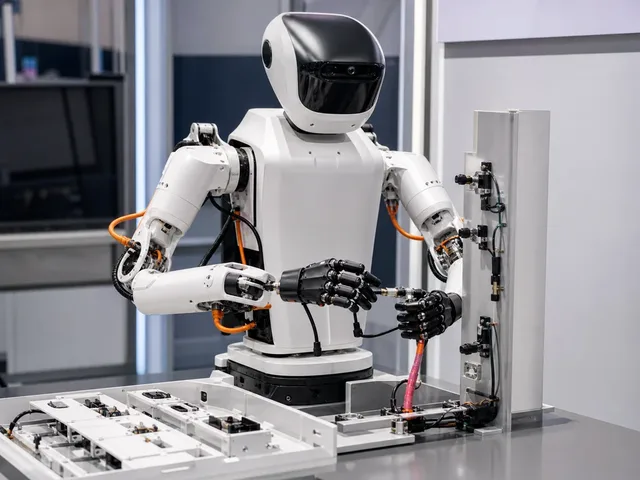
A1 is TARS Robotics' embodied-AI manipulation robot platform for industrial precision automation research and public demonstrations. TARS' June 2026 ICRA release says A1 was shown with the 21-DoF DexHand and AWE 3.0 foundation model performing multi-step backpack packing and sub-millimeter wire-harness insertion with live error correction and re-planning. Pandaily separately reported that A1 completed 105 valid sub-millimeter wire-harness assemblies in one hour for a Guinness World Records title in March 2026. TARS positions the platform around real industrial environments, but public hardware dimensions, battery specs, payload ratings, and sale terms have not been disclosed.
Listed price
See pricing details
Public pricing and commercial buyer terms have not been officially disclosed; public materials describe prototype demonstrations and industrial precision-automation work rather than a retail product.
Release window
Mar 1, 2026
Current status
Prototype
TARS Robotics
Last verified
Jun 6, 2026
Share this robot
Open a plain share composer on X or Bluesky for this robot profile.
Technical overview
A fast read on the mechanical profile, sensing package, and listed platform details for A1.
Height
Not officially disclosed
Weight
Not officially disclosed
Battery Life
Not officially disclosed
Charging Time
Not officially disclosed
Max Speed
Not officially disclosed
Operational profile
Capabilities
9
Connectivity
1
Key capabilities
Listed platforms & ecosystem
Certifications
Explore further
Benchmark set
Shortcuts to the closest alternatives in the current ui44 set.
Research
SURENA IV
University of Tehran (CAST)
See pricing details
Research
HOPEJr
Hugging Face LeRobot
$3,000
Research
TIAGo Pro
PAL Robotics
See pricing details
Research
Blueprint Robotics
Sphero
$649
The A1 is a Research robot built by TARS Robotics. A1 is TARS Robotics' embodied-AI manipulation robot platform for industrial precision automation research and public demonstrations. TARS' June 2026 ICRA release says A1 was shown with the 21-DoF DexHand and AWE 3.0 foundation model performing multi-step backpack packing and sub-millimeter wire-harness insertion with live error correction and re-planning. Pandaily separately reported that A1 completed 105 valid sub-millimeter wire-harness assemblies in one hour for a Guinness World Records title in March 2026. TARS positions the platform around real industrial environments, but public hardware dimensions, battery specs, payload ratings, and sale terms have not been disclosed.
Public pricing and commercial buyer terms have not been officially disclosed; public materials describe prototype demonstrations and industrial precision-automation work rather than a retail product. See all TARS Robotics robots on the TARS Robotics page.
Detailed specifications for the A1
Read this recorded AI entry alongside the model description and source notes for announcement or deployment context. A platform name alone does not establish implemented features, autonomy, or performance.
The profile lists the sensor descriptions below. These entries do not establish physical sensor counts, sensor fusion, redundancy, or performance.
Consult the linked profile sources for hardware configuration and tested behavior. A technology label alone does not verify an operating capability.
Explore sensor technologies: components glossary · full components directory
Research robots serve as platforms for advancing robotics science and engineering. They enable researchers to test theories about locomotion, manipulation, perception, and human-robot interaction in controlled and real-world environments.
The A1 record lists 9 capabilities. Keep any announcement or demonstration qualifiers attached to these entries; the count alone does not establish practical performance.
These are the capabilities listed in the profile. Hardware configuration and demonstrated performance should be checked against the linked sources.
These are the platforms, communities, or ecosystem relationships listed in the profile. A listed name or protocol alone does not confirm home-device interoperability or automation support.
9
Capabilities
AI
TARS AWE 3.0 general…
The A1 profile lists the following communication and voice-system descriptions.
The A1 by TARS Robotics has the following technology descriptions in its profile.
The profile lists DexHand ultra-high-resolution micro-cameras, DexHand elastomer tactile sensors. Hardware quantities, integration, and tested behavior require separate source evidence.
The connectivity descriptions listed for the A1 are Not officially disclosed. Specific services and device interoperability require separate documentation.
Research robots are acquired by universities, government labs, and corporate R&D departments. They serve as experimental platforms for developing new algorithms, testing locomotion strategies, and advancing the field of robotics. Some are also used for educational purposes.
Open-source software compatibility (ROS/ROS 2), sensor modularity, programmability, available SDK/API quality, community support, and published research papers using the platform are key factors. Documentation quality and the ability to modify both hardware and software are essential for research use.
Listed pricing
The A1 is listed as Prototype, indicating a prototype-stage record. Specifications may change; the label alone does not establish purchase availability. Check TARS Robotics's current documentation for access options.
Recorded features and considerations to assess
The A1 record lists 9 capabilities. Review their qualifiers and supporting evidence for the tasks you need. The number of entries does not establish workflow coverage, reliability, or the ability to replace other robots.
Public pricing and commercial buyer terms have not been officially disclosed; public materials describe prototype demonstrations and industrial precision-automation work rather than a retail product.
The A1 is listed as Prototype, indicating a prototype-stage record. Specifications may change; the label alone does not establish purchase availability. Check TARS Robotics's current documentation for access options.
Note: This strengths and trade-offs assessment is based on the A1's documented specifications as tracked in the ui44 database. Real-world performance depends on deployment conditions, firmware maturity, and environmental factors. For the most current information, check the TARS Robotics manufacturer page or visit the official source. Use the comparison tool to evaluate these trade-offs against competing robots in the same category.
Understanding the engineering behind this category
Research robots serve a fundamentally different purpose than commercial or consumer models. They are platforms for discovery — enabling scientists and engineers to test theories, develop algorithms, and push the boundaries of what robots can do. The technology in research robots prioritizes openness, flexibility, and access to raw data over consumer-friendly packaging or commercial reliability. Understanding this distinction is important for anyone considering a research robot platform.
Research robots typically expose their navigation systems at a much lower level than commercial products. Researchers can access raw sensor data, modify SLAM algorithms, implement custom path planners, and test novel navigation approaches. ROS (Robot Operating System) and ROS 2 compatibility is standard, providing a common framework for sharing navigation modules across the research community. This openness enables rapid iteration — a researcher can swap between different SLAM implementations, test new obstacle avoidance strategies, or develop entirely novel navigation paradigms without being locked into a vendor's proprietary stack.
Research robots serve as physical testbeds for AI algorithms that may eventually appear in commercial products years later. Reinforcement learning, imitation learning, few-shot task learning, and human-robot interaction studies all require robot platforms that can execute AI-generated commands in the physical world. The gap between simulation (where training is cheap and fast) and reality (where physics is unforgiving) makes physical robot platforms essential for validating AI approaches. Research robots must support rapid deployment of new AI models without extensive integration work.
Research platforms prioritize sensor modularity and data access. Standard mounting interfaces allow researchers to attach custom sensors alongside built-in ones. Raw sensor data streams (not just processed results) are accessible for developing novel perception algorithms. Precise time-stamping and synchronization across sensor streams enable accurate multi-modal fusion research. Many research robots include more sensors than strictly necessary for any single application, providing researchers with rich datasets for developing and testing new algorithms.
Research robots balance operational runtime with practical lab use. Sessions of one to four hours are typical, with quick charging between experiments. Some research setups use tethered power for long-running experiments where battery limitations would interrupt data collection. Power monitoring and logging capabilities help researchers understand the energy costs of different behaviors and algorithms — important for developing efficient approaches that will eventually run on battery-constrained commercial systems.
Research environments present unique safety challenges because robots are constantly being programmed with untested behaviors. Hardware safety limits (joint speed caps, force limits, emergency stops) must be robust regardless of software commands. Safety-rated monitored stop and speed monitoring ensure the robot cannot exceed safe operating parameters even when running experimental code. Collaborative operation standards apply when researchers work alongside the robot during experiments. Many labs implement layered safety with physical barriers for high-speed testing and open-area operation restricted to validated, lower-risk behaviors.
Research robot platforms are becoming more accessible and capable. Cloud robotics enables remote experiment execution and shared datasets. Digital twins and high-fidelity simulators reduce the need for physical hardware time while improving sim-to-real transfer. Standardized benchmarks and open datasets enable fair comparison of results across labs. The democratization of robotics research — through lower-cost platforms, open-source software, and cloud infrastructure — is expanding who can contribute to advancing the field.
These are category-level technology examples; they do not establish the capabilities of the A1. For its recorded hardware details, see the sensor analysis and connectivity sections above. Check model-specific documentation from TARS Robotics for supported behavior, or use the components glossary to look up terminology.
How this robot compares in the research landscape
Public pricing and commercial buyer terms have not been officially disclosed; public materials describe prototype demonstrations and industrial precision-automation work rather than a retail product.
The A1 is listed as Prototype, indicating a prototype-stage record. Specifications may change; the label alone does not establish purchase availability. Check TARS Robotics's current documentation for access options.
Side-by-side specs, capability overlap analysis, and key differentiators.
For the full picture of TARS Robotics's portfolio and market strategy, visit the TARS Robotics manufacturer page.
What the public profile tells you, and what still needs direct vendor confirmation
From a buying and rollout perspective, the A1 should be read as a research platform aimed at labs and development teams validating robotics workflows. ui44 currently tracks 9 capability signals and a last verification date of 2026-06-06. That mix gives buyers a useful first-pass picture, but it is still only the public layer of due diligence, especially when procurement, uptime, and support commitments are decided directly with TARS Robotics.
Commercial model
See pricing details
Public pricing and commercial buyer terms have not been officially disclosed; public materials describe prototype demonstrations and industrial precision-automation work rather than a retail product.
Integration posture
1 connectivity option
The profile lists Not officially disclosed. These labels do not establish APIs, fleet-management features, or workflow integration. These are the platforms, communities, or ecosystem relationships listed in the profile. A listed name or protocol alone does not confirm home-device interoperability or automation support.Recorded AI description: TARS AWE 3.0 general embodied foundation model for perception, re-planning, tactile interpretation, and dexterous task execution
Spec disclosure
0/7 core specs public
ui44 currently has 0 of 7 core physical and operating specs filled in for this model, leaving 7 gaps that matter for deployment planning. Missing runtime, charge, speed, or payload details can materially change staffing and site-readiness assumptions.
The current profile is useful for scouting, but it still leaves meaningful operational unknowns. If this robot is heading toward a pilot or purchase discussion, the next step should be a structured vendor Q&A that fills the remaining runtime, charging, payload, safety, or integration blanks before anyone builds ROI assumptions around it.
If you want a faster apples-to-apples read, compare the A1 against nearby alternatives in ui44's compare view, then cross-check the underlying AI, sensor, and subsystem terms in the components glossary. For manufacturer-level context, the TARS Robotics profile helps anchor this robot inside the wider product lineup.
Practical guide from day one through years of ownership
Research robot setup combines hardware assembly with software environment configuration. Unpack and assemble the platform following the manufacturer's documentation. Install the development framework — typically ROS or ROS 2 — and verify sensor connectivity. Calibrate all sensors using the manufacturer's tools and procedures. Set up the simulation environment (Gazebo, Isaac Sim, or equivalent) alongside the physical platform for parallel development. Establish version control for your experiment code and configuration. Document the initial calibration values and system state as your baseline for future reference. Plan network and computing infrastructure to handle the data rates your sensors will generate.
Research robots need maintenance that preserves the precision required for valid experimental results. Regularly verify sensor calibration — drift in camera intrinsics or IMU biases can invalidate experiment data. Maintain clean workspace conditions to protect optical sensors. Document any hardware modifications or maintenance performed, as these can affect experimental reproducibility. Update software dependencies carefully, documenting versions used for each experiment. Joint and actuator wear in research robots that perform repetitive tasks should be monitored and factored into experimental design.
Research robot software updates require careful management to maintain experiment reproducibility. Document the exact software versions used for each experiment. Test updates in a separate environment before applying to your experiment platform. Contribute bug fixes and improvements back to the community when using open-source frameworks. Be aware that ROS and other framework updates may require code changes in your custom packages — budget time for integration testing after major framework updates.
Research robots often have longer productive lives than commercial products because they can be upgraded and repurposed. Extend your investment by maintaining clean mechanical and electrical systems, documenting all modifications for future lab members, and keeping spare parts for common wear items. When specific components become obsolete, community forums and lab networks can be valuable sources for replacements. Consider the platform's modularity when planning future research directions — a platform that can accept new sensors and actuators adapts to evolving research questions.
Find product and source links on the TARS Robotics page on ui44 or open TARS Robotics's official source. Use model-specific manufacturer documentation for setup, cleaning, and service instructions.
The A1 record brings together the listed specifications and attributed claims. Consult the model description and source notes to distinguish manufacturer announcements, reported information, and unknowns. A source link or review date does not establish independent testing or manufacturer confirmation of every claim. Record last checked: 2026-06-06. Official source: TARS Robotics official source. If you find outdated or incorrect information, please let us know — accuracy is our top priority.
See how the A1 stacks up — compare specs, browse the research category, or search the full database.