Commercial model
See pricing details
Not commercially sold (prototype humanoid)
Height
160 cm
Weight
130 kg
Battery
25 min
Speed
2 km/h
Payload
2 kg
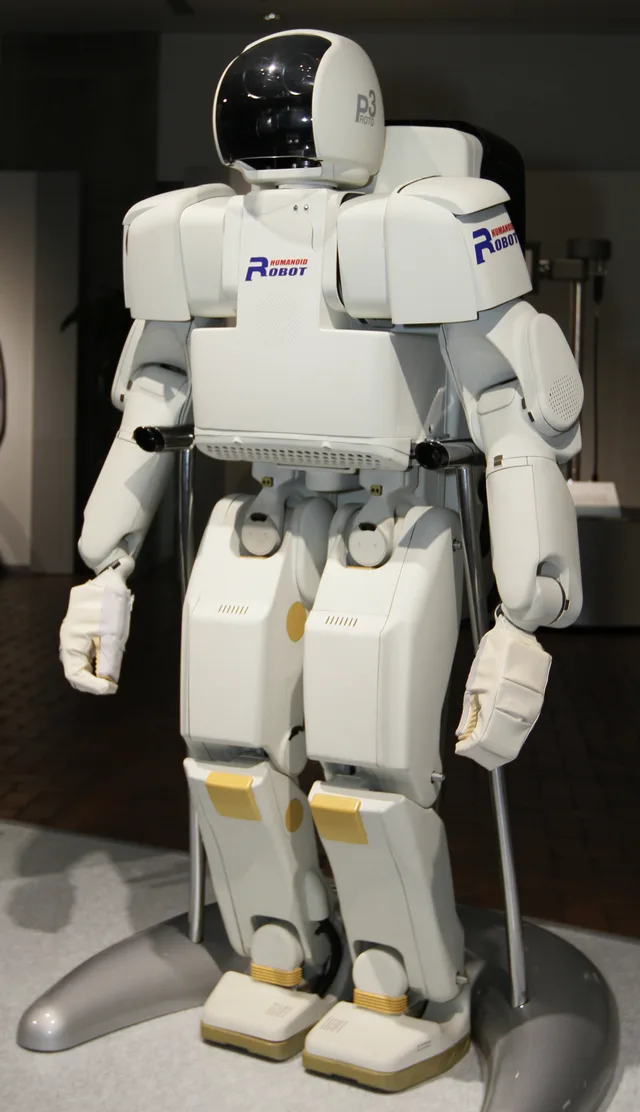
Honda P3 was unveiled in September 1997 as the first completely independent bipedal humanoid in Honda's P-series, preceding ASIMO. Compared with the larger P2, P3 used miniaturized components and a distributed control system to reduce size and weight while maintaining autonomous walking.
Listed price
See pricing details
Not commercially sold (prototype humanoid)
Release window
Sep 1, 1997
Current status
Discontinued
Honda
Last verified
May 25, 2026
Share this robot
Open a plain share composer on X or Bluesky for this robot profile.
Technical overview
A fast read on the mechanical profile, sensing package, and listed platform details for P3.
Height
160 cm
Weight
130 kg
Dimensions
160 cm H × 60 cm W × 55.5 cm D
Battery Life
25 min
Charging Time
Not disclosed
Max Speed
2 km/h
Payload
2 kg
Operational profile
Capabilities
4
Connectivity
0
Key capabilities
Explore further
Benchmark set
Shortcuts to the closest alternatives in the current ui44 set.
Research
ASIMO
Honda
See pricing details
Research
SURENA IV
University of Tehran (CAST)
See pricing details
Research
HOPEJr
Hugging Face LeRobot
$3,000
Research
TIAGo Pro
PAL Robotics
See pricing details
The P3 is a Research robot built by Honda. Honda P3 was unveiled in September 1997 as the first completely independent bipedal humanoid in Honda's P-series, preceding ASIMO. Compared with the larger P2, P3 used miniaturized components and a distributed control system to reduce size and weight while maintaining autonomous walking.
Not commercially sold (prototype humanoid) See all Honda robots on the Honda page.
Detailed specifications for the P3
Height
160cmThe listed height is 160cm. Height alone does not establish working reach or clearance under furniture; check the documented operating configuration and required space.
Weight
130kgThe listed weight is 130kg. Weight alone does not establish locomotion, stability or safety around people. Check handling requirements and the model’s documented operating limits.
Dimensions
160 cm H × 60 cm W × 55.5 cm DThe overall dimensions of 160 cm H × 60 cm W × 55.5 cm D are a recorded size entry. Check which axes and configuration it covers: a height-only entry does not establish width, depth or passage fit. Planning clearance also requires the operating envelope, turning space, attachments and documented margins.
Battery Life
25 minutesThis is the recorded runtime entry. Test conditions and independent verification are not established by this field. Confirm workload, operating mode and environmental conditions before comparing runtimes.
Maximum Speed
2 km/hThe recorded maximum-speed entry is 2 km/h. It does not establish sustained travel speed, terrain handling, or safe speed around people. Check the source's gait, operating mode, surface and load conditions before planning movement through a shared space.
Payload Capacity
2 kg/handThe recorded payload entry is 2 kg/hand. A load figure alone does not establish which objects the robot can grasp, lift or carry. Confirm whether the limit applies to one arm, two arms or a mounted load, and check reach, posture and motion conditions in model-specific documentation.
AI Platform
Honda distributed control systemRead this recorded AI entry alongside the model description and source notes for announcement or deployment context. A platform name alone does not establish implemented features, autonomy, or performance.
Sensor details are not specified in the available profile. This does not establish that sensors are absent.
Consult the linked profile sources for hardware configuration and tested behavior. A technology label alone does not verify an operating capability.
Explore sensor technologies: components glossary · full components directory
Research robots serve as platforms for advancing robotics science and engineering. They enable researchers to test theories about locomotion, manipulation, perception, and human-robot interaction in controlled and real-world environments.
The P3 record lists 4 capabilities. Keep any announcement or demonstration qualifiers attached to these entries; the count alone does not establish practical performance.
These are the capabilities listed in the profile. Hardware configuration and demonstrated performance should be checked against the linked sources.
Compatibility and ecosystem details are not specified in the available profile.
4
Capabilities
AI
Honda distributed control…
General context · confirm model-specific support
Bipedal walking involves moving on two legs while controlling balance. To evaluate a particular platform, check the demonstrated surface, gait, speed, turning and assistance conditions. Controller design and sensing must be documented separately. Historical milestones should remain tied to the named generation and source; a walking label does not identify a specific balance algorithm or prove useful task performance.
General context · confirm model-specific support
Independent operation needs a stated boundary: it may concern power, physical tethering, computation or human assistance. Establish which resources are onboard, which services remain external, and how long the demonstrated mode operates. A historical description of an untethered platform should not be expanded into a claim that every task runs without remote computing or supervision.
General context · confirm model-specific support
Carrying an object requires a defined load, grip or support, route and operating mode. Ask whether the demonstration includes lifting and placement or starts with an object already loaded. Check movement and payload limits for the actual configuration. The label does not establish bipedal locomotion, a particular gripper or automatic compensation for every changing load.
General context · confirm model-specific support
Cart-pushing results depend on the cart, load, wheels, floor, route and contact arrangement. Check starting, stopping, turning and release behaviour, including who positions the robot and cart. A demonstration should identify the model generation and assistance used. The label alone does not establish a walking-force strategy, safe operation on other surfaces or a historical first.
Research robots are acquired by universities, government labs, and corporate R&D departments. They serve as experimental platforms for developing new algorithms, testing locomotion strategies, and advancing the field of robotics. Some are also used for educational purposes.
Open-source software compatibility (ROS/ROS 2), sensor modularity, programmability, available SDK/API quality, community support, and published research papers using the platform are key factors. Documentation quality and the ability to modify both hardware and software are essential for research use.
Listed pricing
The P3 is listed as Discontinued. The discontinued label does not establish remaining stock, software support, or parts availability. Check Honda and any secondary markets or refurbished sellers for current terms.
Recorded features and considerations to assess
The battery-life entry is 25 minutes. Check the operating mode and source conditions against your intended session. This entry alone does not establish a charging schedule or a need for additional units.
At 130kg, the P3 is a substantial piece of equipment. Check documented floor-load limits, transport and handling requirements, and operating precautions. Weight alone does not establish stability, robustness or safety around people.
Not commercially sold (prototype humanoid)
Compatibility and ecosystem details are not specified in the profile for the P3. Confirm supported platforms, device-control functions, and deployment requirements in product documentation before relying on an integration.
The P3 is listed as Discontinued. The discontinued label does not establish remaining stock, software support, or parts availability. Check Honda and any secondary markets or refurbished sellers for current terms.
Note: This strengths and trade-offs assessment is based on the P3's documented specifications as tracked in the ui44 database. Real-world performance depends on deployment conditions, firmware maturity, and environmental factors. For the most current information, check the Honda manufacturer page or visit the official source. Use the comparison tool to evaluate these trade-offs against competing robots in the same category.
Understanding the engineering behind this category
Research robots serve a fundamentally different purpose than commercial or consumer models. They are platforms for discovery — enabling scientists and engineers to test theories, develop algorithms, and push the boundaries of what robots can do. The technology in research robots prioritizes openness, flexibility, and access to raw data over consumer-friendly packaging or commercial reliability. Understanding this distinction is important for anyone considering a research robot platform.
Research robots typically expose their navigation systems at a much lower level than commercial products. Researchers can access raw sensor data, modify SLAM algorithms, implement custom path planners, and test novel navigation approaches. ROS (Robot Operating System) and ROS 2 compatibility is standard, providing a common framework for sharing navigation modules across the research community. This openness enables rapid iteration — a researcher can swap between different SLAM implementations, test new obstacle avoidance strategies, or develop entirely novel navigation paradigms without being locked into a vendor's proprietary stack.
Research robots serve as physical testbeds for AI algorithms that may eventually appear in commercial products years later. Reinforcement learning, imitation learning, few-shot task learning, and human-robot interaction studies all require robot platforms that can execute AI-generated commands in the physical world. The gap between simulation (where training is cheap and fast) and reality (where physics is unforgiving) makes physical robot platforms essential for validating AI approaches. Research robots must support rapid deployment of new AI models without extensive integration work.
Research platforms prioritize sensor modularity and data access. Standard mounting interfaces allow researchers to attach custom sensors alongside built-in ones. Raw sensor data streams (not just processed results) are accessible for developing novel perception algorithms. Precise time-stamping and synchronization across sensor streams enable accurate multi-modal fusion research. Many research robots include more sensors than strictly necessary for any single application, providing researchers with rich datasets for developing and testing new algorithms.
Research robots balance operational runtime with practical lab use. Sessions of one to four hours are typical, with quick charging between experiments. Some research setups use tethered power for long-running experiments where battery limitations would interrupt data collection. Power monitoring and logging capabilities help researchers understand the energy costs of different behaviors and algorithms — important for developing efficient approaches that will eventually run on battery-constrained commercial systems.
Research environments present unique safety challenges because robots are constantly being programmed with untested behaviors. Hardware safety limits (joint speed caps, force limits, emergency stops) must be robust regardless of software commands. Safety-rated monitored stop and speed monitoring ensure the robot cannot exceed safe operating parameters even when running experimental code. Collaborative operation standards apply when researchers work alongside the robot during experiments. Many labs implement layered safety with physical barriers for high-speed testing and open-area operation restricted to validated, lower-risk behaviors.
Research robot platforms are becoming more accessible and capable. Cloud robotics enables remote experiment execution and shared datasets. Digital twins and high-fidelity simulators reduce the need for physical hardware time while improving sim-to-real transfer. Standardized benchmarks and open datasets enable fair comparison of results across labs. The democratization of robotics research — through lower-cost platforms, open-source software, and cloud infrastructure — is expanding who can contribute to advancing the field.
These are category-level technology examples; they do not establish the capabilities of the P3. For its recorded hardware details, see the sensor analysis and connectivity sections above. Check model-specific documentation from Honda for supported behavior, or use the components glossary to look up terminology.
How this robot compares in the research landscape
Not commercially sold (prototype humanoid)
The P3 is listed as Discontinued. The discontinued label does not establish remaining stock, software support, or parts availability. Check Honda and any secondary markets or refurbished sellers for current terms.
Side-by-side specs, capability overlap analysis, and key differentiators.
For the full picture of Honda's portfolio and market strategy, visit the Honda manufacturer page.
What the public profile tells you, and what still needs direct vendor confirmation
From a buying and rollout perspective, the P3 should be read as a research platform aimed at labs and development teams validating robotics workflows. ui44 currently tracks 4 capability signals and a last verification date of 2026-05-25. That mix gives buyers a useful first-pass picture, but it is still only the public layer of due diligence, especially when procurement, uptime, and support commitments are decided directly with Honda.
Commercial model
See pricing details
Not commercially sold (prototype humanoid)
Integration posture
Integration details thin
The page does not list any connectivity standards, so procurement teams should verify network requirements, remote management options, and how the robot fits into existing software or facility infrastructure.Recorded AI description: Honda distributed control system
Spec disclosure
6/7 core specs public
ui44 currently has 6 of 7 core physical and operating specs filled in for this model, leaving 1 gap that matter for deployment planning. Missing runtime, charge, speed, or payload details can materially change staffing and site-readiness assumptions.
The current profile is detailed enough to support early comparison work, shortlist creation, and cross-checking against other research robots. It is still worth validating the final deployment package, because integration services, support coverage, software entitlements, and site-preparation requirements often sit outside the raw hardware spec sheet.
If you want a faster apples-to-apples read, compare the P3 against nearby alternatives in ui44's compare view, then cross-check the underlying AI, sensor, and subsystem terms in the components glossary. For manufacturer-level context, the Honda profile helps anchor this robot inside the wider product lineup.
Practical guide from day one through years of ownership
Research robot setup combines hardware assembly with software environment configuration. Unpack and assemble the platform following the manufacturer's documentation. Install the development framework — typically ROS or ROS 2 — and verify sensor connectivity. Calibrate all sensors using the manufacturer's tools and procedures. Set up the simulation environment (Gazebo, Isaac Sim, or equivalent) alongside the physical platform for parallel development. Establish version control for your experiment code and configuration. Document the initial calibration values and system state as your baseline for future reference. Plan network and computing infrastructure to handle the data rates your sensors will generate.
Research robots need maintenance that preserves the precision required for valid experimental results. Regularly verify sensor calibration — drift in camera intrinsics or IMU biases can invalidate experiment data. Maintain clean workspace conditions to protect optical sensors. Document any hardware modifications or maintenance performed, as these can affect experimental reproducibility. Update software dependencies carefully, documenting versions used for each experiment. Joint and actuator wear in research robots that perform repetitive tasks should be monitored and factored into experimental design.
Research robot software updates require careful management to maintain experiment reproducibility. Document the exact software versions used for each experiment. Test updates in a separate environment before applying to your experiment platform. Contribute bug fixes and improvements back to the community when using open-source frameworks. Be aware that ROS and other framework updates may require code changes in your custom packages — budget time for integration testing after major framework updates.
Research robots often have longer productive lives than commercial products because they can be upgraded and repurposed. Extend your investment by maintaining clean mechanical and electrical systems, documenting all modifications for future lab members, and keeping spare parts for common wear items. When specific components become obsolete, community forums and lab networks can be valuable sources for replacements. Consider the platform's modularity when planning future research directions — a platform that can accept new sensors and actuators adapts to evolving research questions.
Find product and source links on the Honda page on ui44 or open Honda's official source. Use model-specific manufacturer documentation for setup, cleaning, and service instructions.
The P3 record brings together the listed specifications and attributed claims. Consult the model description and source notes to distinguish manufacturer announcements, reported information, and unknowns. A source link or review date does not establish independent testing or manufacturer confirmation of every claim. Record last checked: 2026-05-25. Official source: Honda official source. If you find outdated or incorrect information, please let us know — accuracy is our top priority.
See how the P3 stacks up — compare specs, browse the research category, or search the full database.