Hexagon Robotics

1 robot in the ui44 database

1 robots 1 available 1 category

About Hexagon Robotics

Hexagon Robotics is a robotics company headquartered in Unknown. The company currently has 1 robot tracked in the ui44 Home Robot Database, spanning the Humanoid category.

At a Glance

Robots Tracked

1 model

Category

Humanoid

Headquarters

Unknown

Available Now

1 robot

Key Capabilities

Manipulation Part inspection Reality capture Operator-assist tasks Material delivery Obstacle-aware navigation High-voltage battery assembly support Component manufacturing support Battery auto-swap

Browse all robotics companies on the manufacturers directory, or explore robots from Unknown.

All Hexagon Robotics Robots

Active
Humanoid
Hexagon Robotics

AEON

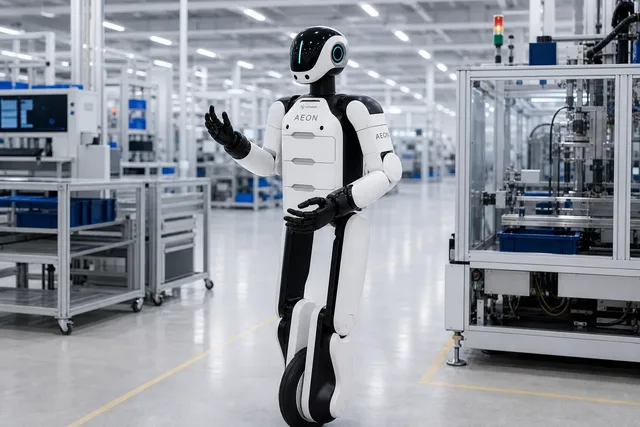
AEON is a wheeled industrial humanoid from Hexagon Robotics, introduced in June 2025 for manufacturing, inspection, reality-capture, and operator-support tasks.

Up to 4 hours per charge; auto-swap battery system for continuous work60 kg
Price TBA No public pricing announced; Hexagon pos… View

Hexagon Robotics Product Lineup

Hexagon Robotics offers 1 robot model across 1 category. Below is a breakdown of each product line, current availability, and key specifications.

Technology & Capabilities

Hexagon Robotics's robots combine a range of technologies and capabilities. Here is a consolidated look at the sensors, connectivity, AI platforms, and capabilities found across their product line.

Key Capabilities

  • Manipulation 1/1 (100%)
  • Part inspection 1/1 (100%)
  • Reality capture 1/1 (100%)
  • Operator-assist tasks 1/1 (100%)
  • Material delivery 1/1 (100%)
  • Obstacle-aware navigation 1/1 (100%)
  • High-voltage battery assembly support 1/1 (100%)
  • Component manufacturing support 1/1 (100%)
  • Battery auto-swap 1/1 (100%)

Sensor Technology

  • Multimodal sensor suite 1/1 (100%)
  • Precision measurement system 1/1 (100%)

Connectivity

  • Not publicly specified 1/1 (100%)

AI & Intelligence

AI-based motion control with multimodal sensor fusion, 3D spatial intelligence, and Hexagon mission control system

Pricing & Availability

1/1

Available now

Hexagon Robotics does not currently list public pricing for any of its model. This is common for enterprise-focused and research robotics companies that operate on custom quotes or contact-sales pricing.

Buying Guide: Is a Hexagon Robotics Robot Right for You?

Choosing the right robot depends on your use case, budget, and technical needs. Here's what to consider when evaluating Hexagon Robotics's product line.

Who Should Consider Hexagon Robotics Robots

Enterprise & Research Buyers

Hexagon Robotics serves enterprise and research customers. 1 of their models require contacting sales for pricing, indicating enterprise-tier products with custom deployment support.

Key Factors to Evaluate

Availability

1 of 1 models are currently available. Check individual robot pages for the latest status.

Category Fit

Make sure the robot's category matches your primary use case. Browse all categories.

Sensor Ecosystem

Review the technology section to understand what sensing and connectivity each model offers.

Price Transparency

0 of 1 models list public pricing. For unlisted models, request quotes early.

Compare Before You Buy

Evaluate Hexagon Robotics robots head-to-head or against competitors with our comparison tool.

Compare robots →

Hexagon Robotics Specifications Explained

Raw numbers only tell part of the story. Here is a plain-language explanation of what each specification means for the Hexagon Robotics robot — and what it means for you as a buyer or researcher.

AEON

Specifications Breakdown

Height

165 cm

At 165 cm, the AEON is roughly the height of an average adult human, which allows it to interact naturally with human-designed environments including countertops, doorways, and shelving at standard heights. This size is important for robots that need to work alongside people in factories, warehouses, or homes.

Weight

60 kg

Weighing 60 kg, the AEON is a substantial machine. This weight provides stability during physical tasks and manipulation but means it requires careful consideration for floor loading and may need dedicated charging infrastructure. Industrial-weight robots typically offer higher payload capacity and more robust construction.

Battery Life

Up to 4 hours per charge; auto-swap battery system for continuous work

The AEON offers Up to 4 hours per charge; auto-swap battery system for continuous work of battery life per charge. Battery life is one of the most critical real-world performance metrics for any mobile robot. It determines how much work the robot can accomplish in a single session before needing to recharge. For humanoid robots, this runtime should be evaluated against the size of the area you need covered and the intensity of the tasks involved. Robots with self-charging capability can partially compensate for shorter battery life by autonomously returning to their dock.

Charging Time

Not publicly specified (auto-swap battery system)

The AEON requires Not publicly specified (auto-swap battery system) to reach a full charge. Charging time directly impacts the robot's daily operating capacity — faster charging means less downtime and more productive hours. Combined with its battery life, the charge-to-runtime ratio reveals how much of each day the robot can actually spend working versus sitting on its dock.

Max Speed

2.4 m/s on Hexagon product page; BMW article says up to 2.5 m/s

The AEON can move at up to 2.4 m/s on Hexagon product page; BMW article says up to 2.5 m/s. Maximum speed affects how quickly the robot can traverse its operating area, respond to commands, and complete tasks. For humanoid robots, speed must be balanced against safety — faster robots need better obstacle detection and stopping capabilities to prevent collisions and ensure safe operation around people and pets.

AI Platform

AI-based motion control with multimodal sensor fusion, 3D spatial intelligence, and Hexagon mission control system

The AEON runs on AI-based motion control with multimodal sensor fusion, 3D spatial intelligence, and Hexagon mission control system for its artificial intelligence capabilities. The AI platform determines how intelligently the robot behaves — from basic reactive responses to sophisticated scene understanding, natural language processing, and adaptive learning. A more advanced AI platform generally means better obstacle avoidance, more natural interaction, and the ability to improve performance over time through software updates.

Payload: 15 kg short-term, 8 kg constant carry

Determines what tools and sensors the robot can carry

Sourced from official Hexagon Robotics docs · Full AEON specs →

Real-World Use Cases for Hexagon Robotics Robots

Understanding how a robot fits into your specific situation is more important than any single specification. Here are the real-world scenarios where Hexagon Robotics robots can make a meaningful impact.

Factory and Warehouse Automation

Industrial environments are seeing rapid robot adoption for tasks including picking, packing, inspection, and material transport.

  • Humanoid robots offer the advantage of working in spaces designed for humans without facility modification, while quadrupeds excel at inspection tasks in challenging terrain.
  • Key evaluation criteria include payload capacity, battery life for shift coverage, safety certifications for human-adjacent work, and integration with existing warehouse management systems.

Research and Education Platform

Academic and research teams need robot platforms that offer deep programmability, well-documented APIs, and active community support.

  • Research robots should provide access to raw sensor data, support standard robotics frameworks (ROS/ROS2), and offer simulation environments for algorithm development before deploying on hardware.
  • Consider the platform's track record in published research, available documentation, and whether the manufacturer provides academic pricing or grants.

Household Physical Tasks

Home assistant robots represent the next frontier in domestic automation — robots that can physically interact with your environment.

  • From fetching items to folding laundry, these robots need sophisticated manipulation, reliable navigation, and an understanding of household objects and layouts.
  • This category is still emerging, but early products demonstrate the potential for robots that handle physical chores beyond floor cleaning.

Not sure which type of robot fits your needs? Browse our categories guide or use the comparison tool to evaluate options side-by-side.

Hexagon Robotics in the Robotics Industry

Hexagon Robotics operates in the humanoid robotics segment.

Humanoid Market Landscape

Market Overview

The humanoid robot market is one of the fastest-growing segments in robotics, driven by advances in AI, computer vision, and actuator technology. Companies from Tesla to Boston Dynamics are racing to create bipedal robots that can work alongside humans in factories, warehouses, and eventually homes. The market is projected to grow significantly through the late 2020s as hardware costs decline and software capabilities improve.

Hexagon Robotics competes in this space with AEON.

Key Industry Trends

Integration of large language models (LLMs) for natural interaction and task understanding
Transition from research prototypes to commercial deployment in logistics and manufacturing
Decreasing costs through standardized actuator designs and mass production
Whole-body control systems enabling more fluid and natural movement
Teleoperation capabilities for remote task execution and training data collection

Common Use Cases for Humanoid Robots

Warehouse picking and logistics automation Manufacturing line assistance and quality inspection Elderly care and household assistance Hazardous environment operations Research and education platforms Retail and hospitality customer service

Buyer Considerations

Most humanoid robots are still in pre-commercial or limited-deployment stages
Enterprise buyers should evaluate total cost of ownership including integration and maintenance
Payload capacity and battery life are critical differentiators for industrial applications
Software ecosystem and SDK availability determine how customizable the robot is
Safety certifications (ISO 13482, CE marking) are essential for human-adjacent deployment

Future Outlook

The humanoid robotics industry is approaching an inflection point. As AI models become more capable at understanding physical tasks and costs continue to fall, expect to see humanoid robots move from controlled industrial settings into more varied commercial environments by 2027–2028. The key challenges remain battery technology, reliable manipulation, and building public trust.

Hexagon Robotics Robot Capabilities Explained

Understanding what a robot can actually do is more important than raw specifications. Here is a detailed look at the 9 capabilities found across Hexagon Robotics's robot.

Additional Capabilities

ManipulationPart inspectionReality captureOperator-assist tasksMaterial deliveryObstacle-aware navigationHigh-voltage battery assembly supportComponent manufacturing supportBattery auto-swap

Connectivity & Smart Home Integration

How a robot connects to your network and integrates with your existing smart home determines how useful it will be in practice. Hexagon Robotics's robot supports 1 connectivity technology.

Learn more about robot connectivity options in our connectivity components guide or browse the full components directory.

How Hexagon Robotics Compares in the Market

How Hexagon Robotics positions itself in the competitive landscape — beyond individual products.

Price positioning: Hexagon Robotics does not publicly disclose pricing, which is typical for enterprise-focused robotics companies that customize solutions for each deployment. Contact-sales pricing usually indicates a higher-touch customer relationship and tailored support.

Category focus: Hexagon Robotics is a specialist focused entirely on the humanoid category. Category specialists often develop deeper expertise and more refined products in their focus area compared to multi-category companies that spread their R&D across different robot types.

Technology breadth: Across its product line, Hexagon Robotics integrates 2 unique sensor types and 9 distinct capabilities. This technology stack determines the range of tasks and environments their robots can handle, and indicates the depth of the company's engineering investment.

Market maturity: All 1 of Hexagon Robotics's robot is commercially available, indicating a mature product portfolio focused on serving current customer needs.

Compare Side by Side

Use the comparison tool or browse the manufacturers directory.

Owning a Hexagon Robotics Robot: What to Expect

Purchasing a robot is the start of an ongoing relationship with technology that requires setup, maintenance, and periodic attention.

Setting Up Your Robot

First-time robot setup varies significantly by category and complexity. Consumer robots like vacuums and lawn mowers typically involve downloading a companion app, connecting to Wi-Fi, and running an initial mapping or boundary setup routine. More complex robots like humanoids or quadrupeds may require professional installation, calibration, and training. Allow extra time for the first session — the robot needs to learn your space, and you need to learn its controls. Most modern robots improve their performance over the first few uses as their maps and AI models refine based on your specific environment.

Ongoing Maintenance Requirements

Every robot requires some level of maintenance to operate at peak performance. For cleaning robots, this includes emptying dustbins, washing filters, replacing brush rolls, and cleaning sensors — typically a few minutes per week. Lawn mowing robots need periodic blade replacements and seasonal cleaning. Legged robots may require joint lubrication and firmware updates. Check the manufacturer's recommended maintenance schedule and factor replacement part costs into your total cost of ownership. Establishing a regular maintenance routine significantly extends the robot's useful life and maintains cleaning or task performance over time.

Software Updates and Long-Term Support

Modern robots receive regular software updates that can add features, improve navigation, fix bugs, and enhance security. When evaluating any robot, consider the manufacturer's track record for software support — how frequently do they release updates, and for how long do they support older models? Some companies provide updates for years after purchase, while others may discontinue support sooner. Cloud-dependent features are particularly important to evaluate: if the manufacturer shuts down cloud services, will your robot still function? Prefer robots with strong local processing capability for long-term reliability.

Safety Considerations

Robot safety encompasses both physical safety (preventing collisions, falls, and injuries) and digital safety (data privacy, network security, camera access). Physically, look for robots with emergency stop mechanisms, collision detection, cliff sensors, and speed-limiting features when operating near people or pets. Digitally, understand what data the robot collects, where it is stored, who can access it, and whether the manufacturer has a clear privacy policy. For robots with cameras and microphones, hardware privacy indicators (LED lights when recording) and physical mute switches provide important transparency and control.

Warranty and After-Sales Support

Robotics purchases represent significant investments, making warranty terms and after-sales support critical evaluation criteria. Standard warranties in the industry range from one to three years, with some manufacturers offering extended warranty options. Beyond warranty length, consider what the warranty covers — some exclude consumable parts like brushes and filters. Also evaluate the manufacturer's service infrastructure: do they have authorized repair centers in your region? Is support available by phone, email, or chat? Response times and repair turnaround times can vary significantly between companies. User community forums and third-party repair guides can supplement official support.

Total Cost of Ownership

The sticker price of a robot is just the beginning. Total cost of ownership includes the initial purchase price, replacement parts and consumables, electricity for charging, any subscription fees for cloud or premium features, and potential repair costs. For commercial robots, add integration, training, and downtime costs. For consumer robots, factor in accessories like extra mop pads, replacement brushes, or boundary accessories. A thorough TCO analysis over the expected product lifetime — typically three to five years for consumer robots and longer for commercial platforms — provides a much more accurate picture of value than purchase price alone.

For model-specific ownership details, visit individual robot pages or contact Hexagon Robotics directly.

Deployment Planning for Hexagon Robotics Robots

Successful robot deployment depends on preparation that goes well beyond selecting the right model.

Readiness Assessment

At least one Hexagon Robotics model carries an available or active status, indicating that procurement conversations can proceed with current product specifications rather than pre-release estimates.
No public pricing is currently listed for Hexagon Robotics products in this database. Contact the manufacturer directly to request quotes, and ask for itemized pricing that separates hardware, software licensing, support, and integration costs.
With 9 distinct capabilities documented across the product line, Hexagon Robotics robots offer a broad feature surface. Prioritize capabilities that directly map to your operational requirements and treat additional features as secondary evaluation criteria.
1
Laboratory and research environment preparation

Research deployments require controlled conditions that differ from commercial settings. Verify that the lab space meets the robot's power requirements, including dedicated circuits for charging stations and any auxiliary computing hardware. Plan for motion capture or external sensor arrays if your research protocol requires ground-truth positioning data. Establish clear demarcation between the robot's active workspace and personnel areas, especially for platforms with manipulator arms or high-speed locomotion capabilities. Document the software development environment requirements, including supported operating systems, SDK dependencies, and network configurations needed for remote operation and data collection.

2
Network infrastructure and cybersecurity planning

Modern robots are networked devices that require thoughtful integration with existing IT infrastructure. Plan a dedicated network segment or VLAN for robot operations to isolate robot traffic from critical business systems. Implement certificate-based authentication where supported, and verify that firmware update mechanisms use signed packages. Establish a security review cadence for robot software components, especially for robots that process camera feeds, microphone input, or personal data. Create an incident response plan specific to robot compromise scenarios — what happens if a robot's navigation system is tampered with, or if sensor data is intercepted? These questions are easier to answer before deployment than during an active incident.

3
Operator training and workflow integration

Even highly autonomous robots require human operators who understand normal behavior, can recognize anomalies, and know when and how to intervene. Develop a training program that covers daily operations (startup, shutdown, charging), routine maintenance (cleaning sensors, checking mechanical wear), and emergency procedures (manual override, safe power-down, physical recovery from stuck positions). Integrate robot operations into existing workflow documentation so that robot tasks and human tasks have clear handoff points. Track operator confidence levels over time and provide refresher training when procedures change or new capabilities are deployed through software updates.

4
Performance benchmarking and acceptance criteria

Define measurable success criteria before the robot arrives. For cleaning robots, this might be coverage percentage and cleaning quality scores. For commercial service robots, track task completion rates, customer interaction quality, and mean time between interventions. For research platforms, establish reproducibility metrics and data quality thresholds. Having objective benchmarks prevents the common failure mode where a robot is judged impressive in demos but disappointing in sustained operation. Create a 30-60-90 day evaluation framework with specific milestones at each stage, and define clear decision points for scaling up, adjusting configuration, or discontinuing the deployment.

5
Regulatory compliance and liability assessment

Deploying a robot in a commercial or public-facing setting triggers regulatory considerations that vary by jurisdiction. Verify compliance with local safety standards for autonomous machines, including emergency stop accessibility, speed limitations in human-occupied spaces, and noise level restrictions. Assess liability coverage — does your existing insurance policy cover robot-caused property damage or personal injury, or do you need a specific rider? For healthcare or eldercare companion deployments, review data privacy regulations that govern the collection and storage of health-related observations. Document your compliance posture before deployment so that auditors and regulators see proactive governance rather than reactive scrambling.

6
Long-term maintenance and total cost modeling

The purchase price of a robot is typically a fraction of the total cost of ownership over its operational lifetime. Model the full cost picture including consumables (filters, brushes, wheels, batteries), scheduled maintenance (sensor calibration, actuator inspection, firmware updates), unscheduled repairs (motor replacement, sensor failure, structural damage), and operational costs (electricity, network bandwidth, operator time). Request maintenance schedules and spare-part pricing from the manufacturer before purchase. For commercial deployments, calculate the break-even point against the labor or service cost the robot replaces, factoring in realistic uptime assumptions rather than manufacturer-stated maximums. Revisit the cost model quarterly as real operating data replaces initial estimates.

Deployment planning is iterative — capture lessons learned and refine your approach as you progress with Hexagon Robotics products.

Hexagon Robotics: Summary and Key Takeaways

Hexagon Robotics is a Unknown-based robotics company with 1 robot tracked on ui44, focused on humanoid robotics
Their robots integrate 2 sensor types, 9 capabilities, and 1 connectivity option across the product line
All 1 model is currently available for purchase or deployment, with pricing available on request
Notable capabilities span manipulation, part inspection, reality capture, operator-assist tasks, and 5 additional features

Next Steps

Frequently Asked Questions

What robots does Hexagon Robotics make?
Hexagon Robotics has 1 robot in the ui44 database: AEON. These span the Humanoid category.
Where is Hexagon Robotics headquartered?
Hexagon Robotics is headquartered in Unknown. Browse all manufacturers from Unknown or explore the complete manufacturers directory.
How much do Hexagon Robotics robots cost?
Hexagon Robotics does not publicly list pricing for its robot. This is typical for enterprise and research-focused robotics companies. Contact Hexagon Robotics directly for quotes and availability.
Can I buy a Hexagon Robotics robot today?
Yes — 1 Hexagon Robotics model is currently available or actively deployed: AEON (Active). Check each robot's page for the latest purchasing details.
What can Hexagon Robotics robots do?
Across their product line, Hexagon Robotics robots offer 9 distinct capabilities including: Manipulation, Part inspection, Reality capture, Operator-assist tasks, Material delivery, Obstacle-aware navigation, High-voltage battery assembly support, Component manufacturing support, and 1 more. See each robot's detail page for the full capability breakdown.
What sensors do Hexagon Robotics robots use?
Hexagon Robotics robots use 2 types of sensors including Multimodal sensor suite, Precision measurement system. Visit the components directory to see how these compare across the industry.
How current is the Hexagon Robotics data on ui44?
All robot data on ui44 is periodically verified against manufacturer sources. The most recent verification for a Hexagon Robotics robot was on 2026-04-05. Each robot page includes a "last verified" date so you can gauge data freshness.

Data Integrity

All Hexagon Robotics robot data on ui44 is verified against official manufacturer sources, spec sheets, and press releases. Most recent verification: 2026-04-05. If you notice outdated or incorrect data, please let us know — accuracy is our top priority.

Explore the database

Go beyond the spec sheet

Full specifications, side-by-side comparisons, and buyer guides for every robot.