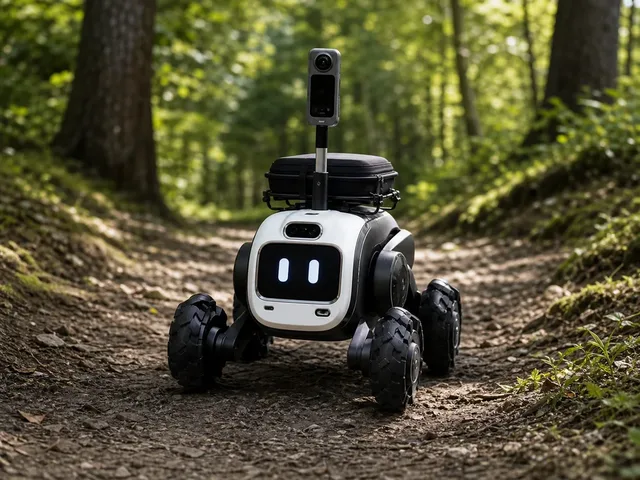

- Price N/A
- Weight Not officially disclosed
- Battery Life 6 hours (reported by The Verge from CES 2026)
- Max Speed Not officially disclosed
- Status Prototype
- Category Companions
Capabilities
Select 2–4 robots to compare specs, capabilities, and pricing side by side.
Selected robots
Tip: Use "Show differences only" to focus on what matters.
Share this comparison →Swipe horizontally to compare robot cards. Green highlights indicate best-in-class numeric values.
Capabilities
Capabilities
| Spec | ||
|---|---|---|
| Price | N/A | $2,899 USD |
| Height | 45.7cm (1.5 ft) | 494mm (19.45 in) |
| Weight | Not officially disclosed | Robot body 2.8kg (6.17 lbs) + mobility base 1.4kg (3.08 lbs) |
| Battery Life | 6 hours (reported by The Verge from CES 2026) | ~2 hours |
| Charging Time | Not officially disclosed | 80% in 1 hour |
| Max Speed | Not officially disclosed | 0.05m/s (bipedal); 0.6m/s (wheeled) |
| AI | Official product page describes multimodal adaptive following plus multimodal fusion of visual, gaze, and gesture inputs for attention and emotion understanding. | Embodied-intelligence platform with whole-home mapping, visual recognition and obstacle avoidance, posture/motion tracking, multilingual conversational interaction, and support for open programming, VR integration, and reinforcement-learning tools |
| Sensors | Visual perception system, Face ID tracking, ReID tracking, Gait recognition, Gaze and gesture input sensing | LDS LiDAR, iTOF depth sensor, Vision camera, IMU, 3-microphone circular array |
| Connectivity | ||
| Voice Assistants | None | None |
| Status | Prototype | Pre-order |
| Category | Companions | Companions |
| Manufacturer | Sentigent Technology | Zeroth Robotics |
| Capability | ROVAR X3 | M1 |
|---|---|---|
| Accessory interface for outdoor scenarios | ✓ | — |
| Active perception and interaction | ✓ | — |
| Adaptive motion control | ✓ | — |
| Autonomous following | — | ✓ |
| Bipedal and wheeled mobility | — | ✓ |
| Daily reminders and assistance | — | ✓ |
| Developer programming and VR experimentation | — | ✓ |
| Gentle fall detection | — | ✓ |
| Home companionship | — | ✓ |
| Interactive learning for kids | — | ✓ |
| Mobile safety checks | — | ✓ |
| Outdoor human-following | ✓ | — |
| Pet behavior monitoring | — | ✓ |
| Remote family interaction | — | ✓ |
| Social navigation | ✓ | — |
| Terrain handling for steps, gravel paths, lawns, and shallow streams | ✓ | — |
A step-by-step guide to getting the most from side-by-side robot comparisons.
128
Robots in database
47
With listed prices
383
Sensor types tracked
954
Capability types
Compare robots that serve the same purpose. A $300 vacuum vs. a $100k humanoid won't yield useful insights — they solve different problems.
Start by selecting robots from the same category or price range:
Focus on these comparison areas:
Toggle "Show differences only" to filter the table down to specs where robots actually diverge.
This is especially useful when comparing robots from the same manufacturer, where 80% of specs may be identical.
Gold standard for distance measurement and mapping. LiDAR-equipped robots navigate more efficiently.
RGB cameras enable object identification. Depth cameras provide 3D spatial awareness.
Essential for balance and orientation. Critical in bipedal and quadruped robots.
Close-range obstacle detection. Catches transparent surfaces that LiDAR can miss.
Compare a specialized cleaning robot against a home assistant with cleaning capabilities to decide whether a specialist or generalist approach is better for your home.
If your home runs on Alexa, Google Home, or HomeKit, verify compatibility in the comparison table. Check Wi-Fi standard support and whether integration is basic (on/off) or full routine support.
Every comparison generates a unique shareable URL. Bookmark it, share with family, or post in forums for feedback. The URL preserves your robot selections and toggle state.
Compare sub-$500 against $1,000+ models to see what the premium buys in navigation, suction, and smart features.
See how robots balance vacuum and mop performance — some excel at one, sacrificing the other.
Compare major humanoids on locomotion, AI, intended use cases, and pricing.
Compare speed, battery life, payload, sensor suites, and SDK availability.
When a brand offers basic/pro/max tiers, compare to find the best-value tier.
Should you get a dedicated cleaner or a multi-purpose robot that also cleans?
Translate comparison data into a confident purchase decision with this framework.
Not all spec differences matter equally. A $200 price gap might be decisive for one buyer and irrelevant for another. Here's how to rank what matters:
A robot that's marginally better on many unimportant specs but worse on the one thing that matters most isn't actually the best choice. Focus on YOUR priorities.
Cloud AI features, remote monitoring, premium app tiers — a cheaper upfront robot may cost more over 3 years.
Brushes, filters, mop pads, dust bags, blades — some budget robots have pricier replacements.
Battery size and charging frequency affect electricity costs for daily-use robots.
Local service availability and parts pricing significantly affect long-term maintenance cost.
Specs describe ideal conditions — your home determines real-world performance. Evaluate each finalist against these factors:
Return policy
Risk-free trials let you test both
User community
Active forums provide ongoing value
Ecosystem
Complementary products from the same brand
Aesthetics
Products you like using get used more
Common questions about comparing robots on ui44.