CES 2026 changed the conversation. Two products attacked the stairs problem from opposite directions: the Roborock Saros Rover, a robot vacuum with two wheel-legs that climbs stairs itself, and the Dreame Cyber X, a bionic quad-track module that ferries a compatible vacuum between floors and cleans the steps on the way down. This post separates what's shipping from what's stagecraft, and tells multi-story owners what to actually buy today.
Why could no robot vacuum climb stairs until now?
Robot vacuums conquered every other terrain problem: LiDAR maps multi-floor layouts, auto-empty docks handle dust for two months, and mop-washing bases removed the daily mop chore. But stairs combine three hard problems at once — vertical locomotion, balance under a shifting water/dust payload, and fall safety on open risers. A fall down a staircase destroys a $1,000+ machine and risks injuring whoever is below.
The industry's workaround was software: save up to 4 floor maps, and the user carries the bot. That works, but it means a "whole-home clean" still needs you home. For elderly owners and anyone with mobility issues, carrying a 4–5 kg robot plus water up stairs defeats the purpose.
Can robot vacuums really climb stairs yet?
Roborock Saros Rover: legs on a vacuum
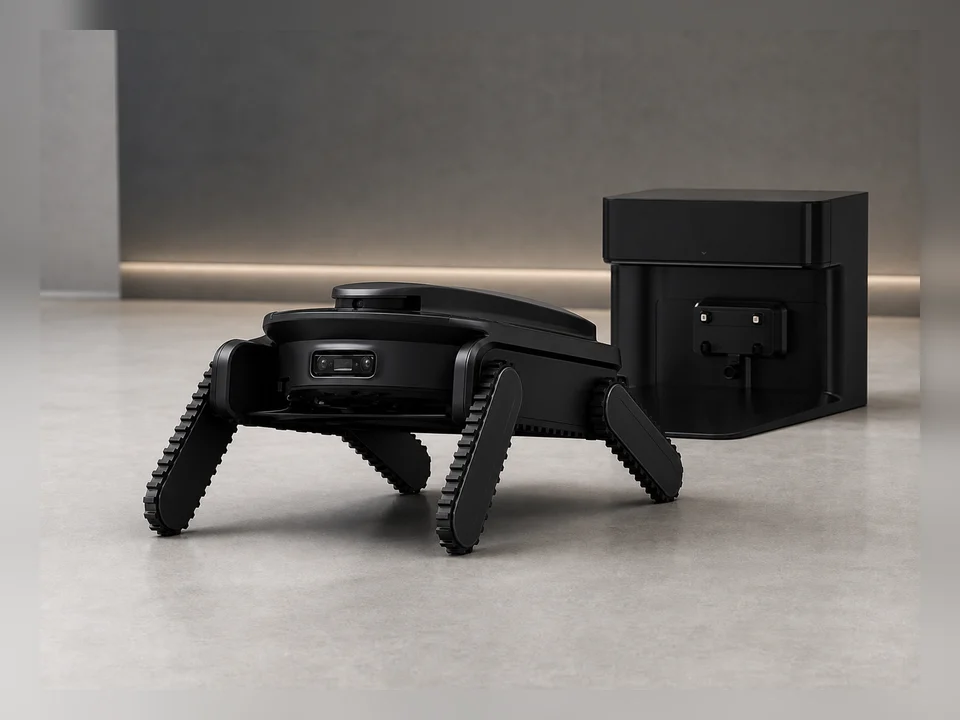
The Saros Rover is a development-stage robot unveiled at CES 2026 with a two-wheel-leg architecture. Independently controlled wheel-legs raise and lower to keep the body level on changing terrain, handle slopes and complex thresholds, and — in Roborock's demo — climb and clean stairs instead of stopping at them. Roborock even showed small jumps and agile direction changes.
Be honest about the status: Roborock says it is a real product in development with an unconfirmed launch date. No final retail specifications, no pricing, no ship date. Treat it as a direction signal, not a buyable product. What matters is that the company behind the best-selling premium robot vacuums is investing in legged locomotion — the same bet that produced the Saros Z70's OmniGrip arm, the first mainstream vacuum arm that picks up socks and cables before cleaning.
Dreame Cyber X: the stair elevator that cleans
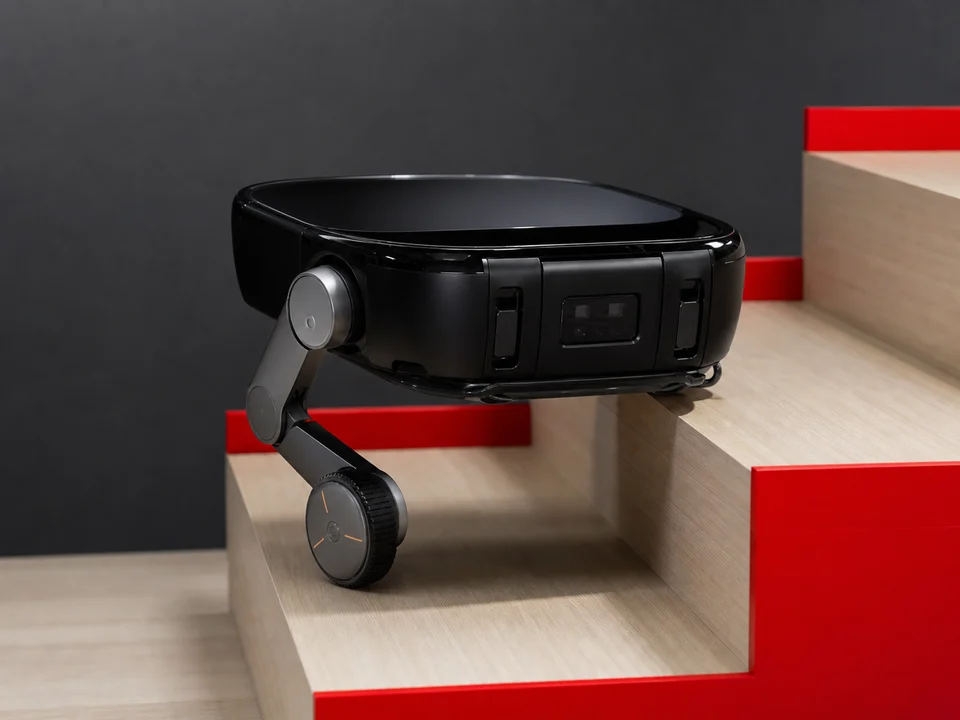
Dreame took the modular route. The Cyber X is a bionic quad-track stair-climbing module for compatible X60 Pro Series vacuums. It carries the vacuum between floors, handles straight, L-shaped, spiral, open-riser, and carpeted stairs, and cleans stair steps while descending with its own rear dual-brush cleaning module and 6,000 Pa suction. It has its own 3D ToF vision, independent computing, a 6,400 mAh battery, rubber tracks, and a triple brake system — the brakes matter more than the suction when you're on a staircase.
Independent coverage after Dreame's France launch reported a European price of EUR 1,199 with a September 2026 launch window, though Dreame's UK press materials say availability details will be announced later. So: priced like a second robot vacuum, launching imminently in at least one region, but confirm your region before planning around it.
Legs vs. elevator: which stair-climbing approach wins?
Approach
- Roborock Saros Rover
- Integrated wheel-legs on the vacuum
- Dreame Cyber X
- Separate quad-track carrier module
Stair types
- Roborock Saros Rover
- Stairs, slopes, thresholds (demo)
- Dreame Cyber X
- Straight, L, spiral, open-riser, carpeted
Cleans stairs themselves?
- Roborock Saros Rover
- Climbs and cleans (claimed)
- Dreame Cyber X
- Yes — cleans while descending
Price
- Roborock Saros Rover
- Unannounced
- Dreame Cyber X
- ~EUR 1,199 reported (EU)
Availability
- Roborock Saros Rover
- Development stage, no date
- Dreame Cyber X
- Sept 2026 window (France/regional)
Risk
- Roborock Saros Rover
- May never ship in this form
- Dreame Cyber X
- Accessory lock-in to X60 Pro Series
| Roborock Saros Rover | Dreame Cyber X | |
|---|---|---|
| Approach | Integrated wheel-legs on the vacuum | Separate quad-track carrier module |
| Stair types | Stairs, slopes, thresholds (demo) | Straight, L, spiral, open-riser, carpeted |
| Cleans stairs themselves? | Climbs and cleans (claimed) | Yes — cleans while descending |
| Price | Unannounced | ~EUR 1,199 reported (EU) |
| Availability | Development stage, no date | Sept 2026 window (France/regional) |
| Risk | May never ship in this form | Accessory lock-in to X60 Pro Series |
The tradeoff is classic: Roborock's integrated design, if it ships, does the whole job in one machine — but integrated stair-climbers carry their climbing hardware on every flat-floor meter, paying weight and battery costs everywhere. Dreame's module only climbs when needed, but you buy, store, and maintain two machines, and you're locked into the X60 Pro Series.
Safety is the unanswered question for both. Tracks with triple brakes (Dreame) are a more conservative answer than wheel-legs doing jumps (Roborock's demo). Watch for third-party safety testing — UL or TÜV stair-fall test results — before trusting either on open-riser stairs above a living room.
What safety testing should you demand before buying?
No stair-climbing robot vacuum should operate above a living space without documented fall protection. Ask vendors for three things: (1) a stair-edge false-negative rate measured over hundreds of trials on open risers, carpeted nosings, and low light; (2) a brake-hold test showing the unit stays put on a mid-stair power cut; and (3) a drop-test report for the worst-case single-step tumble. Dreame's triple brake system is the right kind of answer — mechanical redundancy rather than software promises — but until independent labs publish pass/fail results, treat every demo video as marketing. Homes with children or pets on the stairs below should wait for that paperwork.
What should multi-story homes buy right now?
Neither stair-climber is a safe purchase today in most regions. The good news: the 2026 flagships already solve 80% of the multi-story pain without climbing:
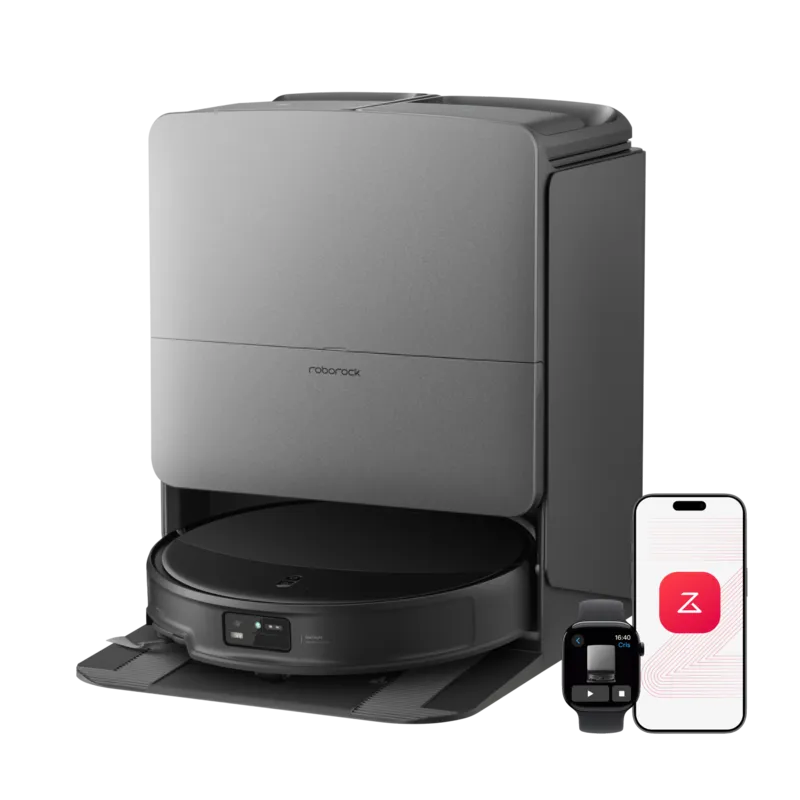
Roborock Saros 20 — the shipping flagship with the AI architecture from the Rover program. 36,000 Pa suction, AdaptiLift Chassis 3.0 that crosses double-layer thresholds up to ~3.46 inches, StarSight 2.0 navigation recognizing 300+ object types, and a RockDock that auto-empties, hot-water mop-washes, and supports refill/drainage plumbing. Multi-floor mapping is mature. You still carry it between floors, but each floor is genuinely autonomous, and the threshold climbing means fewer stuck-on-transition calls. Available in the US since March 2026.
Practical multi-story setup today:
- One robot, multiple maps. Save a map per floor; carry the bot (4–5 kg) and let it run. Total human effort: ~30 seconds per floor change.
- One robot per floor. The math works when mid-range models drop under $400 on sale — two $400 bots beat one $1,200 flagship for a two-story home, with zero carrying.
- Wait for Cyber X if you're already on Dreame's X60 platform. At ~EUR 1,199 it's priced against the two-bot solution, so only buy if stair-step cleaning itself (not just transport) matters to you — that's its unique feature.
Skip the Rover wait unless you're an enthusiast. Development-stage robots with no price or date have a long history of becoming different, later, pricier products.
Where will stair climbers launch first — and will your region get one?
Expect a Europe-first rollout pattern: Dreame's France launch with a September 2026 window fits the pattern of EU-first vacuum accessory launches, where premium adoption and compact multi-story housing make early demand strongest. US launches typically lag by one to two quarters pending certification and dock voltage variants, while UK availability often tracks EU timing with separate pricing. Before planning a purchase, confirm three region-specific facts: local dock voltage and plug, local warranty coverage for a stair-fall failure, and whether the vendor's app supports your region's firmware channel. A stair climber without local service is a $1,000+ risk you carry up the stairs yourself.
When will stair climbing actually work reliably?
Short answer: the transport problem looks solvable in 2026–2027 via modules like the Cyber X, while fully autonomous integrated climbers remain a 2027+ bet. Buy for today's multi-floor competence; treat stair climbing as a bonus, not the buying reason.
- Now: Multi-floor mapping + one-bot-per-floor is the rational answer.
- Late 2026: Dreame Cyber X regional launches will show whether stair modules survive contact with real carpeted spiral stairs. Watch return rates, not launch videos.
- 2027+: Integrated climbers like the Rover either ship as flagships or get absorbed as threshold-crossing tech (which is already in the Saros 20's chassis).
The stairs problem is finally a product roadmap instead of a physics joke. But until a climber has a price, a ship date, and a third-party safety test, carry the bot — and spend the savings on the flagship dock that plumbs into your water supply so you at least never carry mop water.
_Browse stair-relevant flagships: Roborock Saros Rover · Dreame Cyber X · Roborock Saros 20 — or compare all models on ui44 compare._
Related in the database
Use this article as a warranty and coverage workflow
Turn the article into a warranty and coverage pass grounded in the robots and manufacturers it actually references.
Rover vs Cyber X: Stair-Climbing Robot Vacuums Tested already points you toward 4 linked robots, 2 manufacturers, and 1 country inside the ui44 database. That matters because strong buyer guidance is easier to apply when you can move immediately from a claim or warning into concrete product pages, manufacturer directories, component explainers, and country-level context instead of treating the article as an isolated opinion piece. The fastest next step is to turn the article into a shortlist workflow: open the linked robot pages, verify which specs are actually published for those models, then compare the surrounding manufacturer and component context before you decide whether the underlying claim changes your buying plan.
For this topic, the useful discipline is to separate the editorial lesson from the catalog evidence. The article gives you the framing, but the robot pages tell you what each product actually ships with today: sensor stack, connectivity methods, listed price, release timing, category, and support-relevant compatibility notes. The manufacturer pages then show whether you are looking at a one-off launch, a broader lineup pattern, or a company that spans multiple categories. That layered workflow reduces the risk of buying on a single marketing phrase or a single support FAQ.
The most practical move is to keep warranty language and product context together. Compare the linked robots first, then check whether the manufacturer pages suggest a mature service lane or a more limited lineup. On this article, Saros Rover, Cyber X, and Saros 20 are the right place to start. If you want a quick working shortlist, open Compare Saros Rover, Cyber X, and Saros 20 next, then keep this article open as the reasoning layer while you compare structured data side by side.
Practical Takeaway
Every robot, manufacturer, category, component, and country reference below resolves to a real ui44 page, keeping the follow-up path grounded in database records rather than generic advice.
Suggested next steps in ui44
- Compare the listed price, release timing, and category fit of the linked robots before you treat warranty length as a direct value proxy.
- Open Roborock to see whether the brand has several relevant models in the same lane or whether the article is centered on one flagship product.
- Record what the article proves, what still depends on seller or region rules, and which consumables or battery-related details you still need to verify externally.
- Use Compare Saros Rover, Cyber X, and Saros 20 before checkout so the warranty conversation stays anchored to a real shortlist.
- Do not treat the article as the final source of truth on coverage terms. Treat it as the framing layer that tells you which documentation you still need to inspect before purchase.
Robot profiles worth opening next
Use the linked product pages as the evidence layer
The linked robot pages are where this article becomes operational. Instead of asking whether the headline is interesting, use the robot entries to inspect the actual mix of sensors, connectivity options, batteries, pricing, release timing, and stated capabilities attached to the products mentioned in the article. That is the easiest way to see whether the warning or opportunity described here affects one product family, a specific design pattern, or an entire buying lane.
Saros Rover
Roborock · Cleaning · Development
Saros Rover is tracked on ui44 as a development cleaning robot from Roborock. The database currently records a listed price of Price TBA, a release date of TBD, Not officially disclosed battery life, Not officially disclosed charging time, and a published stack that includes Motion Sensors and 3D Spatial Sensing plus its listed connectivity stack.
For warranty and coverage questions, the robot page gives you the operating context that fine print often leaves out. Review the published capability mix, including Stair Climbing, Stair Cleaning, and Wheel-Leg Architecture, and the listed battery and charging profile before deciding whether a coverage term meaningfully reduces your ownership risk or merely sounds reassuring in isolation.
Cyber X is tracked on ui44 as a development cleaning robot from Dreame. The database currently records a listed price of €1,199, a release date of 2026-09, 6,400 mAh battery; number of staircases per charge not officially disclosed battery life, Not officially disclosed charging time, and a published stack that includes Independent 3D ToF vision, Step-edge recognition, and Slope-change detection plus Mobile app control.
For warranty and coverage questions, the robot page gives you the operating context that fine print often leaves out. Review the published capability mix, including Carries compatible X60 Pro Series robot vacuums between floors, Bionic quad-track stair climbing, and Straight, L-shaped, spiral, open-riser, and carpeted stair support, and the listed battery and charging profile before deciding whether a coverage term meaningfully reduces your ownership risk or merely sounds reassuring in isolation.
Saros 20 is tracked on ui44 as a available cleaning robot from Roborock. The database currently records a listed price of $1,600, a release date of 2026-03, Up to 190 minutes battery life, Not officially disclosed charging time, and a published stack that includes Embedded 3D ToF LiDAR (StarSight 2.0), VertiBeam Lateral Obstacle Avoidance, and RGB Camera plus Wi-Fi and Bluetooth.
For warranty and coverage questions, the robot page gives you the operating context that fine print often leaves out. Review the published capability mix, including 36,000 Pa HyperForce Suction, AdaptiLift Chassis 3.0 (wheel lifting + climbing arm), and Double-Layer Threshold Crossing (up to ~3.46 in / 8.8 cm), and the listed battery and charging profile before deciding whether a coverage term meaningfully reduces your ownership risk or merely sounds reassuring in isolation.
Saros Z70 is tracked on ui44 as a available cleaning robot from Roborock. The database currently records a listed price of $1,000, a release date of 2025-05, 6,400 mAh Li-ion; official FAQ says about 2h15+ vacuuming/mopping with the arm disabled, or about 2h10+ with the arm enabled while tidying 10 items (Mop Wash Frequency set to 15 minutes). battery life, 2.5-hour fast charging charging time, and a published stack that includes LiDAR (StarSight 2.0), 3D Structured Light, and RGB Camera plus Wi-Fi and Bluetooth.
For warranty and coverage questions, the robot page gives you the operating context that fine print often leaves out. Review the published capability mix, including OmniGrip 5-Axis Mechanical Arm, Object Pickup up to 300 g (socks, sandals, crumpled tissues, towels; more items planned via OTA), and Obstacle Relocation, and the listed battery and charging profile before deciding whether a coverage term meaningfully reduces your ownership risk or merely sounds reassuring in isolation.
Manufacturer context behind the article
Check whether this is one product story or a broader company pattern
Manufacturer pages add the support context that individual product pages cannot show on their own. They help you check whether the article is pointing at one coverage promise or at a company with a broader service footprint and multiple products to maintain.
Roborock
ui44 currently tracks 6 robots from Roborock across 2 categorys. The company is grouped under China, and the current catalog footprint on ui44 includes Saros Z70, Saros Rover, Saros 20.
That wider brand context matters because support confidence is easier to judge when you can see the company’s overall footprint, not just one warranty phrase attached to one product. A broader tracked lineup can change how you interpret the article’s coverage discussion. The category mix here currently points toward Cleaning, Lawn & Garden as the most useful next route if you want to see whether this article reflects a wider pattern inside the brand.
Dreame
ui44 currently tracks 10 robots from Dreame across 2 categorys. The company is grouped under China, and the current catalog footprint on ui44 includes X50 Ultra, A3 AWD Pro, X60 Max Ultra Complete.
That wider brand context matters because support confidence is easier to judge when you can see the company’s overall footprint, not just one warranty phrase attached to one product. A broader tracked lineup can change how you interpret the article’s coverage discussion. The category mix here currently points toward Cleaning, Lawn & Garden as the most useful next route if you want to see whether this article reflects a wider pattern inside the brand.
Broaden the scan without leaving the database
Categories, components, and countries add the wider context
Category framing
Category pages are useful when the article touches a buying pattern that shows up across brands. A category route helps you confirm whether the linked products sit in a narrow niche or whether the same question should be tested across a larger field of alternatives.
Cleaning
The Cleaning category page currently groups 62 tracked robots from 27 manufacturers. ui44 describes this lane as: Robot vacuums, mops, pool cleaners, and window cleaners — the workhorses of home automation that keep every surface spotless.
That makes the category route a practical follow-up when you want to check whether the products linked in this article are typical for the lane or whether they sit at one edge of the market. Useful starting examples currently include Scuba V3, EcoSurfer S2, Scuba V3 Ultra.
Country and ecosystem context
Country pages give extra context when support practices, launch sequencing, regulatory posture, or manufacturer mix matter. They are not a substitute for model-level verification, but they do help you see which ecosystems cluster together and which manufacturers sit in the same regional field when you broaden the search beyond the article headline.
China
The China route currently groups 189 tracked robots from 87 manufacturers in ui44. That gives you a useful regional lens when the article points toward support practices, launch sequencing, or brand clusters that may share similar ecosystem assumptions.
On the current route, manufacturers like AGIBOT, Dreame, Unitree Robotics make the page a good way to broaden the scan without losing the regional context that often shapes availability, documentation style, and adjacent alternatives.
Questions to answer before you move from reading to buying
A follow-up FAQ built from the entities already linked in this article
Frequently Asked Questions
Which page should I open first after reading “Rover vs Cyber X: Stair-Climbing Robot Vacuums Tested”?
Start with Saros Rover. That gives you a concrete product anchor for the article’s main claim. From there, branch into the manufacturer and component pages so you can tell whether the article is describing one specific model, a repeated brand pattern, or a wider technology issue that affects multiple shortlist options.
How do the manufacturer pages change the buying decision?
Roborock help you zoom out from one article and one product. On ui44 they show lineup breadth, category spread, and the neighboring robots tied to the same company. That context is useful when you are deciding whether a risk belongs to a single model, whether it shows up across a brand’s portfolio, and whether you should keep looking at alternatives before committing.
When should I switch from reading to side-by-side comparison?
Move into Compare Saros Rover, Cyber X, and Saros 20 as soon as you understand the article’s main warning or promise. The article explains what to watch for, but the compare view is where you can check whether price, status, battery life, connectivity, sensors, and category fit still make the robot a good match for your own home and budget.
Where to go next in ui44
Keep the research chain inside the database
If you want to keep going, these follow-on pages give you the cleanest expansion path from article to research session. Open the comparison route first if you are deciding between products today. Open the manufacturer, category, and component routes if you still need to understand the broader pattern behind the claim.
Written by
ui44 Team
Published September 16, 2026
Share this article
Open a plain share link on X or Bluesky. No embeds, no widgets, no cookie baggage.