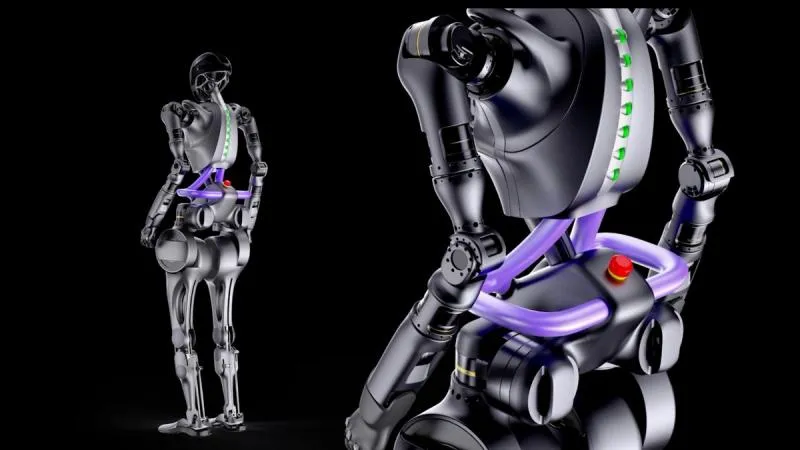
- Price $34,000
- Weight Not disclosed
- Battery Life 8 hours
- Max Speed Not disclosed
- Status Active
- Category Humanoid
Capabilities
Select 2–4 robots to compare specs, capabilities, and pricing side by side.
Selected robots
Tip: Use "Show differences only" to focus on what matters.
Share this comparison →Swipe horizontally to compare robot cards. Green highlights indicate best-in-class numeric values.
Capabilities
Capabilities
| Spec | ||
|---|---|---|
| Price | $34,000 | N/A |
| Height | Not disclosed | 165cm |
| Weight | Not disclosed | 55kg |
| Battery Life | 8 hours | ~60 minutes (483 Wh battery) |
| Charging Time | Not disclosed | Not disclosed |
| Max Speed | Not disclosed | 5 km/h walking |
| AI | NEBULA AI system — reinforcement learning and imitation learning, semantic task processing, natural language commands | Large language model integration, visual perception systems, autonomous locomotion |
| Sensors | Vision System, Force Sensors, 96 Fingertip Sensors, IMU | Intel RealSense Depth Camera D435i, IMU, Force/Torque Sensors |
| Connectivity | Wi-Fi, Ethernet, Cloud Computing (hybrid onboard/cloud) | Wi-Fi, Ethernet |
| Voice Assistants | None | None |
| Status | Active | Active |
| Category | Humanoid | Humanoid |
| Manufacturer | Kepler Robot | Fourier |
| Capability | Forerunner K2 Bumblebee | GR-1 |
|---|---|---|
| Assembly Work | ✓ | — |
| Autonomous Navigation | — | ✓ |
| Bipedal Walking | — | ✓ |
| Bipedal Walking (heel-strike and toe-off) | ✓ | — |
| Guided Tours | ✓ | — |
| Heavy Payload (30kg dual-arm) | ✓ | — |
| Language Model Integration | — | ✓ |
| Loading/Unloading | ✓ | — |
| Manufacturing Tasks | ✓ | — |
| Natural Language Task Commands | ✓ | — |
| Object Manipulation | ✓ | ✓ |
| Payload Carrying (up to 50kg) | — | ✓ |
| Stair Climbing | — | ✓ |
| Uneven Terrain Navigation | — | ✓ |
| Visual Perception | — | ✓ |
A step-by-step guide to getting the most from side-by-side robot comparisons.
110
Robots in database
37
With listed prices
335
Sensor types tracked
804
Capability types
Compare robots that serve the same purpose. A $300 vacuum vs. a $100k humanoid won't yield useful insights — they solve different problems.
Start by selecting robots from the same category or price range:
Focus on these comparison areas:
Toggle "Show differences only" to filter the table down to specs where robots actually diverge.
This is especially useful when comparing robots from the same manufacturer, where 80% of specs may be identical.
Gold standard for distance measurement and mapping. LiDAR-equipped robots navigate more efficiently.
RGB cameras enable object identification. Depth cameras provide 3D spatial awareness.
Essential for balance and orientation. Critical in bipedal and quadruped robots.
Close-range obstacle detection. Catches transparent surfaces that LiDAR can miss.
Compare a specialized cleaning robot against a home assistant with cleaning capabilities to decide whether a specialist or generalist approach is better for your home.
If your home runs on Alexa, Google Home, or HomeKit, verify compatibility in the comparison table. Check Wi-Fi standard support and whether integration is basic (on/off) or full routine support.
Every comparison generates a unique shareable URL. Bookmark it, share with family, or post in forums for feedback. The URL preserves your robot selections and toggle state.
Compare sub-$500 against $1,000+ models to see what the premium buys in navigation, suction, and smart features.
See how robots balance vacuum and mop performance — some excel at one, sacrificing the other.
Compare major humanoids on locomotion, AI, intended use cases, and pricing.
Compare speed, battery life, payload, sensor suites, and SDK availability.
When a brand offers basic/pro/max tiers, compare to find the best-value tier.
Should you get a dedicated cleaner or a multi-purpose robot that also cleans?
Translate comparison data into a confident purchase decision with this framework.
Not all spec differences matter equally. A $200 price gap might be decisive for one buyer and irrelevant for another. Here's how to rank what matters:
A robot that's marginally better on many unimportant specs but worse on the one thing that matters most isn't actually the best choice. Focus on YOUR priorities.
Cloud AI features, remote monitoring, premium app tiers — a cheaper upfront robot may cost more over 3 years.
Brushes, filters, mop pads, dust bags, blades — some budget robots have pricier replacements.
Battery size and charging frequency affect electricity costs for daily-use robots.
Local service availability and parts pricing significantly affect long-term maintenance cost.
Specs describe ideal conditions — your home determines real-world performance. Evaluate each finalist against these factors:
Return policy
Risk-free trials let you test both
User community
Active forums provide ongoing value
Ecosystem
Complementary products from the same brand
Aesthetics
Products you like using get used more
You can compare up to four robots simultaneously. The comparison table displays all specifications side by side, with robots arranged in columns. For the clearest and most actionable results, comparing two or three robots at a time tends to be the most manageable and practical approach, but four-way comparisons are fully supported for broader market surveys.
Yes. You can select any of the 110 robots in the database regardless of category. Cross-category comparisons reveal interesting approach differences — like comparing a dedicated cleaner against a multi-purpose robot with cleaning capabilities.
It filters the table to hide rows where all selected robots have identical values, showing only where they differ. Extremely useful when comparing similar models from the same manufacturer.
After selecting your robots, a 'Share this comparison' link appears. It contains a permanent URL with your exact selections and toggle state encoded.
Specifications are sourced from official manufacturer documentation and independently verified on a rolling basis. Commercially available products are re-verified most frequently, ensuring pricing and feature data stays current. If you notice a discrepancy between our data and current manufacturer specs, please let us know and we will investigate.
The comparison tool shows price as one of many attributes. For pure price sorting, the all robots page offers price sorting with category and manufacturer filters.
When data is unavailable, the comparison table shows a dash or 'Not specified' in that cell. This does not necessarily mean the robot lacks that feature — it may simply mean the manufacturer has not publicly disclosed the information. Check the robot's official product page or contact the manufacturer directly for the most current specifications.
Yes — the comparison table includes sensor and component breakdowns. For deeper analysis, the components directory lists all robots using each component. The trends page shows adoption shifts.
Robots marked 'Available' or 'Active' have confirmed, shipping specifications. Robots in 'Development' or 'Announced' stages show planned specs that may change before release. When comparing across stages, treat shipping specs as reliable and pre-release specs as aspirational targets. The comparison table clearly labels each robot's current status so you can weigh the data accordingly.
The most actionable comparisons involve robots that share at least one common attribute — same category, overlapping price range, similar intended use case, or competing manufacturer positioning. Comparing a $400 robot vacuum against a $150,000 humanoid research platform is technically possible but yields little practical insight. Instead, narrow your selection to robots you would genuinely consider purchasing for the same task. Use the category and price filters on the robots listing page to identify your shortlist before returning here.
Yes. Every comparison generates a permanent URL containing your robot selections and filter state. Simply bookmark the page or copy the URL from your browser's address bar. You can also use the 'Share this comparison' link that appears after selecting robots, which produces a clean shareable URL that preserves your exact configuration including the differences-only toggle.